The tips of icebergs are notoriously dangerous: the old saying posits that nine-tenths of the iceberg is under the water. This larger invisible ice stabilises the whole ice structure. Ignoring them is a dangerous choice.
In the past few days politicians have been bandying about the phrase ‘Islamic terror hatred’. They state that preventing such hatred may prevent further shootings. The Government are proclaiming victory. Their new law will make Australian Jews safer.
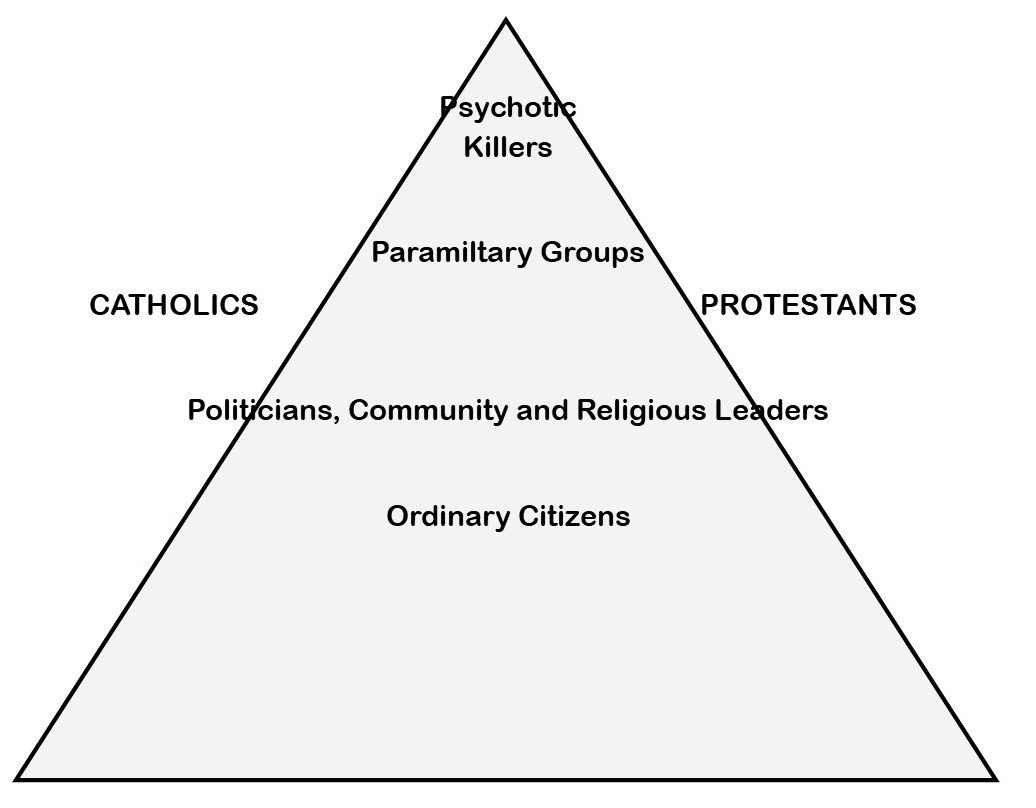
That may be true – as far as it goes. There is a great deal going on ‘under’ the tip of the iceberg: the psychotic killers who use Islamic language to justify their criminal actions are only the visible iceberg. Laws condemning such statements should have some effect. Reducing the number of guns in the community may also reduce opportunities for killers to act.
These psychotic killers are buoyed by hate groups. Neo-Nazis spout hatred of Jews. I note that they are not Islamic terrorists, but nasty just the same. ISIS may not be an identifiable group in Australia, but its hate speech empowered the killers at Bondi. These militant groups may not be killers, but they give permission to the few who are.
But drill down further into the iceberg, into the Australian community. Politicians, community leaders and religious leaders, myself included, have not been strong enough, persistent enough and clear enough in our condemnation of these hate groups.
As a Christian priest, my clear task is to promote the truth that every person, regardless of race, religion, ethnic background, is made in God’s image, beloved by God, and therefore worthy of respect. God loves each person and weeps over every instance of discrimination and hatred. God doesn’t tolerate it.
Other faith and community leaders may express these values differently. Even these differences are wonderful and to be welcomed.
Our lack of leadership gives permission to the hate groups. We need to own the fact that our condemnation of them has not been strong enough.
And of course, leaders can be strong in promoting community harmony only if the community itself encourages us leaders to speak out against hate and for respect.
As we drill down even further, into the general community, we should examine ourselves: are we harbouring discrimination in our hearts? Are we tainted by not accepting difference ourselves? These are uncomfortable questions, and lead to other questions even more discomforting: do we call out casual racism when we hear it? Do we show acceptance to those of different skin colour or strange religions (strange to us)?
My assessment is that we participate in a society that fails to live up to its values of acceptance and compassion. I cringe when I recognise the sting of the discriminatory attitudes I grew up and I catch myself flinching from different skin colour or distinct dress.
We are a racist mob. And for as long as we don’t challenge it, we let our leaders off the hook. They, in turn, avoid difficult conversation. They fail to condemn. They, in turn, give power to the rhetoric of the hate groups, who, in their turn, give cover to those who would use their rhetoric to kill.
One law won’t stop ‘Islamic terror hatred’ or anti-Muslim diatribes. There’s a rottenness running through our whole society. Of course, not every individual is a racist, but too often I find myself willing, by inaction, to participate in it.
As well as laws against hate speech, we need education for harmony. That is a huge task to get on with, but it is a possible remedy to the danger of the iceberg. The choice to do nothing through every part of the community is the choice to run into more horror like that on the beach at Bondi.
Pyramid courtesy Northern Ireland Mediation
Racism is not a new problem, but all the more reason to tackle it.
The man-child Herod, 22 months into his reign, Points a chubby finger, Says, ‘He is a bad person’, and has him put to death. His hands are clean, washed and washed again in a gilded porcelain basin, His hands are clean; his mind washes in blood.
The man-child, 22 months into his reign, Is full of fear.
The boy-child, 22 months into his reign, Smiles, Says, Mama, and Baba, toddles in his swaddling clothes, his world overflows with love, His hands are in the dirt, close by the people of earth, His hands cultivate a garden of love; his mind washes in love.
The boy-child delights in his world.
The man-child, 22 months into his reign, Prophesies that a boy-child will take his throne away, Pouts his fleshy lip, points, Says, ‘All boys under two are bad persons,’ And has them put to death.
The monstrosity…
Howling in the streets. Mothers wail. Countries grieve. Squares fill with flowers. Torrents of tears through channels of love.
Wise men avoid the border guards. They do not show their visas. They run. Smugglers: love is their contraband.
Wise men show whose reign is true.
The man-child, 24 months into his reign, Fears. Still fears. Herod’s own kidneys turn on him. Gangrene eats his private parts. He dies in pain.
The boy-child on the cross. Hands and feet pierced. Head bloodied. A halo of red. His breathing stops. He exults, ‘It is finished.’ He is returning to his Baba.
In the past two weeks, I have been thinking about the late Kim Beazley, Snr. I knew the great man slightly when I was a priest at Christ Church Claremont, and he was a parishioner. I greeted him after church each Sunday. I visited him at his home in Cottesloe, and on one memorable occasion, he took my colleague John Warner and me to a long lunch at Parliament House, combined with a history of the characters in the Labor Party before the split. He was a lively raconteur.
I have also been thinking of the Headmasters Conference and their actions beginning in the 1930s.
I have been thinking that the massacre at Bondi Beach last week could have been prevented if their vision had been grasped back then.
In 1938, the Headmasters Conference consisting of the Heads of all the Independent boys’ schools in Australia, together with those of some Catholic Schools, were disturbed by the rise of antisemitism in Europe. The Conference proposed that an association to promote the high-quality teaching of religion in Australian schools should be created.
The war intervened, and nothing came of the proposal until 1974, when the HMC and the Association of the Heads of Girls Schools Australia (AHIGSA) formed the Australian Association for Religious Education. I joined AARE in 1975 and over the next 30 years I served at State and National levels, so I know this Association well. And there have been other similar associations.
The question haunts me; did we not do enough? Did we fail to raise the quality of the teaching of religion? Maybe we could have stemmed the tide of antisemitism, Islamophobia and all the other hatreds of different religious groups.
Teaching in schools about religion may have had more effect if the educational community had listened to Kim Beazley, as Australia’s Minister for Education in 1973-75. Mr Beazley proposed a National Curriculum consisting of nine learning areas. He included Religion as a learning area alongside English, Maths and Science. He meant, of course, not the doctrinaire teaching of Christianity – although he was a Christian – but the proper teaching of the religions in our society.
Other prominent educators, like Professor Brian Hill, Foundation Professor of Education at Murdoch University, who was one passionate advocate, pushed for the inclusion of religion in the general curriculum.
It is true that the learning area of Humanities and Social Sciences (HASS) mandate some attention to religion in society. And the Arts cannot avoid the heritage of Christians and others who have made wonderful music, literature, paintings, and sculpture to express their faith. Some educators told us that we should be content just to have religion included within other learning areas.
Teachers resist the teaching of religions believing that they are not sufficiently informed about the subject. To me, that is a sad excuse. We can all be better informed. That’s why the Principals of Independent Schools set up the AARE with its biennial Conference model of in-service preparation for their teachers. Teacher educators could easily devise similar in-service for teachers in State Schools.
Imagine if as much effort had been poured into the teaching of Religion as has been poured into English and Maths. Imagine if the students graduating from our High Schools, both public and private, had a sympathetic understanding of Islam, and Judaism, and Christianity, of Hinduism, and Buddhism, and Bahai, of Taoism and Shinto, and Confucianism, of paganism, and Wicca, as well as Indigenous culture as a special and focused Australian spirituality.
Imagine if those students had met Australian adherents of those religions, individual Jews or Buddhists or Christians and recognised them, as they would, as fellow Australians, fellow human beings. Imagine how that would percolate through society and act as a damper on religious hatred. (Not to mention how much richer their ownlives would be.)
Maybe that would have been enough to stop this hatred of religions, especially the hatred of the Jews.
It is possible that I’m overstating the case. No amount of high-quality education would likely have stopped the shooters at Bondi on 14 December 2025. They were too filled with hatred.
But great educators like Kim Beazley Snr, Sir James Darling (Geelong Grammar’s renowned Headmaster from 1930-1961), Peter Moyes (Headmaster of Christ Church Grammar in Claremont from 1952-1982, and my mentor in AARE) and Brian Hill, must all be wondering whether it would have been any different if Australia had listened to them.
Courtesy Anglican Diocese of Edmonton, Canada
n
Ted Witham is a Life Member and former President of AARE, and was Executive Director of The Churches’ Commission on Education (YouthCARE WA) from 1999-2003, and founding Convenor of the National Association of Government School Chaplaincy Providers (now called Chaplaincy Australia) from 2000-2003.
He taught Religious Education as Senior Chaplain to Christ Church Grammar School (1978-1984). He also followed Professor Brian Hill from 1998-2004 as the teacher of the unit ‘Religious Education in Schools’ to students at Murdoch University preparing to be teachers.
In 1985, AHIGSA and HMC amalgamated to become AHISA, the Association of Heads of Independent SchoolsAustralia
To hear Ted preach this sermon, click ‘play’ below.
In the name of the living God, + Father, Son and Holy Spirit.
+++
Pray for the peace of Jerusalem.(Psalm 122:6a)
It’s a kind of code. The writer of the Psalm believes that if Jerusalem has peace, then the whole world will be at peace. ‘Pray for the peace of Jerusalem’ means pray for peace in Jerusalem and everywhere.
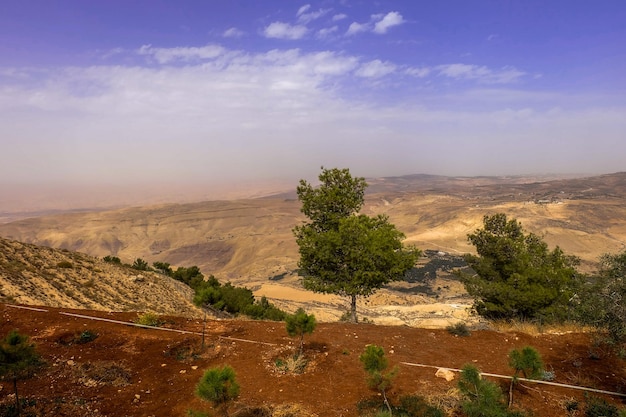
When Moses was 120 years old, the Bible tells us, he climbed Mount Nebo, a mountain in today’s Kingdom of Jordan, about 800 metres above the Plains of Moab. There God showed him all the land that God had promised the children of Israel, from the river to the sea, the river Jordan to the Mediterranean Sea, from Dan in the far north to Gilead near Jerusalem and further south to the Negeb desert. (Deut. 34:1-5).
Then Moses died.
The last thing Moses did in his long life was to look towards the land that God was promising his people. Moses looked forward to how blessed the tribes would be when they crossed the Jordan into Palestine. He paints a picture of how good the future will be for the children of Israel.
13b Blessed by the Lord [is] his land, with the choice gifts of heaven above and of the deep that lies beneath, 14 with the choice fruits of the sun and the rich yield of the months, 15 with the finest produce of the ancient mountains and the abundance of the everlasting hills, 16 with the choice gifts of the earth and its fullness and the favour of the one who dwells on Sinai. (Deuteronomy 33:13b-16 NRSV)
Moses could have sat around the campfire and regaled the Israelites with memories of leading his people out of Egypt. He could tell hoary tales about the 40-year trek through the wilderness, or reprise the joy, and the terror of meeting the living God in the burning bush. But instead, he chose, after 120 years, to go to the high mountain, and to look forward to the future, to the promised land.
Moses couldn’t have prayed for the peace of Jerusalem for the simple reason that Jerusalem didn’t exist until many years later, when King David fortified a tiny Jebusite village and began building the Temple.
What God wants for not only Jerusalem, but for the whole world’s future is peace, ‘shalom’ (שָׁלֹ֥ום). This word appears 237 times in the Old Testament, making shalom a significant concept. It means peace, and shalom is much more than absence of conflict.
Shalom means well-being in all its forms. Shalom means prosperity, but not the prosperity where only a few become wealthy, but prosperity where everyone shares their bounty with one another. Shalom is closer to communism than it is to the capitalism we experience in 2025. The prophet Isaiah reminds us that shalom is the opposite of war, which breeds hatred, fear, and scarcity. Shalom means love-in-action between people.
Pray for the peace of Jerusalem, the psalmist urges us, pray for Jerusalem’s shalom. God will bring peace for Jerusalem out of the fraught and complicated mess in the Middle East today. The promised land that Moses looked forward to stretches from the river to the sea. But today, Palestinians want to be free ‘from the river to the sea.’
These two visions of the future clash. They seem contradictory: how do we pray for the peace of Jerusalem?
How do we pray for peace for a people who were nearly exterminated a generation ago in the Holocaust? There are Palestinians and others like Hamas who say they would like to wipe out the Jewish people. Could it happen again? Never mind the politics: many Jews believe they are surrounded now by the same murderous hatred as they were in 1938.
As Lloyd said last Sunday in his sermon, now it is important for Christians to express solidarity with Jews. Write to Temple David in Mount Lawley; or write to the Perth Hebrew Congregation. Or to both. A simple email will be genuinely appreciated.
And how do we pray for a people who, a generation ago, were pushed out of the land their families had farmed for generations, for thousands of years? The Palestinians believe that Jewish settlement from the river to the sea is a policy that bulldozes them out of the way, often quite literally. What should we pray? How should we support Palestinians and their allies locally? Sending money to an aid agency is one possibility. Gaza desperately needs the basics for life. Or finding out about the rallies held regularly in the city and joining them or supporting them is another.
How do we pray for the peace of Jerusalem? What would bring about the shalom of all the people of the Holy Land? This morning’s readings encourage us to pray with hope. Hope in God. The problems of the Middle East are difficult to fix. But as Christians, we know that God’s intention is for all Jews and all Palestinians to thrive, to enjoy God’s shalom. The divisions will find healing.
We pray with hope, knowing that the future is in God’s hands. We look to the future with hope, learning with a deep confidence that God will meet us there.
Pray for the peace of Jerusalem. We can pray for the peace of Jerusalem only if we pray for peace in our own lives. We ask God to meet us in the conflicts of our families, knowing that some of those fights and divisions seem intractable to us.
We ask God to meet us in our everyday encounters. What do we need to do to foster shalom in our communities, as we encounter people serving us in shops, people on the footpaths, people at homeless respite, and neighbours of all sorts?
As Christians, we have a vocation to be makers of shalom; to be peacemakers. Saint Francis of Assisi, my favourite saint, told his followers to meet everyone with a greeting of peace.
[We should note that we Christians don’t have a monopoly on peacemaking. Jews greet each other with ‘shalom-aka’ and Muslims greet each other ‘As-salamu alaykum’; both saying, ‘peace be with you’.]
We too can make a greeting of peace a holy habit. For most of us, it might be a bit precious to say ‘peace be with you’ or ‘shalom’ every time we greet someone, but we can, for example, sign off emails or end phone conversations with the word ‘Peace’ – and mean it!
In this Eucharist, the priest greets us, ‘The peace of the Lord be with you’, and we respond, ‘And also with you.’ This morning, let us make the peace especially meaningful. Let us pray earnestly for the well-being and security of everyone we greet. Maybe greet fewer people and make sustained eye contact with each one if you can. Take two or three seconds to really see our neighbours, to remember that God delights in each one and seeks their shalom.
+++
As you know, today is the second anniversary of Lloyd’s ordination as a priest (congratulations, Father!), and it is my 50th. At the 8:30 Eucharist, Bryan Shattock marked his 42nd year of priesthood.
We as priests have a special role as a peacemakers.
Firstly, we bid the people we serve to ‘pray for the peace of Jerusalem’, and we bid the people to pray more generally for peace. Temple David replied to me that my email was appreciated because I am a priest. My support as a priest carried your goodwill along with mine.
So, secondly, our role in the community of faith, especially our parish priest, our bishops and the archbishop, is to be bridge-builders.
One of the titles for the Pope is Pontifex, the Latin for ‘bridge-builder’.Pope Leo has an account on X called ‘Pontifex’, and he repeated on social media his first greeting as Pope. This is what the Pontiff said:
“Peace be with you all! This is the first greeting spoken by the Risen Christ, the Good Shepherd. I would like this greeting of peace to resound in your hearts, in your families, and among all people, wherever they may be, in every nation and throughout the world.”(Pope Leo XIV on X)
I’m not saying that priests should be Popes. But like the Pope, the priest builds bridges between people and God.
One of the roles the church entrusts to priests is to speak words of absolution, either to all of us in the Eucharist, or to each of us in private in the Sacrament of Reconciliation, formally and informally. These words of absolution make space for peace with God.
This role of absolving carries with it the responsibility for us priests to make peace, to promote shalom, in the entire community we serve. We should never provoke division or hatred.
But as pontifex, as people entrusted with opening space for God, priests try to discern when to challenge people; when to ask people to fulfil roles for which they feel unworthy or not ready, or when to expose evil and hatred to the light by challenging people to do better, and by challenging, so build peace among people.
One anecdote from my time as a priest at Christ Church Claremont. A few parishioners looked with disapproval at families with young children. They stared at them critically, they shushed them, they rudely moved away from them, and they demanded that parents take their children to the crèche.
One morning during the Eucharist, I saw families being disturbed by these parishioners. There were many whispers and many scowls. I saw one mum on the brink of tears. I got very hot under my dog collar. When we came to the notices at the end, I told the congregation in what I thought were terms everyone could understand, that if they continued to treat kids like that, there would be no church left.
As I shook hands with people leaving, one woman said to me, ‘I’m so glad you said that about the children. Someone has to speak up about how badly behaved they are in church.’
So much for my discernment to challenge, to create connections and shalom between people!
So, we as priests have the privilege of promoting love between the people we serve. Priests speak well of people, knowing that God sees every person as whole, as holy, as complete. Priests who gossip or who speak badly of others are smashing those bridges between people, not building shalom. We try to be peacemakers whenever and wherever we can.
We priests have a special role in building bridges into the future. Like Moses, we look with hope to God’s church in the years ahead. It’s so easy to look at the church and be despondent.
There are fewer churchgoers, we say. There are no young people, we say. We have only seniors who don’t have the energy for organising things, we say. There are divisions tearing Anglicans apart, we say, between St Brendan’s and St Nic’s, reflecting bigger divisions between Canterbury and Sydney. It’s easy for priests to be despondent. It’s easy for priests to think that we must come up with all the solutions.
We should be realists. God’s church is today what it is.
But as priests, we have a responsibility to remind people of a bigger story. God has been faithful to the church for 2,000 years. We have no reason to think God will not continue to grace God’s people with love and harmony, with shalom.Of course God will. God is not going to change or withdraw his love from the church.
Of course, all of us are all called to be bringers of peace, nurturing shalom. In fact, we can all do all the things priests do. But we priests are called to model peacemaking, to make space for peace, to call others to be makers of shalom. It’s a challenge for us, and it’s an extraordinary privilege.
We priests, like Moses on top of Mount Nebo, should be saying to the church:
The church’s future is blessed.
The church is blessed with the choice gifts of heaven above and of the deep that lies beneath; with the finest produce from the faith of those who have gone before us,
their stories, their hymns, their deep spirituality. With the abundance of faith of those who will continue to come,
their joy, their faithfulness to Christ, their willingness to live a life of service; with the choicest gifts of love and shalom
And, above all, the church’s future is blessed with the never-ending favour of the One who dwells with his people.
Pray for the peace of Jerusalem, and pray for your priests.
If you prefer to listen to Ted preaching this homily, click below (12 minutes):
The Holy Gospel of our Lord Jesus Christ according to Saint Luke.
Glory to you, Lord Jesus Christ.
[Luke 17:5-10]
5 The apostles said to the Lord, “Increase our faith!” 6 The Lord replied, “If you had faith the size of a mustard seed, you could say to this mulberry tree, ‘Be uprooted and planted in the sea,’ and it would obey you.
7[Jesus said], “Who among you would say to your slave who has just come in from ploughing or tending sheep in the field, ‘Come here at once and take your place at the table’? 8 Would you not rather say to him, ‘Prepare supper for me; put on your apron and serve me while I eat and drink; later you may eat and drink’? 9 Do you thank the slave for doing what was commanded? 10 So you also, when you have done all that you were ordered to do, say, ‘We are worthless slaves; we have done only what we ought to have done!’”
For the Gospel of the Lord,
Praise to you, Lord Jesus Christ.
In the Name of the Living God, Father, Son and Holy Spirit.
The whole point of having a slave is that person can do whatever you want whenever you want.
When we were in Mauritius Rae and I used to worry about our hosts’ driver who was called Anil. Our hosts owned a sugar plantation and invited us to dinner a couple of times during our seven-week stay on the island.
They would send a message ‘Anil will pick you at 5:30.’ Anil arrived promptly at 5:30. Anil drove us back to the plantation. We had dinner, not with Anil, of course. Just with Pierre and Doris. Pierre showed us over their sugar refinery, a 24-hour operation. We talked. At 11:30 in the evening, it was time to go home.
Pierre yelled across the backyard, ‘Anil! Anil!’ Anil stumbled out of his hut, shook off his sleep and drove us home. It was an hour’s drive, and then, of course, Anil had to drive an hour back again.
Anil wasn’t a slave, but Rae and I worried that he was treated like one.
The people of Jesus’ time had slaves. The Jews had always had slaves, going back to the time of Abraham. At least, the more affluent Jews had slaves. And the whole Roman Empire depended on the labour of slaves. Apparently one third of the population was enslaved. People 2,000 years ago didn’t have the same moral objection to slaves that we have now.
And the whole point of having a slave is that person can do whatever you want whenever you want.
In this morning’s Gospel reading, Jesus invited the people of his day to try a radical thought experiment: imagine you are the owner of a slave who has been ‘working all day in the field, ploughing or tending sheep.’ (Luke 17:7) When evening comes, you allow the slave to take as much time as he wants to wash and change into clean clothes. Then the slave reclines on the best dining couch in the house. Then you, the owner, the master, serve the slave his dinner, and the slave can eat the meal quickly, or can spend four or five hours at the table chatting to friends and drinking wine. You are on call until the slave tells you he has finished his meal.
Then Jesus stops the thought experiment. No: you treat the slave as a worthless slave whose job is to serve you and not the other way around. If it doesn’t suit the slave or the slave is too tired makes no difference.
This thought experiment comes from Jesus, who as Saint Mark and Saint Matthew tell us, ‘…came not to be served but to serve and to give his life a ransom for many.’ (Mark 10:45, Matthew 20:28). Not to be served, but to be a slave.
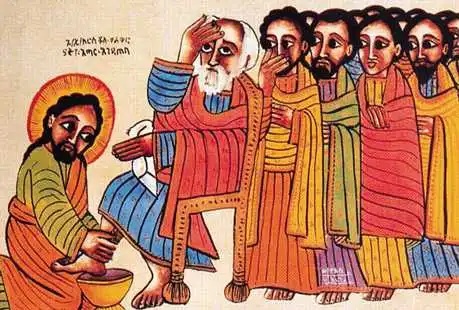
In other words, this thought experiment is not as fanciful as it sounds. Jesus himself swaps the role of Lord for that of a slave for example, when he washed the disciples’ feet (John 13:5), and really upsetting Simon Peter. ‘You will never wash my feet!’ wails Peter (John 13:8).
It’s not possible, we think. Even if you don’t own a slave, the point of having slaves is to do anything their masters want at any time. Jesus upends this idea. A slave is a human being created in the image of God, and simply because of that should be, at least, respected. But more than just respecting slaves, Jesus challenges us to serve others as if we were slaves ourselves. And especially, we should serve those who are treated as slaves.
Yesterday was the feast of Saint Francis of Assisi, a saint who means a great deal to me. Francis was the son of a cloth merchant, Pietro di Bernadone, who was growing richer and richer. Francis was privileged by having the benefit of this extreme wealth, and when he was a teenager, he made the most of the lavish lifestyle. He threw wild parties with his friends, providing the wine and food for the feasts. He gained the nickname ‘The King of The Revels’.
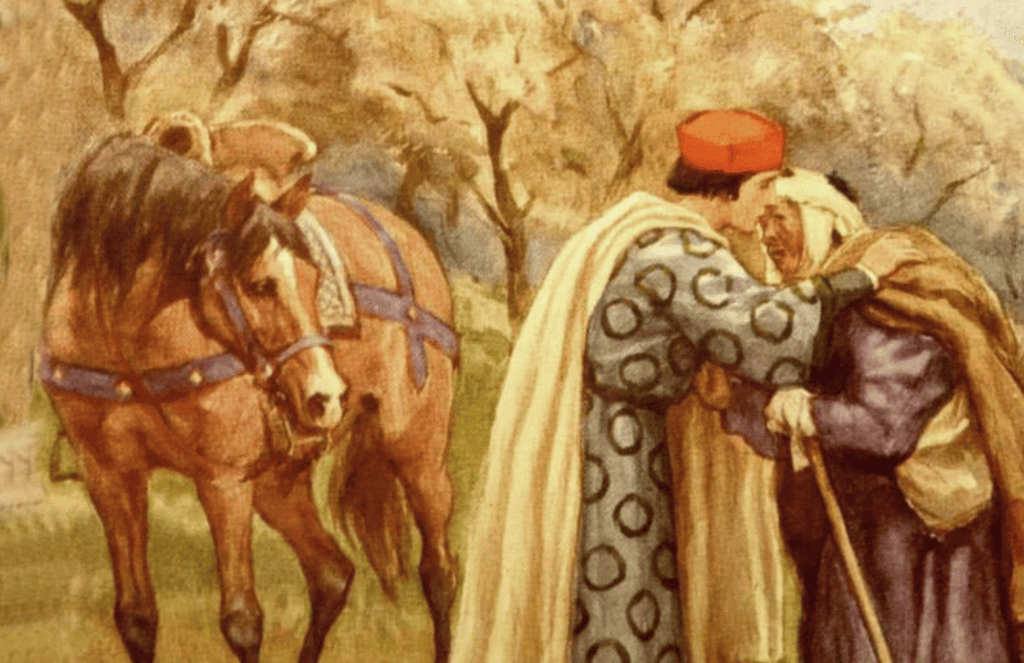
But he grew uncomfortable with this privilege. He was riding outside Assisi one day – and owning a horse was something like owning a Morgan Super 3 sports-car today or maybe a Rolls Royce Sweptail with a million-dollar price tag. As he rode, he saw a leper. Until then, Francis had been revolted by lepers. They were disgusting, repulsive. But on this day, Francis was moved to dismount and approach the leper and embrace him. Something changed in Francis from that moment. ‘That which was bitter had become sweet,’ he wrote later. (The Testament, 1, FAED I, 124.)
One of the first ministries Saint Francis undertook was caring for lepers; becoming their slave, their servant, looking with love on their distorted features and running sores, feeding them, keeping them safe from brigands and dressing their wounds.
Francis knew that this was how Jesus challenges us to be a slave to others. It’s a confronting idea. And we should be confronted. It goes against the way things are. It turns the world upside down.
I find it interesting that even though Francis is known for poverty, in the early years, many of his followers were queens and princesses: the Blessed Isabelle of France, Saint Louis’ sister, was a princess, and Saint Elizabeth was the wife of the future king of Hungary. Saint Clare too was from a noble family. These royals and aristocrats responded to the challenge to become a slave for others, serving the poorest, putting their lives at the service of the neediest.
I am impressed by Saint Jeanne Jugan in France just after the French revolution. She was inspired by Saint Francis to look after homeless women, eventually setting up a network of refuges throughout the east of France and becoming the Little Sisters of the Poor, who are in 2025 still serving the elderly poor. They have a house in Glendalough just north of Perth city. She too, and her sisters, respond to the challenge to be a slave to others.
And we are followers of Jesus too. The same challenge applies to us – as individuals, as the people of Saint Brendan’s. We don’t have to be the founder of a religious order, or even join one, to take up this challenge of Jesus. But if royals and aristocrats can become slaves, so can you and I.
Is there some situation where God is calling you to be a slave? Is there a person whose needs you can try to meet, but whom you avoid because you know it will be difficult? Is someone you know being held captive, ensnared in some way by someone? Is there a way to be a slave to them, to serve them in their needs? Being a slave is not about knowing you can succeed. It’s about putting aside our needs to achieve, to make a mark. Being a slave’s only about obeying the master. ‘When you have done all that you were ordered to do, say, ‘We are worthless slaves; we have done only what we ought to have done!’” (Luke 17:10)
And our ultimate Master is Jesus, and Jesus chooses to serve when others are certain it’s beneath Him.
As a parish community, we rightly hold up our ministry to the Homeless as one example where we put energy and care into serving others whatever their needs. But just because we are serving one needy group does not mean there are not others in the Warnbro/Rockingham community calling out for our service as a parish.
Today we bless our pets. The same challenge applies to animals as it does to human beings. We sometimes think of our pets as slaves. We keep them locked them up in our house or yard. We have them on a leash when we take them outside. We expect them to do emotional work for us, loving us when we come home from being away. But I am sure that we bless our cats and dogs because we know the challenge to be a slave to them too. Take note of that Lottie, and Caesar.
So this story in the Gospel about a slave coming in from a day’s work in the field is not a hypothetical. It’s a challenge. It confronts us to find ways in which serving others turns the world on its head and creates a kinder, more loving world in partnership with the One who came to serve.
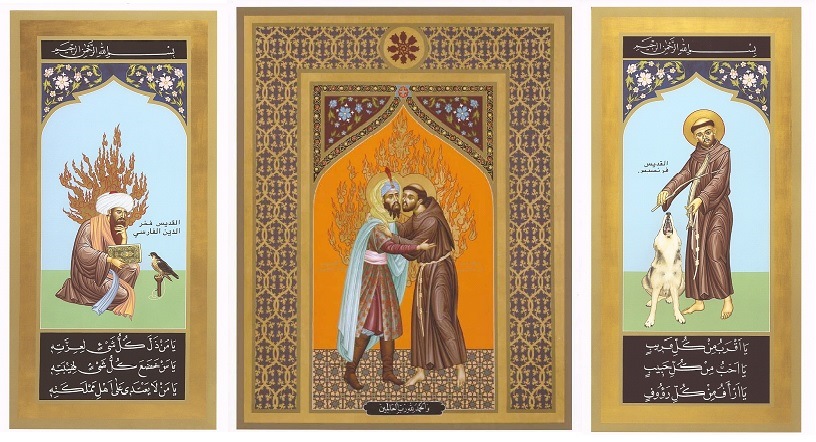
Saint Francis, restless, always on the move, wanting Morocco, Palestine, and Spain, (though oft prevented by illness) to prove ways of fraternity, and peace explain.
Embarks at last to crusade in the Nile, no fixed strategy, gospelling his goal; to nurse crusaders who undergo the trial of dysentery, and their homesickness console.
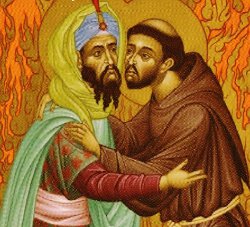
At last, with Brother Illuminato, Francis discovers God’s authentic aim: befriend the Sultan, talk love and credo, and Islam in the Christian to proclaim.
On coming home, he sounds the bells for prayers, and all true Christian Names of God he shares.
Ted Witham, St Francistide 2025
The Sufi Path of Love – Saint Francis and the Sultan
Noel Jeff’s two chapbooks reviewed by Ted Witham tssf
Noel Jeffs SSF, Ode to Warrigal Creek Massacre, 2025, A4 card folded. ISBN 9780646826042.
Noel Jeffs, a Brother in the Society of Saint Francis comes from a farming family as I do. Settler folk like us cannot deny that our comparative wealth and social position derive from the dispossession of Aboriginal people.
The name Warrigal Creek in Victoria, like Pinjarra in WA, and doubtless similar names in other States, resonates because of the massacre perpetrated there. The name produces a complex amalgam of emotions, which Brother Noel explores in this poem.
Hope for reconciliation of country seems to be blown away by the ‘hot anger of a tied-up dog’ (line 3); shame for these murderous acts follows, and ‘now in pain I knead this atrophy’. (line 11). This line describes the violence with which the recollection of Warrigal Creek is turned over in the poet’s mind, like pushing, smoothing, pulling, pounding, tearing and restoring flour and water when making bread. The word ‘knead’ is a homonym for ‘kneed’, and I take from this that the poet’s rumination brings him to a silent place of kneeling in penitence.
The last and biggest emotion is ‘grieving’, grieving that the ‘litter of bones’ (18) may let the poet’s shame be revealed.
But hope seeps through the crammed lines of the poem. The insistence that this is ‘my country’ is used here to recognise the shared pain of remembering. It is ‘country’ as named by its original inhabitants, but it becomes ‘my country’ when truth is revealed.
The poem is printed on one A4 card folded. The front depicts four rainbow serpents entwined in a circle. The heads of the snakes form a cross with the word ‘sacred’ inscribed four times on the circumference. Printing in black and white has made the symbol rather harsh. References to the full story of the Warrigal Creek massacre are on the front and back covers.
The card would make a suitable emblem of remembrance for participants in a day of truth-telling, especially about the Warrigal Creek massacre. I commend Brother Noel for this brave contribution to the national and necessary task of truth-telling, This poem on its card is ‘a plaque to heroically // scold’ (13-14)
The Angelus and Mudbricks
Noel Jeffs SSF, Roads to Stroud: Grasping at Tears, Precipices, Sydney, Darkstar Digital 2024, 19 pages
Brother Noel’s chapbook consists in two poems of just under 140 lines each, describing the journey taken by the poet from the city into the bush of the Hunter Valley in NSW.
The Stroud of the title of Brother Noel’s poems needs some explanation as Stroud figures large in the imaginations of Australian Anglican Franciscans.
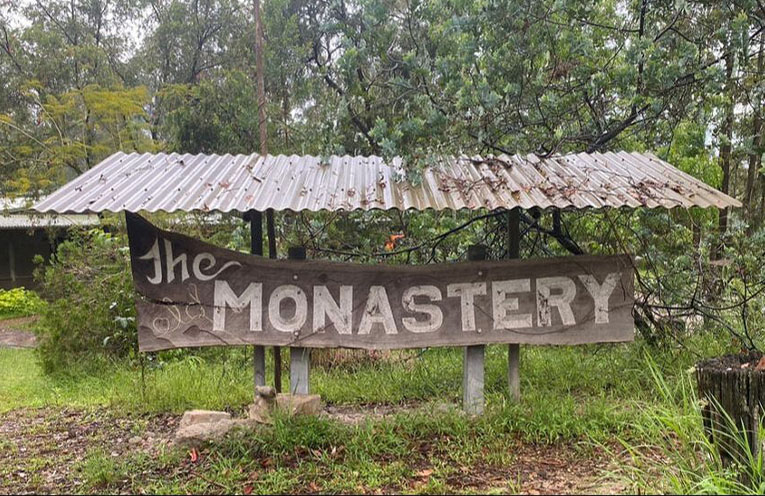
Nearly 50 years ago, three Anglican Franciscan nuns from the Community of Saint Clare in England arrived in Stroud in NSW with a vision to build a house for the Community. A small block of land just outside the town of Stroud was sold to the Sisters. Under the leadership of Sister Angela, an Australian, the Sisters, with volunteers helping, made mudbricks and constructed them into a unique building – a monastery with almost no straight lines but a lot of character.
A Chapel and Hermitage for the Brothers, initially for the priest-brothers to provide chaplaincy to the Sisters, was constructed 100 metres away from the monastery.
Since then, all three branches of the Franciscan family have made deep connections with this small section of attractive bush. Some of Noel’s fellow-Brothers make their home here, and Third Order members have enjoyed the rich hospitality of the place. Sadly, the Sisters returned to England in 2000, but memories of them are strong, especially in the old monastery, now a retreat house imbued with prayer.
In Brother Noel’s second poem under review, Precipices, ‘mudbricks and mudbricks’ (p.14) and the Angelus bell of the Chapel (p.16) take us straight to the property at Stroud. (It may also be intentional that the grey cover and simple typeface mimic the covers of the Sisters’ booklets of poetry and spirituality back in the 70s – a fitting homage!)
Noel Jeffs’ writing is thick with classical, Biblical and Franciscan allusions giving the whole experience of the poet’s visits to Stroud a nuanced exploration of ‘this parade of // fervour to want to come back year, // after year’.
The poet’s experience of leaving the city ‘awash with railway yards // tracks to sentience and homely inner-city birds’ (page 3) and arriving at Stroud where he finds it ‘ensconced in // its wilderness of wildness, made a // garden estate.’ (15)
The natural world and the human world are as entwined in the city as in they are in the country.
When the first Europeans arrived in NSW in 1788, some described the ‘natural’ parklands, the result of many thousands of years of land care by the Indigenous inhabitants, as a garden estate, so there’s a double irony in Jeffs’ description. Stroud, with its beautiful curated gum trees and mown grass, is a ‘garden estate’ hewn from wilderness.
The ‘loss’ of wilderness (or the Indigenous parkland?) is claimed with ‘a black fella warrior stood here // beckoning on, welcoming us in // in a vision.’ (15), the word ‘vision’ doing double duty here for physical vision and insight.
Jeff’s language is oblique. Words slip from meaning to meaning. As the poet is travelling north, watching the illusion of staying still in the train and seeing the bush moving, he asks, ‘What do I want to say about // the cantering bushland which // surrounds and is enveloped // by a tunnel of true darkness // which shapes my life in all its // passages?’ (12) The bush is cantering by as a horse canters, but it is also ‘canted’, (‘written slant’ as Emily Dickinson would say), so that it describes both the scenery and the poet’s inner feelings.
I relish the musicality of Brother Noel’s verse. He is a master of assonance which ranges from pure rhyme to distant echoes of sound. Savour the repeated ‘s’ , ‘p’, ‘ps’, and ‘l’ sounds in these three lines:
‘The circumference is here, and no longer
lying lips, give me a platypus and make
them safe.’ (13)
Simple in intention, the poems describe a journey home. But where is home, and what does it mean? The city ‘in which I am free // and lucky to be alive’ (1), or Stroud, where ‘I have gone to heaven, and am // coming down on the other side // of the earth’ (14)?
The archetypal ‘snakes [which] make love on poles’ (3) are a striking and original image, but they are surely meant to evoke the Caduceus, the staff of Mercury, the messenger of the gods, and widely used as a symbol of medicine. In ‘Grasping at Tears’, the poet is going to Stroud, and with him the messenger of the gods, a diplomat, the bringer of medicine, peace and healing. But the Caduceus also speaks truth with deception. The poet is an unreliable messenger, and his message is a rich potpourri of ambiguous imagery, alluring music and insights almost made explicit.
The poems are introduced by two fine photos taken by Brother Noel, the first shows the gravel road into Stroud, and the second a butcherbird enjoying her reflection in the outdoor shaving mirror at the Hermitage.
The poet may be ‘Grasping for Tears’, but it is unclear whether the tears are tears of sadness or tears of delight – probably both. I find the two poems ultimately hopeful, as the poet claims that:
‘Home is a handsome place
an exotic space for silence
A limbering tree-house (5)
***
Ode to Warrigal Creek Massacre and Roads to Stroud are available direct from the author, Noel Jeffs SSF, at noeljeffs@hotmail.com.
I stood earnestly at the front of my Infants class. 34 pairs of eyes were intent on me and the story book of Jack and the Beanstalk I was reading. I was five. Most of my classmates were six years old, and they sat in pairs on the heavy wooden and iron desks on the wooden floor. The tiny bench seats folded down from the desk behind: they were the sort of desks that tempted little boys to pin to their desk the pigtails of the girl in front, or plunge them into the inkwell.
My job was to prevent this kind of naughty trick.
‘Fee-fi-fo-fum,’ I rumbled my voice. I was the mighty giant. ‘I smell the blood of an Eng-lish-man!’ I could feel the shiver of fear in every girl and boy in the room.
There was a measure of desperation in my performance as I squeaked out Jack’s voice and made Jack’s Mum sound angry but still loving. It was imperative I held the class’s attention. Miss Lang had left the room suddenly just as I had started the story. She had whispered in my ear, ‘I’ve got to go to a teachers’ meeting,’ she said, ‘Keep reading stories until I get back.’
There was no teacher nearby. The Infants’ class was in an old wooden room from its days as a one-teacher school, with a verandah outside and pegs to hang our leather school satchels. 50 yards separated it from the main redbrick school building, so there was no near adult to call on. It was on my shoulders, I told myself, to keep the whole class absorbed in my storytelling and so prevent any outbreak of mischief.
I reached the climax. Jack scrambles down the magic beanstalk to escape the giant, and sees the giant catching up fast. Jack grabs his mother’s axe and cuts down the beanstalk. The giant falls from a great height and dies an oversize death befitting him.
I was already thinking ahead. I need another book. I reached out to Miss Lang’s table and quickly found her copy of Hansel and Gretel. The general feeling of anticipation which I could sense behind me would last but a few seconds. I must get the book, and I must start reading.
I bless my mother who taught me to read with expression and drama. I came to school already reading, although the family story is that I came home from my first day at school complaining that Miss Lang hadn’t taught us to read on day one.
The responsibility Miss Lang placed on me to read in her absence wasn’t fair, of course, but I guess now that she found it impossible to delay the headmaster’s summons to attend the staff meeting. Authorities were like that in 1954. His intransigeance also wasn’t fair.
But I was confident that I could keep the eyes of the children on the picture book and their ears on my dramatic voice. I knew that most of the class had not yet learned to read, and I also knew that my rival Jenny Bessen was, like me, an advanced reader and a competent teller of the tales in Miss Lang’s books.
I continued leading the children into the forest with Hansel and Gretel. There was pressure in my bladder. I knew I should hand the book over to Jenny Bessen and run to the smelly toilets on the far side of the school playground. But Miss Lang had asked me to read. I was sure she would return, and I could then excuse myself.
I ploughed on. Hansel and Gretel were trapped in the gingerbread house by the wicked witch. They were clever enough to work out a sweet way to escape while the witch was away. But the smarting itchy feeling below my tummy grew stronger. Hansel started to eat the gingerbread. I was more determined not to let Jenny read.
My bladder suddenly gave way. I was standing in a puddle on the wooden floor. But the story had to go on. Would Hansel and Gretel escape? I reached the end of the story, my sandals and feet soaked in pee.
The door opened. Miss Lang saw my predicament and reached for the book. I burst into tears. Miss Lang gathered me up and lifted me onto a dry part of the floor. I watched her, unable to move, with a mixture of relief, embarrassment and victory, as the teacher found an old rag and cleaned my feet and the urine-soaked floor.
I looked at Jenny Bessen, and I was a little ashamed to see the disapproval in her eyes. But I hung onto the sense of accomplishment that I had succeeded in holding the class’s attention until the teacher’s return. It was just a pity that I hadn’t held back from piddling in front of the class.
******************
Copies of my memoirs sKerricKs are still available from me: $22.50 + $15 postage in Australia. Email TedWitham1@gmail.com
I was just six years old, still young enough to be cute, yet old enough to grind down my father by simply insisting. ‘I want to climb Mount Pix with you and Jim and Len.’ The aforementioned were my oldest brothers, Jim the grand old age of 17, with a Brylcreemed slick of brown hair, and blond Len 14.
I had nagged my way into the big grey Pontiac. My father’s intention, I now think, looking back, was to park the car at the foot of the western-most peak in the Stirling Ranges, and leave me there while he and the big boys climbed their way to the top.
But I was having none of that.
From our farmhouse 30 kilometres north, Mount Pix appears a heart-stopping shade of blue. It is longer than it is high, and I have always thought its silhouette was like the cupid’s bow drawn in red on a lady’s lip.
Close up, you can still imagine the shape of the bow, but the blue has changed to the sage green of knee-high vegetation with the stolid grey of the granite sub-stratum.
Dad and the boys were each standing at a car door, leaning in to retrieve wet-weather gear, thermoses of tea, and other equipment suited for a hike in the hills. They set off along the kilometre walk to the base of the mountain.
My sandals were not suitable for the grass underfoot and leaves and stalks scratched viciously at my thighs. As I struggled to keep up, I realised quickly that the team was not about to accommodate my laggard progress. Their intent was to lose me in the early stages of the hike.
The mountain loomed before us. As the climb became steeper, the going was a bit easier. It was mainly rock at my feet and the fauna grew sparser. At 30 kilograms, I discovered my advantage over my heavier siblings. I scampered up behind them.
As I climbed, I discovered a new vantage of the mountain. It was unfolding like a vast paper toy: Mount Pix had more than one peak!
‘Stay there and we’ll collect you on the way back,’ Dad called over his shoulder. They disappeared over the first peak. I followed. For a moment, the way ahead deterred me. Beyond this first peak, the ground fell rapidly away. There was a deep valley and beyond that, an even higher peak. Was this the top of Mount Pix?
I stumbled down towards the valley, my family small sticks on the upward climb opposite. Soon, they disappeared over the top. There was another peak beyond this one.
The point and bumps of the Cupid’s bow were unfolding to be three of several peaks.
I was in fact getting tired. I remembered that Dad always fabricated a suitable hiking stick by snapping a branch off a jam tree. I looked around for a tree.
I made my stick and tested it. I was now alone in this enormous valley. Should I turn back? No, this mountain is not going to beat me. I pressed on upward with my stick working well.
The blue sky rose from the peaks either side of me. A pair of wedge-tailed eagles circled above. A willy-wagtail suddenly chatted nearby, making me jump. Something slithered in the undergrowth. My experience suggested that a bobtail or similar small lizard had produced this noise; my imagination conjured up a large snake.
I looked towards the peak, searching for the reassuring figures of my family. But they had gone over the peak. I stumbled up the hill. I thought, if I run fast enough, I will find them.
Puffing hard, I reached the next peak. From this peak, like the first, the ground fell away steeply at about 45 degrees before rising to an even higher peak. A vast empty vista of the mountain’s inside. My heart beat even faster. I wanted my Dad, but he had vanished. Can I catch up?
Then I wondered how many preparatory peaks there were before the final peak. I hadn’t thought that a mountain might go on opening up like Dad’s accordion.
If I go on, I might miss them on their return trek.
If I turn back into these huge mountain folds, I might get lost altogether. Tears ran down my face.
I will go back, I decided. I’ll pick out my outward path exactly and follow it religiously. I had to circumnavigate the slithering noise, but then I would concentrate on retracing my exact steps.
As I pushed on up the steep slope, the sky went black. I wondered if it was going to get dark, nighttime dark, but the cloud covering the mountain burst into torrents of cold rain. My t-shirt and shorts were suddenly drenched. My sandals slipped on the slick granite. My stick slipped out of my hand.
I had a picture of my body rolling down the slope, bumping and breaking bones as it went.
Suddenly, strong hands lifted me and there I was, safe up on Dad’s shoulders.
Two hours later, I was drying in front of the kitchen fire, naked. My pyjamas were in the oven, warming. Behind me, my parents’ comforting voices, an edge to my mother’s.
‘But, Roy, you couldn’t just leave him floundering while you went on. You were thoughtless. He’s only six.’
Then Dad’s calm laconic reply, ‘But he’ll learn from it, Joan. Probably remember it all his life. ‘
####
copies of my memoirs SKerricKs are still available from me: $22.50 + $15 postage in Australia. Email TedWitham1@gmail.com
The Universal Basic Income, as you will know, proposes that every citizen receives a basic income, an amount sufficient to live on. The scheme would replace most, if not all, of the support the Government provides through Centrelink and NDIS. Studies show that it would cost a similar amount to our current system.
The UBI promises to
Raise the poorest in our community out of poverty, especially those on Youth Allowance, people caring for loved ones full time and tertiary students.
Reduce inequality between the rich and the very poor, thus giving all citizens a sense of dignity.
Decrease homelessness through better distribution of wealth.
Lift productivity. People freed from meaningless work would make their contribution to society through work for which they have a passion.
The Albanese Government has the confidence of the Australian people to make bold changes to make ours a better society. Rather than tinker around the edges of the tax system, you could make a wonderful improvement to the Australian community.












 Mind Journeys