The outsized machete in the street vendor’s hand came down with sharp force on the leafy top of the pineapple. The fruit gleamed yellow in his brown hand. With two sharp blows he decapitated the fruit and sliced it open down the middle.
‘Ananas,[i]’ he said with quiet pride. As he smiled, I could see the dark gaps in his mouth where teeth should have been, and the lopsided way the gaps made him smile. But his pride in the pineapple was palpable. He wanted us to enjoy the fruit. He passed each of us, my lover, my son and daughter, a pineapple and swiftly pocketed the notes I gave him.
I contemplated my pineapple. Where do you start eating it when standing in the noisy streets of Port-Louis in Mauritius? I took my pineapple gingerly in my right hand. The prickles on the outside stung momentarily as I examined its surface. The skin was a browny-grey colour, speckled with sharp prickles. Each prickle grew from its own prominent pore. The glossy flesh inside the skin, crosshatched with veins, was dripping golden beads of moisture.
With my left hand, I broke off the top ring of fruit. My fingers tingled with sticky moisture. I raised the circle to my lips. The first caress of pineapple juice on my lips brought me a thrill of refreshment. Standing in the muggy streets of humid Mauritius, I felt clean and cool. The pedestrians rumbling by along the busy street simply rushed past me. In my zone of silence, I barely noticed their presence.
My teeth met resistance as I bit into the pineapple, as if to tell me, take your time, relish the experience, ravish me slowly. As my teeth pushed through to the sweetness between, I felt juice spatter the palace of my mouth and squeak along my teeth. The juice was so powerful that it partly anæsthetised my lips.[ii] It felt sticky on my chin.
Then the taste of the pineapple. It was sweet and tart in my mouth, the flavours doing a ballet of balance on my tongue, the effect so exquisite I was aware only of this ropy mess of fruit in my mouth and the sticky substance spilling from my chin onto my hands and shirt.
I swallowed and started to say something to my beloved and my two smaller beloveds. But each was equally submerged in pineapple that words would have spoiled the moment. I did know that for just a few rupees we had become the wealthiest people in the world[iii].
‘Ananas!’ shouted the pineapple seller hoping to catch more people with his sticky fruit.
[i] Columbus brought pineapples to Spain under the name piña de Indes, pine of the Indians. It is known in Latin and French and most other languages as ananas, perhaps after a village in South America called ‘Añanas.’
[ii] Pineapples contain a substance which ‘eats flesh’, so their juice feels tingly on the lips. This substance bromain is used as a meat tenderiser.
[iii] When they were introduced to England, pineapples were such a rarity that they were worth thousands of pounds, and were displayed at the dinner tables of the nobility. Persons of a more middling rank could hire a pineapple to show off under your arm as you walked around the town.
Candida Moss, God’s Ghostwriters: Enslaved Christians and the Making of the Bible. London, William Collins, 2024. Paperback 267 pages + back matter In Public Library System. From $52 online.
Reviewed by Ted Witham
The healing of the paralytic is a favourite story in the New Testament. We’ve heard the story. Four friends bring a paralysed man on a stretcher. Unable to carry the man through the crowd to Jesus, they lift the stretcher onto the roof and dig their way down to Jesus.
Except that the story nowhere calls the stretcher-bearers ‘friends’. In the Greek text, they are just called ‘they’ with no indication of their relationship with the man on the stretcher. Some details, however, point to the man’s identity. It took four men to carry him, and the stretcher itself was solid enough to be lowered through the roof. It was a substantial litter. This man is likely an enslaver, and his four bearers are enslaved.
If this is true, it twists the meaning of the story.
Enslaved people were not seen as people. And yet, when the stretcher touches down, Jesus addresses the four slaves. Courtesy demanded that he address the man being carried about, not his slaves. Jesus, however, chooses first to praise these slaves. He praises their loyalty, their faith. The Greek word pistis means both. In the story as we have it, these slaves come off well.
Only then does Jesus turn to the man on the mattress. He forgives his sin. Jesus faces down the scribes who accuse him of blasphemy. ‘No one can forgive sins but God alone.’ And then he tells the man, ‘Stand up, take up your mat and walk!’ It’s almost as though the man could do that all along. His ‘sin’ may have been ordering others to carry him about when there was no need. He was making that demand on them because, as a slave owner, he could.
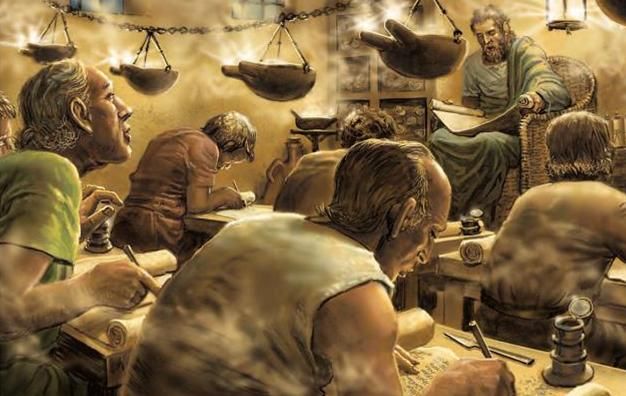
In God’s Ghostwriters, Candida Moss argues that enslaved people did much of the writing of the New Testament. Named authors like Paul depended on slaves well-trained in literacy to write down his words, edit them, and make copies of them. Messengers, who were usually slaves, would carry these words and read them, often as an after-dinner performance.
Professor Moss is Edward Cadbury Chair of Theology at the University of Birmingham. She is well-equipped to write about the ancient world and how the Christian scriptures fit into the Roman culture. She writes with verve and clarity.
Dr Moss argues that it is almost certain that these scribal tasks involved changing the words they were given.
Firstly, the slaves had to knead the master’s words into shape. This editing enabled those hearing the words to make sense of them.
Secondly, these slaves would have been tempted to make substantive changes to the text – and probably did. These tweaks would inevitably have introduced changes from the point of view of the enslaved, like the four stretcher-bearers digging through Peter’s roof being obedient slaves and not simply good-hearted friends.
Some parables, as Moss points out, make sense only from the enslaved point of view. Slaves, for example, would have been accustomed to absentee owners of vineyards who appointed their son as master of the vineyard. The slaves would see that one was the same as the other. So God and Jesus could be simultaneously distinct entities and one person.
Thirdly, as part of their task, messengers would be required to perform these stories or letters. It was the custom for these readings to use voice, gestures, props and other devices to hold the audience. At times when audience attention failed, they would tell the story in other more interesting words, even inventing new passages.
Candida Moss suggests that the ‘long ending’ of Mark’s Gospel may have come into existence in this way. The slave reading the text would come to the words at the end, ‘They said nothing to anyone, for they were afraid!’ In the atmosphere of a dinner at which wine had been consumed, diners would hear this as an anti-climax and the reader would be blamed. Why not add some stories of the appearances of Jesus, wild stories of handling snakes and drinking poison?
Professor Moss concludes that we cannot know the individual changes that enslaved people made in the development of the received texts of the Gospels and letters. But we can know for certain that slaves did do the writing and did make changes as they went.
After reading Professor Moss’s attractive book, I, for one, will not read the New Testament in the same spirit. I will now try to really see these enslaved writers,bring them out of the shadows where they have been taken for granted for 2,000 years, and see what new and fascinating truths God is teaching me through their work.
Mum was born in 1914, while her Dad was away fighting in France. She became a teacher at South Newdegate School, and met and married Dad in 1938. She had five children.
Mum chose the life of a farmer’s wife. She worked hard all her life, raising us with love and practicality. She and Dad had a strong moral core which she transmitted to us. She encouraged our ambitions, ‘Aim for the stars and you’ll hit the moon,’ was one of her sayings.
I think of Mum often and I am thankful for her life.
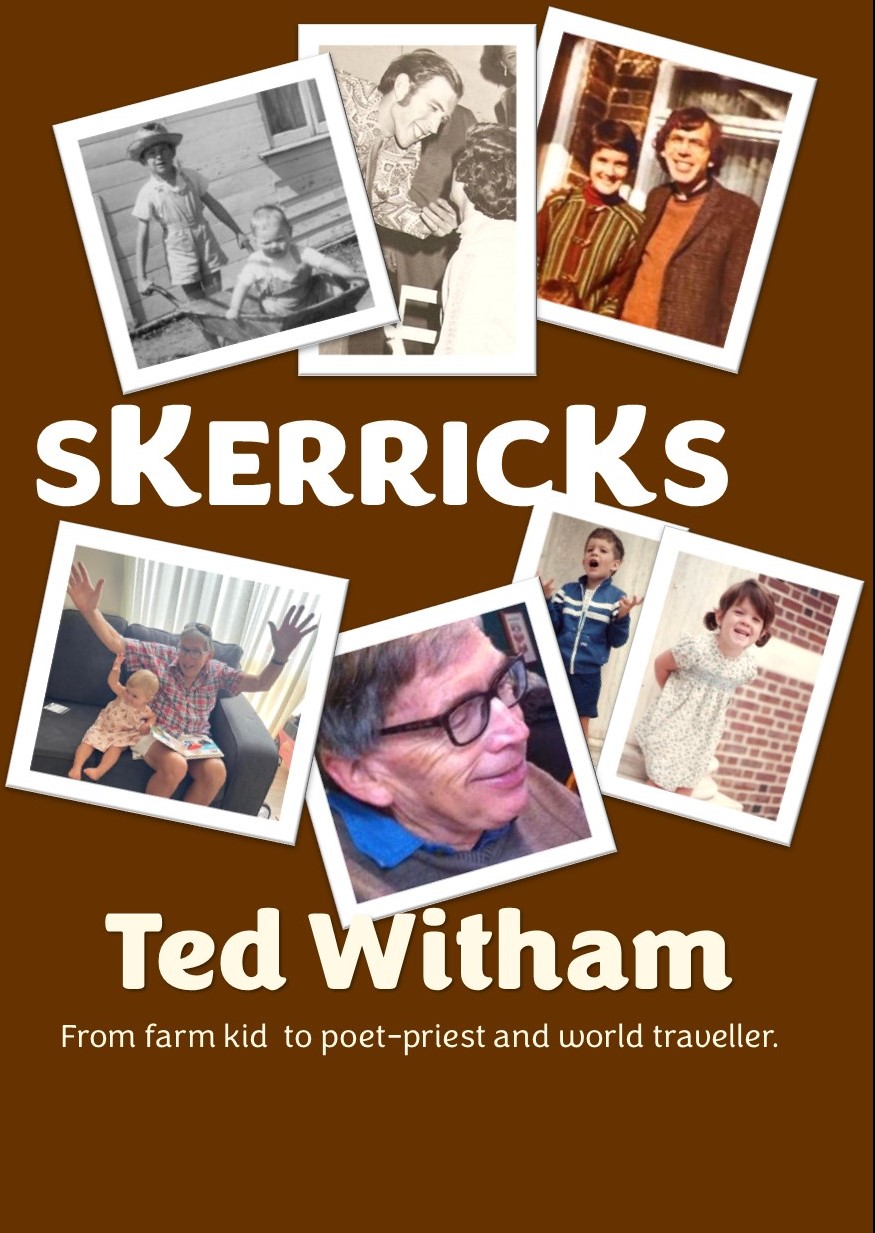
Ted Witham, Skerricks: from farm boy to poet-priest and world traveller. 2024
Reviewed by Shirley Claughton
for the Anglican Messenger, September 2024
An impressionable memory in Ted’s teenage years comes from a shearing shed encounter, “Normally one or the other was away at boarding school, or at a Junior Farmer’s State conference or visiting girlfriends in Perth” But at this party, Ted at 15, was chaperoned by brothers Barry, 18, Len 20 and Jim 24…not only ordered in years but also in height” – from 6 foot to over 6 foot five. When the guttural rumble of motorbikes made their presence felt – spoiling for a fight: Katanning versus Tambellup“ we formed up shoulder to shoulder…making a slow synchronized progress towards the door” and the bikes slowly turned around, revved their bikes with a sneer and drove off…”
But Ted’s life has been punctuated by life-threatening calamities. He ponders that had he been born just a few months earlier, no treatment for his condition (pyloric stenosis) he would simply have died. A surprising number of close calls with death throughout his early life might have started as a “sense of being lucky” but “gradually matured in being grateful.
A wonderful tribute to Sir George Bedbrook OBE who performed experimental surgery, never attempted in Australia before, “which mammoth operation kept me out of a wheelchair and allowed me to walk, run and play sport for many years.” Nevertheless, in his characteristic humbleness, he treats the reader to an image of a theatre crowded with assistants and he “uncomfortably naked”.
He had nurtured his ability for language, from childhood, discovering French “between the pages of Arthur Mee’s Children’s Encyclopedia” and nurtured this secret interest, eventually becoming bilingual, but also studying and excelling in Hebrew and Greek. Ted ponders over the inability of the farming community to recognize the Noongar presence, “they simply weren’t there, and nor were the Noongar words that seeped into our talk…it was as if English had a stubborn claim on the landscape”, and felt subversive when he was discovering the love of language. In a heartening story, this came together when, at twenty-nine years, he met Rae. As curate in the parish, he was writing pastoral notes in French as a measure of confidentiality. “Rae was looking over my shoulder and asked ‘why are you writing in French? ‘Well, I struggled for a reply. it can be private to me.’ Rae grinned. Not if I can read it’”
As a 14-year-old, the experience of attending the Commonwealth Games made a huge impact, “I saw so much, experienced so much…my eyes bulged..I had never seen so many folk in one place. Anticipation swung through the crowd, sweeping me up as it passed…” “In nine days I had seen the whole world, and the world really could never be the same again.”
Theatre was important – in his 20’s he was involved at all levels and even briefly considered it as a career, but explains his sincere reasons for “not wanting my psyche to be constantly shoved around by one character and then another…” and also seeing incompatibility with his vocation as a priest. “Now in my eighth decade, I have returned to writing short plays and nudging them onto the stage” And as an addendum, he wonders “if I was wrong to fear the psychological and value downsides of the theatre. People know that plays are storytelling ..”
Ted was a leader of reforms in the institutions he was part of. Whilst he does sometimes suggest he was really in the right place at that time, Ted was a crucial part of the movement of change in recognizing the value of individuals in schools and institutions.
He credits Rae as “his anchor and a magnificent companion, who makes me the best person I can be.”
Some years ago, two delegates to a conference in Sydney, happened to be seated next to each other for the long plane ride from Perth. “Great,” said one, “we can have a good chat to pass the time”. “Sorry ,mate,” said Ted, I have to take a sleeping tablet to get me through the journey” and proceeded to sleep soundly for the next four hours.
For Ted, a huge part of life was survival – in this memoir, he always sees the good in everyone he meets – when they get ripped off by a taxi driver, he nevertheless reflects that “for the rest of our week in Rome, we learned how generous Italians are”. This charitableness permeates all his encounters. It also helps to recognize the steps toward the journey to the Third Order of St Francis, undertaken by both Ted and Rae.
We are treated to the skerricks of his journey, every little bit revealing more of his humanity, his humbleness, his self-awareness, and his willingness to admit to mistakes. Skerricks is a tell-tale memoir and is a very good read.
Ted acknowledges how lucky he is that his four siblings are alive at the time of writing this memoir: Jim, Len, Barry and Marion, and how blessed he is with Rae, children Brendan and Clare, and grandchildren Sienna, Zoe, Asher and Immie and Aurora.
This book is self-published and available from the author and St Johns Books.
Copies can be made available at Synod for purchase if requested beforehand.
The words were there at first, lying about randomly. Words taught to us wadulah by Noongar kids. We threw boondies at trees. We took gidgies to spear fish (at least, some kids did. Fishing was never a pastime for me).
We tried in vain to lure shrewd gilgies out of the water onto our catcher made of string and meat. We made our own kylie and failed to kill any birds with them. We picked bardie grubs off tree trunks and ate them. Their fat flesh tasted like delicate white fish.
My Dad said, ‘Let’s have a wongi,’ It’s time for a talk. ‘Wongi’ a word from the Eastern Goldfields from the Wangkatja people .
We knew we were wadulah. We knew the Aboriginal kids, and their families, were Noongars. We laughed at grown-ups grown stupid with drink. We called them kaat-wara – soft in the head. We wadulah were double ignorant and cruel. For the Noongars, alcohol was a poison and those affected were not to blame.
The shelters Noongars built were called maya maya. We put ‘maya’ together with the Yamatji word ‘guna’. We giggled along with the Noongar kids. ‘Guna’ is ‘shit’ and ‘maya’ is shelter, so ‘guna maya’ is an outdoor dunny.
We teased the town cop as manitj, the white cockatoo. The yellow crest of the cockatoo resembled the police cap, and ‘Manitj!’ became the warning: ‘Police are coming!’
We watched yongar with his trademark hop. Wesaw groups of ‘wetj’, the birds as tall as men, running across open land.
Quenda scurried about on the dry leafy ground, while inquisitive quokka snuffled up to visitors on Wadjemup, called Rottnest, And in coastal heath near Albany. Tiny dunnart scampered under bushes, fearful of the wedge-tail eagles flying above. These animals don’t have a name in English, nor does the word for ‘numbat’.
These names were simply there in the land, befitting the animals they described.
At night, the owl sang, ‘mopoke’.
The words were there, stirring in the depths of the land. The words rose up from Noongar To became part of West Australian English and held on to in Noongar Aboriginal Creole.
And the place names: We splashed in Lake Toolbrunup, ‘the place that has water when all else is dry’. It was on our farm.
We travelled every day to school in Tambellup. The wallaby ‘tamar’ may give Tambellup its name. Near our farm were Gnowangerup, the home of ngow, the mallee hen, and Ongerup, the home of the yongar.
Nearer Perth, Gidgeganup was the place for making spears, and Willagee was where the ochre wilgee for ceremonies was dug. Rae and I lived there from 2003-2006.
Like the dry bones in the valley imagined by Ezekiel, so many words were lying around the landscape, rattling and trying to come alive.
One day, along came a Noongar with a welcome to her country. ‘Kaya’, she said, ‘Hello.’
Then she said, ‘Wanju – Welcome!’
And with these smiling words changed everything.
We wadulahs are welcome on this Noongar land, unceded and unconquered as it is. We wadulahs, despite our colonising destruction, are welcome.
With these words, ‘Kaya, Wanju,’ the relationship between humans and the country began to heal. With these words, ‘Kaya, Wanju,’ Noongar and wedulah began to reconcile.
With these words, ‘Kaya, Wanju,’ we hear with fresh ears the knowledge keepers of Noongar booja. wise men who become to us wedulah as uncles in their kinship system.
With these words, ‘Kaya, Wanju,’ we saw the land with new eyes. We began to discern song lines from Derbal Yerrigan, the Swan River, to Kepa Kurl, Esperance, in the southeast.
With these words, ‘Kaya, Wanju,’ the land opened up and began to sing.
I prepared the Prayers of the People for the Eucharist this morning – only to discover that they weren’t needed.
There is so much talk on social media about the dire state of the world and the possible end of the world, that I feel it is incumbent of us Christians to recall that Christian faith brings hope not despair.
Below is what I would have prayed:
The response for this morning’s intercessions is:
God of hope and assurance,
We thank you and we bless you.
God of peace, we thank you for those who bring peace to their neighbour and turn their despair and grief to hope and determination;
Empower those who are in negotiations for peace in Palestine and in Ukraine. Give them diplomacy, skill and a vision for the future.
Strengthen the leaders who are turning their word of peace into action.
God of hope and assurance,
We thank you and we bless you.
Lord of the Church, we thank you for those who show us the way of the Gospel, for our teachers in the faith as they assist us to work and pray.
We thank you for our ministry of encouragement one to another.
We praise you for your world-wide Church and the ways it witnesses to peace and kindness.
God of hope and assurance,
We thank you and we bless you.
God, you are the author of all healing. We thank you for all who care for the sick: for nurses and doctors, for care workers and researchers, for hospital staff and volunteers. We bless you for their ministry.
We thank you for parents and adult children who take time to care for their loved ones and nurture them back to health.
We thank you for all who are restored to health, and especially we thank you for Milton as he recovers from surgery.
God of hope and assurance,
We thank you and we bless you.
God, you call us into community. We bless you for the love of all who build and maintain community. We thank you for politicians and councillors as they work to make a more loving community. We thank you for each other as we contribute to the solidarity of our parish community.
God of hope and assurance,
We thank you and we bless you.
God, the author of all life, we praise you that you have called us into this life. We thank you for the joys and blessings of life, for those who love us, for our gifts well-used. We confidently praise you for leading us to a marvelous and eternal life.
Sermon at Saint Brendan’s-by-the-Sea, Warnbro, October 8, 2023
If you would rather listen to Ted preaching this sermon, click on the audio below:
The Lord be with you.
And also with you.
The Holy Gospel according to Saint Matthew
Glory to you, Lord Jesus Christ.
(Matthew 21:33-46)
33 ‘Listen to another parable. There was a landowner who planted a vineyard, put a fence around it, dug a wine press in it, and built a watch-tower. Then he leased it to tenants and went to another country. 34 When the harvest time had come, he sent his slaves to the tenants to collect his produce. 35 But the tenants seized his slaves and beat one, killed another, and stoned another. 36 Again he sent other slaves, more than the first; and they treated them in the same way. 37 Finally he sent his son to them, saying, “They will respect my son.” 38 But when the tenants saw the son, they said to themselves, “This is the heir; come, let us kill him and get his inheritance.” 39 So they seized him, threw him out of the vineyard, and killed him. 40 Now when the owner of the vineyard comes, what will he do to those tenants?’ 41 They said to him, ‘He will put those wretches to a miserable death, and lease the vineyard to other tenants who will give him the produce at the harvest time.’
42 Jesus said to them, ‘Have you never read in the scriptures:
“The stone that the builders rejected has become the cornerstone;[a] this was the Lord’s doing, and it is amazing in our eyes”?
43 Therefore I tell you, the kingdom of God will be taken away from you and given to a people that produces the fruits of the kingdom.[b]44 The one who falls on this stone will be broken to pieces; and it will crush anyone on whom it falls.’[c]
45 When the chief priests and the Pharisees heard his parables, they realized that he was speaking about them. 46 They wanted to arrest him, but they feared the crowds, because they regarded him as a prophet.
This is the Gospel of the Lord
Praise to you, Lord Jesus Christ.
In the name of the Living God, + Creator, Redeemer and Spirit.
Amen.
From Psalm 24:
The earth is the Lord’s, and everything in it. (Psalm 24:1)
Ngaala kaaditj Noongar moort keyen kaadak nidja boodja We acknowledge the Noongar people as the original custodians of this land.
I have a special reason this morning for acknowledging that we are walking on the land of the Whadjuk people here in Noongar country near the border of the Pinjar Noongars.
There is something powerful and mysterious to reflect that human feet have trod this part of God’s world for at least 40,000 years.
I’d like to take you back just 65 years to Tambellup School, 80 kilometres north of Albany. I went to this school for seven years along with 200 other kids. About a quarter of the students were Noongar children.
One day when I was about eight, a group of three or four of the Noongar kids said to me that they had something special to tell me – but it had to be outside the school grounds. I was a well-behaved kid, so they must have been persuasive, because I found myself outside the school in the scrubby sandy country with the Noongar kids.
They told me an exciting story. I didn’t understand much of it, but I gathered it was about their grandparents being shot at. Some were very brave. Some hid in the river. Others ran away. One or two of the old men threw spears.
The same thing happened to me when I was about 11. Different kids, same story. I understood it more this time around. A band of white men on horseback attacked an Aboriginal camp. As they shot indiscriminately into the people for a full 90 minutes, an hour and a half, the frightened Noongars ran. The only way they could go was to the Murray River. They were forced into the river. Some hid in the water for hours using reeds to breathe. Others ran away. They were all brave.
I eventually found out that this event is known as the Pinjarra Massacre. The stories I heard were so vivid, I thought they were describing events in the life of their immediate grandparents, in 1934, but the shooting of perhaps 30 Noongars, maybe more, actually took place in 1834, just 30 minutes from here.
When I started putting these events into the context of European settlement and the taking of Noongar land, I found I wasn’t the only one to hear this story growing up. Other West Australian kids had had the same experience in the 1950s.
It seems to me this was a plan: to encourage Noongar kids to tell white kids the story of the Pinjarra Massacre, and to encourage us to tell other white people the story.
What amazes me is the tone in which this story was told to us. It wasn’t an accusation. It wasn’t to make us white people feel guilty. It was so that we would see the story from their side. It was to acknowledge that this is our shared history. It was to declare that the Noongar people want to walk side by side with us.
When they say, ‘Welcome to country’, they mean it. ‘We want to make peace. We want you to walk on our land together with us. We welcome you.’
If I have heard that message of welcome correctly, it’s amazing. The Pinjarra Massacre, as you know, was not the only mass killing of Noongar people near here.
Ambitious Lieutenant Bunbury making the road ‘safe’ for travellers heading south from Perth, led two mass shootings. One, which took place near York, was so ferocious that the Swan River Guardian in 1837 reported it as ‘Barbarities of theMiddle Ages.’[i]
… and they named the city after the young Lieutenant!
Where we used to live in Busselton, we learned that, on two occasions at least, settlers killed numbers of Wadandi Noongars each time in retaliation for a settler being killed.
Of course, I am not saying that the Noongars like what Europeans have done to them. Of course not. Mass killings to drive the First People off their land has meant that today – in 2023 – more of them are locked up, more of them die young, more of them have poor health and low levels of education. They grieve all that has happened and is still happening. It creates a burning anger. Noongars have every right to resist, and they have done in the past and they are still fighting. Yagan is a hero for a reason.
But each time violence is done to them, Noongar people still say, ‘We welcome you.’
To go on inviting us to peace, over and over again; this is crazy brave, and, I think, quite amazing.
The parable Jesus tells in this morning’s gospel is about the violence that the tenants in the vineyard inflict on the servants the landowner sends.
‘When the harvest time had come, he sent his slaves to the tenants to collect his produce. But the tenants seized the slaves, and beat one, killed another, and stoned another. Again he sent other slaves, more than the first. And they treated them in the same way.’ (Matthew 21:34-37).
Over and over. Slaves come. They are beaten. Others come. They are stoned. Others are sent. They are killed. The tenants inflict violence over and over. Finally, the landowner sends his son. They throw the son out of the vineyard and kill him.
When you hear this parable the first time, it seems to be about violence. The story shows the violent end that will come to people who live by violence.
But what if the parable is not mainly about the tenants and their violence?
What surprises me about the parable is the landowner’s actions. Right from the beginning we see that how patient this landowner is.
Anyone who plants a vineyard is patient.
My brother Jim decided to grow grapes on his farm at Broomehill. He planted the grapes and fenced the area. He tended the grapes. He attended lessons on viticulture at Harvey Ag. It was four years before he got any kind of harvest, and a couple more years before he could sell his own vintage. If you’ve ever been to Broomehill and bought Wadjekanup wines or Henry Jones port, you will have enjoyed the result of Jim’s patience.
So this landowner in today’s story is prepared to wait for his vines to bear fruit and produce wine. And then, when he thinks he can collect his share, his servants meet violence after violence. And what does the landowner do? He sends more servants. And then what does he do? He sends more servants. Even if they are only slaves, they are worth something. It’s extravagantly expensive to lose so many servants. It must break his heart each time. But he keeps sending them. Despite the repeated violence, the landowner still believes he can do business with the tenants.
In this way, the landowner is like God. God comes, God invites Godself into the life of his vineyard, over and over again.
God sends servants to us. Moses, for example. We keep hearing about Moses and the Ten Commandments. And we need to. The Ten Commandments are like a fence for the good life. Moses invites us to keep within those boundaries. But it’s so easy to say, ‘We don’t need moral guidance. We know what is good.’ We reject Moses. But God keeps sending him. At least once every three years in the lectionary, Moses pops up. God reminding us of the good life.
And poor Moses. Having led the people of Israel to within sight of the Promised Land, Moses dies on Mount Nebo before he can enter the new land.
God sends other prophets. Jeremiah is a whistleblower who speaks out about corruption. He ends up dropped in a dry well and then exiled to Egypt.
And on and on, through the Old Testament, and still after the time of Jesus.
God keeps sending servants. Last Wednesday, we celebrated the feast day of Saint Francis of Assisi. For me, St Francis is a special prophet.
Through him, God reminds us that all of creation is our sister or brother. Through St Francis God reminds us not to be sucked into consumerism and greed. We need God to go on sending prophets like Saint Francis. Just look at the polluted environment we live in. Just look at the greed that capitalism engenders.
But for all his positive message, Francis ended up ill with malaria, managing the wounds in his hands and sides from the stigmata, coping with blindness and stomach complaints.
I think God is crazy brave, continuing to send us his servants. God is like the Noongars, continuing to invite us into their story, despite our repeated violence to them.
But finally in the parable, the landowner sends us his son. The son is treated no differently from all the other good servants. But we know now that there is a different ending for the Son of God. His death and resurrection are a signal from that the cycle of violence does not just go on and on. God will bring it to a joyful end.
So what is Jesus teaching us in this parable?
Firstly, that God is so generous. God keeps sending people and signs and messengers of all sorts to make sure that you and I know God’s love.
We are full of gratitude that God takes so much trouble to reach each one of us. This morning, as every Sunday morning, God comes to us in the bread and the wine, God’s presence among us and within us. We thank God for God’s persistent love.
Secondly, we too are God’s servants. We may find ourselves called to be messengers of God’s persistent love to others. We see the young Mum in the shops with a baby in her arms and a rebellious toddler screaming her lungs out. We can express sympathy. We’ve been there before. We might even find a way to help her.
Or a relative comes to talk to us about their faltering marriage. We listen. We may even dare to offer some advice.
Or we meet someone with a terminal diagnosis. We hesitantly find the words to say that, in Christ, death is not the end of the story. That God’s love goes on forever, in a more glorious fashion than we can begin to imagine.
Of course, when we are called to be a messenger, there’s a cost. The young Mum may angrily refuse our help. She may misunderstand our intentions.
Other members of the family may resent our intervention in someone’s marriage.
When we try to express God’s love for someone on the journey to death, we trip over our own grief, and our own fears. It hurts us, too.
We just sang William Vanstone’s hymn,
Love that gives, gives ever more, … spares not, keeps not, all outpours. … Drained is love in making full, … weak in giving power to be.
But God gives us the grace to go on being God’s persistent messenger of love. And, whatever the cost, we know ourselves to be more and more deeply immersed in God’s love.
Let us pray the prayer attributed to Saint Francis of Assisi.
Lord, make us channels of your peace: where there is hatred, let us sow love; where there is injury, pardon; where there is discord, union; where there is doubt, faith; where there is despair, hope; where there is darkness, light; where there is sadness, joy. O divine Master, grant that we may not so much seek to be consoled as to console, to be understood as to understand, to be loved as to love. For it is in giving that we receive, it is in pardoning that we are pardoned, and it is in dying that we are born to eternal life.
Amen.
[i] Barbarities of the Middle Age have been committed even by boys and servants, who shot the unarmed woman, the unoffensive child, and the men who kindly showed them the road in the bush; the ears of the corpses have been cut off, and hung up in the kitchen of a gentleman, as a signal of triumph.
David Lord (may he rest in peace and rise in glory) was a Third Order Franciscan. The letters TSSF meant a lot to David. I know he valued Franciscan spirituality and he appreciated being part of our WA Region fellowship.
For various reasons – mainly because David was such a big character, ‘Big David’ as his family nicknamed him – his Franciscan commitment was not mentioned at his funeral.
David was a dear friend, a fellow priest and a fellow Tertiary.
I had the privilege of walking beside David when he was a novice. He told me how his three months at the Franciscan International Study Centre in Canterbury shaped him both spiritually and intellectually as a Franciscan. The inspiring stories of Francis and Clare were unpacked at the FISC in challenging ways. David realised that the question for us Tertiaries is not how to live like Clare and Francis, but how their faith journeys could inspire his.
Like all of us in wealthy Australia, Clare’s utter poverty confronted David. How could Clare’s uncompromising poverty inform our lives? He saw that many decisions that he had made in life were to create and maintain a comfortable life.
He and Lyn went to the Philippines and India for several years in a row, and they saw there that their contribution through ‘Pilgrimage’ was to find ways of alleviating the shocking poverty they encountered there. Yet all the while, as they provided loving and educational experiences for the children they met, like those living on rubbish tips at the edges of the large metropolis, David and Lyn claimed that the children enriched them more.
I suspect that this is real poverty – knowing how others enrich us!
David was disappointed that the Study Centre in Canterbury was closed. He was in the last cohort of students. He was angry that the Centre was moving in a new direction which privileged Roman Catholics above students from other denominations. David felt that this was a betrayal of the spirit of St Francis. David always understood God as love; God as embracing all people and creatures. Putting up territorial boundaries always riled David as it did St Francis.
When we began coming to St Brendan’s when David was Rector, we noted how animals, dogs in particular, were always welcome at church. No fuss was made of them; they were just part of the congregation.
When David was interviewed for the role of Rector at Saint Brendan’s, the nominators asked him whether he would be okay with the parish’s Homelessness Respite ministry. Not only did he approve, he said, but it was also one of the main attractions of the role!
He made Homelessness Respite a priority of his week, visiting every Friday and many Fridays even when he was ill. He chatted and laughed with both guests and volunteers. Watching him, I saw how much he enjoyed it: he was enriched by the guests as he was enriched by the children he met on ‘Pilgrimage’. David was a mirror of the joy of St Francis and the joy of Jesus.
May we reflect the same encompassing inclusiveness that David embraced.
This is how it has always been:
Christ upturning the cosmos, mingling the darkness of death
With the ever-burning promise of life
The Feast of the Stigmata – on the 15th Sunday after Pentecost 2023
Moses stretches his hands wide across the Stop Signed Red Sea. The prophet is backlit by the pillar of cloud and fire (The double defence cleaving the hosts of Egypt from the hosts of Israel.) His arms cast a vast shadow on the dark billowing waters. The shadow is a cross leaning forward centuries and cross countries Through forty ages of wilderness and desire The pillar of fire with its mass of deaths behind – the cream of Pharaoh’s army Separated from the joyful fire of the feasting masses ahead.
This is how it has always been: Christ upturning the cosmos, mingling the darkness of death With the ever-burning promise of life; sifting through the expiration of tohu and bohu* which is death He forever speaks into existence the tenacity of fresh life: And on the steep mountain top near Assisi, Saint Francis sees with his eyes within The truth of this eternal intermingling when only life can win
Ted Witham tssf. Feast of the Stigmata 2023
Genesis 1:2. ‘And the earth was tohu and bohu’ (formless and void)
The current life conditions for the First Nations of Australia are poor compared to the rest of us. They die younger than the rest of us; they are imprisoned in greater numbers than the rest of us; they fail to thrive in schools. This inequality has been brought about by chronic injustice, first through frontier conflict throughout the 19th Century and then through White Australia and other discriminatory policies in the 20th Century. As Prime Minister Keating said,
We took the traditional lands and smashed the traditional way of life. We brought the diseases and the alcohol. We committed the murders. We took the children from their mothers. We practised discrimination and exclusion. It was our ignorance and our prejudice. And our failure to imagine that these things could be done to us”.
Recognising First Nations in the Constitution is an appropriate way of recognising this injustice and will go some way to make a more equal platform for all Australians.
Far more than this, the mention of the First Nations in the Constitution will be a source of our national pride. Theirs is a rich, complex and dazzling culture that is at least 60,000 years old. The song lines, the rock art, the fish traps, even bread-making, are Australian inventions.
Secondly, the Voice isn’t about race. As a Christian, I do not accept the concept of separate races. There is one race, the human race, Adam’s race. And if the idea of race does creep into the Old Testament before Christ, it is quite clear from Saint Paul that ‘in Christ Jesus, there is … neither Jew nor Greek.’ We Christians are blind to race… or should be!
Our post-colonial world usually defines race against whiteness. Being a European is seen as the norm; if you differ in any way, you are cast as less. This is a nasty concept. Blacks, Asians, Africans, Inuit, may have different histories, they may even have different physical features, but we are all one race.
So recognising the Voice in the Constitution is not racist. It will acknowledge a different history. They are the First Peoples. They were here before European colonisation. But we are one race.
First Nations history has accounts of megafauna, of changes in landforms and seascapes, with the record of deep time in kinship structures, even crafts learned over aeons like making boomerangs or weaving dillybags. How wonderful it will be to be able to say, This is our history.
The invitation from the Uluru Statement from the Heart is to add their 60,00-year history to the history of the settlers, to make the Dreaming as important for us Australians as Aristotle or Confucius. The Uluru Statement is not asking whitefellas to give up anything; it is an offer to bestow on all Australians another stream of thought and culture.
As Christians, we take seriously that the referendum arises from an invitation. We are people who value relationship. We prioritise love. We proclaim that God is love. Invitations come, not from a place of anger, or from a desire to dominate, but from the hope to connect.
As those ‘coming from all points of the southern sky’ have reached out to the whole Australian community, I, for one, want to respond with hope and love, and say Yes to this gracious invitation.
I look forward with excitement to the new future it will bring for all Australians.







 Mind Journeys