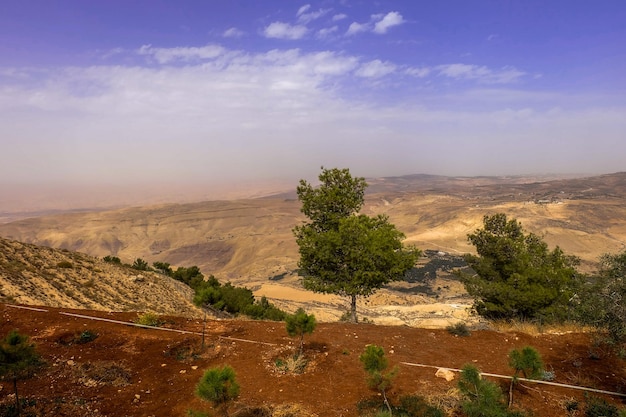
The View from Mount Nebo.


In the name of the living God, + Father, Son and Holy Spirit.

+++

Pray for the peace of Jerusalem. (Psalm 122:6a)

It’s a kind of code. The writer of the Psalm believes that if Jerusalem has peace, then the whole world will be at peace.  ‘Pray for the peace of Jerusalem’ means pray for peace in Jerusalem and everywhere.

When Moses was 120 years old, the Bible tells us, he climbed Mount Nebo, a mountain in today’s Kingdom of Jordan, about 800 metres above the Plains of Moab. There God showed him all the land that God had promised the children of Israel, from the river to the sea, the river Jordan to the Mediterranean Sea, from Dan in the far north to Gilead near Jerusalem and further south to the Negeb desert. (Deut. 34:1-5).

Then Moses died.

The last thing Moses did in his long life was to look towards the land that God was promising his people.  Moses looked forward to how blessed the tribes would be when they crossed the Jordan into Palestine. He paints a picture of how good the future will be for the children of Israel.

13b Blessed by the Lord [is] his land,
    with the choice gifts of heaven above
    and of the deep that lies beneath,
14 with the choice fruits of the sun
    and the rich yield of the months,
15 with the finest produce of the ancient mountains
    and the abundance of the everlasting hills,
16 with the choice gifts of the earth and its fullness
    and the favour of the one who dwells on Sinai.

                                                                            (Deuteronomy 33:13b-16 NRSV)

Moses could have sat around the campfire and regaled the Israelites with memories of leading his people out of Egypt. He could tell hoary tales about the 40-year trek through the wilderness, or reprise the joy, and the terror of meeting the living God in the burning bush.  But instead, he chose, after 120 years, to go to the high mountain, and to look forward to the future, to the promised land.

Moses couldn’t have prayed for the peace of Jerusalem for the simple reason that Jerusalem didn’t exist until many years later, when King David fortified a tiny Jebusite village and began building the Temple. 

What God wants for not only Jerusalem, but for the whole world’s future is peace, ‘shalom’ (שָׁלֹ֥ום). This word appears 237 times in the Old Testament, making shalom a significant concept. It means peace, and shalom is much more than absence of conflict.

Shalom means well-being in all its forms. Shalom means prosperity, but not the prosperity where only a few become wealthy, but prosperity where everyone shares their bounty with one another. Shalom is closer to communism than it is to the capitalism we experience in 2025. The prophet Isaiah reminds us that shalom is the opposite of war, which breeds hatred, fear, and scarcity. Shalom means love-in-action between people.

Pray for the peace of Jerusalem, the psalmist urges us, pray for Jerusalem’s shalom. God will bring peace for Jerusalem out of the fraught and complicated mess in the Middle East today. The promised land that Moses looked forward to stretches from the river to the sea. But today, Palestinians want to be free ‘from the river to the sea.’

These two visions of the future clash. They seem contradictory: how do we pray for the peace of Jerusalem?

How do we pray for peace for a people who were nearly exterminated a generation ago in the Holocaust? There are Palestinians and others like Hamas who say they would like to wipe out the Jewish people. Could it happen again? Never mind the politics: many Jews believe they are surrounded now by the same murderous hatred as they were in 1938.  

As Lloyd said last Sunday in his sermon, now it is important for Christians to express solidarity with Jews. Write to Temple David in Mount Lawley; or write to the Perth Hebrew Congregation. Or to both. A simple email will be genuinely appreciated.    

And how do we pray for a people who, a generation ago, were pushed out of the land their families had farmed for generations, for thousands of years?  The Palestinians believe that Jewish settlement from the river to the sea is a policy that bulldozes them out of the way, often quite literally. What should we pray? How should we support Palestinians and their allies locally? Sending money to an aid agency is one possibility. Gaza desperately needs the basics for life. Or finding out about the rallies held regularly in the city and joining them or supporting them is another.

How do we pray for the peace of Jerusalem? What would bring about the shalom of all the people of the Holy Land? This morning’s readings encourage us to pray with hope. Hope in God. The problems of the Middle East are difficult to fix. But as Christians, we know that God’s intention is for all Jews and all Palestinians to thrive, to enjoy God’s shalom. The divisions will find healing.

 We pray with hope, knowing that the future is in God’s hands. We look to the future with hope, learning with a deep confidence that God will meet us there.

Pray for the peace of Jerusalem. We can pray for the peace of Jerusalem only if we pray for peace in our own lives. We ask God to meet us in the conflicts of our families, knowing that some of those fights and divisions seem intractable to us.

We ask God to meet us in our everyday encounters. What do we need to do to foster shalom in our communities, as we encounter people serving us in shops, people on the footpaths, people at homeless respite, and neighbours of all sorts?

As Christians, we have a vocation to be makers of shalom; to be peacemakers. Saint Francis of Assisi, my favourite saint, told his followers to meet everyone with a greeting of peace.

[We should note that we Christians don’t have a monopoly on peacemaking. Jews greet each other with ‘shalom-aka’ and Muslims greet each other ‘As-salamu alaykum’; both saying, ‘peace be with you’.]

We too can make a greeting of peace a holy habit. For most of us, it might be a bit precious to say ‘peace be with you’ or ‘shalom’ every time we greet someone, but we can, for example, sign off emails or end phone conversations with the word ‘Peace’ – and mean it!

In this Eucharist, the priest greets us, ‘The peace of the Lord be with you’, and we respond, ‘And also with you.’ This morning, let us make the peace especially meaningful. Let us pray earnestly for the well-being and security of everyone we greet. Maybe greet fewer people and make sustained eye contact with each one if you can. Take two or three seconds to really see our neighbours, to remember that God delights in each one and seeks their shalom.

+++

As you know, today is the second anniversary of Lloyd’s ordination as a priest (congratulations, Father!), and it is my 50th. At the 8:30 Eucharist, Bryan Shattock marked his 42nd year of priesthood.

We as priests have a special role as a peacemakers.

Firstly, we bid the people we serve to ‘pray for the peace of Jerusalem’, and we bid the people to pray more generally for peace. Temple David replied to me that my email was appreciated because I am a priest.  My support as a priest carried your goodwill along with mine. 

So, secondly, our role in the community of faith, especially our parish priest, our bishops and the archbishop, is to be bridge-builders.

One of the titles for the Pope is Pontifex, the Latin for ‘bridge-builder’.Pope Leo has an account on X called ‘Pontifex’, and he repeated on social media his first greeting as Pope. This is what the Pontiff said:

“Peace be with you all! This is the first greeting spoken by the Risen Christ, the Good Shepherd. I would like this greeting of peace to resound in your hearts, in your families, and among all people, wherever they may be, in every nation and throughout the world.” (Pope Leo XIV on X)

I’m not saying that priests should be Popes. But like the Pope, the priest builds bridges between people and God.

One of the roles the church entrusts to priests is to speak words of absolution, either to all of us in the Eucharist, or to each of us in private in the Sacrament of Reconciliation, formally and informally. These words of absolution make space for peace with God.

This role of absolving carries with it the responsibility for us priests to make peace, to promote shalom, in the entire community we serve. We should never provoke division or hatred.

But as pontifex, as people entrusted with opening space for God, priests try to discern when to challenge people; when to ask people to fulfil roles for which they feel unworthy or not ready, or when to expose evil and hatred to the light by challenging people to do better, and by challenging, so build peace among people.

One anecdote from my time as a priest at Christ Church Claremont. A few parishioners looked with disapproval at families with young children. They stared at them critically, they shushed them, they rudely moved away from them, and they demanded that parents take their children to the crèche.

One morning during the Eucharist, I saw families being disturbed by these parishioners. There were many whispers and many scowls. I saw one mum on the brink of tears. I got very hot under my dog collar. When we came to the notices at the end, I told the congregation in what I thought were terms everyone could understand, that if they continued to treat kids like that, there would be no church left.

As I shook hands with people leaving, one woman said to me, ‘I’m so glad you said that about the children. Someone has to speak up about how badly behaved they are in church.’

So much for my discernment to challenge, to create connections and shalom between people!

So, we as priests have the privilege of promoting love between the people we serve. Priests speak well of people, knowing that God sees every person as whole, as holy, as complete. Priests who gossip or who speak badly of others are smashing those bridges between people, not building shalom. We try to be peacemakers whenever and wherever we can.

We priests have a special role in building bridges into the future. Like Moses, we look with hope to God’s church in the years ahead. It’s so easy to look at the church and be despondent.

There are fewer churchgoers, we say. There are no young people, we say. We have only seniors who don’t have the energy for organising things, we say. There are divisions tearing Anglicans apart, we say, between St Brendan’s and St Nic’s, reflecting bigger divisions between Canterbury and Sydney.  It’s easy for priests to be despondent. It’s easy for priests to think that we must come up with all the solutions.

We should be realists. God’s church is today what it is.

But as priests, we have a responsibility to remind people of a bigger story. God has been faithful to the church for 2,000 years. We have no reason to think God will not continue to grace God’s people with love and harmony, with shalom. Of course God will. God is not going to change or withdraw his love from the church.

Of course, all of us are all called to be bringers of peace, nurturing shalom. In fact, we can all do all the things priests do. But we priests are called to model peacemaking, to make space for peace, to call others to be makers of shalom. It’s a challenge for us, and it’s an extraordinary privilege.

We priests, like Moses on top of Mount Nebo, should be saying to the church:

The church’s future is blessed.

The church is blessed with the choice gifts of heaven above
and of the deep that lies beneath;
with the finest produce from the faith of those who have gone before us,

their stories, their hymns, their deep spirituality.
With the abundance of faith of those who will continue to come,

their joy, their faithfulness to Christ,
their willingness to live a life of service;
with the choicest gifts of love and shalom

And, above all, the church’s future is blessed with

the never-ending favour of the One who dwells with his people.

Pray for the peace of Jerusalem, and pray for your priests.

Peace be with you.

Advent’s Four Last Things: JUDGEMENT


JUDGEMENT

The last judgement takes place on the first page of the Bible: ‘in the beginning,’ speaking of the creation, ‘God saw that it was good… God saw that it was very good.’ (Genesis 1:4, 10, 12, 18, 21, 24, and 31 (‘very good’). God’s judgement that creation is good is a refrain that echoes throughout the first chapter of Genesis.

tob_ Hebrew letters

The Hebrew word ‘tov’ is full of rich meaning. The meanings of ‘tov’ include ‘righteous’ and ‘right’ as well as ‘fitting’ and ‘beautiful’. ‘Good’ is a good translation of ‘tov’ if we hold in our minds both moral and aesthetic goodness.

God’s judgement is that what God has made is morally and aesthetically very good.

Michelangelo’s great painting gives us a picture of a ‘last judgement’ taking place at the end of time, with the righteous received into heaven and the wicked being cast out of Christ’s presence. [See below.] It is a powerful but misleading metaphor. The ‘last judgement’ in the New Testament is not so much an apocalyptic judgement at the end of time as the revelations of the ultimate judgement. The Latin word ‘ultimus’ means both ‘last’ and ‘ultimate’. Ultimately, the wicked are never close to Jesus, the good always proceed from his presence.

Jesus’ imagery of sheep and goats show what has been right and beautiful from the beginning to the end of time. It is always good to feed the hungry; it is always good to visit the sick and imprisoned; it is always good to clothe the naked. It is always bad not to (Matthew 25:31-46). It is always wrong and ugly to refuse to give to those in need.

My Grandad once sat me down on a pew in our little bush church and admonished me that God is judging me now as he always will right until I stand before God at the end of time. (I must have been naughty to get that lecture!) I don’t remember Grandad telling me, that, in the end, God’s judgement of me is that I am good; I am very good.

The good news is not some version of Father Christmas where the good will get their presents and those who have been naughty will miss out. The Last Judgement as described in the Bible is far more serious than that. The Judgement is that God’s world ultimately reflects the nature of God, God’s goodness in the richest sense of the word (Genesis 1:27). In the end nothing can extinguish that light (John 1:5).

The baby Jesus embodies the Last Judgement. Despite his poverty, homelessness and human vulnerability, Mary and Joseph, shepherds and magi are judged by the infant Jesus. He brings out their goodness. The death of Jesus spotlights human cruelty, greed, jealousy and fear. It shows them for what they are, and that evil cannot stand against the love that flows from God’s goodness.

The Ultimate Judgement is for all time: goodness was the judgement in the beginning, we judge the present by the standard of God’s goodness, and goodness will be the criterion until the end of time. It is a judgement not of punishment, but of grace. Our response is not fear, but joy.

A joyous Christmas!

michelangelos-last-judgment
Michelangelo Buonarroti (1475-1564), The Last Judgement (1536-41)


Advent’s Four Last Things: DEATH


DEATH

In the New Testament, resurrection is key. Its light transforms all the life described there, placing all things under its spotlight, and revealing the extent of God’s love for us.

Without shadows, it is hard to see death in its full harshness. It’s there, of course: the young man at Nain, Lazarus, Jairus’ daughter, are all stone-cold dead. Lazarus has been dead for so many days that there’s a stench. Jairus has brought in the professional mourners. The townsfolk of Nain are already wondering what will happen to the bereaved widow without a man to belong to. (Luke 7:11, John 11:39, Mark 5:38.)

The New Testament depicts death as final and irreversible. Lazarus is not sleeping. Jesus told the disciples plainly, “Lazarus has died.”’ (John 11:14)

A humorous old spiritual, The Deacon Went Down to the Cellar to Pray, has a chorus which claims ‘You can’t get to heaven on roller-skates, You’ll go right past them pearly gates.” Underneath the humour there’s a serious point: If you fail to take death seriously enough, you’ll miss out on the resurrection.

Despite popular culture’s love-affair with murders, we are reluctant to talk seriously about death. Our unexamined fear of death makes Western society especially vulnerable to, say, Al-Qaeda’s acts of terror.

At Christmas-time when absence scratches at people’s wound of loss, our unfamiliarity with death prevents us from providing comfort and community to the bereaved.

Death has the last word. We are the stronger for facing its power. Classics like Bishop Jeremy Taylor’s Holy Dying admonish Christians to face death full on as a powerful way of growing spiritually.  It’s not good enough to say that we will be raised with Christ. First, we die. We must experience the reality of death: no-one escapes it.

Eugène Ionesco’s play, Exit the King, is a powerful meditation on death. The King comes to realise that the whole world dies when he dies. Trees, people, stars, the universe, all disappear with me, me! he complains. Each death is indeed an appalling loss. Each individual is of cosmic worth, and her or his unique talents and personality are plundered from the world at death. All ceases to exist when we die.

As Christians, we shout, ‘Death may have the last word, but God has the last last word!’ God reached into the tomb where Lazarus’ earthly remains were starting to rot, and brought him back to the world of the living.  Jesus himself was dead and buried: gone from existence. Yet God called Jesus back into existence so triumphantly that the raising of Jesus is a guarantee that, if we stick with him, we too will be called back into life (I Thessalonians 4:14), a life that is even more glorious than this life.

Believing in resurrection is not enough. It’s like being sure that Houdini will escape from the water-tank. Of course, he will: that’s the nature of illusions. But our dying is real, not an illusion. Jesus, like us, was born to die, and it is only in the spiritually-bracing acceptance of death, death as final act, that we can open to the possibility of being raised from the dead.

Our response can only be ‘Alleluia’.

sebastiano_del_piombo2c_the_raising_of_lazarus_28cropped529
Raising of Lazarus, Sebastiano del Piombo, 1519 (Wikipedia)

Advent’s Four Last Things: HELL


HELL

To be trafficked, and forced to live and work where you have not chosen; this is hell. Your captor counts your value in dollars, not in your humanity, and so treats you with the indifference a bad tradie treats his tools.

To be in pain, constantly without end; this is hell. Pain holds your body prisoner and you are unable to live as you wish because of the pain.

To be abused, and to live with memories of abuse; this is hell. Someone you trusted violated you and treated you just like a willful child stomping on a toy.

In his Divine Comedy, Dante describes the descent through the circles of Hell (L’Inferno). In a region called Ptolomea are those who have been thrown deep into Hell for treachery to their guests. These are people who insinuate themselves in a position of trust and use that power to take advantage of their victims. Significantly, Dante believes that these people die at the moment of their crime; their body may live on, but their soul is thrown immediately to this bottom part of hell.

In the world of Dante’s poem, there’s justice in this punishment. The Australian churches now must allow justice to be dealt both to the perpetrators of sexual abuse, and also to those who, by action or inaction, covered up those crimes.

I want to give little oxygen here to perpetrators, however.

Rather, consider the hell of being a victim of abuse: the inability to trust; the devaluing of the self; the trauma of being violated, and the secondary, and sometimes worse, trauma of remembering it. There is a shocking trauma for those who recover a memory long repressed. There’s the ongoing trauma of flashbacks and dreams. Relationships take on extra challenges. Some victims become hypervigilant, expecting at every moment something bad to overtake them. Taken together, this is hell lived out in daily experience, like a young woman trafficked, or the person experiencing high levels of pain every day.

Is ‘victim’ the right word? Many prefer ‘survivor’. While a person remains without hope, then they are in hell: they are a victim of the violence done to them.

Being destroyed by abuse, or corroded by pain, or forcibly held become hell when the victim can see no way out. This person understands that their situation will go on unchanged for ever. It is hell, and one of the four last things: an ultimate reality.

Christian faith reveals God who can undo the final reality of death. Death, the end, is no longer the end. The God who has power to raise Jesus from the dead has power to release victims from hell. The person who believes there is a future becomes a survivor, literally, one who lives beyond.

Christian faith bears witness, in the hells which people experience, to the reality of hope. This is the key which unlocks the door of hell. Hope is the secret ingredient which explodes the murderous captors of this world.

We must believe in hell because it is part of people’s lived experience. We are invited, however, to grasp hope, because hope turns victims into survivors, and eventually into joyful survivors; hope destroys hell.

child
Joy!

Advent’s Four Last Things: HEAVEN II


A young mother, grieving for the death of a baby, asks the question, ‘Will I be reunited with my Olivia in heaven?’

An elderly widower expresses certainty that he will be with his bride in heaven.

It’s almost as though Christian faith depends on after-death reunions of loved ones. The guidance, however, that Scripture gives us on this is vague and contradictory.

So, the totally honest answer to this question, especially as no-one has returned to tell us, is that we don’t know. But when faced with the direct question, ‘Will we be reunited in heaven?’, I hesitate.

Of course, the temptation for us pastors is to give the easy answer, the answer that people want to hear. The reality, however, is that we understand so little about life after death: what does time mean in life and after we die? What does resurrection mean for us as individuals? Will there be a different experience for those who do not identify as Christians? How will we connect with those from whom we have been estranged in this life? Cynical Sadducees asked Jesus a similar question, ‘In the resurrection, whose wife will she be?’ (Matthew 22:28)

Many people believe firmly that the church teaches that we, as individuals, will be united after death with loved ones. Many clergy taking funerals, without directly endorsing this view, allow it to stand as an implication of their pastoral message. I understand this prevarication: we are motivated to tell good news. I am deeply uncomfortable, however, with its dishonesty. This teaching falls short. There is better news.

The idea that we will be united with loved ones after death springs from a good place: it is an idea that the best God has given us in this life is love, and the one thing that we should expect from the eternal God is ongoing love.

In this life, we love with our bodies: we make love with our spouse with our body; we are present in the body to our friends. When we are absent from our loved ones, we project our bodies through space to continue the contact – our image on FaceTime, our voice on the telephone, our hand-writing in a card. These symbols of our body tell our loved one that we yearn to be present in the body.

Death destroys the body. Dust we are, and to dust we return (v. Genesis 3:19). The body is then transformed in resurrection. We know almost nothing about what Saint Paul calls the ‘resurrection body’, only that we would be a ‘foolish person’ to imagine it to be the same as our current body. It is as different from the natural body as the wheat plant is from a grain (I Corinthians 15:36-37)!

Love, after death, will also be the same and categorically different. While our bodies can love gloriously, God promises a love after death that is different in degree and in expression:  a much better love. All bodily limitations to love will be removed and transformed. Who knows whether we will rise as individuals, or as love promises, somehow joined in love? Or something entirely different, and, as yet, unimagined?

My plea is that we settle for more than the idea that we will be reunited with loved ones, and that we take the Bible at its word (I Corinthians 2:9, quoting Isaiah 64:4), that God will exceed our imagination as to how wonderful love in the resurrection will be. It will be heaven!

allinone-banner


Advent’s Four Last Things: HEAVEN I


‘Twenty thousand kilometres; two thousand dollars.’

Like us, the signora in the pensione had travelled to Assisi for Christmas. Her annual highlight was driving herself 60 kilometres. She had never been further from home than her annual trip south.

She kept wondering aloud in Italian the statistics of our journey:

Venti mila chilometri, duemila dollari. Venti mila chilometri, duemila dollari. 

The world is a big place, and our overnight flight from Perth to Italy had disguised how huge the distance to Assisi is. It is, as for our friend the signoraa cause of wonder.

Scientists tell us there are 300 billion stars in our Milky Way galaxy. The size of one star, one sun is hard to imagine. The trip from Perth to Assisi would take only a fraction of the sun’s circumference. 300 stars are hard enough to imagine, but 300 billion… Then, astronomers estimate, there are between 100 billion and 200 billion galaxies. How many stars there must be.  My digital calculator puts it at 4.5e16 stars. The number is meaningless, staggering in its scope.

Many scientists then tell us that our universe may be one only of an infinite procession of universes, coming in and out of existence at a fantastic rate. At this point, I’ve lost the power of imagination completely. The best I can do is stand outside and gaze at the night sky. I see red Mars, 10 years of rapid travel away. I see bright Southern Cross 350 years ago, its light just now reaching me, light that started on its journey when Charles II finally became king and the 1662 Prayer Book was promulgated.

This colossal creation can be a starting point in our journey searching for heaven. No, I am not suggesting that heaven is a place, perhaps hiding behind one of Saturn’s moons or in a 10-lightyear distant galaxy! But such a startling and amazing universe can flex our sense of wonder. Like the signora at Assisi, we can contemplate over and over the complex and awe-inspiring cosmos of which we are part, and yield to wonder.

This is the universe our God is creating. Spectacular and lovely.  A Creator God of such power has intentions. He has an agenda that his beautiful universe should more and more reflect God’s own qualities of love and goodness.

And if God is prepared to pour Godself into the making of such a spectacular and lovely universe, we can begin to imagine how wonderful are God’s intentions for you and me: to be more and more the love, goodness and beauty we discern in the physical universe. In fact, God promises it. God promises that we shall see face to face. (I Corinthians 13:12) God promises that his agenda for us is better, more delightful, more caring than anything we can imagine, just as his universe is more than we can imagine (I Corinthians 2:9)

Venti mila chilometri300 billion stars, God of a wondrous universe. Let us find heaven in our wonder.

Christmas challenge 2009


CHRISTMAS UNSHOPPING
Buy NOTHING this Chrismas

 Give no gifts this Christmas.
 Explain to your family that you are using your economic power to help the poorest by giving no gifts. Often, the gifts we give are useless or unwanted.
 Instead, make gifts or cards which are much more personal.
 Join the Advent conspiracy
 Give Christmas gifts directly to the poor by buying presents through Oxfam Unwrapped, Christian Blind Mission Gifts of Life or the Tear Fund.

GIVE to the needy

IN AUSTRALIA, some examples:
Christmas Bowl
The Mutunga Partnership
Christian Blind Mission
Oxfam
Anglicare

PRAY differently

More silence
More meditation
More reflective reading of Scripture
Fewer words
Different symbols (candles, ikons, etc.)