
In the name of the living God, + Father, Son and Holy Spirit. Amen.

Fifty years a deacon. The Church 50 years ago was a very different church. Churches around Perth were generally full on Sundays – many churches filled two times over with two services. Men still wore suits to church, and women wore Sunday best dresses. Some women wore hats, but hats were beginning to stay away. The declining attendance of hats was a sure sign that the Church was about to change.
We were still ‘The Church of England in Australia’ – our name didn’t change until 1981, and I think our English culture is only now beginning to change.
Sunday Schools around the city were huge. 70 or 80 kids and a dozen teachers turned out every Sunday at Christ Church Claremont and parishes like it. The General Board of Religious Education, set up by the Australian General Synod, produced the course book used by most Anglican Churches. Children were completely segregated from adults, and, many children were dropped off by their parents. These parents may have seen benefit in Christian education for their kids but not for themselves.
There were arguments that you might remember about whether children were really ‘people’ for the purpose of attendance numbers and statistical returns!
By 1975, the once-flourishing Y.A.F. – the Young Anglican Fellowship – had pretty much shrunk and died.
I grew up in a country church in the 1950s. You could definitely see the decline in little churches all over the southwest corner of the state. Our little church, St Mary’s in Tambellup, might cram 70 people in for Christmas services. They even put out little folding stools with canvas seats down the aisle to accommodate everyone. But the Sunday after Christmas, and for most Sundays of the subsequent year, the congregation was fewer than 15 or so. There was a little Sunday School, taught by Mrs Lorna Taylor, who also played the organ, ducking in and out of the church and the church house next door during the service. That Sunday School had less than five kids.

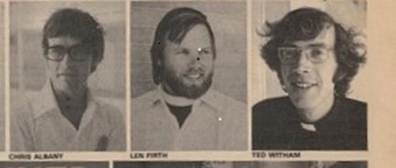
This was the Church five of us were called to be deacons in 1975. The church appeared to be flourishing, but there were clear signs that we were about to be pruned – enormously.
Although accurate statistics were hard to find, 8,000 or more people turned up to Anglican services across this Diocese each Sunday: more, we were reminded, than attended WAFL football matches each weekend.
The Diocese tried some big things to stop the runaway numbers. 1975 was the year of Celebration 75, a huge mission of the Diocese, culminating in 10,000 Anglicans gathering at Perry Lakes stadium for the Eucharist on Palm Sunday.
Celebration 75 was memorable because of the murder of Archbishop Janani Luwum from Idi Amin’s Uganda. Luwum was one of the bishops visiting Perth for Celebration 75. Some months after he returned to Uganda he was found in a crashed car just outside Kampala – his body riddled with bullets. ‘The blood of the martyrs,’ Tertullian said 1800 years ago, ‘are the seed of the Church.’ Maybe a little of Luwum’s blood would impact Perth Diocese!
Goals were set for our diocese – 24 new parishes to be planted in 24 months. When we young clergy spent time with Archbishop Sambell, his parlour game was to get us to state as many new suburbs as possible (Kallaroo, Mullaloo, Heathridge, Connolly, Joondalup, Currambine, Iluka, Ocean Reef). Then the Archbishop would comment: ‘And that is our mission field.’
Luke’s telling of the calling of the first disciples reminds us of three things about the ‘mission field’ – the situation which they were called into. The painting by the 14th– Century Italian painter Duccio di Buoninsegna is a sermon in itself. Buoninsegna means ‘teaches well’, and that’s what this beautiful picture does.

Duccio’s painting tells the story of the Miraculous Draft of Fish all in one image. He starts with Jesus meeting Simon and Andrew. Notice the sky is golden. When Simon and Andrew meet Jesus, we are not in the normal everyday world. Duccio paints them in heaven with its gold sky. Jesus is on the rock; Jesus is the rock. Jesus invites Simon and Andrew to step on to the rock, onto the solid ground of a new relationship with Jesus and to turn the everyday world into the glory of heaven.
I must admit that the two disciples don’t appear to be straining to haul in the heavy net of fish. With Jesus by their side, the effort is shared with Jesus and their burden becomes light. There are fish everywhere in Duccio’s picture, both in the net and outside the net. In this vision of heaven, you don’t need to be inside the net. Everyone is included in God’s love.
Duccio the painter is teaching that what is true for Simon and Andrew then is true for us now. Jesus continues to invite us into a life-giving relationship with God. Jesus calls us to the work of mission with him. We are to be encouraged that in the end, God makes sure that there is a good haul of fish – of people.
Simon’s encounter with Jesus sees him coming to terms with the way Jesus, a carpenter, told him where the fish were. Jesus told Simon to put out into the deep and put his drag net out the other side of the boat. Just imagine how Simon must have swallowed his disbelief: he may be Jesus the preacher, but really, what does he know about finding fish?
Simon puts the cumbersome net into the boat, I imagine with some reluctance, gets the oars organized, rows out to deeper water, puts the net in the water and then drags it in a half-circle from the boat; all the while expecting nothing. What difference can Jesus possibly make?
And then surprise! ‘So many fish that their nets were going to break!’ They filled two boats to the point of sinking. (Luke 5:6)
Simon is shaken. Shocked to the core. This man Jesus is like no other human being Simon has met. ‘Get away from me, Lord, for I am a sinful man!’ (Luke 5:8) Seeing Jesus in this moment makes Simon squinch and shudder. This encounter with the power of Jesus strikes Simon (and Andrew and James and John) as so massive and so stupendous that they left everything – everything! and followed him.
I assume Simon used to go to synagogue and had heard the scrolls read. He knew about the prophet Isaiah, who, like Simon, was overpowered when he was encountered by the Lord God in the Temple, and, like Simon, Isaiah’s first reaction was with dramatic words: ‘Woe is me! I am a man of unclean lips, and I dwell among a people of unclean lips.’ (Isaiah 6:5)
In this squeal of pain, Isaiah recognises that he could not stand before the living God unless God reached out and made him stand. And for Simon, the catch of fish had the same effect.
The second part of Simon being called to the ‘mission field’ was calling others to help him. To haul in so many fish Simon needed to call on his brother Andrew and their partners James and John. You need others. Jesus rarely invites single heroes to do the work of ministry. It’s too hard. It’s too big.
Jesus himself is on a fishing expedition to catch people. Luke implies that his catch, consisting of Simon and Andrew, James and John, is also a good haul. These four will make a significant difference to the ministry of Jesus.
All ministry requires hauling in people. Maybe ‘hauling in’ people is not the best image. The church is not the Ringling Bros and Barnum & Baileys, hauling suckers into the Big Tent! Rather the church’s business is inviting people respectfully and gathering them in. Even so, the church of God is a Big Tent.
Our parish’s ministry to the homeless always needs volunteers. Morning tea after church needs volunteers. Children’s ministry needs volunteers. Even the work of worship – our liturgy – needs all of us and not just the priest out front.
The third idea is to underline that ministry is always about people. Simon is called to catch people; not so much catching fish.
This was really underlined 50 years ago during our year as deacons. Five of us deacons and one presbyter from the Church of South India spent 1975 in the Deacon’s Training Program. This program was designed for us to experience the practicalities of every ministry in the Diocese.
We spent 10 weeks in an established parish: I was assigned to Kelmscott Parish, and then to Balga Parish north of the river. Balga was a more catholic parish, and Kelmscott an evangelical parish, so all of us participated in leading different styles of worship.
We spent 4 weeks in hospital chaplaincy, visiting patients and taking them communion.
We spent a fascinating 5 weeks in mental health. We saw the way the behaviour of acutely mentally ill people challenges the staff to care appropriately for them. We visited residential homes and wondered whether those big institutions were the right place for the severely developmentally challenged.
We spent just a few days in Industrial Chaplaincy – basically a visit to the Alcoa Refinery in Kwinana to meet John Bowyer the then chaplain!
For this Deacon’s Year, we resided at Wollaston College We each shared leadership in music and worship in that wonderful big tent Chapel. Following the Benedictine Rule, we had to do some manual work around the College, cleaning windows and pruning and sweeping paths and roads.
I’ve never been one for manual work, so I offered to restore the old harmonium which provided our music in Chapel, and I enjoyed cleaning reeds and fixing wires and bellows. It took me the whole year to complete – conveniently!
The Deacon’s Year was fast-paced. Two weeks in a country parish, where I watched with amazement Henry Tassell, a country pastor who had the rare knack of turning up on a farm at the right time, say, morning teatime during shearing. He kept overalls and work boots in the boot of the car to pitch in and help the farmer.
Two weeks in a church school.
I was anxious to be a school chaplain.
When I was about ten, I had a dream one night. After this dream, I remember rushing to my Mum and blurting out, ‘When I grow up, I’m gonna be a teacher and a priest!’ Mum advised me not to say anything about the dream.
But I did think of it every now and then. I interpreted it to mean that I would be a school chaplain. So, the Headmaster of my school Peter Moyes, even when I was still at school, had also encouraged me to be a school chaplain and before going to theological college in Melbourne, I had taught in the country for two years and enjoyed it.
So I learned a lot in those two weeks at Perth College. Teaching girls only in a classroom opened my eyes. When girls behave badly, they behave badly in big groups. Suddenly the whole class, it seems, turns on one person and bullies them, one of the girls, or the teacher. Unlike boys, you can’t just pick out the perpetrator and punish him. I had to learn strategies to deal with feminine mob rule!
But that didn’t dampen my determination to be a chaplain. I saw how the chaplain Terry Curtis conducted the Chapel services, what opportunities he had for pastoral care for the girls and for the staff – and a scary Headmistress!
Later, I had nine satisfying years as a school chaplain, one year at Hale School, and eight years at Christ Church Grammar. After those years, I discovered even more ways of being a teacher and a priest.
But back in the Deacons’ Year, we had a tough 36-hour Urban Training course We had to survive in the city without money. We pretended to be homeless, living on the streets, under stress to experience how our society looks after the needy.
A four-day Human Relations course back in Wollaston College turned out to be a deep dive into our inner psychological lives. Some of the deacons found this group work too threatening, so it was abandoned in subsequent years.
Anglicare, Anglican Homes, how to conduct weddings: at the time some of it was a blur. But the basic point was made: ministry is about people – worshippers in a parish, patients in hospitals, kids in schools, brides and grooms, people on the street, certainly neighbours and friends and families. And ministry meant making connections with hospital chaplains, diverse parish clergy, school chaplains, Government agencies, and a whole host of carers who gave us insight into other caring people in our society.
This practical year 1975 followed three years of theology study. None of my fellow deacons complained that the academics were not relevant to ‘real ministry’. I felt, and I think the others agreed, that we can only understand the purpose of practical ministry if we understand a bit about God. In our Deacons’ Year, we experienced God in the marginalised. We made sense of it with Bible study and through Church History.
Luke doesn’t tell us that Jesus ordained deacons. Jesus calls all the baptised to ministry. Jesus invites each one of us to be a deacon and serve the needy. Matthew writes a parable, you remember, about sheep and goats. When we minister to the least of these, we are loving Jesus. The ministry of service is for all of us.
Deacons, ordained deacons, some permanent deacons and all priests and bishops, we are deacons before we are priests; as ordained deacons, we are the church’s sign to itself of helping the needy. Our life of service shows that all of us rely on God to empower ministries of service. Deacons’ service in the community emphasises that the church doesn’t exist for its own sake. The church exists always for others. The great wartime Archbishop of Canterbury, William Temple, is often quoted that ‘The Church is the only society that exists for the benefit of those who are not its members.’ The church is a diaconal church, a serving church, a church of deacons, and our holy task is to love God by serving people.
Fifty years on. 2075. I won’t be around to see it, but some of you will. And I hope you experience how God keeps loving you, and you will keep loving your neighbour. Because whatever changes 2075 will bring, we will still be a deacon-shaped church – and that’s worth celebrating.
 Keith and Kristyn Getty, Sing! How Worship Transforms your Life, Family and Church, Nashville TN: B&H Books, 2017. 176 pages hardback.
 Mind Journeys