The Nine Lives of India’s Religions


William Dalrymple, Nine lives: in search of the sacred in modern India, Knopf 2010.
Hardcover 304 pages. Approx. $27 posted from online stores.
Reviewed by Ted Witham
Published in REJA, the journal of the Australian Association for Religious Education, Volume 21, No. 2, 2010

I took my first tentative steps in teaching Indian religion 30 years ago. I still remember my confusion: I learned lists of Four Noble Truths and Eight Right Pathways; I rehearsed the story of Gautama’s enlightenment to tell in class; I read about Shiva and Ganesh. But I couldn’t sort out why some Buddhists are effectively atheists, while others worship the Buddha as a god. I didn’t understand how Hindus appeared to worship hundreds of gods while the text books said there was one, or perhaps three, gods in Hinduism.

No doubt I passed on my confusion to my students. I could have done with Dalrymple’s engaging book then.

Only many years later I learned that “Buddhism” and “Hinduism” were effectively the creation of 19th Century English and German scholars, who had only recently classified Islam and Judaism as “religions”. These scholars cast their eyes across the practices of the teeming shrines of South Asia looking for religious systems. Not surprisingly, they saw what they were looking for and used the suffix “-ism” to describe them.

As Dalrymple knows, the reality is much more complex, and much more interesting, than can be contained in the religion scholars’ enthusiasm for classification. William Dalrymple is a travel writer living in India. He has a particular interest in religious practice. These are the Nine Lives of nine exceptional holy women and men up and down the country.

This approach achieves three things: first, it personalises what might otherwise be abstract notions of religion. We meet articulate people who know what they believe. With his travel writer’s eye for detail, Dalrymple sets these extraordinary sages in their setting, and allows them to tell their stories. All have found that it has cost dearly to pursue the holy.

Second, it allows Dalrymple the opportunity to describe faith-worlds of the “lay” folk who still flock to the shrines and their holy people. The 2,500 year old practices of India are not dead. Who knows how many of their proverbial “nine lives” they have had?

Third, it helps the Western reader build a picture of the lived reality of Hindus, Buddhists and Jains. It shines a light on the difference between a Tamil Buddhist in India’s south and a Tibetan monk in Dharamsala. It lets us see practitioners in many shrines as they intertwine Islamic and Hindu practices and ideas. It describes particularly Indian Sufis, and it shows the pressure the Saudis are placing on them to conform to the austere Wahabbi interpretation of the Qur’an.

Teachers of religion will find this book to be a treasure. Some may use the nine sections of the book to structure a term’s work and allow students to experience the same discovery as the reader. Year 12 and university students could read each chapter in preparation for a class discussion. To use the book in this way for younger students would require more structuring.

Others will be enriched by the contemporary update of their understanding of Indian religions. Others, like me, will recognise how India is not a confusion of spiritualities, but a vibrant, and fascinating, profusion of faith and ritual.

*************
Ted Witham is the Immediate Past President of AARE. He taught religion in Anglican schools and at Murdoch University. Now retired, he lives in the south-west of Western Australia, where there appears to be minimal religious diversity.

The Meaning of Pain


Melanie Thernstrom, The Pain Chronicles.
New York: Farrar, Straus and Giroux, 2010.
EAN:978-0865476813
$22 approx. on line

Reviewed by Ted Witham

One purpose of religious faith is to make meaning. Christians especially find it difficult to make sense of chronic pain. As Melanie Thernstrom explains in her entertaining Pain Chronicles (yes, entertaining!), acute pain is an excellent response to injury. Acute pain protects us. Chronic pain, like cancer cells that don’t know how to stop, serves no such purpose. It afflicts at least one person in ten and resists most treatments.

Christians need a strong theodicy to incorporate pain into their understanding of a loving God. In his 1993 memoir missionary doctor Paul Brand, famous for his work with leprosy, tried to sell the idea that pain is “the gift nobody wants.” Brand saw the lepers’ infected cuts and burns, injuries caused because they could not feel pain, and argued that we should praise God for the protective properties of pain. For Christians with chronic pain, this is not persuasive. Chronic pain serves no good purpose. As a chronic illness it challenges God’s ability to heal.

The Pain Chronicles tells two inter-twined stories: it is a memoir of Melanie Thernstrom’s own journey from her futile searching for cause and cure, to a more productive attempt to make sense of a life with ongoing pain. Formerly a staff writer with the New York Times, Thernstrom shares this journey with a robust honesty, especially her initial belief that her pain was a punishment for an ill-advised love affair.

This leads Thernstrom to meditate on the historical connections between the word “pain” and the Latin word for punishment “poena”. This excursion into history and language takes the reader through changing theologies and attitudes, and is typical of the second story of The Pain Chronicles: its pleasure in intellectual curiosity. Thernstrom follows her forensic curiosity down many byways in the history of pain and medicine, analgesia and anaesthesia. We learn both how the ancients understood pain and how contemporary researchers peer into the brain’s response to pain with real-time brain-imaging.

The Egyptian Ebers Papyrus from the 13th Century BC declares that “Magic is effective together with medicine. Medicine is effective together with magic.” “Although it would take millennia to understand why,” writes Thernstrom, “words in combination with physical treatment can alleviate pain in ways better than treatment alone.” (p. 35). She is clearly delighted to have affirmed that medications work better in a good healing relationship.

Some Christians believe that pain can lead one into the imitatio Christi. Elaine Scarry’s classic 1985 study The Body in Pain examines how the Bible understands pain, beginning with the pain of childbirth (“all those begats”) and following through the pain inflicted on God’s enemies in the Old Testament. Ultimately, claims Scarry, all this pain can only be understood through the lens of the Cross. Women’s pain, the pain of Israel’s enemies, and ultimately our pain should be viewed as a share in Christ’s Passion. After consideration, Thernstrom dismisses this idea as unhealthy: “I didn’t want to be in Pain. I didn’t want to want it. Pain is not a cross; it’s a Harrow.” (p. 76)

Ms Thernstrom cites studies that show “positive religious coping”. For some Christians, their faith does help them make sense of chronic pain by cognitive reframing the suffering or placing it in a wider context. For other Christians, however, pain leads to greater distress perhaps because they interpret their pain as punishment. (p. 206)

Hearing about the Hindu devotees who thread hooks through their flesh, Thernstrom heads to Kuala Lumpur to see whether they might have some insights into dealing with pain. Her journalist’s pen describes the festivals vividly, but they are of only marginal help on our journey. These pilgrims choose temporary pain to induce a spiritual high. This may lead to effective analgesia, but it is a practice worlds away from chronic pain: not choosing pain that never stops. No wonder the priest snorted when Thernstrom asked the god to take away the burden of her pain.

Thernstrom returns to science to make meaning of chronic pain. This malady is a disease of the brain, in fact, a disease of consciousness, that we cannot yet cure or treat effectively because brain science knows so little about consciousness.

She compares our current understanding of chronic pain to consumption in the 19th Century. Consumption was used as a metaphor for dying Romantic poets or operatic heroines. In 1882, a German physician identified mycobacterium tuberculosis. Although the cure, antibiotics, was half a century away, this scientific discovery reduced the illness from a metaphor to a disease. Chronic pain, Thernstrom concludes, currently evokes many metaphors, but until science unlocks its secrets, we will remain like pre-1882 sufferers of TB.

The Pain Chronicles cover much fascinating territory. Metaphors of pain and suffering are explored with elegance, intelligence and humanity. Melanie Thernstrom offers no theodicy of her own. She fears, I think, that to do so would belittle the experience of her fellow sufferers. What she does provide, though, is a fascinating sampling of others throughout history making meaning in chronic pain. While there may not yet be a cure for chronic pain, there is a lot of understanding here, and therefore comfort.

Losing Our Religion?


Losing My Religion

Tom Frame, Losing My Religion: Unbelief in Australia. Sydney: University of New South Wales Press, 2009

337 pages, paperback.
RRP $34.95

Tom Frame is not afraid that Australia will “lose its religion”. Not really. But he is concerned that Australian Christians will pay a high price if they do not engage in a vital conversation about belief and unbelief.

Losing my Religion has won the 2010 Christian Book of the Year prize – and deservedly so. It is not only a heartfelt plea to Christians to put energy into thinking about faith and its place in a pluralist society, but it is also a comprehensive history of the interactions between religion and the Australian community.

Dr Frame is balanced in his description of the tensions surrounding religion in the convict days on the east coast and in the lead up to the framing of the Commonwealth constitution. But where the book shines, in my opinion, is when Tom Frame teases out the contemporary scene. He takes issue with anti-theists like Richard Dawkins for their lack of respect for their opponents, but he engages with the Australian unbelievers like Philip Adams. He demonstrates respect for their view but has no fear in putting forth his own.

Dr Frame is well qualified to explore belief and unbelief. As a former bishop to the Australian forces, he has ministered at an important interface between public life and the Church. Now Director of the St Mark’s National Theological Centre in Canberra, he writes lucidly on these complex issues. He draws on some of the same materials that he used in Evolution in the Antipodes (2009), but here with different intent.

Frame teases out the thread in atheism that claims it is not a belief and therefore a guarantor of reasoned tolerance. He shows this as specious reasoning both because atheism is a belief borne out of theism and also because atheism has no monopoly on reason. The presence of religious people in secular society is therefore more likely to bring tolerance and harmony than their absence, because they can take the beliefs of others into account.

Losing My Religion will make you agree and it will make you disagree. Frame knows that keeping your religion involves being confronted by a Christ who asserts his divinity; and for all of us, believers and non-believers, when we think seriously about it, that is controversial.

The Messenger reviews my book


I am proud of the review by Ruth McIntyre in February’s Anglican Messenger. Her comments are generous. Read them below.

In the Messenger
In the Messenger

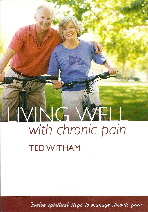
SUFFERERS OF chronic pain, and those who care for them, will find great comfort in this short book. It does not recommend throwing away the prescribed medication, but offers carefully described ways to make the most of a life that must be lived as well as possible.

As Ted Witham writes: Pain disables us. Pain takes us out of circulation – it seems to erect barriers between us and our families, our friends and our work. Pain imprisons us. At its worst, pain claims our total attention, and we can do nothing else but react in anguish.

How then to cope? In twelve steps, each detailing ways of understanding, Ted Witham offers his own experiences of meditation with exercises that will challenge other sufferers.

Refreshingly honest in approach, Living Well discusses the accompanying depression of chronic pain and suggests ways that will help to overcome it. Spiritual responses are thoughtfully underpinned with practical methods of approach.

Practical and emotional support is highly desirable and the writer has produced a manual to accompany the text. Walking the 12 Spiritual Steps with those in Chronic Pain: The Manual for spouses, friends and pastoral carers (Spirit-Ed 2008 ) is carefully and thoughtfully presented to help people closely involved with the affected person to gain increased knowledge and understanding. How is it possible to be truly helpful and supportive without impinging on the dignity and privacy of the person with chronic pain? What inner struggles are likely to be standing in the way of accepting the burden of pain and probably affecting the relationship?

Ted Witham, though a priest himself, places no great restrictions on the views of God held by those who seek help. There is room to develop knowledge and grace on this journey of pain and he shares his experiences, both practical and spiritual. as guides to enrich the lives of others. Relevant readings from the Scriptures are suggested for each of the steps.

Pain Management Programmes have the capacity to improve the patient’s quality of life, reduce suffering and distress and provide a more satisfactory lifestyle. They are not designed to eliminate pain or provide the patient with a cure. (Australian Pain Society: http://www.apsoc.org)

The Book's Cover
Living Well: The Book's Cover
Ted Witham is equally realistic. His goal is abundant living – the best quality of life that is possible – and that will include taking part in some of the things patients want to do and activities that are important to them.

If chronic pain is a problem to you or someone you love, this book and its guide will prove invaluable.

Ruth McIntyre