Believing: a tangled skein


I heard of a priest who was asked recently, ‘Do you ever have moments of doubt about your Christian faith?’ The priest replied, ‘On some days I have moments of faith.’

I am intrigued by atheists who seem to think that if they can knock one argument out from under a Christian, they will have of necessity knocked the person off their Christian stool. Comedian Ed Byrne, for example, talking to agnostics, ‘If you haven’t heard God speak to you in a sunset or a beautiful landscape by the time you’re 40, you’re an atheist.’ His assumption appeared to be that just one thing could make the difference between being a Christian or not.

I experience being a Christian not as a series of skittles to be knocked over, but as a tightly tangled skein of meaning-making, experiences and fellowship. Included among my persuasions are doctrines, ethics and aesthetics, the ever-fascinating engagement with the Bible, my identity and my incorporation into particular parts of Christ’s Church.

So atheists sometimes try to win the argument by asking what I would believe it were proved that some bones were definitively identified as the remains of Jesus. The empty tomb is only one little part of my believing, so, depending on the day, my answer is either a confident argument from logic, ‘It will never happen’, or an answer from conviction, ‘It would make no difference to my foundational belief.’

Some Christians trip over philosophical wires by trying to solve the puzzles of the 2nd and 3rd Centuries. What does it mean to call God a Trinity? The Prophet Mohammed was one person for whom the doctrine of the Trinity disproved Christian faith. He founded a new religion with monotheism front and centre. Five times a day, his followers now proclaim the Shahada, ‘There is no God but Allah.

trinityflyer‘One God in three persons’ makes less sense for our times because of the philosophical assumptions at the time the Creeds were written. Faith that God is one in three is always faith, however, and Christians can choose simply to believe it, or like Catherine La Cugna or Karl Rahner in the 20th Century devise completely new philosophical pre-suppositions for the doctrines of Trinity.

Other Christians recite the Creed each Sunday, ‘We believe in One God’ – the Trinity – as a statement of the historical faith of the Church. This is the Church and its beliefs in which I choose to belong, even while holding lightly to the details of these dogmas.

I have many moments of not believing or understanding how Jesus Christ can be completely human and completely divine: there are just too many paradoxes in the doctrine to contemplate at once. However an atheist who shows me how irrational this belief is will not therefore persuade me out of being a Christian.

Bedrock to my faith is the person of Jesus, yet many atheists join me at the core of acclaiming Jesus as a provocative teacher of good living, although some atheists try to make Jesus interchangeable with other gurus and guides.  I do stick to the uniqueness of Jesus. This comes partly from my ongoing fascination with the Hebrew and Christian Scriptures. Many atheists find they can reject Christian faith without reading the Bible. I find its books more and more intriguing as I read them, whether it’s unravelling the insights of Wisdom literature or attempting to interpret the Book of Revelation.

123166-004-87cb3f17
Saint Jerome – courtesy brittanica.com

As I read the Gospels, I find more and more to surprise me. In the ‘Good Samaritan’, Jesus tips the world of loving upside down. Unlike his peers, Jesus calls us loving outsiders as equal a duty as loving our families. Another surprise: Being a neighbour is not so much about those whom I can help, but about who I allow to be neighbourly to me.

Much of my experience of being a Christian comes from the Church which has shaped me, paid for my theological education, and which continues to give me support. Just this fortnight with my wife away, I am experiencing the practical help of the local congregation bringing me meals. Of course, such do-gooding is not limited to Church people, but the fact that it is Church people living out charity as part of their faith reinforces my Christian identity too.

I cannot undo my experiences. I have discovered God in the music of Olivier Messaien. I can try to explain it away in psychological terms, but nothing can change what Messaien has revealed to me.

There are days when I try to persuade myself out of faith, but it can’t be done, I don’t think, because my faith is too vigorous a garden and grows by weeding and digging out old growth. One-punch atheists don’t get the complexity of religious faith as they believe it is a single flower.

I offer this short piece as one flower of my thinking as a Christian.

m


Helpful Whiff of Heresy


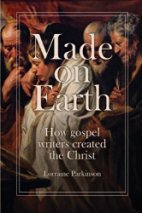
5111brslwkl-_sx142_sy224_sclzzzzzzz_Lorraine Parkinson,
Made on Earth: how the gospel writers created the Christ, Richmond, VIC: Spectrum Publications, 2016.
ISBN 9780867862546
Online: Paperback $49, Kindle $11.99

Reviewed by Ted Witham

For some years, I’ve held lightly to the doctrine that Jesus Christ was fully human and fully divine. It’s not that I wish to demote the importance of Jesus, which was the purpose of the original dogma. It’s more that a pre-modern conception of divinity does not do justice to the ways in which Jesus of Nazareth actually  connects me with the sacred world.
Lorraine Parkinson’s new book Made on Earth helps me on my journey of belief by adding to the ways in which I can articulate my unease about Christology. She systematically works through the gospels in the order of their writing – Mark, Matthew, Luke and John – to show how the message of Jesus about the kingdom was deliberately transformed into a message about the identity of Jesus as the expected Messiah.
Lorraine Parkinson is a retired ordained minister in the Uniting Church based in Victoria, and is in demand as a speaker for meetings of progressive Christians around Australia.
She tells the story crisply of how the infancy narratives appear to have been added to Matthew and Luke inventing the idea of Jesus being conceived by the Holy Spirit, and thereby being God’s Son. She reveals how the life of Jesus was fitted into the typology of Moses or Elijah to further the argument for Jesus’ more than human status. The gospels

2000px-shield-trinity-scutum-fidei-compact-svg
incomprehensible?

were a sermon to persuade readers that Jesus had transcended Judaism and that his followers needed to distinguish themselves from the Jews.

 
She makes a plea for ‘progressive Christians’ to turn back to the original teachings of Jesus. The gospel of Jesus as the one Messiah  has led to a church that

  1. relies on fear (making sure you are right with God so you can enter the afterlife),
  2. that promotes anti-Semitism (the Jews are depicted as Christ-killers), and
  3. that ends up as Christendom (the Church as a new Roman Empire focused on power).

Returning to a simple reliance on the Sermon on the Mount and the parables of Jesus will invigorate individual followers of the Way of Jesus and remove the weight of having doctrinal commitments to a divine Christ.
She asks us to remember that the Gospel writers were ordinary human beings who believed they were inspired by the Holy Spirit. Her arguments here appear to be based on common sense alone and I would have liked her to wrestle with the theology of inspiration a little more deeply. As followers of Jesus, understanding God’s truth and how we know it is an important issue.

 
This book is dangerous. It emits a whiff of heresy. I admire Lorraine Parkinson’s honest courage in questioning the 3rd and 4th Century interpretations of the meaning of the Gospel. We need prophets to show the way forward for followers of Jesus of Nazareth, and Made on Earth is an important step on that path.

sermon-on-the-mount
Sant’Apollinare, Ravenna – mosaic

Sermon: Ask, search, knock


Luke 11:9-10

I wrote this poem a few years ago, reflecting on Jesus’ teaching that our desire to love, when taken far enough, eventually leads us to see the world in ‘I-thou’ terms. 

– Ted Witham

I asked for a Mercedes, coupé 220, of course.
Received a mirror, 360, signed, with love, Yours.
Reflected… the shiny image that was my deep desire;
to climb up the world’s path, a higher flyer.

I searched for love in writing reviews,
Expecting my readers to walk in my shoes;
I searched for love, making Church work my life,
but found love closer in children and wife.

I knocked on the door of God, Father, King,
Insight opened: metaphor turns God to ‘thing’;
I opening saw God as all my ‘Thou’,
me to be present in the Eternal Now.

Asking, searching, knocking, all stones stepped
to draw near to the One so wind-swept,
Spirit-blown, tempest-tendered,
The ‘Thou’ who all my love has ended.


First Notes of the New World


An Easter sonnet for my friends who are musicians and poets:

First Sprung from the Dead

The cloth which yesterday so reverently kept
our Lord’s head, is today lying by itself;
the shroud appears like the bed where he has slept,
pillow face cloth arranged on the rock shelf.

The tomb is ordered, the Paschal setting
is not a wild off-planet getaway:
the presence who has folded the netting
has artfully followed the Passion Play.

Easter’s presence/absence on limestone set
covered in the linen weave of white cloth,
powerful mystery in quietest calm yet:
Life bursts from silent Yahweh Sabaoth.

The folded cloth, the ordered tomb resound.
The living Jesus in measured singing found.

  • John 20:1-14
  • empty-tomb-good-evidence

Rejection


Rejection

—They’re dazzling Da-Esh with wonders and signs
Across widespread Islamist latitudes,
Where gospel is grounded in physical confines
And must be proved by miracles’ certitudes.

—We in Nazareth are more Word-based, of course,
Our gospel is rooted in reason’s deep grace,
In doctrine and Midrash is Jesus’ real source,
In text and good preaching we see Jesus’ face.

So Jesus can stand and read the whole scroll,
he can sit and discourse and be learned as well,
he can count off the ways he will save your soul –
but he cannot act. No! We’ll move to expel.

Your water to wine, your sadness to joy,
disrupting our world prepared to destroy.

  • Luke 4:21-30

christpreachnaz

Christ Preaching in the Synagogue at Nazareth. 14th c. fresco (detail).
Visoki Decani Monastery, Kosovo


Impossible Things for Breakfast


Gospel: John 6:1-21

You never seem to come to an end to this reading from St John’s Gospel.

When I was about nine years old, I discovered a book on my grandparents’ shelves called The Robe by Lloyd C. Douglas… or was it A.J. Cronin’s The Keys of the Kingdom? The book explained the miracle of the feeding by suggesting that the little boy sharing his lunch shamed all the people into sharing the picnics they had brought with them.

And maybe that’s part of what John is saying to us: that when we recognise that people are hungry, we should share the little we have with our friends and neighbours and that will encourage a spirit of sharing in the community, and there will be enough to go around and more.

I think I knew even at nine that this explanation was a brush-off. Obviously sharing is a good thing, far better than the alternative, but a little disappointing if that was all Jesus was teaching. All the sharing that has happened since then has not made a dent in world hunger, and in any case, the people in the story were hungry, not for food, but for teaching and for a leader, a Messiah.

This is a story about two shocking events: a man who can feed 5,000 with virtually nothing, and who can walk on water. The story is firstly about who Jesus is, not about our puny efforts to feed the world.

I don’t know what to make of the two events. I don’t do miracles. But that in fact is the point. John is introducing a person who does things that cannot be done; a person who doesn’t fit the normal world we live in. We can’t go back in a time-machine and see exactly what happened, but we can be sure that Jesus was so far out of the ordinary that John shocks us into a new recognition: Jesus is no ordinary man. I may not do miracles; but I have spent my life trying to come to terms with who this Jesus is.

On the basis of John’s evidence, I can’t come to an honest conclusion. Jesus continues to escape my understanding. But if he feeds human beings with bread, and, not only with fish and bread, but with symbolic bread, himself, his presence, then, like the crowds, I want to keep following him. If his presence in stormy seas makes the journey more bearable, then, like the disciples, I’m glad to invite him aboard.

The crowds couldn’t pin Jesus down. They saw the signs he had been doing on the sick. These signs pointed to something important, something good, but exactly what Jesus was doing when you closely examined the signs was a bit harder to grasp. Not universal health-care; not every human being without health problems, but a sign that God’s kingdom was breaking in in a new way. While it may seem that evil and disease have the upper hand, the signs Jesus were doing on the sick were pointing to a different reality, and therefore worth following up, worth finding out more.

Maybe he was the Messiah who had come to throw off the Roman yoke. Jesus organised the crowd into men and women. In Mark’s version, they were in companies of 100 and 50, just like an army.

It’s a three-day forced march from Galilee to Jerusalem. There were, presumably, Roman spies in such a large crowd. The crowd acclaimed Jesus as the Prophet, and calculated that they could get to Jerusalem before spies could get to Roman headquarters at Caesarea and alert the Roman legion there, who would take many hours to prepare and then two days to march from Caesarea to Jerusalem.

A popular uprising could just work on that timetable. On the other hand, an uprising like that could be violently put down too. As soon as Jesus saw the way the crowd was thinking, he disappeared. He was not a political Messiah.

If not a political Messiah, then something else. The disciples stuck around to find out.

They were intrigued by Jesus’ handling of the fragments. Twelve baskets full. And of course John, as a master story-teller, is well aware of the symbolism. By the time John writes his Gospel, the Temple has been destroyed, the Jewish nation has been smashed, and only fragments are scattered throughout the Middle East. The twelve new tribes, the twelve fragments, so carefully and lovingly picked up by Jesus, are the new Israel, the followers of Jesus, the Church.

So is Jesus the new Moses? Like Moses he distributes bread to people in the wilderness. Like Moses he teaches on a mountain. As with Moses, the Passover is at hand. Jesus is to lead his people out of slavery to a new promised land. However, this cannot be a geographical Exodus. So what will this new Moses mean? What will his Exodus look like?

John doesn’t tell us that Jesus is God. He doesn’t make the equivalence. But he does tease us, and shock us, into asking the question, well, if not, what? If not God, what is Jesus? If not a political Messiah, what sort of Messiah? If not a new Moses, what sort of Moses? If not only a healer, then what sort of healer?

As I said earlier, I don’t have an answer. Of course, you can’t turn five barley loaves and two fish into bread for five thousand with twelve baskets left over. Of course, you can’t walk on water. But the response of the crowds, and the response of the disciples tells me that Jesus did things that cannot be done, and just like them, I want to know more.

In nearly 50 years of trying to find out who Jesus is, I have found that he feeds me. I gain an enormous amount spiritually and personally from exploring the scriptures and from sharing the Eucharist with you, my brothers and sisters. I have found that when life is hard, frightening, worrying, then in the midst of that, Jesus is there, and suddenly, I am through the storm.

And who Jesus is keeps just out of reach. I need to keep on following someone so intriguing whose only attitude to me is one of enormous love and goodwill.


Beloved Daughter, Beloved Son


Mark 5:21-43 – Gospel for Sunday 28 June 2015 (Pentecost 5)

Preached at St George’s, Dunsborough

These stories are partly about two women’s ability to have children. The girl is twelve years old. On her next birthday she would have been old enough to marry and bring a baby into the world. As modern Western people we recoil from this whole business of treating a girl as a commodity to be sold. Bride price, dowry, physical attributes, and then the sheer hard work of bearing babies and keeping house – and keeping to the house – for the rest of their lives. To us, the customs of those times were as repugnant as the Taliban’s are now.

But her age is mentioned for that reason. Jesus restores her to her life prospects as wife and mother.

The older woman has had a bleed for 18 years. It doesn’t specify what sort of bleed, and that leads most scholars to suggest that it was related to her womb, not a stomach ulcer. With the medical care of those days, there is no way she could have children. There is no way she could be a wife under the Jewish Holiness code. Her life as a wife and mother was on hold at the least, probably finished, dead.

Jesus restores both women to life; and that includes to restore the possibility of their cultural role as wives and mothers. Whatever we think would have been best for them, being wife and mother was what they would have known and wanted, and certainly better than being dead!

But as Mark tells us the story, he insists on two words which take the restoring of these women far beyond those cultural expectations. The two words:

  • life
    and
  • daughter

The woman has spent everything she had on cures. ‘Everything she had’: the Greek work is ‘bios’ which we know in English words like ‘biology’. She had spent her whole ‘bios’, her whole ‘life’, her whole ‘living’ on doctors and cures. At one level, it just means, she had spent all she had chasing a cure. But if you’ve ever had a complex medical problem, you know it’s not just the monetary cost. We are so blessed in Australia with Medicare, cost is not usually the problem. But we can find ourselves with so many appointments and treatments, visits to the pharmacist and physio as well as to the GP and specialists, not to mention waiting on the phone to make those appointment, that our whole life starts to revolve around our medical issues. Our life is in danger of becoming our medical impairments. There are times when we could easily spend our whole life on chasing a cure. It’s not good. That’s where this woman was.

Jesus healed her. Jesus gave her her life back.

Jairus’s daughter was dead. The professional mourners were already in place, and laughing at Jesus for thinking he could achieve anything. Her life was gone. There was nothing left but her pious burial. Jesus raised her from the dead. He gave her her life back.

Of course, both of these resuscitations are prefiguring the resurrection. And they are also mirrors to us. If we reach out to Jesus, just touch the hem of his robe, just taste his power in the Eucharist, then he may give us our life back. That’s what Jesus wants to do. There is no person, no thing, so far from God, who cannot be restored, who cannot receive their life back.

What that will mean will vary from person to person, just as it was different for the woman with the bleed and Jairus’s daughter, so it will be for you. But Mark is telling us the Good News that Jesus considers every person – even women in his society – should be able to live her life to the full, and that she can do that if she allows Jesus to restore life to her. Or him.

That’s more than the cultural script of being a wife and mother. That’s a gift of life that is wide open to all good possibilities.

The second word that Mark uses is ‘daughter’. Each of the women healed in these stories is called a daughter, because each is unconditionally loved. Jesus calls the woman he heals by the name of ‘Daughter’: ‘Daughter, your faith has made you well. Go in peace, and be healed of your disease.’ (Mark 5:34). And then immediately follows the rest of the other story. ‘While he was still speaking there came from the house some who said, “Your daughter is dead”.” (5:35) Whose daughter? It is ambiguous, because she is both Jairus’s much loved ‘little daughter’, and a daughter to Jesus too.

I am blessed to have a wonderful daughter. I remember the day in 1983 when she was born. I remember a lot more of her childhood than she might like me to. I am so proud of her now as a young mother of three, working at an interesting job part-time. She is a lovely and accomplished young woman. Everyone knows that. But only Rae and I can call her ‘Daughter’. We have the privilege of loving her especially. The love that I have for Clare, and the love that I know is returned, is a real joy.

Jesus emphasises with the women in these stories that the Father loves each daughter just like, and even more, than a human father loves his daughter. Daughters, you are loved, you are loved by God, with a love that gives you your life and goes on giving you your life back. Sons, you are loved, you are loved, too, by the Father, but sometimes, even in this 21st Century after Jesus, the daughters need to be told more intensely, more Intentionally, that God’s love is for them in this way of deep joy.

But for all of us, daughters and sons, can we in reality imagine what Jesus is offering to us?

  • the fulfilment of our lives up to our expectations so that we can do what God wants us to do in this world, as the two women were given the opportunity to be wives and mothers;
  • secondly, to get our lives back richer than we can imagine and better than we can imagine: this is Christ’s gift to us. As we open ourselves to Christ, so we are being transformed into new people, leaving the old one behind, becoming the person God intended us to be from the beginning, and discovering more and more joy in that. This is why for me being fed with the bread and wine, Christ’s body and blood is so important, as it feeds us on that journey of transformation.
  • and thirdly, knowing ourselves deeply loved as God’s children. God has loved us from the beginning and will love us eternally.

This is good news. It takes time to seep into us. It can be hard to hear this good news. God took human flesh in Jesus of Nazareth to show us what God is like. And this is what God is like. This is what God delights in doing for people.

Sin is when we refuse to let this love, the love of Christ penetrate more and more deeply into our hearts and lives, when we refuse to connect to Christ. Christ for his part continues to offer us our lives back, renewed and better than before.

Out of our poverty, we become rich, as Paul said in this morning’s epistle (2 Cor. 8:9) – and what wealth it is. What Good News it is! And what good news we become for others as this transformation takes place.

If you think I am being too idealistic, I plead with you to go back to the reading and see again what the gift is that Jesus gives to the woman and to Jairus’ daughter, and then to resolve to go about your lives knowing that it is true. God loves you through and through for eternity. Let him change you into his glory bit by bit.

****

What is Prayer? (II)


WHAT IS PRAYER?

for the Pastoral Care Group at  St George’s, Dunsborough

 23 April, 2015

On February 13 in 2008, I was on my way to a meeting south of Melbourne. I remember because I caught a taxi at 9 a.m. and heard on the taxi radio the Prime Minister’s apology to Australia’s indigenous people, and I was very moved.

Our meeting was at the Community of the Holy Name, a community of Anglican nuns, and lasted three days. Mother offered me a lift to the airport coach to save the cost of a taxi on the way back. Sister Jenny, who I hadn’t met, jumped at the chance to volunteer to drive me to the coach stop. She talked non-stop. She wanted to know about my back, why my mobility was limited, and why I was putting up with pain.

Surely I should be able to fix it by prayer. I told Sister I had prayed, and as far I was concerned, I had been completely healed. I could walk – which was in doubt before my operation in 1969, and I had had 30 years of rich living as a husband and father, a school chaplain, a parish priest, head of an inter-church organisation (YouthCARE). In fact, I rather resented what Sister was saying, and in my mind, I christened her Sister Grinch.

She insisted that I should go to a healing service with Margaret Court when I got home. We parted, not very happily, because everything she said to me about prayer was rubbing me up the wrong way.

I know the theory: we are God’s children. God wants the best for us. There is nothing good that we cannot ask from God, and God will give it. Simply have faith. The implication of Sister Grinch’s sermonising was that I didn’t have enough faith. That may be true, but it was certainly not for her to judge me. If God doesn’t give what we ask, then there must be a reason: God must be teaching us something. Again, that may be true, but I experience life as more random than that. I believe God is in control of the big picture, but I don’t expect to work out the reason for everything. I’d go mad as a pastor trying that approach on the kids I buried who had committed suicide; or the boy in Special Ed. whose body simply gave up living on his 14th birthday.

God is not like Santa Claus, granting our wishes simply because we ask. Rae and I prayed hard that our son would be OK, that he wouldn’t have a problem, but he’s still struggling with mental and physical illness at 33 years old.

So our personal experience has coloured our ideas of prayer. In a nutshell, prayer for me is not about curing people from problems, prayer is a way of drawing closer to God and to the people prayed for. Of course, I’ve seen some extraordinary healings, and I celebrate those. But they don’t seem to be God’s usual way of working with people.

So I see prayer a bit differently:

Firstly, it is not primarily about asking God for things. We pray because Jesus prayed. We pray because, as we follow Jesus, prayer keeps us close to Father, Son and Spirit. Prayer keeps us, as St Paul says, in Christ.

 Secondly, prayer is recognising that we live in a broken world, as Jesus did. Jesus had the courage both to face the crowds of the sick and lame in Capernaum, and to move on to other villages and towns, leaving behind many not healed. He forgave those who betrayed him, and those who nailed him to the cross. He gazed on the world with love. That gaze can be our prayer too.

Thirdly, prayer is offering ourselves in love and service to that broken world, as Jesus did. Prayer is often only holding out our heart – but our heart is powerful. The gift of our solidarity with the suffering can be transformative. There is nothing I can say to someone dying of liver cancer. It is painful and quick, often only a few weeks from diagnosis to death. But I can gaze with love on the person – not look away – and stand with the person in prayer, and that can be the gift that truly heals, that opens up for that person a new wholeness in their last pilgrimage on earth.

Sometimes the prayer of solidarity turns into something practical that only I can do. Instead of telling God to do something, the prayer empowers me to act. A word, a card, a recommendation, an insight, a hug. But these practical prayers are only the tip of the iceberg. The invisible heart of prayer, the 90% that is mystery, is the solidarity, the standing with the suffering person.

Of course, there’s much more to prayer than that. When teaching kids or adults new to the faith, I use a mnemonic:

A.C.T.S.

A for Adoration. All prayer starts in praise and worship.

C for Confession. We can only pray when we acknowledge the distance between us and God.

T for Thanksgiving. Our whole life should be Eucharistic, one big Thank You to God; and

S – and note it’s last – for Supplication. We ask God to help those who suffer. This is the portion of prayer we’ve been discussing today, and only really scratching the surface of intercessory prayer or Supplication.

We can’t help praying as Christians, because we can’t help loving. Prayer is a way of loving a person or people in need, and meaning it, and discovering the living Christ in that space also loving you and the one in need. What transformation can come from that!

* * * *

Handout : Click here:  What is prayer