I’ve heard many complaints about boat-people in the past few weeks, no doubt fuelled by the inflammatory statements of some politicians. Here are six of those complaints with my response to them. For each of the complaints there is, I think, an underlying and unnecessary fear. I have listed these as well because I believe that our community will not begin to resolve these issues unless we listen intently to these fears and reassure people of our safety.
One cheer for the Americans. It is reported that a drone aeroplane killed Abu Yahya al-Libi, Al-Qaeda’s number two. Oh, and by the way, probably six other militants were killed in the same strike.
The world is probably better off without al-Libi and his like. They plot terrorist acts against Westerners, and I have no cheers for terrorists.
But our Christian moral tradition calls this extra-judicial taking of life by its proper name. It is murder. It is a violation of the sixth commandment: “You shall not kill.” It happens that my personal Christian commitment is to non-violence, and I am against all killing including killing in war and killing by the death penalty.
But I respect those who fought in wars. I think of my grandfather and the difficulty he had in re-connecting with his children after nearly three years away on the Western front. I think of my uncle Sim, his body racked with the shakes of Parkinson’s and a fragile mind, pushed to its limits by the memory of an engagement on ‘No-Man’s Land’ between trenches.
As soldiers, they were involved in killing. But they were fighting to keep our kind of society: they wanted a free society; a society where there is due process; a society where the actions of criminals are tried before punishment is pronounced.
Killing bin Laden and killing al-Libi without a trial makes a travesty of our democratic way of life. It is the behaviour not of a true democracy, but the actions of a vigilante group. We Christians may not agree on the specifics of these targeted strikes against individuals, but we should agree on the desire for justice and the care necessary for every human being if true justice, the justice envisaged by the prophet Isaiah is to be the real experience of our society.
Do you think it was right to kill this man? And what would you say about this to President Obama if you met him … or if you decide to write to him. (Go online to http://www.whitehouse.gov/contact, or address the envelope to The White House, 1600 Pennsylvania Avenue NW, Washington, DC 20500, USA, and (from Australia) put a $2.35 stamp on it).
Politicians, particularly conservative politicians, are constantly talking up the need for more police and more prison places, and generally being tougher on crime. They are being dishonest and they know it. These campaigns are based on cultivating fear, and have nothing to do with the real situation.
The Hon. Christine Wheeler QC is a former judge of the Supreme Court of Western Australia who is trying to promote constructive public debate about crime. In a recent article, she lists these facts:
former Justice Christine Wheeler
The facts
• Most people think the crime rate is higher than it is, especially for violent offences, and overestimate the likelihood of becoming victims themselves;
• Crime is believed to be increasing, when it is on the whole decreasing;
• Rates of imprisonment in WA are very high, by world and Australian standards, and going up;
• Imprisonment costs the community a lot of money;
• Imprisonment generally does not prevent crime, and may tend to increase it;
• There are effective ways to prevent crime, and to treat many criminals, and people generally would like to see more expenditure in these directions; and
• When ordinary people, including victims of crime, are given all the facts of an offence (as opposed to a brief media report) they generally think the sentence imposed by the court is either about right, or a bit harsh. That is, current sentencing is far from “soft”.
Uniview, The University of Western Australia, Summer 2011-12, page 38
The impression that the media gives is that 50% of crimes involve violence: only about 7% do. This means that people overestimate their risk of being victims of crime. Women and the elderly are the least likely to be victims of crime, but their worry about their vulnerability is affecting their quality of life.
Imprisoning people actually increases the crime rate. When someone goes to prison, they meet other prisoners, they lose their relationships and their jobs. People who have nothing to lose are not deterred by the threat of imprisonment, so they re-offend, causing greater crowding in the prisons. The management of over-crowded prisons creates difficulties that are totally unnecessary. It seems that the more over-crowded the prison, the higher the per prisoner cost to the taxpayer. Currently according to Ms Justice Wheeler the annual cost for each prisoner is about $100,000. “In broad terms,” she writes, “for every extra year an offender is imprisoned, there is one less teacher or nurse or police officer the state is able to employ.”
Mental ill-health and drug and alcohol consumption are major issues in violent crime. There are too few treatment options for offenders coming before the courts. Investment in mental health would reduce crime, as would any measures aimed at reducing alcohol consumption.
Media reporting on crime is designed to heighten our awareness of crime, because the nature of the media is to focus on the drama. In addition, police rounds journalists report stories of three or four crimes in succession and this adds to the false impression of the quantity of crime.
Of course sympathy for victims of crime and outrage at violence are appropriate responses to individual crimes; but the next time you hear a politician claim that Western Australia has a law and order problem, call them and tell them they are lying.
Dickens’s reach is amazing: there would be few people alive who have not read a Dickens novel or seen an adaptation for film or stage of one of his stories. The characters of Oliver Twist (‘Please, sir, I want some more’) and A Christmas Carol, Scrooge and Tiny Tim have become part of the language.
Charles Dickens was a social reformer. He believed that he could use his fiction to bring change. I was surprised when I re-read Oliver Twist recently by the anger Dickens expresses, not so much at the poverty that children (and others) experience, but by the two facts that some middle class people couldn’t care less about poverty and that others actively exploit the poor. Dickens describes the parish system with its beadles and work-houses in the most negative terms.
Dickens did not restrict his social reforming to fiction and journalism. As he became rich, he was generous to individuals, not only giving them money, but also providing ongoing personal support for them. With the fabulously wealthy Miss Coutts he founded a Home for Fallen Women to rehabilitate prostitutes and equip them for a good life in Canada or Australia.
Dickens had a conventional belief in God. He probably attended church only for weddings and funerals. It would be wrong for us Christians to claim Dickens as some kind of saint: the 19th Century did produce saints who were inspired by their Christian faith to battle poverty and injustice. Charles Kingsley and Elizabeth Fry come to mind; as does Florence Nightingale, who though a highly unconventional Christian, was deeply inspired by John’s Gospel.
However, I believe as Christians we are called to work with not only other Christians in the fight against injustice, but also to work alongside others engaged in similar work. In this light, we can celebrate Charles Dickens, social reformer, as one who translated his outrage at the treatment of the vulnerable into real change. Dickens made the world a better place, and if we hear his anger now as we read his novels, his influence can continue.
1974 Theological College – (Trinity College, Melbourne)
A fellow theological student and I were arguing ferociously. I was 25, and presented the Left’s view of Aboriginal rights in the sharply political terms I had learned from the Campaign for Racial Equality.
‘Come back and talk to me when you can argue as a Christian,’ my friend told me.
~~~~ ~~~~ ~~~~
I remember clearly the challenge he put to me that day, although I know he looks back on that statement with embarrassment at the priggishness of his former self.
Unless Christ is central, goes the argument, it’s not Christian. And unless Christ is central to your thoughts about any subject, then they are sub-Christian. All these decades later, I am still challenged by this position, and even more so by my reading of Joseph Ratzinger’s The Theology of History in Bonaventure.
I have wanted for some time to read this exploration of Bonaventure, and I am enjoying the experience. Ratzinger is learned and lucid, a teacher whose range is so wide that he includes the reader by providing enough backstory. For example, he shows how Bonaventure differed from Thomas Aquinas in his treatment of Aristotle, because Bonaventure wanted to preserve the primacy of Christ in his philosophy. Ratzinger delights by showing not only where they disagreed but the courtesy with which Bonaventure attacks the arguments and never the person of Thomas.
And the central challenge Bonaventure throws to us is to argue for a radically Christian view of history, in which Christ is the central point, and in this age of the Holy Spirit, we are returning to the Father. As Ratzinger diagrams it: Father > egressus > Christus > regressus > Father. (To read Ratzinger, your Latin needs to be reasonably tuned.)
In our age, we have become so used to secular versions of history and time, notably the past-centred view of conservatives; the apocalyptic view of ruptured time promoted by the Green movement and the various views of time implicit in scientists’ narratives around cosmic and biological origins.
Bonaventure’s challenge to us is to see history in God’s terms. The victory of Jesus on the cross and his sending of the Spirit change the direction of history – not just salvation history, but political history, human history and the history of creation. Bonaventure is a medieval scholar; he does play with different schema of sevens (seven days of Creation, seven days of Redemption, seven aeons of the new Creation), threes (Creation, Redemption, New Creation), and twos (Old and New), but these elaborate and fascinating frameworks all point back to the centre-point who is Christ.
We are rightly enthusiastic for inter-faith dialogue and the ways other faiths can deepen our own. But how do I deal with Bonaventure’s insistence that the final word is Christ’s? We fear ecological destruction, but does the confidence of our return to Christ sharpen our concern or bolster our hopes for the future? We worry about the imbalance of the world between a wealthy West, a rising China and poverty and violence. Do Bonaventure’s certainties reduce those worries?
Sometimes the Pope’s present pronouncements seem to come from another world. Maybe they do. His love for Bonaventure and the place of the Franciscans in history indicate that Ratzinger’s views have been heavily shaped by the ‘other world’ – that of medieval theology.
I am glad to be challenged again to argue as a Christian, and to place Christ at the centre in all my thinking.
Yesterday the residents’ association of our village held elections. There was quite a tussle over the position of Chairman of the Social Committee, with arguments about the Constitution and fights about procedure. The sub-text was reasonably easy to discern: two strong people clashing and both leading with their shadows!
This made me reflect on the nature of power in Christian communities. You can’t avoid the reality of power and it usually plays out in the dance between leader and community.
When St Benedict wrote his Rule – or re-wrote that of the Master – he envisaged the Abbot as God for the monks. They owed him total obedience and he was elected for life. His absolute power was balanced by the requirement that he act to further the needs of the community.
The Rule of St Benedict
Benedictine communities could become dysfunctional. When they did, some believed it was because of the lifelong dictatorship of the Abbot. When St Francis of Assisi in the 12th Century, some four hundred years later, came to set out his ideal community, he made sure that its leaders had limited terms. When they had finished as leader, they went back to being a little brother again. Franciscan leaders are called Ministers, and their focus is to serve their brothers and sisters. Power, for St Francis, was exercised always by giving it away.
The downside of Franciscan leadership is that it can be chaotic, and when Franciscan communities are dysfunctional, it often manifests in fights that no-one has the authority to resolve.
Roger Shutz arrived in France from Switzerland during World War 2 looking for a site near Lyon to establish a community of reconciliation. By 1945, the community at Taizé was working, with Brother Roger as its founding Prior. Leadership, for him, was that of Prior, first among equals. He was evidently aware of the shortcomings of both Benedictine and mendicant leadership, and his Rule shows a new emphasis. Not only should the Prior consult with the majority of the community, but should also pay special attention to those in the community without power: the young, the voiceless, the marginalised, and allow those voices to be celebrated and followed.
Brother Roger’s style of leadership resonates well with our era. Its downside is that it requires a great gift of discernment to hear the voice of Christ when it is not the voice of mainstream members of the Christian community.
I beleive that the heritage of Christian leadership has much to teach us. We are, we claim, the Body of Christ, and the way in which we exercise power should reflect Christ’s way of power. Brother Roger
Firstly, Benedict teaches us power is for the community more than the individual. Francis teaches us that power becomes oppression when it is held for oneself. Roger of Taizé reminds us of the ways the Bible holds up the little one.
These styles of exercising power can be seen in parishes and all Christian communities. There are some parishes where the priest is Father, and Father knows best what is in the interest of his parish. Father initiates people in Christian faith, particularly in the sacrament of baptism, and Father prevents the nasty nature of some people from dominating the parish agenda.
Other leaders are very conscious that their time in the parish is temporary. The minister is there to coach the ministries that were there before she came and will continue after she leaves. She is an enabler, and an encourager, and above all, she models the way in which Christ gave away his power to others.
In other parishes, the smallest member is heard. Children are on worship committees, clients of the soup kitchen design the ministry for the hungry, and the majority give way to the smallest voice with grace and gratitude that in them they have heard the voice of Christ.
Of course,no parish is purely one or the other of these leadership styles. But I hold them up like this partly as a warning that each can be dysfunctional. If we know that Abbots can become dictators, Ministers can be disengaged, and Priors can so honour the voice of the little one that they desert the way of common sense.
Power can spoil any community, and understanding how it works in the Body of Christ can lead to vibrant community living.
Calls to destroy capitalism and boycott Facebook and Google resonate well with Franciscans. They are a way of dealing with our anger at the greed of corporations and the selling of our personal lives to advertisers. My Facebook wall is filled with slogans against this consumerist plague.
But slogans are not an effective way to critique capitalism. Slogans have no hope of achieving their purpose, because capitalism is so entrenched that its power permeates everything we do. Our slogans will simply accrue to capitalism’s benefit as we use Google or Facebook to shout them. Religion scholar George Gonzalez puts it this way, ‘Capitalism buys and sells futures and shares in the ideas of its own enemies.’
A more thoughtful response will admit the value of capitalism. In the 19th Century, wealthy Christians wanted to respond to the growing urban poverty, and used the new technologies of the industrial revolution to raise many out of poverty into respectable working lives. They poured money into enterprises that not only gave workers the financial means to house and feed their families, but gave them consumer goods, infrastructure like electric lighting, and the sense of well-being that only meaningful work can supply.
The surplus money generated recycled into this system, and most of us in the West have seen the final results of this Christian endeavour in our living standards. Think of the difference in housing, consumer goods, entertainment, and communications in the last fifty years. These are the fruits of capitalism, and few of us protesting its evils are willing to give them up.
In the urbanisation of India and China today, we are seeing millions being lifted out of poverty annually, as the benefits of capitalism trickle down.
When I was young my parents taught me that I should always spend real money that I had actually had earned or owned. I should restrict debt to buying a house, and I should ensure that any shares I owned were shares in real life productive industries.
A rule of thumb current in the sixties was that CEOs should earn no more than four times the wage of their lowest paid employee, and that virtuous companies produced useful goods or provided useful services.
Most people failed to acknowledge the importance of the creative tension between unions and bosses. For this system to work at all the employers need to insist on making a profit to continue the operation of the industry, and the workers’ associations need also to insist that workers are paid fairly and that conditions uphold human dignity.
This ‘modest capitalism’ works. I am neither Calvinist nor conservative, and I believe, for example, that relying on the ‘trickle down’ effect is an abrogation of responsibility, but I understand that this system has its value and should not be easily abandoned. What makes me angry is the distortion of this system. We know the symptoms:
1. Executives paid thousands of times more than their lowest paid employee.
2. People exposed to risk through virtual money, derivatives and futures which relate to nothing in the real world.
3. The commodification of human beings to be sold by giant corporations to advertisers.
These expressions of greed should be condemned, but slogans are not sufficient. We need to understand more fully how the system we have inherited actually works and to thoughtfully articulate good reasons why these practices despoil the vulnerable and destroy our community.
I submit that the responsibility of Franciscans (who are called to be sensitive to the use and abuse of money) is to grow in their understanding of economics, to be real about how capitalism lifts people out of poverty, and from that position of understanding articulate their critique of greed.
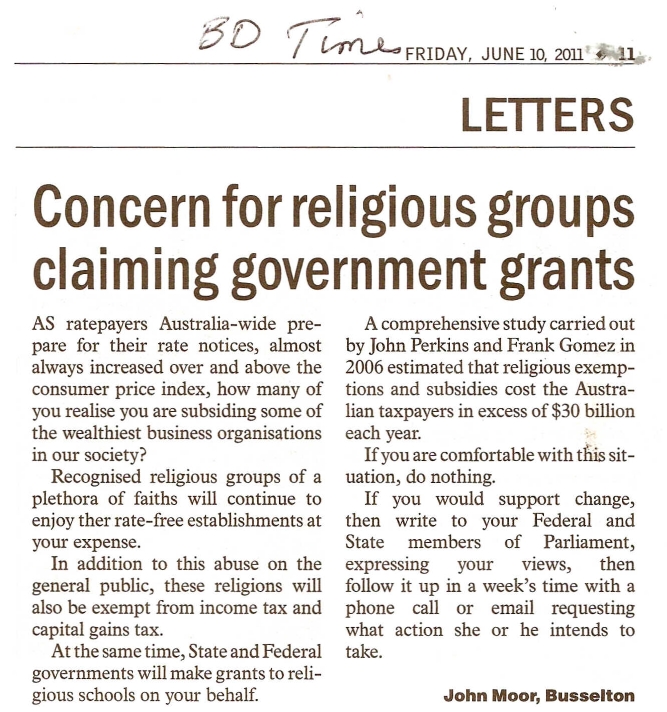
The Busselton-Dunsborough Times has published my letter in response to my neighbour John Moor’s letter last Friday (which I have attached below).
Here is my letter as published:
John Moor (Letters June 10) laments the fact that churches are exempt from some rates and taxes. These exemptions date from a time when the churches provided many services to the community that governments could not. The question to ask is whether the community is still getting good value from the churches.
In Busselton, as elsewhere, the churches use their buildings to give services unavailable elsewhere. Cliff’s Kitchen, for example, at St Mary’s Church feeds several dozen needy people each week and provides friendship and support for those doing it tough. Parenting and life-skill courses are offered at many churches. The churches make meeting rooms available to self-help groups, sometimes at no charge, sometimes for a small donation.
Read the “What’s On in the Community” column in this newspaper and ask who is paying for the services offered at our churches – it will almost always be that church.
Governments acknowledge that the churches provide many helping agencies at a cost well below that which they could manage, and actively look for more ways to out-source those services.
Many Christians would also argue that just by being there churches provide spiritual solace and challenge to the community widely beyond their memberships.
By all means, demand that your politicians withdraw the churches’ exemptions, and then be prepared for the rate rises and the tax hikes as shire and governments pick up the important services churches now offer the community.
Losing My Religion Tom Frame, Losing My Religion: Unbelief in Australia. Sydney: University of New South Wales Press, 2009
337 pages, paperback.
RRP $34.95
Tom Frame is not afraid that Australia will “lose its religion”. Not really. But he is concerned that Australian Christians will pay a high price if they do not engage in a vital conversation about belief and unbelief.
Losing my Religion has won the 2010 Christian Book of the Year prize – and deservedly so. It is not only a heartfelt plea to Christians to put energy into thinking about faith and its place in a pluralist society, but it is also a comprehensive history of the interactions between religion and the Australian community.
Dr Frame is balanced in his description of the tensions surrounding religion in the convict days on the east coast and in the lead up to the framing of the Commonwealth constitution. But where the book shines, in my opinion, is when Tom Frame teases out the contemporary scene. He takes issue with anti-theists like Richard Dawkins for their lack of respect for their opponents, but he engages with the Australian unbelievers like Philip Adams. He demonstrates respect for their view but has no fear in putting forth his own.
Dr Frame is well qualified to explore belief and unbelief. As a former bishop to the Australian forces, he has ministered at an important interface between public life and the Church. Now Director of the St Mark’s National Theological Centre in Canberra, he writes lucidly on these complex issues. He draws on some of the same materials that he used in Evolution in the Antipodes (2009), but here with different intent.
Frame teases out the thread in atheism that claims it is not a belief and therefore a guarantor of reasoned tolerance. He shows this as specious reasoning both because atheism is a belief borne out of theism and also because atheism has no monopoly on reason. The presence of religious people in secular society is therefore more likely to bring tolerance and harmony than their absence, because they can take the beliefs of others into account.
Losing My Religion will make you agree and it will make you disagree. Frame knows that keeping your religion involves being confronted by a Christ who asserts his divinity; and for all of us, believers and non-believers, when we think seriously about it, that is controversial.