The Parable


THE PARABLE


How sad the sower —
the thrower
of seed.
In bonding for ever
in life
is his need.
Yet the task
the Father asks
is to throw
Far from his heart
to death to part,
and perchance not grow.
It’s utter folly
to risk losing love
and throw life away.
Yet the melancholy
Jewish raconteur
enjoins you and me
to lose all,
and in the losing
not to know
if the prize is yours.

Ted Witham


Christ’s truth


The truth about Christ


They wanted a Christ to blaze out the Romans,
a warrior, a men amongst men, a giant.
A Christ to right all wrongs, to fight all omens,
To end all nightmares, ultimately defiant.


They wanted a Christ who was nice to people,
a yes-man, a crowd-pleaser, indiscriminately tolerant.
A Christ to suit the moment, a respectable sample,
To grace society, selectively competent.


They wanted a Christ who hated their foes,
on our side, a party man, with the vision of a tunnel.
A Christ to back our bias, who our way goes,
To be our justification, an upside-down funnel.


Jesus lives with an all-blazing love,
a heart saturated with God and endless understanding.
A cruel cross joining below with above,
To be our other side, our way to God’s landing.


© Ted Witham, 1998


Emerging Butterfly?


Peter Rollins, How (Not) to Speak of God, Paraclete Press 2006. E-Book 2012

Reviewed by

Ted Witham

The key idea of How (Not) to Speak of God is that many Christians in the “Emergent Church” movement embrace paradox. The first few chapters unpack the implicit idea in the title: that the moment we speak of God, we deny who God is. All attempts to define or describe the Christian God are doomed.

This is, of course, not a new idea, but it is unusual for evangelical Christians to push the point as hard as Rollins does. Essentially, Christians are atheists, because our God is beyond human category. At best, we can glimpse God in icons which often appear to point away from the reality of God, but which express metaphors that are self-consciously metaphors and not definitions.

Christians are defined not so much by what they believe as by how they believe; and this dynamic faith will manifest in works of mercy and restorative justice in the real world.

The second part of this encouraging book is a series of liturgies designed by the house church in the Menagerie Bar, the pub that Rollins calls his spiritual home. The themes range from Judas to Corpus Christi to Eloi Eloi Lama Sabachthani. The description of each liturgy is preceded by a reflection introducing the theme. The liturgies emphasise imagination and emotion and are described in practical detail, so that readers could use them as they are, or adapt them for their own setting.

If this is the coming, emerging church, then I would not mind belonging.

Six Complaints about “Boat-People”


Asylum seekers arrive at Christmas Island

I’ve heard many complaints about boat-people in the past few weeks, no doubt fuelled by the inflammatory statements of some politicians. Here are six of those complaints with my response to them. For each of the complaints there is,  I think, an underlying and unnecessary fear. I have listed these as well because I believe that our community will not begin to resolve these issues unless we listen intently to these fears and reassure people of our safety.

Click on the link below to open a PDF file:

6 THINGS ABOUT BOAT-PEOPLE

Killer planes and Christians


One cheer for the Americans. It is reported that a drone aeroplane killed Abu Yahya al-Libi, Al-Qaeda’s number two. Oh, and by the way, probably six other militants were killed in the same strike.

The world is probably better off without al-Libi and his like. They plot terrorist acts against Westerners, and I have no cheers for terrorists.

But our Christian moral tradition calls this extra-judicial taking of life by its proper name. It is murder. It is a violation of the sixth commandment: “You shall not kill.” It happens that my personal Christian commitment is to non-violence, and I am against all killing including killing in war and killing by the death penalty.

But I respect those who fought in wars. I think of my grandfather and the difficulty he had in re-connecting with his children after nearly three years away on the Western front. I think of my uncle Sim, his body racked with the shakes of Parkinson’s and a fragile mind, pushed to its limits by the memory of an engagement on ‘No-Man’s Land’ between trenches.

As soldiers, they were involved in killing. But they were fighting to keep our kind of society: they wanted a free society; a society where there is due process; a society where the actions of criminals are tried before punishment is pronounced.

Killing bin Laden and killing al-Libi without a trial makes a travesty of our democratic way of life. It is the behaviour not of a true democracy, but the actions of a vigilante group.  We Christians may not agree on the specifics of these targeted strikes against individuals, but we should agree on the desire for justice and the care necessary for every human being if true justice, the justice envisaged by the prophet Isaiah is to be the real experience of our society.

Do you think it was right to kill this man? And what would you say about this to President Obama if you met him … or if you decide to write to him. (Go online to http://www.whitehouse.gov/contact, or address the envelope to The White House, 1600 Pennsylvania Avenue NW, Washington, DC 20500, USA, and (from Australia) put a $2.35 stamp on it).

First posted at Dunsborough Anglican Church

A human trinity


It’s Trinity Sunday again. I regard this feast as a tipping point in the church’s year. It’s our last chance until Advent Sunday to celebrate the life of God, God’s coming in Jesus Christ, and God’s ongoing presence in Holy Spirit. From Trinity Sunday on, we turn green and turn our attention to growing in the grace of Holy Spirit.

Trinity Sunday then marks a turn from God to humanity. On Trinity Sunday, we celebrate God as Three and God as One.  We know that though God’s Threeness and Oneness may be logically incompatible, they say something important about God.

Trinity Sunday sends us back to the beginning. And for us humans, the beginning is described in Genesis 1 and 2. We humans, we are told, are made in the image of God. If God is Three and God is One, then there is also an aspect of our lives that make us a Trinity too.
Saint Augustine of Hippo
The great African Saint Augustine of Hippo taught that human beings are three in one. We are made, Augustine said, of
memory,
will, and
love.

As far as we know, human beings are the only creatures who have a past to remember. Our memories are vital to us. We often hear people say that if their house were burning down, the first thing they would rescue would be their photo albums, because ‘they contain our memories’. Our memories, we say, make us who we are.

We are also the only creatures with a sense of the future, and the knowledge that, through our  wills, we can affect the future. Our will partly determines the experiences we will have from this point on. Our will and our desires are deep parts of ourselves.

But memories can be bitter. Good times of the past can be locked up by our sinful actions. To be truly human, we need more than memories: we need love. Love will lead us to be grateful for our memories. Love will empower us to forgive and be forgiven, so that our memories will shine with goodness.

The future can be uncertain. We can be horrified that our wilful actions can turn out to be destructive. At the same time, we know how little effect our wills have on the future. We can live in fear of what is going to happen. So our will needs to be coloured by love too. Love will give us the grace to will that which is good. Love will give us the confidence to go on in faith rather than in fear.

Love is what makes us truly human. It is the jigsaw piece that fits in between our memory and our will.

In the Creed each week we make the amazing affirmation that in Jesus, God became “truly human.”.Jesus carries in him the memory of all our pasts. Through his death and resurrection, Jesus has opened up for us a future that is life and not death, glory and not shame. His love, memory and will, makes him truly human too, and makes us like God, “partakers in God’s nature”.

So let us celebrate the human trinity of memory, will and love. They are a way to God.

Ted Witham

First posted at Dunsborough Anglican Church (St George’s).

Interviewing Thomas


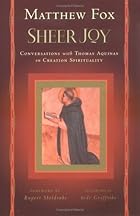
Matthew Fox, Sheer Joy, Conversations with Thomas Aquinas on Creation Spirituality,
HarperSan Francisco, 1992, 532 pages.
reviewed by Ted Witham

In 1986, I was lucky enough to spend 13 weeks with the medieval genius, Saint Thomas d’Aquino. It was by accident. Forced to choose a Church History unit in my studies, I opted for the subject with fewest dates and chronological gymnastics: Thomas Aquinas.

What a joy it was for me to shatter my image of him as a dry-as-dust scholastic theologian, concerned about angels dancing on pinheads.

Brother Thomas came alive for those 13 weeks, a spiritual companion who enlarged the view I had of faith in Christ. His personality is quirky, warm, courageous, utterly straight. He showed complete disinterest in things such as social etiquette.

Thomas was a mystic, and a genius of the order of Albert Einstein.

But after my course I found it difficult to communicate my enthusiasm for the ‘seraphic doctor’. His writings are hard work to read, and if you wish to follow through an idea, apart from the 30-40 volume set of the Summa Theologica, you really need a knowledge of medieval Church Latin. (If you are blessed with a e-Reader, you can download the complete Summa edited by the Dominicans for 99 cents.)

That is, until Matthew Fox’s Sheer Joy. Sheer Joy is a Thomas reader that aims to make Aquinas accessible to a wider audience. In Sheer Joy, Fox “interviews” Thomas, his brother in the Dominican Order (or ex-brother, as Matthew Fox is now an Anglican)! Fox puts questions to Aquinas, the answers to which are the actual words of Aquinas.

This interview format achieves three things:

* Fox can ‘ask’ 20th Century questions to reveal Aquinas’ relevance for us.
* Fox invites Thomas Aquinas to show his skill as an interactive teacher. Brother Thomas has a warmth easily submerged in long passages of translation.
* Fox displays his enthusiasm for his mentor and the reader can catch it!

As it is a selection from the writings of Aquinas, Sheer Joy is inevitably an interpretation of the master theologian’s ideas. Matthew Fox does set out to show in what ways Aquinas is a creation mystic. The themes of the four conversations (decided by Fox not Aquinas) are the movements of mystic theology: the Positive Way, the Negative Way, the Creative Way and the Integrative Way. Fox does take the risk of distorting Aquinas by placing him in an alien framework. I think, however, that the distortion is minimal. Medieval mysticism is not so alien to Thomas, who was a great poet of the Eucharist, influenced by Francis of Assisi and the medieval archetypes of the “goddess” and the “green man”. Fox also takes pains not to limit his viewpoints to modern frameworks of understanding. In any case, the words of Thomas are so powerful as to stand in their own terms.

Matthew Fox succeeds in making Brother Thomas more accessible. Don’t, however, expect an easy read. This is serious and deep stuff demanding real thought. Aquinas is not noted for levity. A brother once tried to tease Thomas by telling him that there was an ox flying outside. Thomas ran to the window. Everyone laughed. Thomas said woodenly, “I would rather believe that an ox could fly than that a friar could tell a lie.” (No wonder they nicknamed Thomas “the Dumb Ox”.)

Thomas tells it straight. He tells it straight from the heart, but through one of the most powerful intellects in the history of Western civilisation. So do persevere with Sheer Joy. It yields depths of wisdom. Thomas yearns for every Christian to draw closer to God, and his insights can light the way.

Fox brings out Aquinas’ holistic teaching about the creation, the delight that God’s love brings to all his creatures and the conscious response of love and pleasure (“sheer joy”) mortals are invited to make to God for themselves and on behalf of all creatures. This basic indwelling of God in all things and all things in God releases creativity both in God and in humanity. Desire to work with God to bring about a better world, what Fox calls ‘social justice’ and what Aquinas calls ‘perfecting’ creation, is the task of all Christians.

Fox shows that the best way to understand Thomas is primarily as a scriptural teacher, who uses philosophy only as a tool to bring contemporary meaning to the Bible. We have the false impression that Aquinas is primarily a philosophical theologian mainly because many of his Biblical commentaries have not been translated before. Fox’s translations are lively, avoiding the muddy ponderings of much previous translation.

I received two gifts from reading Sheer Joy. One was the deep love Thomas Aquinas has for the God who reveals himself in nature and the Bible, and who abides in us in the Eucharist. The second was the burning desire that others might know the embrace of that love.

The dignity of the jabiru


I saw one of these at the beach this morning. I think this type of stork is called a “jabiru”. She was almost stationary with one spidery leg held in the air ready to be replaced on the ground. She stood among sparse beach shrubs about her height in such a way that you had to search to see her even though she was in plain view. Her right eye was fixed on us humans.

The jabiru’s dignity made her appear larger than her perhaps 50 cms in height. With her left leg poised, she had all the time in the world to be herself, the monarch of her world.