Moved by Priest’s First Love


Glynn Young, Dancing Priest, Dunrobin Publishing, 2011

ISBN-13: 978-0983236351, paperback 380 pages (from $AUD14.15),
Kindle $US2.99

Reviewed by Ted Witham

I was surprised at how much this first novel moved me. The two main characters, Michael Kent and Sarah Hughes, are attractive young people who have fallen in love with each other, but who believe that Sarah’s lack of faith is keeping them apart.

Michael Kent is charismatic, an Olympic cyclist, and a theology student in Edinburgh. His life keeps turning out for the better and the better, even despite tragedy at the Olympics and other obstacles in his way. He is also good at dancing. Sarah, too, is talented as an artist, and gains recognition for her paintings late in the book.

Of course, I identified strongly with the main character: I was once a young theological student, and I once fell in love. Reading the book recaptured a lost and idealised youth.

The story is set primarily in Edinburgh, Athens and San Francisco. The sense of place was strongest in the descriptions of California and the topography of San Francisco, particularly from a cyclist’s view point. All cities, however, are exotic enough to be interesting.

Glynn Young writes about faith in a believable way, sympathetically capturing an evangelical mind-set in thought and action, and describing well the dynamics of a parish staff.

I had been so disappointed by US ‘Christian’ novels in the past, where ‘Christian’ equates to avoiding swear words and sex, but Dancing Priest is a refreshing change. Here ‘Christian’ equates to thoughtful prayer and care of others.

I had some quibbles with the Anglican aspects of this novel, the worst of which surrounded Michael’s ordination at St Paul’s cathedral in London. In most dioceses I know, the days before ordination are spent in retreat: playing tourist is a poor preparation for such a major step. (It may be that the Church of England is different precisely because it does gather candidates from all over England, some of whom may not have visited the capital). More jarring was the fact that Michael was not ordained deacon before his priestly ordination. Two-step ordination is fundamental to Anglicanism.

For the most part, however, the picture of a church that was like the real Anglican Communion, but not like it, with splits and tensions like the current ones, but not quite the same, was stimulating and entertaining.

Young’s writing has reminded another reviewer of Madeleine l’Engle, and I see the connection. But in the fresh characters, the way the plot invites the reader onwards from page to page, I was more reminded of C.S. Lewis in his Space Trilogy, only with more open emotions.

Untimely, but gentlemanly, Dying


P.D. James, Death Comes to Pemberley

London: Faber & Faber, 2011. Pback 310 pages. ISBN 9-780-57128358-3. RRP $29.99


I’ve had to have been persuaded to read Jane Austen; despite the enthusiasm of some friends for the 19th Century novelist, I have been put off by her high style and the brittle world she builds of English class distinctions at the end of the 18th Century.

I was anticipating the next police procedural of P.D. James, a modern stylist and great crime writer, and I admit to some disappointment when I read the advance publicity for Death Comes to Pemberley: an amalgam of a Jane Austen novel and a crime thriller.

Elizabeth Bennet has married Darcy and settled at Pemberley. They have two sons in the nursery and their marriage is a happy one. Each year, Pemberley Hall is the scene for a grand ball, named in honour of Darcy’s late mother, Lady Anne. Pemberley is thrown into disarray on the night before Lady Anne’s ball by the bloody death of an army officer in the estate woods. The scene needs much untangling as Wickham, a man never to be received at Pemberley is found kneeling over the body, drunk, and exclaiming that it is his fault that his friend is dead. Wickham is married to Elizabeth’s sister Lydia, and causes ongoing distress to the Darcys by living irresponsibly beyond his means. Darcy as a paterfamilias has in the past been obliged to pick up the tab.

In the subsequent investigation and trial, family loyalties are stretched to breaking point, and Pemberley looks set to be shamed for generations to come, until the final resolution, which – in Jane Austen fashion – is a set of happy outcomes for all.

James’s writing is so good that I was drawn into this complex web of family relationships and intrigue and enjoyed this novel almost as much as her other crime novels. (I don’t think she can better Death in Holy Orders – but then, I’m a priest!)

I was amused that Darcy consulted his wrist-watch and Elizabeth her bedside alarm clock: they were needed to establish times of alibis. The year in which Death Comes to Pemberley is set is 1803, well before the mass production of wrist-watches and the miniaturisation of alarm clocks. Darcy, as a gentleman, would much more likely have a pocket watch, if any time-piece on his person, and Elizabeth would more likely be used to consulting a maid who might know the time from a large hall clock. I can’t help feeling there’s a joke element here. P.D. James is too careful to have simply made a mistake.

The incongruity of the time-pieces emphasise how complete the world is that James has created. I believed her portrayal of reactions to death among the British upper-class of the time. I suspect Baroness James has some nostalgia for a time when gentlemen lived on their estates and as magistrates kept good order in the realm.

The downside to this nostalgia is that Death Comes to Pemberley lacks some of the social edge of James’s earlier novels. This has been a divertissement, and a thoroughly enjoyable one, but I do hope she returns to more modern settings if we are blessed with future novels.

Ted Witham

This Painful Life


Every minute of every day, I experience pain. People say how hard it must be, and I don’t disagree. It just is. I have experienced pain since my late teens. I recently turned 63, and the pain has really been both continuous and severe for the past 20 years.

There are days when I complain about it. Not so much the pain as the extra limits it places on my life: less mobility, so a walk on the beach turns step by step into agony. Less ability to sit, so an evening at a restaurant becomes 20 minutes before the pain just makes me, well, go home. At least in recent years, I’ve learned that I have to either pre-order, or choose a restaurant that serves me quickly.

Doctors now recognize chronic pain as a disease of the nervous system or of the brain. That’s not to say that the pain is all in the mind. Rather it points to the mis-firing of the brain’s systems for experiencing pain. In chronic pain, the nerves that bring messages of pain to the brain and the systems that interpret sensations and the brain’s own map of the body are all out of whack, like an orchestra playing out of tune and out of time.

In my case, it’s as though the brain is replaying pain from previous injury to my spine. Ghost pain messages play havoc in my brain. For other people, the ongoing pain may not relate to tissue damage at all, but it arises, a mystery with no obvious cause.

On a scale of zero to 10, where zero is no pain and 10 the worst pain imaginable, my pain sits uncomfortably around 7 most of the time. Others with chronic pain have more fluctuation.

Pain is one thing. The experience of suffering is another. Both pain and suffering are mysterious experiences. But the extent to which a person suffers from their pain is partly a choice.

Rae Scott's cover "The Secret of Mount Toolbrunup"
As a young man, I climbed Mount Toolbrunup. In W.A.’s Stirling Ranges, Toolbrunup’s the toughest climb, because loose scree covers its steep sides. You scrabble up two or three steps, often on hands and knees, and then slide back one or two. It’s exhausting. Even though you seem to make no progress, the skinned knees and knuckles don’t make you suffer. You are climbing. An interesting activity engages you, and if you lift your head high enough, you see better and better views.

Climbing Mount Toolbrunup is a bit like living with chronic pain. You scrabble along. Your way is exhausting and the pain is real. But you are engaged in something other than the effort to move along: the fascinating activity of life. If you lift your attention away from the pain, you see how absolutely captivating life is. You see people to love, usually those who love you. You see an extraordinary world full of natural and man-made marvels; planets and meerkats and the Sydney Harbour Bridge. You choose interesting activities, reading, watching movies and setting crossword puzzles are some I choose. Life is there to be lived.

Or you can choose to suffer. Chronic pain is different from many illnesses. If you break a leg, it gets better. If you have diabetes, you can take insulin. There are pain pills, but they don’t always work. Meditation and exercise form the best base treatment for chronic pain, but note: you have to work at them. You have to choose.

The pain is unrelenting. I have many strategies to keep me sane, even cheerful. I don’t underestimate the climb. Researchers have found, for example, that chronic pain is experienced in the same region of the brain as depression. For many people ongoing pain and deep depression go hand in hand. It’s easy to slip into the chasm of depression, and I have once or twice.

But in the end, I choose. I choose to minimise the pain and limitations, and as well as I can, I choose not to suffer. The view’s great.

Mount Toolbrunup

Meat and Right for Lent


We Believe

Meat and Right for Lent

John Warner, We Believe: studies in the Nicene Creed, Perth: John Warner, 2011
(available from St John’s Books, Fremantle)
68 pages, A4 paperback

Reviewed by Ted Witham

The Rev’d John Warner believes that “Christians should say what they mean and mean what they say”. The question raised by these substantial Lenten studies is whether most Anglicans do have a spiritual and intellectual grasp on the Nicene Creed, or whether we rattle it off Sunday by Sunday unheeding of its meaning.

One school of thought says that we don’t need to understand all the philosophical ramifications of our central statement of faith. It is expressed in the philosophical categories of the 3rd Century, not in a contemporary framework, so we should recite the Creed believing that we believe the same things about God as Christians did 1,700 years ago. There is a grain of truth in this, but if we rely on it as a reason for not trying to understand the Creed better, then Fr Warner would say we are guilty of hypocrisy – not to mention sloth.

Fr Warner divides the Creed into 30 days collected into 5 sections of various lengths. At the end of each section is a series of discussion starters. The sections are traditional — Belief in: God the Father, God the Son, the saving work of Jesus, God the Holy Spirit, and The Church and the Last Things.

The teaching for each day is both solid and solidly orthodox: meat and right for Lent. The teaching is seasoned with some helpful analogies, metaphors and anecdotes. Fr Warner is aiming to reach thoughtful parishioners, though some readers may need a little encouragement and support to get the most of out the materials.

(On a personal note, I was Associate Priest in Claremont parish when John was Rector. We have worked together in study groups and in Education for Ministry (EfM), so I am accustomed to John’s teaching style.)

The five sets of discussion starters will stimulate worthwhile discussion both on the intellectual understanding of the Creed and on the practical and spiritual implications for life in the Church. I would have preferred more discussion starters and more guidance on how best to use these materials in a group, but restricting the amount of questions will keep group participants focused on the Creed.

There are too few educational materials directing us to know and understand the central teachings of our faith. John Warner’s new studies fill a real need. I hope many parishes will want to use them this Lent.

36 Years a Priest


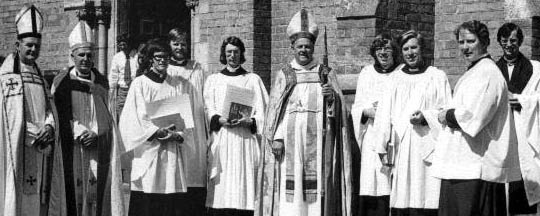
Ordination of deacons 1975 - Diocese of Perth

In the year 1975, November 30 was also Advent Sunday; and that’s not the only reason that Feast of St Andrew was a red-letter day. Along with fellow-deacons Len Firth, Chris Albany and Peter McArthur, I was ordained to the priesthood by Archbishop Geoffrey Sambell in St George’s Cathedral in Perth.

This year, 2011, 36 years, is not a special anniversary, but like all the other occurrences of November 30, it is significant to me.

Underlying a wide range of ministry activities since that day my identity as priest has flavoured and conditioned everything I do. My prayer was – and is – that my priestly identity gives glory to God and serves God’s people well.

I started my ministry as a locum parish priest, but moved quickly into school chaplaincy. In those early years, I believed that the harder I worked the more effective my ministry. I say now with shame that at Christ Church Grammar School, I worked 90 hours a week and neglected my small children. My picture of ministry was that if I put in the majority effort, God would top it up to achieve God’s aims.

Despite my folly, I recognise that God did work through me. I just over-estimated the value of my contribution!

A key date in my life as a priest is March 11, 1992: the ordination to the priesthood in Australia of the first women. I participated as a priest of the diocese, and remember my eyes welling with tears at the conclusion of the rite of ordination. The applause lasted more than five minutes – you can check the duration on recordings of the event – and while the prime focus was on the nine women and one man ordained, I felt a strong sense that my priestly identity was completed.

Firstly, and most obviously, the number of potential colleagues in priestly ministry doubled on that day. The team, or at least the team positions, had grown by 100%. I gave thanks to God that God’s church was no longer persisting in ignoring the talents of half the human race, and probably 70% of the Anglican race! The presence of women in our collegiality meant that new sorts of collaboration could take place.

Secondly, ordaining women affirmed me. I had learned (first from the holy bishop Brian Macdonald) that Jesus exercised the feminine part of his personality, and was able to do that as a man secure in his masculinity. Ordaining women gave me permission to make available in a conscious way for ministry the feminine side of my personality.

This helped me to see, first in practical terms, the importance of being a human being. There was no sin in taking time for myself, and there certainly was no blame in giving real priority to my wife and family. Being present as a husband and father was good ministry in itself!

Beyond that, the ordination of women has helped me to practise more effectively the priority of being over doing. It has helped me undo some of my social conditioning as a man whose job is to get things done.

As ill health forces me to be less active, especially in specifically priestly ministry, I now found I need to draw more fully on the principle that my priesthood is primarily about being. Being present to my wife and family; being present in my community; being present (as much as I can) in my parish. These are the ways, please God, I will continue to give glory to God and serve God’s people well.

Matching Abilities to the Tasks of God’s People


Sermon 6 November 2011

St Mary’s Busselton

Shaped 2011: A (Abilities)
Readings:
Exodus 35:30 – 36:3
Psalm 18:30-37
I Corinthians 3:5-15

The Holy Gospel of our Lord Jesus Christ according to St Matthew, the eleventh chapter, beginning at verse 28:
Glory to you, Lord Jesus Christ.
28 Come to me, all who labour and are heavy laden, and I will give you rest. 29 Take my yoke upon you, and learn from me, for I am gentle and lowly in heart, and you will find rest for your souls. 30 For my yoke is easy, and my burden is light.”
For the Gospel of the Lord:
Praise to you, Lord Jesus Christ.

At different times in the history of God’s people, there has been a task. For the people of Israel settling in the city of Jerusalem, the task was to build a temple. Before that, in the civil war that tore Israel apart for many years, the task was for David to survive and to defeat Saul. In the years after the death and resurrection of Jesus the task for God’s people was to spread the Good News that Jesus rising from the dead had made a difference.

Each of the tasks required God’s people to get on board, to offer themselves for the task, to work to implement God’s will. God invites us to share in the work that God is doing. Many of the tasks set for God’s people, perhaps most of the tasks, are beyond the capacity of human beings. But the story of God’s people shows us again and again that God equips God’s people to carry out these tasks.

Expert jewellers and fine craftsman were required to finish off the Temple. They were called, empowered by the Holy Spirit, and commissioned for the task. The final product – the first Temple of Solomon – was extraordinary. Bishop Gregory of Tours listed it as one of the Seven Wonders of the Ancient World. Bezalel and Oholiab and the other craftsmen evidently did their job well!

Solomon's Temple

Before there could be a capital city for David, there had to be a peace settlement. David rebelled against King Saul, and spent twenty years waging guerrilla war against Saul. I find East Timor an intriguing parallel, because José Ramos Horta and Xanana Gusmao, who both started out as theological students, compared their guerrilla war with that of David against Saul. Gusmao modelled himself directly on David, describing himself as a poet-warrior like his hero.

Xanana Gusmao

For guerrilla war, you need warriors, and not just any warriors but warriors equipped for a dirty war in the harsh terrain of Palestine: warriors with the agility of mountain goats and deer; warriors trained to wait on a higher rock and pounce from above on their enemy; warriors who could handle the crossbow, the most high-tech weapon of the time; warriors who could outrun their enemies with sure footing on slippery, winding paths.

I’m not sorry that God’s people don’t need warriors now. The idea is repugnant to our era. But they needed them then, and God, through David, called them, equipped them and used them.

Paul knew that God’s message of risen love needed messengers to tell it, and we can pick this attitude out from the messy controversy that Apollos seems to have caused. You don’t need to take sides: I’m with Paul; I’m with Apollos. What you do need are more messengers. And although we now don’t know the whole context, Paul is calling for specialisation. If he has built the foundation, they now needed some messengers to consolidate those foundations, others to build on them, others to take them further afield.

These are just some of the Biblical accounts of how God’s people challenged with a task found that God raised up and equipped people with the right abilities.

You know that I am a fan of St Francis of Assisi. St Francis was born into a Europe that was changing. Trade was bringing into existence the first Eurozone. As a boy, Francis travelled with his father on trips from Assisi in central Italy across the Alps into France to buy cloth. In Francis’ time, cash money – coins – was just becoming the currency of choice. St Francis noted, for example, that the wealthy held onto the first-rate coins and the poor tended to have the poorly minted coins which lost their value. The rich could become richer, and the poor even more destitute.

St Francis marries Lady Poverty

The task for God’s people was to challenge this greed, and St Francis, with his radical message of voluntary poverty had the particular abilities needed for this task. I think if St Francis were alive today he would have been occupying Wall Street. He would have understood how greed distorted the money system and unjust men could rip off others. But notice a crucial difference: the means by which the bankers have been ripping off the poor in America is by sub-prime lending. St Francis would probably not be the man to confront today’s task of calling out greed; someone else whose abilities are related to today’s injustices is being called and equipped and commissioned for the task of God’s people. No doubt St Francis would be a great inspiration for that person.

During World War II, God’s people were called on to resist Nazism. This task split the Lutheran church and caused great tensions in the Roman Catholic Church, which are still there today. Was Pope Pius XII hero or collaborator?

The Lutheran theologian Dietrich Bonhoeffer found himself with the abilities needed to resist Hitler. He first challenged the myth of the superior Aryan by nurturing a non-violent community in his underground theological seminary at Finkenwalde. He was involved in two plots to kill Hitler, and we might debate whether he was morally right to go down this path. He was imprisoned and hanged a month before the capitulation of the Nazis.

What can’t be debated is the mix of skills and background that Bonhoeffer brought to the task. He was a fine theologian; his family were the cream of Berlin society with all the connections that implied; he was articulate in person and in writing and a man of courage.

Pastor Bonhoeffer

In the series of SHAPED 2011, we are today at the letter ‘A’ for ‘Abilities’. You remember that we started two weeks ago with ‘S’ for ‘Spiritual Gifts’. The foundational fact is that we are loved by God. This is the most basic spiritual gift. Being loved means we know that we are worthwhile, that God can use us to work with him. Being loved enlarges our capacity in turn to love others. We are given a heart for God’s work. Last week’s word was ‘H’ for ‘Heart’ or ‘Passion’.

David, St Paul, St Francis of Assisi and Dietrich Bonhoeffer are all mighty examples of people who knew how deeply God loved them, and who responded with heart and passion to that love. We will see next week under the letter ‘P’ for ‘Personality’ that God used people’s unique personality to set about his plans. Each of us has a unique combination of talents and potentials. No one is like you, and it is precisely your uniqueness that God uses.

For this week, however, our focus on ‘A’ for ‘Abilities’ is an encouragement that God provides the abilities needed for the tasks of God’s people. All the talent this congregation needs to perform the tasks God asks of us is here.

Some questions for you to ruminate on then: what are the tasks of mission God is calling St Mary’s Busselton to? What talents, skills, platform – abilities – are needed to carry out these tasks? Do some of these abilities seem too hard for the people God has on hand? And what are the talents you bring? What are the abilities God will find in you to foster and encourage and use for God’s glory?

Let us pray:
Loving God, you give to those ask the ability to carry out the tasks that you have set your people: Give us insight, we pray, to know what mission you are calling this parish to.
Show us the abilities needed to fulfil this mission.
Stir our hearts to ask you for the abilities we need,
and give us the courage and confidence to use those abilities in your service,
through Jesus Christ our Lord.
AMEN.

No deal on debts


The most ferocious parable Jesus told was one about two debtors. The lord calls in the first of the debtors, who owed a colossal sum, and demands he pay up. He threatens to thrown the slave in prison and enslave his family. The slave begs for mercy, for time to pay. The lord has compassion on him, and gives him more than time to pay: he forgives the debt and released him.

This forgiven slave then leaves the lord’s presence and meets a fellow-slave who owes him a much smaller debt. He throttles him and demands immediate payment. The fellow-slave falls to his knees and begs for mercy. The first slave refuses to respond. When the lord finds out how the forgiven slave has behaved, he reverses his generosity and has him tortured until he repays everything he owed.

‘And so,’ concludes Jesus, ‘will my heavenly Father do to you if each of you does not forgive brother or sister from the heart.’ (Matthew 18:35)

Kenneth Bailey describes the economic back story. In each village in the Middle East a principal landowner controlled all the cropping and grazing in the village. This abu or sheikh was like a feudal lord. Every aspect of economic life in the village derived from the sheikh.

Jesus makes first a comparison between this village economy and the economy of God. The lord in the story demonstrates a generosity that goes far beyond justice when he ignores the request for time to pay, and instead releases his servant and forgives the debt. This lord is not behaving as a prudent sheikh would behave. A prudent sheikh would be generous by making a deal. This lord reveals instead the divine generosity, which gives total freedom to those who seek it.

The expectation is that those who are graced with freedom should reveal the same generosity in dealing with others. The forgiven slave in the parable acts in the opposite manner than the lord expects and so receives the worst punishment the lord can inflict on him.

But as in the challenging parable of the dishonest steward, Jesus foregrounds the absolute generosity of the lord, the sheikh of the village and not so much the behaviour of the servants. Can you imagine the sheikh of your village forgiving the debt absolutely? If so, can you imagine a little of the extraordinary generosity of the divine economy? Once you start to get this picture of God you can begin to participate in the generous economy.

Imagine if we treated our sister or brother not simply with justice, but by releasing everyone from all the claims we might make on them. Our village, our community, would be marked by a wonderful freedom and genuine intimacy one with another.

At its best, we can glimpse this divine economy at work in our church and even in other communities.

But this parable holds up a mirror to the messy world of commerce as well as God’s economy.

Jesus’ attention is caught by the differential between the first and second slaves. The first slave owed his lord ten thousand talents. My Bible notes that a talent was equal to 6,000 denarii. One talent is what a labourer could earn in 6,000 days. The debt, 10,000 times 6,000 denarii, is in the order of eight billion dollars in contemporary money. Let’s not forget that this is a parable, and there is an element of exaggeration, but even so, the money owed by this slave is tying up at least the economic operation of this village, or more. The Gross National Income of our neighbour East Timor is only 2½ billion dollars.

Jesus contrasts this figure with the debt of the other slave: 100 denarii. This is about $14,000. It is not a trifle for someone who might earn only 300 denarii a year, but it’s a possible debt. The sort of debt I know people have on the credit card or in car finance. If I owed $14,000 and was asked for immediate payment, I could make it, but with difficulty.

Note the contrast in the debt: billions to hundreds. The economy of a nation contrasted with the economy of a small household. The first slave owed six hundred thousand times what the second slave owed.

This differential rings bells: the Institute for Policy Studies says that CEO’s are paid 340 times the average worker in 2011, compared to 42-1 in 1980. (The Institute calls itself a ‘progressive think-tank’, which probably means that is to the left politically, but its figures are compelling.)

Jesus understands the economic system where the sheikh holds the life of every villager in his hands. Everything is the ultimately the sheikh’s gift, and villagers can suffer enormously under greedy or incompetent village management. But surprisingly, Jesus does not criticise the system. His fierce words are for those whose greed exploits the system whatever it is, for those who feel entitled to hundreds of thousands times more resources than his fellow-citizens.

The system, Jesus seems to say, may evolve and repair itself slowly. But whatever the system the urgent wrong to right is the exploitation by the rich of the poor.

The system itself will reward greed: what is asked of us is to express our moral outrage that people feel so entitled.

In the end, Jesus does suggest a subversion of the system: rather than make generous deals with debtors, debts should be forgiven so that no member of the community is beholden to another. The existence of power of one brother or sister over another especially through indebtedness threatens the free functioning of a just and loving community.

We are challenged to make sure that we do not have claims over other people’s lives. Are there debts we can forgive? If there are we should forgive them now. Do we hold a sense of entitlement to things that should belong to all? What does it mean that I can live modestly on $30,000 a year and over a billion of my brothers and sisters are struggling to live on less than $2 a day? How can I let go of that claim?

When the parable is held up as a mirror to the messy world of commerce, these are some of the questions that are revealed. The big question is: How do we parallel the generosity of God?

Jesus tells the parable of the two debtors

Christian power: an oxymoron?


Yesterday the residents’ association of our village held elections. There was quite a tussle over the position of Chairman of the Social Committee, with arguments about the Constitution and fights about procedure. The sub-text was reasonably easy to discern: two strong people clashing and both leading with their shadows!

This made me reflect on the nature of power in Christian communities. You can’t avoid the reality of power and it usually plays out in the dance between leader and community.

When St Benedict wrote his Rule – or re-wrote that of the Master – he envisaged the Abbot as God for the monks. They owed him total obedience and he was elected for life. His absolute power was balanced by the requirement that he act to further the needs of the community.

The Rule of St Benedict

Benedictine communities could become dysfunctional. When they did, some believed it was because of the lifelong dictatorship of the Abbot. When St Francis of Assisi in the 12th Century, some four hundred years later, came to set out his ideal community, he made sure that its leaders had limited terms. When they had finished as leader, they went back to being a little brother again. Franciscan leaders are called Ministers, and their focus is to serve their brothers and sisters. Power, for St Francis, was exercised always by giving it away.

The downside of Franciscan leadership is that it can be chaotic, and when Franciscan communities are dysfunctional, it often manifests in fights that no-one has the authority to resolve.

Roger Shutz arrived in France from Switzerland during World War 2 looking for a site near Lyon to establish a community of reconciliation. By 1945, the community at Taizé was working, with Brother Roger as its founding Prior. Leadership, for him, was that of Prior, first among equals. He was evidently aware of the shortcomings of both Benedictine and mendicant leadership, and his Rule shows a new emphasis. Not only should the Prior consult with the majority of the community, but should also pay special attention to those in the community without power: the young, the voiceless, the marginalised, and allow those voices to be celebrated and followed.

Brother Roger’s style of leadership resonates well with our era. Its downside is that it requires a great gift of discernment to hear the voice of Christ when it is not the voice of mainstream members of the Christian community.

I beleive that the heritage of Christian leadership has much to teach us. We are, we claim, the Body of Christ, and the way in which we exercise power should reflect Christ’s way of power.

Brother Roger

Firstly, Benedict teaches us power is for the community more than the individual. Francis teaches us that power becomes oppression when it is held for oneself. Roger of Taizé reminds us of the ways the Bible holds up the little one.

These styles of exercising power can be seen in parishes and all Christian communities. There are some parishes where the priest is Father, and Father knows best what is in the interest of his parish. Father initiates people in Christian faith, particularly in the sacrament of baptism, and Father prevents the nasty nature of some people from dominating the parish agenda.

Other leaders are very conscious that their time in the parish is temporary. The minister is there to coach the ministries that were there before she came and will continue after she leaves. She is an enabler, and an encourager, and above all, she models the way in which Christ gave away his power to others.

In other parishes, the smallest member is heard. Children are on worship committees, clients of the soup kitchen design the ministry for the hungry, and the majority give way to the smallest voice with grace and gratitude that in them they have heard the voice of Christ.

Of course,no parish is purely one or the other of these leadership styles. But I hold them up like this partly as a warning that each can be dysfunctional. If we know that Abbots can become dictators, Ministers can be disengaged, and Priors can so honour the voice of the little one that they desert the way of common sense.

Power can spoil any community, and understanding how it works in the Body of Christ can lead to vibrant community living.

Spitting at capitalists


Tax and God
Calls to destroy capitalism and boycott Facebook and Google resonate well with Franciscans. They are a way of dealing with our anger at the greed of corporations and the selling of our personal lives to advertisers. My Facebook wall is filled with slogans against this consumerist plague.

But slogans are not an effective way to critique capitalism. Slogans have no hope of achieving their purpose, because capitalism is so entrenched that its power permeates everything we do. Our slogans will simply accrue to capitalism’s benefit as we use Google or Facebook to shout them. Religion scholar George Gonzalez puts it this way, ‘Capitalism buys and sells futures and shares in the ideas of its own enemies.’

A more thoughtful response will admit the value of capitalism. In the 19th Century, wealthy Christians wanted to respond to the growing urban poverty, and used the new technologies of the industrial revolution to raise many out of poverty into respectable working lives. They poured money into enterprises that not only gave workers the financial means to house and feed their families, but gave them consumer goods, infrastructure like electric lighting, and the sense of well-being that only meaningful work can supply.

The surplus money generated recycled into this system, and most of us in the West have seen the final results of this Christian endeavour in our living standards. Think of the difference in housing, consumer goods, entertainment, and communications in the last fifty years. These are the fruits of capitalism, and few of us protesting its evils are willing to give them up.

In the urbanisation of India and China today, we are seeing millions being lifted out of poverty annually, as the benefits of capitalism trickle down.

When I was young my parents taught me that I should always spend real money that I had actually had earned or owned. I should restrict debt to buying a house, and I should ensure that any shares I owned were shares in real life productive industries.

A rule of thumb current in the sixties was that CEOs should earn no more than four times the wage of their lowest paid employee, and that virtuous companies produced useful goods or provided useful services.

Most people failed to acknowledge the importance of the creative tension between unions and bosses. For this system to work at all the employers need to insist on making a profit to continue the operation of the industry, and the workers’ associations need also to insist that workers are paid fairly and that conditions uphold human dignity.

This ‘modest capitalism’ works. I am neither Calvinist nor conservative, and I believe, for example, that relying on the ‘trickle down’ effect is an abrogation of responsibility, but I understand that this system has its value and should not be easily abandoned. What makes me angry is the distortion of this system. We know the symptoms:

1. Executives paid thousands of times more than their lowest paid employee.
2. People exposed to risk through virtual money, derivatives and futures which relate to nothing in the real world.
3. The commodification of human beings to be sold by giant corporations to advertisers.

These expressions of greed should be condemned, but slogans are not sufficient. We need to understand more fully how the system we have inherited actually works and to thoughtfully articulate good reasons why these practices despoil the vulnerable and destroy our community.

I submit that the responsibility of Franciscans (who are called to be sensitive to the use and abuse of money) is to grow in their understanding of economics, to be real about how capitalism lifts people out of poverty, and from that position of understanding articulate their critique of greed.

Planks and Splinters


Wood shaving lodged in a man’s eye as he sawed.
It hurt, looked nasty, might be infected.
His mate drove him to the emergency ward
of the Royal Hospital to have it inspected.

The triage nurse made the doctor race.
He arrived – and obvious for all to spy –
A railway sleeper protruded from his face,
Embedded deeply in his left eye.

He stretched to help the patient – but in vain he tried.
The plank was longer than his reaching finger.
He had no binocular vision to guide
Tweezers and needles to the splinter.

The plank, buried deeply in his skull,
Had also caused massive brain haemorrhage.
The doctor was totally dull,
Not knowing his capacity to damage.

Grotesque metaphor, slapstick simile.
It rivals the Doug¯Anthony¯All¯Stars.
The Jewish clown claimed our refusal to see
Our plank in their splinters seriously mars.

Ted Witham 1996

Published in Studio: A Journal of Christians Writing