36 Years a Priest


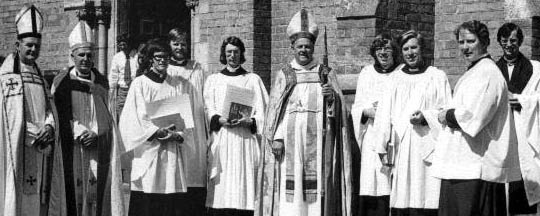
Ordination of deacons 1975 - Diocese of Perth

In the year 1975, November 30 was also Advent Sunday; and that’s not the only reason that Feast of St Andrew was a red-letter day. Along with fellow-deacons Len Firth, Chris Albany and Peter McArthur, I was ordained to the priesthood by Archbishop Geoffrey Sambell in St George’s Cathedral in Perth.

This year, 2011, 36 years, is not a special anniversary, but like all the other occurrences of November 30, it is significant to me.

Underlying a wide range of ministry activities since that day my identity as priest has flavoured and conditioned everything I do. My prayer was – and is – that my priestly identity gives glory to God and serves God’s people well.

I started my ministry as a locum parish priest, but moved quickly into school chaplaincy. In those early years, I believed that the harder I worked the more effective my ministry. I say now with shame that at Christ Church Grammar School, I worked 90 hours a week and neglected my small children. My picture of ministry was that if I put in the majority effort, God would top it up to achieve God’s aims.

Despite my folly, I recognise that God did work through me. I just over-estimated the value of my contribution!

A key date in my life as a priest is March 11, 1992: the ordination to the priesthood in Australia of the first women. I participated as a priest of the diocese, and remember my eyes welling with tears at the conclusion of the rite of ordination. The applause lasted more than five minutes – you can check the duration on recordings of the event – and while the prime focus was on the nine women and one man ordained, I felt a strong sense that my priestly identity was completed.

Firstly, and most obviously, the number of potential colleagues in priestly ministry doubled on that day. The team, or at least the team positions, had grown by 100%. I gave thanks to God that God’s church was no longer persisting in ignoring the talents of half the human race, and probably 70% of the Anglican race! The presence of women in our collegiality meant that new sorts of collaboration could take place.

Secondly, ordaining women affirmed me. I had learned (first from the holy bishop Brian Macdonald) that Jesus exercised the feminine part of his personality, and was able to do that as a man secure in his masculinity. Ordaining women gave me permission to make available in a conscious way for ministry the feminine side of my personality.

This helped me to see, first in practical terms, the importance of being a human being. There was no sin in taking time for myself, and there certainly was no blame in giving real priority to my wife and family. Being present as a husband and father was good ministry in itself!

Beyond that, the ordination of women has helped me to practise more effectively the priority of being over doing. It has helped me undo some of my social conditioning as a man whose job is to get things done.

As ill health forces me to be less active, especially in specifically priestly ministry, I now found I need to draw more fully on the principle that my priesthood is primarily about being. Being present to my wife and family; being present in my community; being present (as much as I can) in my parish. These are the ways, please God, I will continue to give glory to God and serve God’s people well.

No deal on debts


The most ferocious parable Jesus told was one about two debtors. The lord calls in the first of the debtors, who owed a colossal sum, and demands he pay up. He threatens to thrown the slave in prison and enslave his family. The slave begs for mercy, for time to pay. The lord has compassion on him, and gives him more than time to pay: he forgives the debt and released him.

This forgiven slave then leaves the lord’s presence and meets a fellow-slave who owes him a much smaller debt. He throttles him and demands immediate payment. The fellow-slave falls to his knees and begs for mercy. The first slave refuses to respond. When the lord finds out how the forgiven slave has behaved, he reverses his generosity and has him tortured until he repays everything he owed.

‘And so,’ concludes Jesus, ‘will my heavenly Father do to you if each of you does not forgive brother or sister from the heart.’ (Matthew 18:35)

Kenneth Bailey describes the economic back story. In each village in the Middle East a principal landowner controlled all the cropping and grazing in the village. This abu or sheikh was like a feudal lord. Every aspect of economic life in the village derived from the sheikh.

Jesus makes first a comparison between this village economy and the economy of God. The lord in the story demonstrates a generosity that goes far beyond justice when he ignores the request for time to pay, and instead releases his servant and forgives the debt. This lord is not behaving as a prudent sheikh would behave. A prudent sheikh would be generous by making a deal. This lord reveals instead the divine generosity, which gives total freedom to those who seek it.

The expectation is that those who are graced with freedom should reveal the same generosity in dealing with others. The forgiven slave in the parable acts in the opposite manner than the lord expects and so receives the worst punishment the lord can inflict on him.

But as in the challenging parable of the dishonest steward, Jesus foregrounds the absolute generosity of the lord, the sheikh of the village and not so much the behaviour of the servants. Can you imagine the sheikh of your village forgiving the debt absolutely? If so, can you imagine a little of the extraordinary generosity of the divine economy? Once you start to get this picture of God you can begin to participate in the generous economy.

Imagine if we treated our sister or brother not simply with justice, but by releasing everyone from all the claims we might make on them. Our village, our community, would be marked by a wonderful freedom and genuine intimacy one with another.

At its best, we can glimpse this divine economy at work in our church and even in other communities.

But this parable holds up a mirror to the messy world of commerce as well as God’s economy.

Jesus’ attention is caught by the differential between the first and second slaves. The first slave owed his lord ten thousand talents. My Bible notes that a talent was equal to 6,000 denarii. One talent is what a labourer could earn in 6,000 days. The debt, 10,000 times 6,000 denarii, is in the order of eight billion dollars in contemporary money. Let’s not forget that this is a parable, and there is an element of exaggeration, but even so, the money owed by this slave is tying up at least the economic operation of this village, or more. The Gross National Income of our neighbour East Timor is only 2½ billion dollars.

Jesus contrasts this figure with the debt of the other slave: 100 denarii. This is about $14,000. It is not a trifle for someone who might earn only 300 denarii a year, but it’s a possible debt. The sort of debt I know people have on the credit card or in car finance. If I owed $14,000 and was asked for immediate payment, I could make it, but with difficulty.

Note the contrast in the debt: billions to hundreds. The economy of a nation contrasted with the economy of a small household. The first slave owed six hundred thousand times what the second slave owed.

This differential rings bells: the Institute for Policy Studies says that CEO’s are paid 340 times the average worker in 2011, compared to 42-1 in 1980. (The Institute calls itself a ‘progressive think-tank’, which probably means that is to the left politically, but its figures are compelling.)

Jesus understands the economic system where the sheikh holds the life of every villager in his hands. Everything is the ultimately the sheikh’s gift, and villagers can suffer enormously under greedy or incompetent village management. But surprisingly, Jesus does not criticise the system. His fierce words are for those whose greed exploits the system whatever it is, for those who feel entitled to hundreds of thousands times more resources than his fellow-citizens.

The system, Jesus seems to say, may evolve and repair itself slowly. But whatever the system the urgent wrong to right is the exploitation by the rich of the poor.

The system itself will reward greed: what is asked of us is to express our moral outrage that people feel so entitled.

In the end, Jesus does suggest a subversion of the system: rather than make generous deals with debtors, debts should be forgiven so that no member of the community is beholden to another. The existence of power of one brother or sister over another especially through indebtedness threatens the free functioning of a just and loving community.

We are challenged to make sure that we do not have claims over other people’s lives. Are there debts we can forgive? If there are we should forgive them now. Do we hold a sense of entitlement to things that should belong to all? What does it mean that I can live modestly on $30,000 a year and over a billion of my brothers and sisters are struggling to live on less than $2 a day? How can I let go of that claim?

When the parable is held up as a mirror to the messy world of commerce, these are some of the questions that are revealed. The big question is: How do we parallel the generosity of God?

Jesus tells the parable of the two debtors

Really Living After Death


One toxic idea that has seeped into Christianity is the belief that individuals survive death. This cane-toad of an idea has been introduced into the Christian faith either in its Greek form of the immortality of the soul, or in its post-Enlightenment guise of individual personalities somehow living on after death.

These ideas poison by setting our hopes too low. They arise from a careless reading of scripture and impoverished imagining of God’s cosmos. I am certain that the doctrine of the resurrection of the dead has a great deal more life than pallid ideas of “me going to heaven”.

To reduce life after death to individual survival fails to do justice to the concept. Atheists like Richard Dawkins mock Christians for believing that I should survive death in some way and their objections have traction. Given our present time-bound experience of life, we have to ask:
• What would we do after death?
• How would we endure the boredom?
• What would it mean, if anything, to meet our loved ones after death?

There must be more to it than simple survival.

Paul tells us that we are “in Christ”. According to St John being in Christ is having “life more abundant.” (John 10:10) Life in Christ is attaining “to maturity, to the measure of the full stature of Christ.” (Ephesians 4:13)

As individuals, we are cherished in Christ, and because Christ is eternal, then we too are eternal. But these New Testament ideas of more abundant life measuring up to the life of Christ show that we are the best that we can be not as atomised individuals but when we reach out to others and transcend our ego, our selfish nature.

Maturity in Christ means being more than just oneself. The next step in the development of human beings towards maturity is to stop being an inward-looking “I” and start becoming a functioning “we”. After death we lose our precious “self” and are caught up in the greater reality of humanity.

In Christ and Time, 20th-century Lutheran scholar Oscar Cullmann traces St Paul’s thinking on what impact Christ’s death and resurrection has on our own. He sees Paul begin with “primitive” ideas in I Thessalonians of being “caught up in the air… to meet the Lord” (v. 22) and developing into the more sophisticated “resurrection body” in I Corinthians 15.

Note what Paul actually writes: “we will be caught up”. The plural is used. “All will be made alive in Christ” (I Cor.15:22). We usually read these passages with post-Enlightenment eyes and so fail to see the significance of the plural.

To me, it indicates that our real life in Christ now is corporate: as his Body, We have glimpses of the love and unity that Jesus experiences with the Father (John 16, especially v.20). This oneness with each other and with God is the principal promise of the New Testament.

We can imagine different scenarios in which this promise will be fulfilled, all of them with far greater potential than individuals living for ever one way or another. Whatever we imagine resurrection to mean, however, it will be better than our imagination. Paul, paraphrasing Isaiah 64:4, assures us that “What no eye has seen, nor ear heard, nor the human heart conceived … God has prepared for those who love him.” (I Corinthians 2:9)

Vine and branches: one life

Franciscans in ship-wreck


FRANCISCANS DISCOVER HOPKINS
5. THE WRECK OF THE DEUTSCHLAND

The Deutshland foundered in a severe storm in the North Sea. All on board were drowned. Far away in Wales, Hopkins was deeply moved by this ship-wreck, and began to compose a long poem about it.

Hopkins was particularly saddened by the loss of five Franciscan nuns on their way to mission. In the poem, Hopkins explores the issues of ‘theodicy‘, the problem of a loving God in a world where things goes wrong.

Hopkins asks why God lets bad things happen to people in general, and in particular, he asks why God would call the Franciscan sisters to a mission and then cut their lives off. He describes their death as an instance of the stigmata like their father Francis’.

In this poem, Hopkins has no answers to the questions raised in theodicy, but he affirms God’s huge power and the tragedy of the ship-wreck.

The whole poem is 280 lines long. I have chosen the three stanzas about the Franciscan sisters.

22
Five! the finding & sake
And cipher of suffering Christ.
Mark, the mark is of man’s make
And the word of it Sacrificed.
But he scores it in scarlet himself on his own bespoken,
Before-time-taken, dearest prizèd & priced —
Stigma, signal, cinquefoil token
For lettering of the lamb’s fleece, ruddying of the rose-flake.

23
Joy fall to thee, father Francis,
Drawn to the life that died;
With the gnarls of the nails in thee, niche of the lance, his
Lovescape crucified
And seal of his seraph-arrival! & these thy daughters
And five-livèd & leavèd favour & pride,
Are sisterly sealed in wild waters,
To bathe in his fall-gold mercies, to breathe in his all-fire glances.

24
Away in the loveable west,
On a pastoral forehead of Wales,
I was under a roof here, I was at rest,
And they the prey of the gales;
She to the black-about air, to the breaker, the thickly
Falling flakes, to the throng that catches and quails
Was calling “O Christ, Christ, come quickly”:
The cross to her she calls Christ to her, christens her wildworst Best.

Hopkins uses Duns Scotus’ treasure


FRANCISCANS DISCOVER HOPKINS
5. The Franciscan idea of inscape

Hopkins liked Dun Scotus’ idea of haecceitas, but it was too abstract for him to use directly for his poetry. He took the idea of landscape, the way an artist arranges the exterior world and chooses colours, composition and frame to express herself.

Hopkins’ revolutionary idea of inscape was the interior verson of landscape. The poet asks a ‘thing’ to reveal its soul and then finds words to express that spirit.

On his daily walks, Hopkins filled his notebooks with sketches of inscape, phrases and words that described the essence at the heart of what he saw.

Concept of inscape
1. Based on knowing the haecceitas of a thing (“thing” was the word Hopkins used – again it means creature whether animate or inanimate, conscious or not.)
2. A thing’s inscape was firstly what is like within: its spirit or spirituality.
3. Inscape has secondly an aesthetic quality. What expresses the beauty of its inner spirit? How can its inner spirit be communicated artistically; in Hopkins’ case, in words?

Evelyn Wilson explores inscape in her article on Hopkins, “Self-Portrait: Reflection in Water.”

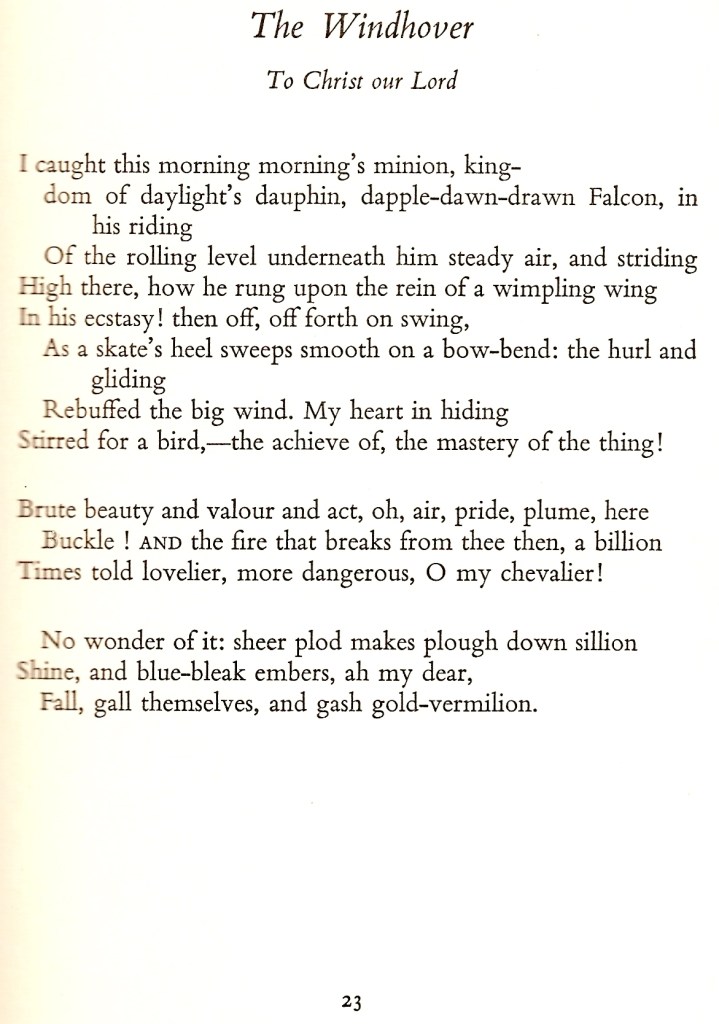
Hopkins captures the inscape of a kestrel in “The Windhover”, a poem which takes my breath away on every reading:

Windhover

Questions to ask to find the inscape of a thing
1. Notice the haecceitas of this creature. Ilia Delio told the story of Hopkins gazing at a tree for three days for its haecceitas to be revealed.
2. What is unique about this creature’s inner nature? What is its spirit/spirituality?
3. This creature praises God in the way appropriate to its inner nature. What is the song it sings, or the poem it makes, or the sculpture it carves, or the picture it paints to praise God?

Exercise:
Work with a thing, a similar creature to last night. Explore its haecceitas. As you gaze at it, let it reveal its inscape to you. Use the questions above. Write down words which express this inscape.

Inversnaid
Inversnaid

The Franciscan who influenced Hopkins


FRANCISCANS DISCOVER HOPKINS
4. THE INFLUENCE OF DUNS SCOTUS

DUNS SCOTUS – Franciscan Theologian 1265-1308

Hopkins acclaims Duns Scotus in Duns Scotus’ Oxford

Towery city & branchy between towers;
Cuckoo-echoing, bell-swarmèd, lark charmèd, rook racked,
river-rounded;
The dapple-eared lily below thee; that country & town did
Once encounter in, here coped & poisèd powers;
Thou hast a base & brickish skirt there, sours
That neighbour-nature thy grey beauty is grounded
Best in; graceless growth, thou hast confounded
Rural, rural keeping — folk, flocks, & flowers.

Yet ah! this air I gather & I release
He lived on: these weeds & waters, these walls are what
He haunted who of all men most sways my spirits to peace;
Of realty the rarest-veinèd unraveller; a not
Rivalled insight, be rival Italy or Greece;
Who fired France for Mary without spot.


Hopkins’ poetic and spiritual interest in Duns Scotus was in his concept of haecceitas.

Duns Scotus’ spirituality was deeply Franciscan. He absorbed the Franciscan idea of prayer as gazing, which was discerned in the prayer of St Francis by St Clare. Clare wrote not only about gazing on Christ the mirror, but also more generally on gazing as prayer.

Sister Ilia Delio in Franciscan Prayer traces how gazing as a way of prayer becomes Duns Scotus’ philosophical concept haeccietas.

1. “Thisness”: this creature (thing, animal, person) is different from all other creatures like it.
2. This creature is unlike all other creatures.
3. This creature was uniquely made by God.
4. This creature is a unique expression of the Word.

Exercise.

Spend some time with a creature. Explore its haecceitas. Engage in dialogue with the Word communicated by the creature.

Suggested creatures: tree, flower, rock.

[A more “advanced” exercise would be to explore the haecceitas of a person, or love, or a kind action.]

Questions to ask about this creature.
1. What makes this creature different from all other creatures like it?
2. What makes this creature different from all other creatures – i.e. what makes it unique?
3. What is there about this creature that reveals God’s special love uniquely directed at this creature?
4. What Word does this creature speak to us? (What revelation of God’s nature is in this creature?

Blessed Duns Scotus contemplates the haecceitas

Priest-poets enrich the Franciscan spirit


2. WHY SHOULD FRANCISCANS BE INTERESTED IN GERARD MANLEY HOPKINS?

Gerard Manley Hopkins was a poet-priest, that is, he wrote poetry as part of his vocation as priest. His poetry is ministry.

Hopkins is in a long line of priest-poets. George Herbert was one.

Hopkins looked back to the Dominican geniusThomas Aquinas, a serious teacher and writer of theology until five years before his death, when his writing stopped – except for a series of beautiful poems celebrating the Eucharist. The most famous of the Thomas Aquinas poems is Adoro Te Devote .The original Latin as Thomas wrote it is here. Gerard Manley Hopkins translated Adoro Te Devote into a moving poem.

Godhead here in hiding, whom I do adore,
masked by these bare shadows, shape and nothing more,
see, Lord, at thy service low lies here a heart
lost, all lost in wonder at the God thou art.

Seeing, touching, tasting are in thee deceived;
how says trusty hearing? That shall be believed;
what God’s Son has told me, take for truth I do;
Truth himself speaks truly, or there’s nothing true.

On the cross they godhead made no sign to men;
here thy very manhood steals from human ken:
both are my confession, both are my belief,
and I pray the prayer of the dying thief.

I am not like Thomas, wounds I cannot see,
but can plainly call thee Lord and God as he:
this faith each deeper be my holding of,
daily make me harder hope and dearer love.

O Thou our reminder of Christ crucified,
Living Bread the life of us for whom he died,
lend this life to me then: feed and feast my mind,
there be thou the sweetness man was meant to find.

Jesu, whom I look at shrouded here below,
I beseech thee send me what I thirst for so,
some day to gaze on thy face in light,
and be blest for ever with thy glory’s sight.

[Latin original attributed to St Thomas Aquinas, English translation by Gerard Manley Hopkins]

Priest-poets puts their craft at the service of God. Thomas Ken (one of the non-juror bishops) headed every letter and every page of poetry Ad Maiorem Dei Gloriam – to God’s Greater Glory, and this is the heart of the priest-poet’s vocation.

Like George Herbert, Australian priest, Elizabeth J. Smith finds that many of her poems work well as hymns, and she is known firstly for her fine hymns.
Words in the hands of the priest-poet become instruments firstly to fathom God’s nature, and then to sing God’s praise.

St Thomas Aquinas: lover of the Eucharistic mysteries

Do Franciscans Bless Animals


Before I start criticising the practice of blessing animals, let me confess that I have blessed animals, and would do so again. In fact for a couple of years, Tom Sutton of Subiaco Parish in Perth invited me, along with other Franciscans and other priests to a great outdoor animal blessing. There is a picture of me blessing a great St Bernard, and it was a delight to make friends with this gentle creature.

Bless me St Bernard!

This jamboree was stopped only because a certain dog food manufacturer was a sponsor and took advantage of this event. It took it over by emblazoning its name on every object and dog parade and snail race in sight.

Tom rightly believed that such rampant capitalism was at odds with the spirit of animal blessing.

But as a Franciscan I do feel ambivalent about blessing animals. Not that I have any theological problem with asking for God’s blessing on either pets or wild animals. Our blessing simply confirms the reality that God has already blessed creation. See Genesis 1.

Nor do I mind the chaos that can be caused by creatures great and small in a little church with God’s people trying to celebrate the Eucharist with devotion.

My problem, I think, is twofold. Firstly, blessing animals can become a sentimental act. “Isn’t it nice? Isn’t it lovely?” If an animal blessing is organised only to evoke superficial sentiments, then it is a dangerous waste of time. If an animal blessing is organised only to delight children, then it is a diversion from reality.

Secondly, blessing animals can easily turn companion animals into possessions rather than being seen as God’s gifts to us. The attitude that our pets are simply a convenience can easily lead to neglect and abuse , but even before it gets to that stage, this attitude diminishes us, making us consumers of animals’ services, rather than their grateful friends.

What Franciscans can do is to encourage people to think carefully about our relationship with animals. Saint Francis believed that each creature is a Word of God. In our encounter with an animal, St Francis encourages us to allow that animal to disclose its story to us. The animal is not there simply for our unfettered use, but is a fellow-creature put on this earth to share existence with us and to join our praise of the Most High Creator.

And I do love our dog!

Our pets are our companions, not our slaves.

And do we bless the animals that give food, are food for us? Much has been written about the distance between us urban dwellers and the milk and meat that we enjoy. If we bless our pets, then we should equally bless the animals that nurture us. We should be prepared to ask whether the cost of being a meat-eater is too high. Dr Rajendra Pachauri Chair of the IPCC spoke of the positive environmental impact of eating one less meat meal each week.

Wild animals are a blessing, too, although I suspect it’s impossible to catch a blue wren or an Oenpelli python to lay hands on and pronounce a blessing over it!

So my plea as a Franciscan is, if we are to bless animals, then let’s do it with thorough thought and prayer, and not just as a liturgical stunt. But no one would do that, would they?

I can say Alleluia!


I wake on Easter morning with my wife’s kiss. “Christ is Risen!” she smiles. I hesitate before responding, “He is risen indeed.” it is a great day, but I feel just pain behind and in front. The Psalmist’s words were louder in my mind than Easter’s liturgical cry: ” Fat bulls of Bashan surround me on every side.” Back pain behind and gastritis before fill my consciousness. in the same breath, I pray, “You are behind me and before: such knowledge is too wonderful for me,”, and I feel the truth of Psalm 139 deep within.
But it is not enough to get me to celebrate the Great Feast in the company of fellow-Christians. I deal with disappointment by turning to the gospel account of the first Easter morning.
I have been reading Brendan Byrne’s “theological reading of Mark’s Gospel” – A Costly Freedom, and it being in the Year of Mark, I turn to Mark 16. It is exciting to re-read the Greek: so much new is there!
Three women leave for the tomb “very early in the morning” (verse 2), between 3 a.m. and 6 a.m. This, according to my hospice nurse wife, is the low time, the time when death often creeps through the house of the dying and claims those who are ready. It is a time of intense dark, and for most, the deepest sleep. Yet in Mark’s Easter story, they arrive “just as the sun was rising.” Easter is a dawn that arrives before expected, the good news that tears away the deepest darkness! The first Easter, and all those that follow, are extraordinary dawns.

As the Sun Was Rising

The story moves on. I smile at the colloquial translation of verse 4(c) that springs to mind. The women are amazed that the stone is rolled away: it was a “bloody great boondie”! This whole business with the stone is amazing. The women discover that it has been moved by “lifting up their eyes and gazing” – the word theoriein calls to mind both wonder and the deep seeing of meditation.” its removal is literally “apocalyptic”, a heavenly revelation.

And then verse 5: “they enter into, into” – the preposition is repeated – the tomb, the realm of death. This detail sets Mark’s resurrection narrative apart from Matthew’s and Luke’s. The three women here enter deeply into the experience of death (“baptised into his death ” (Rom.3.6 perhaps?)) This is more than grief, although the grief is profound, like Jacob’s at the supposed death of Joseph.
This is a mythical experience of the profundity of death; Orpheus going into the place of the dead to retrieve Eurydice, and the lost possibility of new life with her. This is the place where many of Mark’s original readers may have been – in the hell of persecution or martyrdom. This is the place where true disciples must take shelter before they can shout the joy of Easter.
In my pain and disappointment this morning, I can identify some way with the women going into, right into, the place of death.
This also means I can identify with the hope put into the angel’s mouth: I too am looking for Jesus of Nazareth, the Crucified One, the Risen One. Any emptiness I experience is because “he is not here” (verse 6). I too can experience the thrill of being called again to discipleship and mission, “go and tell the disciples that they will see him again.”

Best of all Mark’s “shorter ending” with its abruptness restores to me the sense of being included in this ongoing mission of God. The other Gospels describe many Appearances of the Risen Jesus. Mark doesn’t crowd me out with the experiences of others. Mark trusts that my experience will be authentic on its own terms.
Even though I struggle with pain that takes my breath away, I can feel his breath filling me with new life. He is Risen Indeed! Alleluia!

Walking with the Risen One