
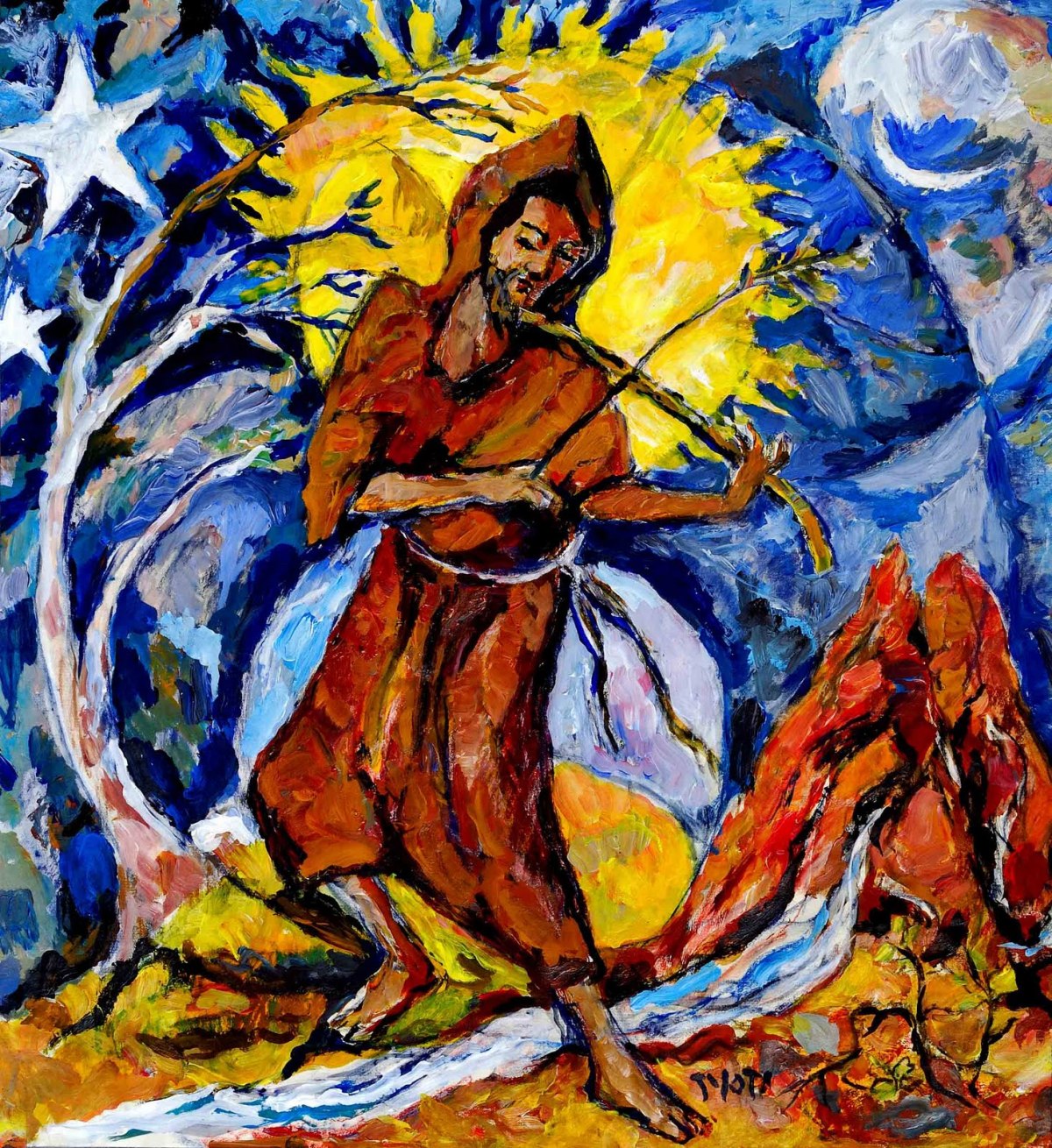
The Party King

Flaunting his wealth, or more accurately, flaunting his father Pietro’s wealth, “Frenchy” provided the meat for feasting and wine for drinking;


They elected him ‘King of the Revels’.

Giovanni di Bernadone, known to all by his nickname ‘Frenchy’ was the most raucous partygoer in the small town of Assisi. Flaunting his wealth, or more accurately, flaunting his father Pietro’s wealth, he provided the meat for feasting and wine for drinking; always the very best wine and the finest quails and swans roasted for the table.

Some of the town’s old residents called them terrorists, because they tore around the town in the early hours singing loud drinking songs. They raced their expensive horses, the click of the horseshoes loud on the cobbles of the narrow streets, their horses whinnying, whether they were joining in the singing or protesting their treatment was hard to tell.

Frenchy was possibly born when Pietro returned from France with cartloads of expensive cloth in about 1191, and Pietro and Pica, the new mother, baptised him as Giovanni. Still, everyone in Assisi knew him from his birth by his nickname.

Later, Pietro and Frenchy set out together on trips to France, the father teaching the son the ways to do business. Doubtless, they caroused in the inns where they stayed, and the father was proud, if sometimes irritated, by the sums Frenchy spent on his friends’ revels.

It was a great time for a young man to be alive, especially if you were looking for knightly action as Frenchy was.

There were rumours of wars between the Emperor and the Pope, and on the small scale, Assisi, on the Emperor’s team, went on and off to war with the Papal town of Perugia. In one of these skirmishes, Frenchy was taken prisoner for a year.

But it was a miserable 12 months for the teenage Frenchy. Knowing that the boy’s father would pay the ransom, the Perugians delayed negotiations until they had extracted the highest price from the rich merchant.

It changed Frenchy. He started to question the extreme wealth into which he was born. He started hanging around some of the old, ruined churches in the forest slopes down from Assisi. He gathered rocks and started rebuilding them. He was guided by a crucifix that spoke to him, telling him to repair his broken Church.

The rest of the story of Frenchy, Francesco in Italian, Francis to us, is well known.

He gave up his great wealth, determined to live in complete poverty. He broke with his father Pietro, never to be reconciled.

Caring for lepers, announcing Good News in towns and villages, begging for food on the same streets, enjoying the company of rich and poor, humans and animals alike.

Francis and his poor Brothers, within a few short years, were known all over Europe and loved by all.  He is still the world’s favourite saint.

In 1226, exactly 800 years ago, Francis lay dying. He asked the Brothers to sing a psalm with him.   He asked them to send for Lady Jacopa to travel from Rome and for her to bring him her almond cookies, Francis’s favourites. By coincidence, the Lady had just arrived with her biccies.  

Surrounded by his Brothers and the Lady Jacopa, his body weakened. Flaunting his wealth, a tattered tunic and some almond crumbs, and yet possessing all things, he died, singing…still partying. 

Giotto – The death of St Francis

Father Algy Robertson SSF: died November 23, 1955


Fr Algy and Brother Douglas are often credited as the founders of the Society of Saint Francis; certainly these two early members of the Society represent the two poles of our charism – order and serving the poor.

Brother Douglas, who earned the name ‘Apostle to the Wayfarers’ died on September 7, 1957. He was a priest and Oxford professor of economics. Thousands of men were thrown out of work in the Great Depression and made homeless and moved from shelter to shelter around the English countryside. Brother Douglas put on a pair of overalls painted with a large cross and joined them for two summers before setting up Hilfield Farm as a community to minister to the wayfarers.

All Franciscans recognise this kind of ministry as typically Franciscan, to be expected of both Brothers and Third Order members. Brother Douglas inspires us to serve the poor where we meet them.

Father Algy’s skills were very different and sometimes overlooked. He had a sound knowledge of the religious life, and he was originally invited to help train SSF novices. Algy had an intuitive understanding of the kind of man who should join the fledgling SSF and a detailed plan for its organisation. In her history of the European Province of SSF, This Poor Sort, Petà Dunstan refers to Algy’s reputation as co-founder of both First Order and the Second Order, the Community of St Clare.

There is no doubt that Fr Algy’s eccentricities, and his reluctance to relinquish all his personal wealth, especially his car, caused friction in the Order as it grew. He was a human being and no claim has been made that he was a saint. However, his gift for organisation continues to shape the First Order and to remind the Third Order that you need structure to stay together.

The Third Order also acknowledges another priest, Jack Winslow, the writer of our Principles, for his role in our founding. His attention to the configuration of the Third Order continues to provide the glue for Tertiaries to live together in loving service.

But on this day, November 23, we thank God for Father Algy SSF and his gift of order to the Society of St Francis, the gift that facilitates our Orders to fulfil our calling to loving service.

The Franciscan who influenced Hopkins


FRANCISCANS DISCOVER HOPKINS
4. THE INFLUENCE OF DUNS SCOTUS

DUNS SCOTUS – Franciscan Theologian 1265-1308

Hopkins acclaims Duns Scotus in Duns Scotus’ Oxford

Towery city & branchy between towers;
Cuckoo-echoing, bell-swarmèd, lark charmèd, rook racked,
river-rounded;
The dapple-eared lily below thee; that country & town did
Once encounter in, here coped & poisèd powers;
Thou hast a base & brickish skirt there, sours
That neighbour-nature thy grey beauty is grounded
Best in; graceless growth, thou hast confounded
Rural, rural keeping — folk, flocks, & flowers.

Yet ah! this air I gather & I release
He lived on: these weeds & waters, these walls are what
He haunted who of all men most sways my spirits to peace;
Of realty the rarest-veinèd unraveller; a not
Rivalled insight, be rival Italy or Greece;
Who fired France for Mary without spot.


Hopkins’ poetic and spiritual interest in Duns Scotus was in his concept of haecceitas.

Duns Scotus’ spirituality was deeply Franciscan. He absorbed the Franciscan idea of prayer as gazing, which was discerned in the prayer of St Francis by St Clare. Clare wrote not only about gazing on Christ the mirror, but also more generally on gazing as prayer.

Sister Ilia Delio in Franciscan Prayer traces how gazing as a way of prayer becomes Duns Scotus’ philosophical concept haeccietas.

1. “Thisness”: this creature (thing, animal, person) is different from all other creatures like it.
2. This creature is unlike all other creatures.
3. This creature was uniquely made by God.
4. This creature is a unique expression of the Word.

Exercise.

Spend some time with a creature. Explore its haecceitas. Engage in dialogue with the Word communicated by the creature.

Suggested creatures: tree, flower, rock.

[A more “advanced” exercise would be to explore the haecceitas of a person, or love, or a kind action.]

Questions to ask about this creature.
1. What makes this creature different from all other creatures like it?
2. What makes this creature different from all other creatures – i.e. what makes it unique?
3. What is there about this creature that reveals God’s special love uniquely directed at this creature?
4. What Word does this creature speak to us? (What revelation of God’s nature is in this creature?

Blessed Duns Scotus contemplates the haecceitas

Why Should Franciscans be interested in poetry?


FRANCISCANS DISCOVER HOPKINS
1. SHOULD FRANCISCANS BE INTERESTED IN POETRY?

• St Francis was influenced by the troubadours. His interest in troubadours probably started on journeys to France as a child.
The troubadours:
o Sang in Italian or Provençal (French) and not Latin.
o Broke convention by singing love songs to ladies beyond their status.
o Used popular harmonies and rhythms.
St Francis wanted to be able to sing love songs to God with the same language of intimacy. He liked the fact that ordinary people could enjoy popular song styles and understand both words and music. Churchy Latin was remote.
Brother William SSF (Can it be True) was a modern Franciscan troubadour. In the late 60s and early 70s in Queensland William wrote ballads and songs and performed them at rallies with thousands of young people.
• Saint Francis was influenced by Sufi poetry. He wanted to travel to Morocco, Spain, and he succeeded in travelling to Damietta, all centres of Sufi poetry.
The Sufis:
o Wrote love poetry to God.
o The “whirling dervishes” got themselves into an ecstatic meditative state.
o Lived in covenanted communities.
Saint Francis asked Leo to whirl to determine which way to proceed at a crossroads. He was intrigued by ecstatic prayer, and he wanted to know more. Some scholars like Idres Shah believe that he came away from his meeting with the Sultan in Damietta having quizzed the sufis there.
Poetry expresses deep insights about God. The best theology is poetry. Good poetry is theology.
It is often difficult to discern the boundary between hymns and poetry. The poet-priest, George Herbert wrote Let All the World in Every Corner Sing, as a poem, but it makes a great hymn.

Sufis
Sufis