
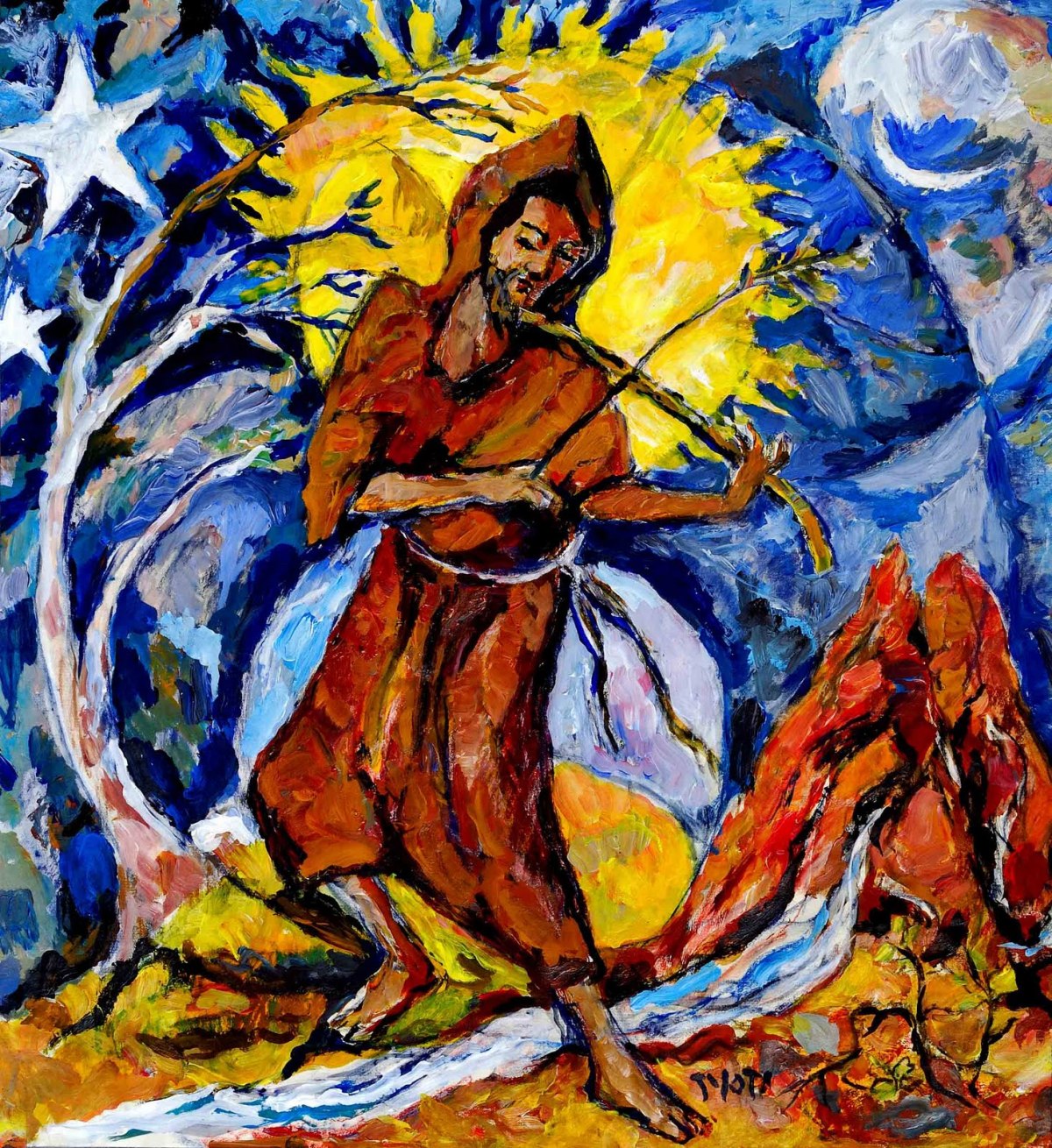
The Party King

Flaunting his wealth, or more accurately, flaunting his father Pietro’s wealth, “Frenchy” provided the meat for feasting and wine for drinking;


They elected him ‘King of the Revels’.

Giovanni di Bernadone, known to all by his nickname ‘Frenchy’ was the most raucous partygoer in the small town of Assisi. Flaunting his wealth, or more accurately, flaunting his father Pietro’s wealth, he provided the meat for feasting and wine for drinking; always the very best wine and the finest quails and swans roasted for the table.

Some of the town’s old residents called them terrorists, because they tore around the town in the early hours singing loud drinking songs. They raced their expensive horses, the click of the horseshoes loud on the cobbles of the narrow streets, their horses whinnying, whether they were joining in the singing or protesting their treatment was hard to tell.

Frenchy was possibly born when Pietro returned from France with cartloads of expensive cloth in about 1191, and Pietro and Pica, the new mother, baptised him as Giovanni. Still, everyone in Assisi knew him from his birth by his nickname.

Later, Pietro and Frenchy set out together on trips to France, the father teaching the son the ways to do business. Doubtless, they caroused in the inns where they stayed, and the father was proud, if sometimes irritated, by the sums Frenchy spent on his friends’ revels.

It was a great time for a young man to be alive, especially if you were looking for knightly action as Frenchy was.

There were rumours of wars between the Emperor and the Pope, and on the small scale, Assisi, on the Emperor’s team, went on and off to war with the Papal town of Perugia. In one of these skirmishes, Frenchy was taken prisoner for a year.

But it was a miserable 12 months for the teenage Frenchy. Knowing that the boy’s father would pay the ransom, the Perugians delayed negotiations until they had extracted the highest price from the rich merchant.

It changed Frenchy. He started to question the extreme wealth into which he was born. He started hanging around some of the old, ruined churches in the forest slopes down from Assisi. He gathered rocks and started rebuilding them. He was guided by a crucifix that spoke to him, telling him to repair his broken Church.

The rest of the story of Frenchy, Francesco in Italian, Francis to us, is well known.

He gave up his great wealth, determined to live in complete poverty. He broke with his father Pietro, never to be reconciled.

Caring for lepers, announcing Good News in towns and villages, begging for food on the same streets, enjoying the company of rich and poor, humans and animals alike.

Francis and his poor Brothers, within a few short years, were known all over Europe and loved by all.  He is still the world’s favourite saint.

In 1226, exactly 800 years ago, Francis lay dying. He asked the Brothers to sing a psalm with him.   He asked them to send for Lady Jacopa to travel from Rome and for her to bring him her almond cookies, Francis’s favourites. By coincidence, the Lady had just arrived with her biccies.  

Surrounded by his Brothers and the Lady Jacopa, his body weakened. Flaunting his wealth, a tattered tunic and some almond crumbs, and yet possessing all things, he died, singing…still partying. 

Giotto – The death of St Francis

Lamenting Leunig


Michael

It was a cold Melbourne night in the year 2000, but we had left our coats at the door to the warm rooftop restaurant with its stunning view of city lights and the shimmering dark shape of Port Phillip Bay beyond.

Women in their best evening dresses outshone the men in suits and ties, or clergy collars. In the meetings during the day, I had been elected as Secretary of the Australian Association for Religious Education (AARE).

‘You are to sit here now that you are our Secretary,’ the Association President pointed to a seat at the top table.

A man about my age (early fifties) with a smart brown leather jacket, an open-necked shirt and a mop of grey hair was already seated.

‘Ted, meet Michael,’ the President said and rushed away to welcome other members.

In the restaurant, buzzing with the enthusiastic voices of members with a common passion, Michael was an oasis of peace. I greeted him and we shook hands.

‘Where are you from?’ he asked.

‘Perth. I work for the Churches’ Commission on Education there. Like Victoria’s CCES.’

‘Yes, I know CCES.’

‘Have you been to Perth?’ I asked.

‘I was in residence at the Chapel at Christ Church Grammar a couple of years ago,’ he replied.

I told him I had been chaplain there in the 1980s, and we chatted about people he had met, especially the then chaplain, Frank Sheehan.

Michael chuckled, ‘Frank put me up with the Wilsons in Peppy Grove.’ He invested the local name for the exclusive suburb with an ironic smile.

The Wilson family owned multilevel car parks in Perth and most other CBDs. I knew the Wilsons. Picking up on Michael’s irony, I asked,

‘The hospitality adequate?’ I asked.

‘Very,’ Michael smiled again. ‘Very comfortable, very friendly, but I couldn’t help feeling uncomfortable.’ He looked down at his dishevelled appearance, which I suspected was a conscious costume. He liked to dress down.

I probed more.

‘Peppy Grove is our wealthiest suburb,’ I said.

‘Yes,’ Michael replied, ‘and I felt sorry for the Christ Church kids. They had drunk the cordial. They believed they merited their privileges. Whether they were from Peppy Grove or Mossie Park or any of the suburbs round about.’

I was intrigued by Michael. Many of the AARE members taught at schools like Christ Church, and if they felt uncomfortable at the privileges of their students, it was impolitic to say so.

I remembered Christ Church kids reporting me to their parents because my views were so left-wing. I think the parents rather expected it of me, so no one criticised me (at least to my face).

I tried to think who this Michael might be. Frank Sheehan invited well-known thinkers to be in his residency program.

‘So I guess you don’t live in central Melbourne,’ I said.

‘I have a studio on my little farm.’ He must have realised he had given me a clue with the word ‘studio’, so he hurried on. ‘Only a few chooks, mind you. And a house. Just enough for me. All pretty rustic.’

I sensed Michael was belittling himself. Meanwhile, the President and other Executive members joined the table. The two of us continued our conversation. We were so deep in talk that others didn’t want to interrupt us.

We talked on about reforming our capitalist society and honouring the poor as Pacific oysters followed by vegetarian linguini and organic boneless chicken were served, paired by Victorian fine wines. Seppelts Riesling or 21 Coldstream Pinot Noir were offered.  

‘Revolutions are out,’ he said, ‘but we need a revolution in the way we think about wealth.’ He held up his glass of white ruefully. ‘A gentle revolution,’ he chuckled, ‘just to whittle away at the rotten foundations of capitalism.’

After the main course, the President interrupted us.

‘I need you now, Michael. Ready?’

Michael nodded.

The President called for quiet.

‘Our guest speaker tonight is well known across Australia. Most of us have seen his cartoons and how he insists we think spiritually about our society. This has piqued our interest. He is the inventor of Mr Curly and Vasco Pyjama. Please welcome … Michael Leunig.’

I was dumbfounded. Or plain dumb. Because I was new to the AARE Executive, I had not been party to the planning for the AARE Dinner and I had no idea that I had chatted so earnestly to the celebrity cartoonist for twenty minutes while he had not revealed his identity.  That took deep humility on his part.

A Spectre, Haunting: Communism and the Christian today

A Spectre, Haunting is above all a masterly commentary on Marx and Engels’ The Communist Manifesto, written with humour and compassion.


China Miéville, A Spectre, Haunting: On the Communist Manifesto, Head of Zeus, 2022

ISBN 9781803282244

Paperback from $29, Kindle $13.19

Reviewed by Ted Witham

For most bourgeois (and I have to admit to being bourgeois), becoming a Communist is a taboo, a step too far. Even for one with progressive politics, the idea of throwing out the whole system by which society governs itself, and starting again, is too, well, too revolutionary.

China Miéville is an English writer I look out for. His fantasy ‘steam punk’ novels explore the use of power and the experience of the underclass. His writing has vigour and joy, so A Spectre, Haunting appealed to me because of its author. If nothing else, it would be well written.

Miéville himself is active in socialist and communist circles in England, so his commitment was no surprise. A Spectre, Haunting is above all a masterly commentary on Marx and Engels’ The Communist Manifesto, written with humour and compassion. The book includes the whole text of the Manifesto and Engels’ prefaces to later editions. It is rounded out with a comprehensive bibliography.

Miéville assures us that Karl Marx was the main author of The Manifesto. The central problem that Karl Marx discerns is that too much wealth is in the hands of too few. In order to create a fairer society, in which everyone has enough and has opportunities to develop themselves, that 1% must be divested of its money and power, so that all can benefit: a commonwealth.

The French Revolution, say Marx and Miévelle, did not go far enough. It replaced the nobility’s hold on the bulk of the wealth in favour of the bourgeoisie. The paysans and the urban poor still missed out.

The difference today is that the wealth is held not only by Queen Elizabeth II and the Sultan of Brunei, but also by Elon Musk and Rupert Murdoch, bourgeois capitalists who, like their royal forebears, have no intention of sharing!

So, the solution to the inequality Marx discerned in 1848 is still the same in 2022: replace the hegemony of the capitalists with government by the workers and the underclasses. Miéville claims that Marx was not idealistic about this. The working classes still need to grow into that role, because as exploited human beings, they have been conditioned by the rich capitalists into the view that they do not have the capacity to build a fairer world.

In 1848, a year of aborted revolutions, Marx whimsically described communism as ‘a spectre, haunting … [a]ll the powers of Old Europe.’ The Berlin Wall came down in 1989. Thirty-three years later, communism still seems to be a spectre, haunting the globalised world. Though technically dead, its persuasive analysis of capitalist society and its attractive vision of a world where everyone has enough to flourish, still sits in the back of our collective mind.

As Christians, we have a love-hate relationship with Communism. Our analysis agrees with that of Marx: that the greed of the very rich robs the poor of a dignified life. But we are suspicious of Marx’s non-violence. We know, right from the Cross, that non-violence resistance usually provokes the violence of the system, however, my reading is that The Communist Manifesto is too ready to condone that violence.  

Maybe China Miéville, writing so compelling about the revolution, will be part of a movement to bring the haunting spectre back to life. Given the ravages of capitalism, we should arise, because ‘we have nothing to lose except our chains’.