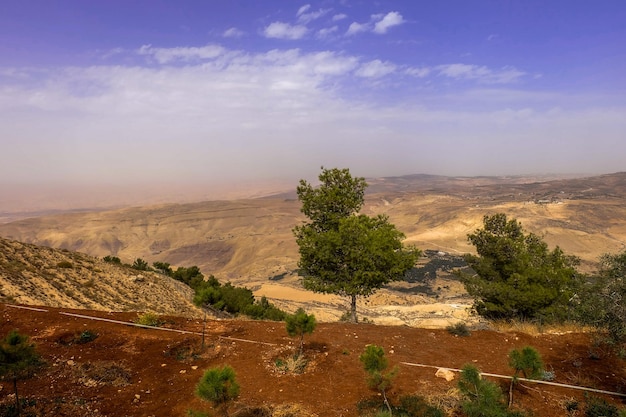
The View from Mount Nebo.


In the name of the living God, + Father, Son and Holy Spirit.

+++

Pray for the peace of Jerusalem. (Psalm 122:6a)

It’s a kind of code. The writer of the Psalm believes that if Jerusalem has peace, then the whole world will be at peace.  ‘Pray for the peace of Jerusalem’ means pray for peace in Jerusalem and everywhere.

When Moses was 120 years old, the Bible tells us, he climbed Mount Nebo, a mountain in today’s Kingdom of Jordan, about 800 metres above the Plains of Moab. There God showed him all the land that God had promised the children of Israel, from the river to the sea, the river Jordan to the Mediterranean Sea, from Dan in the far north to Gilead near Jerusalem and further south to the Negeb desert. (Deut. 34:1-5).

Then Moses died.

The last thing Moses did in his long life was to look towards the land that God was promising his people.  Moses looked forward to how blessed the tribes would be when they crossed the Jordan into Palestine. He paints a picture of how good the future will be for the children of Israel.

13b Blessed by the Lord [is] his land,
    with the choice gifts of heaven above
    and of the deep that lies beneath,
14 with the choice fruits of the sun
    and the rich yield of the months,
15 with the finest produce of the ancient mountains
    and the abundance of the everlasting hills,
16 with the choice gifts of the earth and its fullness
    and the favour of the one who dwells on Sinai.

                                                                            (Deuteronomy 33:13b-16 NRSV)

Moses could have sat around the campfire and regaled the Israelites with memories of leading his people out of Egypt. He could tell hoary tales about the 40-year trek through the wilderness, or reprise the joy, and the terror of meeting the living God in the burning bush.  But instead, he chose, after 120 years, to go to the high mountain, and to look forward to the future, to the promised land.

Moses couldn’t have prayed for the peace of Jerusalem for the simple reason that Jerusalem didn’t exist until many years later, when King David fortified a tiny Jebusite village and began building the Temple. 

What God wants for not only Jerusalem, but for the whole world’s future is peace, ‘shalom’ (שָׁלֹ֥ום). This word appears 237 times in the Old Testament, making shalom a significant concept. It means peace, and shalom is much more than absence of conflict.

Shalom means well-being in all its forms. Shalom means prosperity, but not the prosperity where only a few become wealthy, but prosperity where everyone shares their bounty with one another. Shalom is closer to communism than it is to the capitalism we experience in 2025. The prophet Isaiah reminds us that shalom is the opposite of war, which breeds hatred, fear, and scarcity. Shalom means love-in-action between people.

Pray for the peace of Jerusalem, the psalmist urges us, pray for Jerusalem’s shalom. God will bring peace for Jerusalem out of the fraught and complicated mess in the Middle East today. The promised land that Moses looked forward to stretches from the river to the sea. But today, Palestinians want to be free ‘from the river to the sea.’

These two visions of the future clash. They seem contradictory: how do we pray for the peace of Jerusalem?

How do we pray for peace for a people who were nearly exterminated a generation ago in the Holocaust? There are Palestinians and others like Hamas who say they would like to wipe out the Jewish people. Could it happen again? Never mind the politics: many Jews believe they are surrounded now by the same murderous hatred as they were in 1938.  

As Lloyd said last Sunday in his sermon, now it is important for Christians to express solidarity with Jews. Write to Temple David in Mount Lawley; or write to the Perth Hebrew Congregation. Or to both. A simple email will be genuinely appreciated.    

And how do we pray for a people who, a generation ago, were pushed out of the land their families had farmed for generations, for thousands of years?  The Palestinians believe that Jewish settlement from the river to the sea is a policy that bulldozes them out of the way, often quite literally. What should we pray? How should we support Palestinians and their allies locally? Sending money to an aid agency is one possibility. Gaza desperately needs the basics for life. Or finding out about the rallies held regularly in the city and joining them or supporting them is another.

How do we pray for the peace of Jerusalem? What would bring about the shalom of all the people of the Holy Land? This morning’s readings encourage us to pray with hope. Hope in God. The problems of the Middle East are difficult to fix. But as Christians, we know that God’s intention is for all Jews and all Palestinians to thrive, to enjoy God’s shalom. The divisions will find healing.

 We pray with hope, knowing that the future is in God’s hands. We look to the future with hope, learning with a deep confidence that God will meet us there.

Pray for the peace of Jerusalem. We can pray for the peace of Jerusalem only if we pray for peace in our own lives. We ask God to meet us in the conflicts of our families, knowing that some of those fights and divisions seem intractable to us.

We ask God to meet us in our everyday encounters. What do we need to do to foster shalom in our communities, as we encounter people serving us in shops, people on the footpaths, people at homeless respite, and neighbours of all sorts?

As Christians, we have a vocation to be makers of shalom; to be peacemakers. Saint Francis of Assisi, my favourite saint, told his followers to meet everyone with a greeting of peace.

[We should note that we Christians don’t have a monopoly on peacemaking. Jews greet each other with ‘shalom-aka’ and Muslims greet each other ‘As-salamu alaykum’; both saying, ‘peace be with you’.]

We too can make a greeting of peace a holy habit. For most of us, it might be a bit precious to say ‘peace be with you’ or ‘shalom’ every time we greet someone, but we can, for example, sign off emails or end phone conversations with the word ‘Peace’ – and mean it!

In this Eucharist, the priest greets us, ‘The peace of the Lord be with you’, and we respond, ‘And also with you.’ This morning, let us make the peace especially meaningful. Let us pray earnestly for the well-being and security of everyone we greet. Maybe greet fewer people and make sustained eye contact with each one if you can. Take two or three seconds to really see our neighbours, to remember that God delights in each one and seeks their shalom.

+++

As you know, today is the second anniversary of Lloyd’s ordination as a priest (congratulations, Father!), and it is my 50th. At the 8:30 Eucharist, Bryan Shattock marked his 42nd year of priesthood.

We as priests have a special role as a peacemakers.

Firstly, we bid the people we serve to ‘pray for the peace of Jerusalem’, and we bid the people to pray more generally for peace. Temple David replied to me that my email was appreciated because I am a priest.  My support as a priest carried your goodwill along with mine. 

So, secondly, our role in the community of faith, especially our parish priest, our bishops and the archbishop, is to be bridge-builders.

One of the titles for the Pope is Pontifex, the Latin for ‘bridge-builder’.Pope Leo has an account on X called ‘Pontifex’, and he repeated on social media his first greeting as Pope. This is what the Pontiff said:

“Peace be with you all! This is the first greeting spoken by the Risen Christ, the Good Shepherd. I would like this greeting of peace to resound in your hearts, in your families, and among all people, wherever they may be, in every nation and throughout the world.” (Pope Leo XIV on X)

I’m not saying that priests should be Popes. But like the Pope, the priest builds bridges between people and God.

One of the roles the church entrusts to priests is to speak words of absolution, either to all of us in the Eucharist, or to each of us in private in the Sacrament of Reconciliation, formally and informally. These words of absolution make space for peace with God.

This role of absolving carries with it the responsibility for us priests to make peace, to promote shalom, in the entire community we serve. We should never provoke division or hatred.

But as pontifex, as people entrusted with opening space for God, priests try to discern when to challenge people; when to ask people to fulfil roles for which they feel unworthy or not ready, or when to expose evil and hatred to the light by challenging people to do better, and by challenging, so build peace among people.

One anecdote from my time as a priest at Christ Church Claremont. A few parishioners looked with disapproval at families with young children. They stared at them critically, they shushed them, they rudely moved away from them, and they demanded that parents take their children to the crèche.

One morning during the Eucharist, I saw families being disturbed by these parishioners. There were many whispers and many scowls. I saw one mum on the brink of tears. I got very hot under my dog collar. When we came to the notices at the end, I told the congregation in what I thought were terms everyone could understand, that if they continued to treat kids like that, there would be no church left.

As I shook hands with people leaving, one woman said to me, ‘I’m so glad you said that about the children. Someone has to speak up about how badly behaved they are in church.’

So much for my discernment to challenge, to create connections and shalom between people!

So, we as priests have the privilege of promoting love between the people we serve. Priests speak well of people, knowing that God sees every person as whole, as holy, as complete. Priests who gossip or who speak badly of others are smashing those bridges between people, not building shalom. We try to be peacemakers whenever and wherever we can.

We priests have a special role in building bridges into the future. Like Moses, we look with hope to God’s church in the years ahead. It’s so easy to look at the church and be despondent.

There are fewer churchgoers, we say. There are no young people, we say. We have only seniors who don’t have the energy for organising things, we say. There are divisions tearing Anglicans apart, we say, between St Brendan’s and St Nic’s, reflecting bigger divisions between Canterbury and Sydney.  It’s easy for priests to be despondent. It’s easy for priests to think that we must come up with all the solutions.

We should be realists. God’s church is today what it is.

But as priests, we have a responsibility to remind people of a bigger story. God has been faithful to the church for 2,000 years. We have no reason to think God will not continue to grace God’s people with love and harmony, with shalom. Of course God will. God is not going to change or withdraw his love from the church.

Of course, all of us are all called to be bringers of peace, nurturing shalom. In fact, we can all do all the things priests do. But we priests are called to model peacemaking, to make space for peace, to call others to be makers of shalom. It’s a challenge for us, and it’s an extraordinary privilege.

We priests, like Moses on top of Mount Nebo, should be saying to the church:

The church’s future is blessed.

The church is blessed with the choice gifts of heaven above
and of the deep that lies beneath;
with the finest produce from the faith of those who have gone before us,

their stories, their hymns, their deep spirituality.
With the abundance of faith of those who will continue to come,

their joy, their faithfulness to Christ,
their willingness to live a life of service;
with the choicest gifts of love and shalom

And, above all, the church’s future is blessed with

the never-ending favour of the One who dwells with his people.

Pray for the peace of Jerusalem, and pray for your priests.

Peace be with you.

Scandals and faith


SERMON – ST MARY’S, BUSSELTON/ST GEORGE’S, DUNSBOROUGH

September 30/October 7, 2018.

Pentecost 19/20
Saint Francis

I Corinthians 1:17-31

Mark 9:38-50

In the name of the living God + Father, Son, and Holy Spirit. Amen.

The land where Jesus lived, the land of Palestine/Israel, consists of the Jordan Valley, which is a little bit green, and rocky hills and dry landforms. Jerusalem was the only city in Jesus’s day, so for the most part, there were no roads. Even the Roman road avoided Jerusalem and crossed the Jordan into Galilee in the northern extreme of the province.

The topsoil was thin, and there were always rocks that poked through the topsoil. If you weren’t watching, these obtruding rocks would trip you up. A rock like this was called a skandalon. We get the English word ‘scandal’ from this Greek word. A ‘scandal’ is something, like one of those rocks, that crops up unexpectedly and makes us stumble or fall. A scandal like the child abuse scandals can make us lose faith; we don’t trust the person involved anymore, we feel betrayed and we re-consider what we think of the person’s character.

38410784-rocky-hills-of-the-negev-desert-in-israel
Skandaloi – rocky hills of the Negev

In this morning’s epistle and gospel, scandals are there, but somewhat hidden in the English translation. We hear of ‘obstacles’ to faith.  We hear how Jews are stopped from believing because the signs are wrong. Gentiles are stopped from believing because they don’t think Christian preaching measures up to their sophisticated world of philosophy. Or in the original Greek, the lack of proper signs is a skandalon, a scandal for Jews, the lack of wisdom is a skandalon, a scandal for Gentiles.

The signs were an obstacle for Jews believing. They indicated the wrong sort of Messiah; the Jews wanted a political or military Messiah, the sign of the cross indicates a Messiah for whom love and forgiveness were the winning combination, not defeat of the Romans and the unity of the Jewish nation.

The Gentiles looked for wisdom, the sort of wisdom they found in debates and complex philosophy. We know that the New Testament has depths of interpretation and meaning, but the Gentiles at the time heard only a simple and direct preaching of the cross.

Having tripped up on the issue of philosophy, the Gentiles then found other factors to be scandalised about. Christians appealed to the poor and weak, not to the masters and house-holders and the powerful. How could that make sense in a patriarchal world where the more power you had the wiser you were, and the wiser you were the more powerful? Women and slaves and children had little power. They could not possibly be wise, could they?

So the question Paul poses to us 2,000 years later is this: what is skandalon for us? What crops up unexpectedly to prevent you from believing, or believing more fully? For you, it could be – I know it is for some people – that the cross is a scandal. If Jesus was exterminated like a criminal, wasn’t that losing rather than winning? For you it could be, as it is for some people, that the cross is ugly, that Jesus’s people, tax-collectors and prostitutes, are not proper advertisements for God.

What obstacle do you trip over?

Let us turn to Mark’s Gospel where Jesus paints a picture of sin creating a skandalon. If your hand is a skandalon, cut it off. We don’t need much imagination to envisage our hand becoming a scandal; imagine the sins we can do with our hands – theft, murder, assault, fiddling our tax returns.

Perhaps we have to think a little harder to imagine our eye becoming a scandal, but we know from other things Jesus said that it is not only what we look at, but how we look, that can be a scandal, an obstacle to our faith. Looking at others’ spouses sexually, with lust, looking at valuable property enviously, in other words using our eye to desire things that if we possessed them would be harmful to others and ruin ourselves – that can become a scandal.

But what is this second sort of skandalon? This is not being tripped up by our wrong expectations; this is being tripped up by our own sinful actions. Imagine someone using his hand to enter fraudulent details on the internet, then he feels guilty for stealing. He is tripped up looking at himself as a thief, as a sinner, as guilty. Uh-oh! He should cut off his hand, perhaps by restricting his internet access, then repent, repay the money and re-consider his desire to be ahead in money or material things. Otherwise he will slide into a hell of self-recrimination, self-loathing and become so self-absorbed that he is unable to be in relationship with others. The path to ruin is too easy a story to write.

Jesus makes us squirm by compelling us to ask ourselves what we trip over with the actions of our hand and our eye. What ruinous actions could be our obstacles to faith?

The gospel today gives three remedies for skandalon; three prescriptions for removing these obstacles to faith.

The first is accepting a cup of water because of our faith. If we can’t be kind to others, Jesus suggests we reflect on the kindness of others to us. What does that mean? How does that recall us to our Christian standards and believing? What does their kindness say about the possibility of Christ working through that person, and through ourselves?

The second is a little strange on the surface. Jesus says, ‘Have salt in yourselves.’ Don’t lose your saltiness. There is a cluster of good things, like salt, that we should take into ourselves that will restore us to faith.

Recall the fire, the sharp burning taste, that is in salt. Allow the fire of appropriate criticism to burn away our inclination to turn away from God. It may be a member of your family or a stranger in the street, but when someone criticises our actions, we should welcome it as from God himself.

Secondly, let the strangeness of the Gospel change us. We say we are trying to be more like Christ. The implication is that if we hear something in the Gospel or in the words of other Christians that seem strange, that may well be because it points to unfamiliar characteristics, unfamiliar because it is not yet part of us, but is part of the Gospel. Welcome the strangeness of the Gospel.

Thirdly, a little sprinkle of salt affects the taste of the whole meal. Let the Gospel spread through the whole of your life so that every aspect reflects the love of God.

Last Thursday we celebrated the Feast of Saint Francis of Assisi, a hero and mentor of mine. Francis grew up thinking the church then, 800 years ago, was a scandal. Its main focus was wealth and the power needed to protect that wealth. For example, there was a large Benedictine monastery up the hill from Assisi. When Benedictine property anywhere in the region was threatened, the monks would down their farming tools, their hoes and scythes, and pick up swords. Even the Pope had a large and busy army.

As a cloth merchant, Francis had experienced firsthand how bishops loved the finest cloth for their vestments! Many of the clergy were squeezing peasants for land rents and whatever other corruption with which they could enrich themselves.

The church then was a scandal. St Francis did three things: firstly, he embraced poverty as a way of life. This meant for him that he constantly experienced the generosity of others. Francis believed that when he experienced people’s generosity he was experiencing God’s generosity through them.

Secondly, Francis could be weird, screwy, pazzo as his fellow Italians said. From

Francis & crucifix Brisbane
Saint Francis embraces the Christ on the cross – wooden sculpture in the guest house. Society of St Francis, Brisbane

eccentric dress to over-the-top acted parables, like spinning at a crossroads until you were dizzy to decide which way ahead. But there was gospel in his madness. In dressing down like the worst beggar, Francis reminds us of our constant concern about our appearance and what it says about ourselves. Not necessary in God’s kingdom.


In spinning at a crossroads for direction, Francis reminds us how little control we have over our own decisions. For him this points to the need for greater and greater trust in God.

Thirdly Francis was constantly doing little random acts of kindness, bidding people peace, smiling, listening, leaving behind little scraps of gospel wherever he walked, salting the world with hints of Jesus.

What we need to do to hear the gospel through the scandals will be different than Francis in the 13th century. But just like Francis, just like this morning’s readings we too need to:

  • Have salt in ourselves.
  • Allow the kindness of others to reveal Christ; and when other criticise, let that reveal Christ too.
  • Scatter little signs of gospel everywhere we go.

These are the ways to peace with God and with each other.

Peace be with you!


Francis – program notes


Program notes for the play Francis, presented by the Midnite Youth Theatre Company, November 21, 22, 23 and 24, by Julian Mitchell and directed by Drew Stocker tssf.

By Ted Witham tssf

Poster for the play “Francis”

Saint Francis of Assisi became a leader by giving power away. Francis Bernadone was born in 1181 or 1182 and grew up in a wealthy merchant’s house. As a teenager, he became a leader of wild parties through the streets of Assisi. He was known as ‘The King of the Revels’, and used his money to attract friends.

Like all young men in Assisi, Francis chose to join in the little wars the town fought – for the Emperor (against the Pope) and against the neighbouring hill-town of Perugia. After one battle Francis was taken prisoner in a dark prison in Perugia. Having a wealthy father meant that he was held for ransom.  It took a year to negotiate a price for his release. He began to realise that even with money he couldn’t have what he wanted when he wanted.

After his release he bought a knighthood to fight in the crusades. Instead of a glorious tour in Palestine, Francis returned home sick. In a vision God showed him that he didn’t want him to be a knight, so he gave away his lavish armour.

Everywhere around him, Francis could see people fighting: fighting to keep their possessions and power. Assisi had always been a barter economy, but now, as Francis grew to manhood, it was becoming a greedy money economy. Instead of giving each other life’s necessities, the people of Assisi began to amass cash. The division between the privileged and the poor grew rapidly.

Francis saw a solution to this greed. All people should treat each other as members of their family. Instead of grabbing resources for themselves, they should share with their brothers and sisters what they had. Francis started a community of those who would follow this way. He dreamed of a new world where people gave everything away to each other, so all would be equally rich.

Francis struggled for the rest of his life to find the best way to be the leader of this community. His idea of a leader was someone who did not have power over others. Like Jesus, Francis wanted to be the leader in serving others, a servant leader, a leader in giving power away. The concept was – and is – difficult to put into practice, but the communities Francis founded continue to try to make it work.

St Francis tells Br. Leo about the incident at Gubbio


My heart in my mouth I set off to meet Wolf.
He filled me with fear. He was Other.
I walked dark into the forest, so deeply looking
That at first I failed to see this Brother.

He appeared to be slinking around a tree.
In shadow, he looked all grey and black.
His eyes though lighted were lifeless,
And I froze, my feet bare on the mountain track.

I stared at the terrible empty eyes.
Brother Wolf still as a stone about to slide.
My eyes entered his and the space between melted.
We became one: my eyes and heart in Wolf’s inside.

He swallowed me whole. Yet I possessed him too.
Confused our hunger for love and humanity.
Crossed our praise of power in life and death.
Gubbio lay below in its simple vulnerability.

We stayed like that for time and a time,
Then slowly, gently in two came apart;
The same, yet different than before.
I burning with hunger and he humbled in heart.

I led him back like a lamb to the village.
Aflame, I rebuked him with voice and with prod.
“Share, show respect, live in harmony.”
The villagers rejoiced. I devoured God.

Ted Witham

Published in Assisi, Volume 2 Issue 2,3, the magazine of St Francis’ College in New York.

Picture by William Schaff.

Christian power: an oxymoron?


Yesterday the residents’ association of our village held elections. There was quite a tussle over the position of Chairman of the Social Committee, with arguments about the Constitution and fights about procedure. The sub-text was reasonably easy to discern: two strong people clashing and both leading with their shadows!

This made me reflect on the nature of power in Christian communities. You can’t avoid the reality of power and it usually plays out in the dance between leader and community.

When St Benedict wrote his Rule – or re-wrote that of the Master – he envisaged the Abbot as God for the monks. They owed him total obedience and he was elected for life. His absolute power was balanced by the requirement that he act to further the needs of the community.

The Rule of St Benedict

Benedictine communities could become dysfunctional. When they did, some believed it was because of the lifelong dictatorship of the Abbot. When St Francis of Assisi in the 12th Century, some four hundred years later, came to set out his ideal community, he made sure that its leaders had limited terms. When they had finished as leader, they went back to being a little brother again. Franciscan leaders are called Ministers, and their focus is to serve their brothers and sisters. Power, for St Francis, was exercised always by giving it away.

The downside of Franciscan leadership is that it can be chaotic, and when Franciscan communities are dysfunctional, it often manifests in fights that no-one has the authority to resolve.

Roger Shutz arrived in France from Switzerland during World War 2 looking for a site near Lyon to establish a community of reconciliation. By 1945, the community at Taizé was working, with Brother Roger as its founding Prior. Leadership, for him, was that of Prior, first among equals. He was evidently aware of the shortcomings of both Benedictine and mendicant leadership, and his Rule shows a new emphasis. Not only should the Prior consult with the majority of the community, but should also pay special attention to those in the community without power: the young, the voiceless, the marginalised, and allow those voices to be celebrated and followed.

Brother Roger’s style of leadership resonates well with our era. Its downside is that it requires a great gift of discernment to hear the voice of Christ when it is not the voice of mainstream members of the Christian community.

I beleive that the heritage of Christian leadership has much to teach us. We are, we claim, the Body of Christ, and the way in which we exercise power should reflect Christ’s way of power.

Brother Roger

Firstly, Benedict teaches us power is for the community more than the individual. Francis teaches us that power becomes oppression when it is held for oneself. Roger of Taizé reminds us of the ways the Bible holds up the little one.

These styles of exercising power can be seen in parishes and all Christian communities. There are some parishes where the priest is Father, and Father knows best what is in the interest of his parish. Father initiates people in Christian faith, particularly in the sacrament of baptism, and Father prevents the nasty nature of some people from dominating the parish agenda.

Other leaders are very conscious that their time in the parish is temporary. The minister is there to coach the ministries that were there before she came and will continue after she leaves. She is an enabler, and an encourager, and above all, she models the way in which Christ gave away his power to others.

In other parishes, the smallest member is heard. Children are on worship committees, clients of the soup kitchen design the ministry for the hungry, and the majority give way to the smallest voice with grace and gratitude that in them they have heard the voice of Christ.

Of course,no parish is purely one or the other of these leadership styles. But I hold them up like this partly as a warning that each can be dysfunctional. If we know that Abbots can become dictators, Ministers can be disengaged, and Priors can so honour the voice of the little one that they desert the way of common sense.

Power can spoil any community, and understanding how it works in the Body of Christ can lead to vibrant community living.

Why Should Franciscans be interested in poetry?


FRANCISCANS DISCOVER HOPKINS
1. SHOULD FRANCISCANS BE INTERESTED IN POETRY?

• St Francis was influenced by the troubadours. His interest in troubadours probably started on journeys to France as a child.
The troubadours:
o Sang in Italian or Provençal (French) and not Latin.
o Broke convention by singing love songs to ladies beyond their status.
o Used popular harmonies and rhythms.
St Francis wanted to be able to sing love songs to God with the same language of intimacy. He liked the fact that ordinary people could enjoy popular song styles and understand both words and music. Churchy Latin was remote.
Brother William SSF (Can it be True) was a modern Franciscan troubadour. In the late 60s and early 70s in Queensland William wrote ballads and songs and performed them at rallies with thousands of young people.
• Saint Francis was influenced by Sufi poetry. He wanted to travel to Morocco, Spain, and he succeeded in travelling to Damietta, all centres of Sufi poetry.
The Sufis:
o Wrote love poetry to God.
o The “whirling dervishes” got themselves into an ecstatic meditative state.
o Lived in covenanted communities.
Saint Francis asked Leo to whirl to determine which way to proceed at a crossroads. He was intrigued by ecstatic prayer, and he wanted to know more. Some scholars like Idres Shah believe that he came away from his meeting with the Sultan in Damietta having quizzed the sufis there.
Poetry expresses deep insights about God. The best theology is poetry. Good poetry is theology.
It is often difficult to discern the boundary between hymns and poetry. The poet-priest, George Herbert wrote Let All the World in Every Corner Sing, as a poem, but it makes a great hymn.

Sufis
Sufis

Do Franciscans Bless Animals


Before I start criticising the practice of blessing animals, let me confess that I have blessed animals, and would do so again. In fact for a couple of years, Tom Sutton of Subiaco Parish in Perth invited me, along with other Franciscans and other priests to a great outdoor animal blessing. There is a picture of me blessing a great St Bernard, and it was a delight to make friends with this gentle creature.

Bless me St Bernard!

This jamboree was stopped only because a certain dog food manufacturer was a sponsor and took advantage of this event. It took it over by emblazoning its name on every object and dog parade and snail race in sight.

Tom rightly believed that such rampant capitalism was at odds with the spirit of animal blessing.

But as a Franciscan I do feel ambivalent about blessing animals. Not that I have any theological problem with asking for God’s blessing on either pets or wild animals. Our blessing simply confirms the reality that God has already blessed creation. See Genesis 1.

Nor do I mind the chaos that can be caused by creatures great and small in a little church with God’s people trying to celebrate the Eucharist with devotion.

My problem, I think, is twofold. Firstly, blessing animals can become a sentimental act. “Isn’t it nice? Isn’t it lovely?” If an animal blessing is organised only to evoke superficial sentiments, then it is a dangerous waste of time. If an animal blessing is organised only to delight children, then it is a diversion from reality.

Secondly, blessing animals can easily turn companion animals into possessions rather than being seen as God’s gifts to us. The attitude that our pets are simply a convenience can easily lead to neglect and abuse , but even before it gets to that stage, this attitude diminishes us, making us consumers of animals’ services, rather than their grateful friends.

What Franciscans can do is to encourage people to think carefully about our relationship with animals. Saint Francis believed that each creature is a Word of God. In our encounter with an animal, St Francis encourages us to allow that animal to disclose its story to us. The animal is not there simply for our unfettered use, but is a fellow-creature put on this earth to share existence with us and to join our praise of the Most High Creator.

And I do love our dog!

Our pets are our companions, not our slaves.

And do we bless the animals that give food, are food for us? Much has been written about the distance between us urban dwellers and the milk and meat that we enjoy. If we bless our pets, then we should equally bless the animals that nurture us. We should be prepared to ask whether the cost of being a meat-eater is too high. Dr Rajendra Pachauri Chair of the IPCC spoke of the positive environmental impact of eating one less meat meal each week.

Wild animals are a blessing, too, although I suspect it’s impossible to catch a blue wren or an Oenpelli python to lay hands on and pronounce a blessing over it!

So my plea as a Franciscan is, if we are to bless animals, then let’s do it with thorough thought and prayer, and not just as a liturgical stunt. But no one would do that, would they?