Two Chapbooks by Brother Noel SSF – review


At Home in this Country

Noel Jeff’s two chapbooks reviewed by Ted Witham tssf

Noel Jeffs SSF, Ode to Warrigal Creek Massacre,
2025, A4 card folded.
ISBN 9780646826042.

Noel Jeffs, a Brother in the Society of Saint Francis comes from a farming family as I do. Settler folk like us cannot deny that our comparative wealth and social position derive from the dispossession of Aboriginal people.

The name Warrigal Creek in Victoria, like Pinjarra in WA, and doubtless similar names in other States, resonates because of the massacre perpetrated there. The name produces a complex amalgam of emotions, which Brother Noel explores in this poem.

Hope for reconciliation of country seems to be blown away by the ‘hot anger of a tied-up dog’ (line 3); shame for these murderous acts follows, and ‘now in pain I knead this atrophy’. (line 11). This line describes the violence with which the recollection of Warrigal Creek is turned over in the poet’s mind, like pushing, smoothing, pulling, pounding, tearing and restoring flour and water when making bread. The word ‘knead’ is a homonym for ‘kneed’, and I take from this that the poet’s rumination brings him to a silent place of kneeling in penitence.

The last and biggest emotion is ‘grieving’, grieving that the ‘litter of bones’ (18) may let the poet’s shame be revealed.

But hope seeps through the crammed lines of the poem. The insistence that this is ‘my country’ is used here to recognise the shared pain of remembering. It is ‘country’ as named by its original inhabitants, but it becomes ‘my country’ when truth is revealed.

The poem is printed on one A4 card folded. The front depicts four rainbow serpents entwined in a circle. The heads of the snakes form a cross with the word ‘sacred’ inscribed four times on the circumference. Printing in black and white has made the symbol rather harsh. References to the full story of the Warrigal Creek massacre are on the front and back covers.

The card would make a suitable emblem of remembrance for participants in a day of truth-telling, especially about the Warrigal Creek massacre. I commend Brother Noel for this brave contribution to the national and necessary task of truth-telling, This poem on its card is ‘a plaque to heroically // scold’ (13-14)

The Angelus and Mudbricks

Noel Jeffs SSF, Roads to Stroud: Grasping at Tears, Precipices, Sydney, Darkstar Digital 2024, 19 pages

Brother Noel’s chapbook consists in two poems of just under 140 lines each, describing the journey taken by the poet from the city into the bush of the Hunter Valley in NSW.

The Stroud of the title of Brother Noel’s poems needs some explanation as Stroud figures large in the imaginations of Australian Anglican Franciscans.

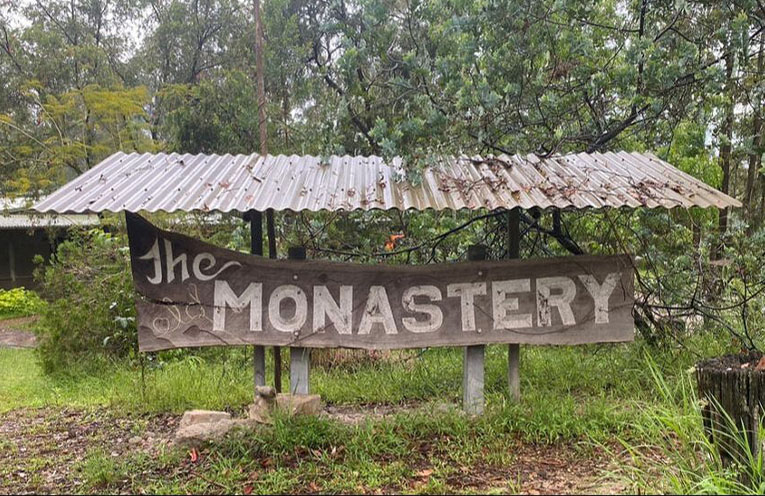
Nearly 50 years ago, three Anglican Franciscan nuns from the Community of Saint Clare in England arrived in Stroud in NSW with a vision to build a house for the Community. A small block of land just outside the town of Stroud was sold to the Sisters. Under the leadership of Sister Angela, an Australian, the Sisters, with volunteers helping, made mudbricks and constructed them into a unique building – a monastery with almost no straight lines but a lot of character.

A Chapel and Hermitage for the Brothers, initially for the priest-brothers to provide chaplaincy to the Sisters, was constructed 100 metres away from the monastery.

Since then, all three branches of the Franciscan family have made deep connections with this small section of attractive bush. Some of Noel’s fellow-Brothers make their home here, and Third Order members have enjoyed the rich hospitality of the place. Sadly, the Sisters returned to England in 2000, but memories of them are strong, especially in the old monastery, now a retreat house imbued with prayer.

In Brother Noel’s second poem under review, Precipices, ‘mudbricks and mudbricks’ (p.14) and the Angelus bell of the Chapel (p.16) take us straight to the property at Stroud. (It may also be intentional that the grey cover and simple typeface mimic the covers of the Sisters’ booklets of poetry and spirituality back in the 70s – a fitting homage!)

Noel Jeffs’ writing is thick with classical, Biblical and Franciscan allusions giving the whole experience of the poet’s visits to Stroud a nuanced exploration of ‘this parade of // fervour to want to come back year, // after year’.

The poet’s experience of leaving the city ‘awash with railway yards // tracks to sentience and homely inner-city birds’ (page 3) and arriving at Stroud where he finds it ‘ensconced in // its wilderness of wildness, made a // garden estate.’ (15)

The natural world and the human world are as entwined in the city as in they are in the country.

When the first Europeans arrived in NSW in 1788, some described the ‘natural’ parklands, the result of many thousands of years of land care by the Indigenous inhabitants, as a garden estate, so there’s a double irony in Jeffs’ description. Stroud, with its beautiful curated gum trees and mown grass, is a ‘garden estate’ hewn from wilderness.

The ‘loss’ of wilderness (or the Indigenous parkland?) is claimed with ‘a black fella warrior stood here // beckoning on, welcoming us in // in a vision.’ (15), the word ‘vision’ doing double duty here for physical vision and insight.

Jeff’s language is oblique. Words slip from meaning to meaning. As the poet is travelling north, watching the illusion of staying still in the train and seeing the bush moving, he asks, ‘What do I want to say about // the cantering bushland which // surrounds and is enveloped // by a tunnel of true darkness // which shapes my life in all its // passages?’ (12) The bush is cantering by as a horse canters, but it is also ‘canted’, (‘written slant’ as Emily Dickinson would say), so that it describes both the scenery and the poet’s inner feelings.

I relish the musicality of Brother Noel’s verse. He is a master of assonance which ranges from pure rhyme to distant echoes of sound. Savour the repeated ‘s’ , ‘p’, ‘ps’, and ‘l’ sounds in these three lines:

‘The circumference is here, and no longer

lying lips, give me a platypus and make

them safe.’ (13)

Simple in intention, the poems describe a journey home. But where is home, and what does it mean? The city ‘in which I am free // and lucky to be alive’ (1), or Stroud, where ‘I have gone to heaven, and am // coming down on the other side // of the earth’ (14)?

The archetypal ‘snakes [which] make love on poles’ (3) are a striking and original image, but they are surely meant to evoke the Caduceus, the staff of Mercury, the messenger of the gods, and widely used as a symbol of medicine. In ‘Grasping at Tears’, the poet is going to Stroud, and with him the messenger of the gods, a diplomat, the bringer of medicine, peace and healing. But the Caduceus also speaks truth with deception. The poet is an unreliable messenger, and his message is a rich potpourri of ambiguous imagery, alluring music and insights almost made explicit.

The poems are introduced by two fine photos taken by Brother Noel, the first shows the gravel road into Stroud, and the second a butcherbird enjoying her reflection in the outdoor shaving mirror at the Hermitage.

The poet may be ‘Grasping for Tears’, but it is unclear whether the tears are tears of sadness or tears of delight – probably both. I find the two poems ultimately hopeful, as the poet claims that:

‘Home is a handsome place   

an exotic space for silence

A limbering tree-house (5)

***

Ode to Warrigal Creek Massacre and Roads to Stroud are available direct from the author, Noel Jeffs SSF, at noeljeffs@hotmail.com.

Three Words to Change the World


Prepared for IPLRadio.org.au

Audio (10 minutes)

I’ve got three words to save the world.

The world is in a bad way, and sometimes it’s hard to look at it.

I see a child in Gaza, his eyes filled with horror and a question: ‘How could someone do this to us?’ So, it’s not surprising that people are turning away from the horror of the news. The Reuters Institute at Oxford University showed that fewer young people are looking at the news online; down from 89% to 76% in 2024. That’s a huge drop. The proportion of older people, those over 55, are also turning off, but at not such a fast rate, 73 to 68% in 2024.

2024 was the first time ever I’ve turned away from the news because it’s too hard to bear.

My father instilled in me the habit of news. At 7 p.m. every evening in our farmhouse everything stopped. ‘Shhh!’ my mum would say, ‘It’s time for Dad’s news.’

Reflecting on those years – the 1950s – I take a guess at why Dad insisted on listening to the news every day. On our farm our family could go days and weeks without seeing anybody; a stranger’s car was quite an event. Yet Dad wanted to know how the war in Korea was going; what the price of wool was in Albany and Fremantle; what international role Australia was playing when Labor politician Bert Evatt was President of the United Nations; and, most important of course, the cricket!

Dad reminded himself and us, every day at 7 p.m., that we were part of a much bigger world.

It’s been my habit since childhood to stop at 7 p.m. and listen to the ABC news. These days I can see the news as well as hear them read. My TV takes me straight to the Oval Office, or straight to the front in the battle for Ukraine, so the news has possibly more impact than 60 years ago.

And the news is bad. Once upon a time, an Opposition advanced opposing policies to sharpen the Government’s ideas. It was more a contest of ideas than attacking those on the other side. There is little civility now as they demean their opponents and not their policies.

The United States have become the Divided States, and the President, whether you approve of his policies or not, is a convicted criminal, a proven misogynist, a loudmouth and a bully.

Israel is carpet-bombing Gaza. It’s still happening.

Put a pin just about anywhere in the world, and the news is bad.

So I have three words to save the world.

  • Gratitude,
  • Awe, and
  • Kindness.

So many good things are buried under the rubbish of our contemporary life together.  Most of us are loved. Most of us have food for today and the confidence that we will have food tomorrow. I live in a new house. I have more clothes than I need. I have a new car with all the latest tech. It’s a van actually, with a hoist for my wheelchair, and both the hoist and the chair are gifts from the Government, my fellow citizens caring for me.

Things work. Trains run, roads are smooth, ships bring all kinds of goods to us. We can visit friends in London or Sydney, and the trip will be safe and the aeroplane seats comfortable; well, not that comfortable.

And gratitude Is a spiritual discipline well worth cultivating. To be thankful, we need to look beneath the world’s garbage and find the good that has been provided for us. We can resolve to be thankful regularly, daily, more often.

I say a short grace before meals. ‘Bless, O Lord, this food to our use, and ourselves to your service. Help us remember those who are hungry and homeless.’ The very word, ‘grace’ means ‘thank you’; gratias in Latin, grazie in Italian. It also means ‘grace’: giving thanks is an act of grace, giving thanks embellishes, it gives style to our way of living.

Gratitude is not just a once-off thank you. It is saying thank you regularly.

Gratitude changes the world. It re-affirms our worth, both the person thanked and the person thanking.

I’m in awe of the beauty in the world. Awe is my second word to save the world.

I have stood in awe of the tingle trees and the karri forest of our southwest. They are awesome.

When we lived in Warnbro, my wife and I often made a point of driving five minutes to Warnbro Beach and watching the sun set over the Indian Ocean, in awe of the change of day to night, in awe of the golds and reds and purples and greys. In awe.

I have been stunned by the astonishing beauty of the impressionist paintings in a museum in France.

With 2,000 other music-lovers, I have stood in the Perth Concert Hall clapping the West Australian Symphony Orchestra after it played extraordinary and beautiful music.

The craft of popular artists like Taylor Swifts and TV dramas also lift morale and bring us to awe.

There is so much beauty in the world, created by our God and created by humans, which brings us to awe. That awe can lift our spirits and change the world. Awe and wonder increase the beauty in the world as they prompt us to see the beauty in other people, other scenery, other art.

Awe changes the world.

Kindness, too, will change the world.

I call them angels. I was driving my van in the Busselton Coles carpark and I turned too sharply over a high kerb, and hooked a rear wheel. I couldn’t move forwards or backwards. While I stood there scratching my head, six burly guys in hi-vis shirts and big boots came walking towards me. These tradies surrounded the car. One said, ‘One …, two …, three …, LIFT,’ and the van was free. The tradies waited while I drove off. They were making sure that I didn’t repeat my bad driving. I watched them in my rear-vision mirrors as they walked off in different directions. These kind tradies did not even know each other! They all just banded together in an act of kindness.

I remember this 10 years later. Whether we are the beneficiary, as I was, or one of the angels, or one of those watching in the carpark, when we see kindness like that, the world changes. We all feel more confident that we live in a community where people help each other out.

We see reports of people rescuing their neighbours from their flooded houses: kindness changing the world. We see people taking next door’s bin to the verge when the owner of the bin can’t manage: kindness changing the world. We see it in the smile of the teenager helping someone lift their shopping into their car: kindness changing the world.  

Gratitude; awe; kindness. These three words have power. I used to worry that people might find them too touchy-feely, and of little value. But I know now that kindness, gratitude and awe are far more powerful than the demonic hatred, violence and ugliness that dominates the seven o’clock news. We still need to watch the news; we still need to know where the world is at. But when it seems that evildoing will never end, we remind ourselves that hatred, brutality and greed will come to an end as they are overcome by the more powerful forces of love. Gratitude, awe and kindness will save the world.           

50 Years a Deacon


In the name of the living God, + Father, Son and Holy Spirit. Amen.

Fifty years a deacon. The Church 50 years ago was a very different church. Churches around Perth were generally full on Sundays – many churches filled two times over with two services. Men still wore suits to church, and women wore Sunday best dresses. Some women wore hats, but hats were beginning to stay away. The declining attendance of hats was a sure sign that the Church was about to change.

We were still ‘The Church of England in Australia’ – our name didn’t change until 1981, and I think our English culture is only now beginning to change.

Sunday Schools around the city were huge. 70 or 80 kids and a dozen teachers turned out every Sunday at Christ Church Claremont and parishes like it. The General Board of Religious Education, set up by the Australian General Synod, produced the course book used by most Anglican Churches. Children were completely segregated from adults, and, many children were dropped off by their parents. These parents may have seen benefit in Christian education for their kids but not for themselves.

There were arguments that you might remember about whether children were really ‘people’ for the purpose of attendance numbers and statistical returns!

By 1975, the once-flourishing Y.A.F. – the Young Anglican Fellowship – had pretty much shrunk and died.  

I grew up in a country church in the 1950s. You could definitely see the decline in little churches all over the southwest corner of the state. Our little church, St Mary’s in Tambellup, might cram 70 people in for Christmas services. They even put out little folding stools with canvas seats down the aisle to accommodate everyone. But the Sunday after Christmas, and for most Sundays of the subsequent year, the congregation was fewer than 15 or so. There was a little Sunday School, taught by Mrs Lorna Taylor, who also played the organ, ducking in and out of the church and the church house next door during the service. That Sunday School had less than five kids.

This was the Church five of us were called to be deacons in 1975. The church appeared to be flourishing, but there were clear signs that we were about to be pruned – enormously.

Although accurate statistics were hard to find, 8,000 or more people turned up to Anglican services across this Diocese each Sunday: more, we were reminded, than attended WAFL football matches each weekend.

The Diocese tried some big things to stop the runaway numbers. 1975 was the year of Celebration 75, a huge mission of the Diocese, culminating in 10,000 Anglicans gathering at Perry Lakes stadium for the Eucharist on Palm Sunday.

Celebration 75 was memorable because of the murder of Archbishop Janani Luwum from Idi Amin’s Uganda. Luwum was one of the bishops visiting Perth for Celebration 75.  Some months after he returned to Uganda he was found in a crashed car just outside Kampala – his body riddled with bullets. ‘The blood of the martyrs,’ Tertullian said 1800 years ago, ‘are the seed of the Church.’ Maybe a little of Luwum’s blood would impact Perth Diocese!

Goals were set for our diocese – 24 new parishes to be planted in 24 months. When we young clergy spent time with Archbishop Sambell, his parlour game was to get us to state as many new suburbs as possible (Kallaroo, Mullaloo, Heathridge, Connolly, Joondalup, Currambine, Iluka, Ocean Reef). Then the Archbishop would comment: ‘And that is our mission field.’

Luke’s telling of the calling of the first disciples reminds us of three things about the ‘mission field’ – the situation which they were called into. The painting by the 14th– Century Italian painter Duccio di Buoninsegna is a sermon in itself. Buoninsegna means ‘teaches well’, and that’s what this beautiful picture does.

Duccio’s painting tells the story of the Miraculous Draft of Fish all in one image. He starts with Jesus meeting Simon and Andrew. Notice the sky is golden. When Simon and Andrew meet Jesus, we are not in the normal everyday world. Duccio paints them in heaven with its gold sky. Jesus is on the rock; Jesus is the rock. Jesus invites Simon and Andrew to step on to the rock, onto the solid ground of a new relationship with Jesus and to turn the everyday world into the glory of heaven.  

I must admit that the two disciples don’t appear to be straining to haul in the heavy net of fish. With Jesus by their side, the effort is shared with Jesus and their burden becomes light. There are fish everywhere in Duccio’s picture, both in the net and outside the net. In this vision of heaven, you don’t need to be inside the net. Everyone is included in God’s love.

Duccio the painter is teaching that what is true for Simon and Andrew then is true for us now. Jesus continues to invite us into a life-giving relationship with God. Jesus calls us to the work of mission with him. We are to be encouraged that in the end, God makes sure that there is a good haul of fish – of people.

Simon’s encounter with Jesus sees him coming to terms with the way Jesus, a carpenter, told him where the fish were. Jesus told Simon to put out into the deep and put his drag net out the other side of the boat. Just imagine how Simon must have swallowed his disbelief: he may be Jesus the preacher, but really, what does he know about finding fish?

Simon puts the cumbersome net into the boat, I imagine with some reluctance, gets the oars organized, rows out to deeper water, puts the net in the water and then drags it in a half-circle from the boat; all the while expecting nothing. What difference can Jesus possibly make?

And then surprise! ‘So many fish that their nets were going to break!’ They filled two boats to the point of sinking. (Luke 5:6)

Simon is shaken. Shocked to the core. This man Jesus is like no other human being Simon has met. ‘Get away from me, Lord, for I am a sinful man!’ (Luke 5:8) Seeing Jesus in this moment makes Simon squinch and shudder. This encounter with the power of Jesus strikes Simon (and Andrew and James and John) as so massive and so stupendous that they left everything – everything! and followed him.

I assume Simon used to go to synagogue and had heard the scrolls read. He knew about the prophet Isaiah, who, like Simon, was overpowered when he was encountered by the Lord God in the Temple, and, like Simon, Isaiah’s first reaction was with dramatic words: ‘Woe is me! I am a man of unclean lips, and I dwell among a people of unclean lips.’ (Isaiah 6:5)

In this squeal of pain, Isaiah recognises that he could not stand before the living God unless God reached out and made him stand. And for Simon, the catch of fish had the same effect.

The second part of Simon being called to the ‘mission field’ was calling others to help him. To haul in so many fish Simon needed to call on his brother Andrew and their partners James and John. You need others. Jesus rarely invites single heroes to do the work of ministry. It’s too hard. It’s too big.

Jesus himself is on a fishing expedition to catch people. Luke implies that his catch, consisting of Simon and Andrew, James and John, is also a good haul.  These four will make a significant difference to the ministry of Jesus.

All ministry requires hauling in people. Maybe ‘hauling in’ people is not the best image. The church is not the Ringling Bros and Barnum & Baileys, hauling suckers into the Big Tent! Rather the church’s business is inviting people respectfully and gathering them in. Even so, the church of God is a Big Tent.

Our parish’s ministry to the homeless always needs volunteers. Morning tea after church needs volunteers. Children’s ministry needs volunteers. Even the work of worship – our liturgy – needs all of us and not just the priest out front.

The third idea is to underline that ministry is always about people.  Simon is called to catch people; not so much catching fish.

This was really underlined 50 years ago during our year as deacons. Five of us deacons and one presbyter from the Church of South India spent 1975 in the Deacon’s Training Program. This program was designed for us to experience the practicalities of every ministry in the Diocese.

We spent 10 weeks in an established parish: I was assigned to Kelmscott Parish, and then to Balga Parish north of the river. Balga was a more catholic parish, and Kelmscott an evangelical parish, so all of us participated in leading different styles of worship.

We spent 4 weeks in hospital chaplaincy, visiting patients and taking them communion.

We spent a fascinating 5 weeks in mental health. We saw the way the behaviour of acutely mentally ill people challenges the staff to care appropriately for them. We visited residential homes and wondered whether those big institutions were the right place for the severely developmentally challenged.

We spent just a few days in Industrial Chaplaincy – basically a visit to the Alcoa Refinery in Kwinana to meet John Bowyer the then chaplain!

For this Deacon’s Year, we resided at Wollaston College We each shared leadership in music and worship in that wonderful big tent Chapel. Following the Benedictine Rule, we had to do some manual work around the College, cleaning windows and pruning and sweeping paths and roads.

I’ve never been one for manual work, so I offered to restore the old harmonium which provided our music in Chapel, and I enjoyed cleaning reeds and fixing wires and bellows. It took me the whole year to complete – conveniently!

The Deacon’s Year was fast-paced. Two weeks in a country parish, where I watched with amazement Henry Tassell, a country pastor who had the rare knack of turning up on a farm at the right time, say, morning teatime during shearing. He kept overalls and work boots in the boot of the car to pitch in and help the farmer.

Two weeks in a church school.

I was anxious to be a school chaplain.

When I was about ten, I had a dream one night. After this dream, I remember rushing to my Mum and blurting out, ‘When I grow up, I’m gonna be a teacher and a priest!’ Mum advised me not to say anything about the dream.

But I did think of it every now and then. I interpreted it to mean that I would be a school chaplain. So, the Headmaster of my school Peter Moyes, even when I was still at school, had also encouraged me to be a school chaplain and  before going to theological college in Melbourne, I had taught in the country for two years and enjoyed it.

So I learned a lot in those two weeks at Perth College. Teaching girls only in a classroom opened my eyes. When girls behave badly, they behave badly in big groups. Suddenly the whole class, it seems, turns on one person and bullies them, one of the girls, or the teacher. Unlike boys, you can’t just pick out the perpetrator and punish him. I had to learn strategies to deal with feminine mob rule!

But that didn’t dampen my determination to be a chaplain. I saw how the chaplain Terry Curtis conducted the Chapel services, what opportunities he had for pastoral care for the girls and for the staff – and a scary Headmistress!

Later, I had nine satisfying years as a school chaplain, one year at Hale School, and eight years at Christ Church Grammar. After those years, I discovered even more ways of being a teacher and a priest.

But back in the Deacons’ Year, we had a tough 36-hour Urban Training course We had to survive in the city without money. We pretended to be homeless, living on the streets, under stress to experience how our society looks after the needy.

A four-day Human Relations course back in Wollaston College turned out to be a deep dive into our inner psychological lives. Some of the deacons found this group work too threatening, so it was abandoned in subsequent years.

Anglicare, Anglican Homes, how to conduct weddings: at the time some of it was a blur. But the basic point was made: ministry is about people – worshippers in a parish, patients in hospitals, kids in schools, brides and grooms, people on the street, certainly neighbours and friends and families. And ministry meant making connections with hospital chaplains, diverse parish clergy, school chaplains, Government agencies, and a whole host of carers who gave us insight into other caring people in our society.

This practical year 1975 followed three years of theology study. None of my fellow deacons complained that the academics were not relevant to ‘real ministry’. I felt, and I think the others agreed, that we can only understand the purpose of practical ministry if we understand a bit about God. In our Deacons’ Year, we experienced God in the marginalised. We made sense of it with Bible study and through Church History.

Luke doesn’t tell us that Jesus ordained deacons. Jesus calls all the baptised to ministry. Jesus invites each one of us to be a deacon and serve the needy. Matthew writes a parable, you remember, about sheep and goats. When we minister to the least of these, we are loving Jesus.  The ministry of service is for all of us.

Deacons, ordained deacons, some permanent deacons and all priests and bishops, we are deacons before we are priests; as ordained deacons, we are the church’s sign to itself of helping the needy. Our life of service shows that all of us rely on God to empower ministries of service. Deacons’ service in the community emphasises that the church doesn’t exist for its own sake. The church exists always for others. The great wartime Archbishop of Canterbury, William Temple, is often quoted that ‘The Church is the only society that exists for the benefit of those who are not its members.’ The church is a diaconal church, a serving church, a church of deacons, and our holy task is to love God by serving people.

Fifty years on. 2075. I won’t be around to see it, but some of you will. And I hope you experience how God keeps loving you, and you will keep loving your neighbour.  Because whatever changes 2075 will bring, we will still be a deacon-shaped church – and that’s worth celebrating.

Ananas – another sKerricK


Ananas

The outsized machete in the street vendor’s hand came down with sharp force on the leafy top of the pineapple. The fruit gleamed yellow in his brown hand. With two sharp blows he decapitated the fruit and sliced it open down the middle.

‘Ananas,[i]’ he said with quiet pride. As he smiled, I could see the dark gaps in his mouth where teeth should have been, and the lopsided way the gaps made him smile. But his pride in the pineapple was palpable. He wanted us to enjoy the fruit. He passed each of us, my lover, my son and daughter, a pineapple and swiftly pocketed the notes I gave him.

I contemplated my pineapple. Where do you start eating it when standing in the noisy streets of Port-Louis in Mauritius? I took my pineapple gingerly in my right hand. The prickles on the outside stung momentarily as I examined its surface. The skin was a browny-grey colour, speckled with sharp prickles. Each prickle grew from its own prominent pore.  The glossy flesh inside the skin, crosshatched with veins, was dripping golden beads of moisture.

With my left hand, I broke off the top ring of fruit. My fingers tingled with sticky moisture. I raised the circle to my lips. The first caress of pineapple juice on my lips brought me a thrill of refreshment. Standing in the muggy streets of humid Mauritius, I felt clean and cool. The pedestrians rumbling by along the busy street simply rushed past me.  In my zone of silence, I barely noticed their presence.

My teeth met resistance as I bit into the pineapple, as if to tell me, take your time, relish the experience, ravish me slowly. As my teeth pushed through to the sweetness between, I felt juice spatter the palace of my mouth and squeak along my teeth. The juice was so powerful that it partly anæsthetised my lips.[ii] It felt sticky on my chin.

Then the taste of the pineapple. It was sweet and tart in my mouth, the flavours doing a ballet of balance on my tongue, the effect so exquisite I was aware only of this ropy mess of fruit in my mouth and the sticky substance spilling from my chin onto my hands and shirt.

I swallowed and started to say something to my beloved and my two smaller beloveds. But each was equally submerged in pineapple that words would have spoiled the moment. I did know that for just a few rupees we had become the wealthiest people in the world[iii].

‘Ananas!’ shouted the pineapple seller hoping to catch more people with his sticky fruit.


[i] Columbus brought pineapples to Spain under the name piña de Indes, pine of the Indians. It is known in Latin and French and most other languages as ananas, perhaps after a village in South America called ‘Añanas.’

[ii] Pineapples contain a substance which ‘eats flesh’, so their juice feels tingly on the lips. This substance bromain is used as a meat tenderiser.

[iii] When they were introduced to England, pineapples were such a rarity that they were worth thousands of pounds, and were displayed at the dinner tables of the nobility. Persons of a more middling rank could hire a pineapple to show off under your arm as you walked around the town.

copies of my memoirs Skerricks are still available from me: $22.50 + $15 postage in Australia. Email TedWitham1@tedwitham

The Prayers that never were


I prepared the Prayers of the People for the Eucharist this morning – only to discover that they weren’t needed.

There is so much talk on social media about the dire state of the world and the possible end of the world, that I feel it is incumbent of us Christians to recall that Christian faith brings hope not despair.

Below is what I would have prayed:

The response for this morning’s intercessions is:  

God of hope and assurance, 

We thank you and we bless you. 

God of peace, we thank you for those who bring peace to their neighbour and turn their despair and grief to hope and determination; 

Empower those who are in negotiations for peace in Palestine and in Ukraine. Give them diplomacy, skill and a vision for the future.  

Strengthen the leaders who are turning their word of peace into action.  

God of hope and assurance, 

We thank you and we bless you. 

Lord of the Church, we thank you for those who show us the way of the Gospel, for our teachers in the faith as they assist us to work and pray.  

We thank you for our ministry of encouragement one to another.  

We praise you for your world-wide Church and the ways it witnesses to peace and kindness.  

God of hope and assurance, 

We thank you and we bless you. 

God, you are the author of all healing. We thank you for all who care for the sick: for nurses and doctors, for care workers and researchers, for hospital staff and volunteers. We bless you for their ministry.  

We thank you for parents and adult children who take time to care for their loved ones and nurture them back to health. 

We thank you for all who are restored to health, and especially we thank you for Milton as he recovers from surgery. 

God of hope and assurance, 

We thank you and we bless you. 

God, you call us into community. We bless you for the love of all who build and maintain community. We thank you for politicians and councillors as they work to make a more loving community. We thank you for each other as we contribute to the solidarity of our parish community. 

God of hope and assurance, 

We thank you and we bless you. 

God, the author of all life, we praise you that you have called us into this life. We thank you for the joys and blessings of life, for those who love us, for our gifts well-used. We confidently praise you for leading us to a marvelous and eternal life.  

God of hope and assurance, 

We thank you and we bless you. 

Peace Be Upon You


‘Peace be Upon You’: Doubting Religion

A sonnet (2016) on what Thomas saw.


Behold, the blemished Lamb of God, and scarred
with unhealed woundings of the nails and spear,
Thomas seeks to know what it was that marred
pure God to now mutilated appear.


Thomas had seen his rising power before,
No question that God could raise the son of Nain,
But why upend complete Prophets and Law
and accept a sacrifice of bloody stain?


And then he saw altar priests cutting throats
and the violent contest of sacred police,
then the deep purpose of the Bible’s quotes:
to bring violence to an end with world’s peace.


The end of religion flashed before Thomas:
in faith and love alone the godly promise.

  • John 20:24-31
  • Luke 7:11-17

A Universe of Delights?


I have been luxuriating in the images of Brian Cox’s Universe (BBC 2021), and being amazed by the new discoveries in astronomy. Professor Brian Cox is a friendly guide to a story that spans nearly 14 billion years.

It is intriguing that the BBC uses a mixture of images generated by real telescopes and CGI ‘imaginings’ of far-off worlds. They are all designed to make the viewer gasp with astonishment.

The series has taught me more about the history of how stars are formed and their conglomeration into galaxies. I think I understand a little more clearly the ways in which space and time bend at the extremes, making it impossible for our minds to grasp whether the universe is infinite or bounded in some way.

If viewers’ wonder at the beauty and extravagance of nature is aroused, you would grade the series as a success. The wonder of it all leads me as a Christian to praise the Creator God who is at the heart of it.

Yet there lies a paradox. ‘Science’ is the Professor’s god, yet his story of the origins of the cosmos, ‘where everything begins and ends‘, as the series’ tagline puts, strays from straight science into philosophy and theology. It has to: the themes are so large.

You could expect ‘Science’ to stay within its domains, yet many times, Brian Cox points out the beauty of the stars and the galaxies. ‘Science’ is not aesthetics, but it would be a dull program that told the story just as the interactions of physical and chemical forces – science.

Professor Cox even uses the phrase ‘The Greatest Story Ever Told’ to describe how the cosmos came to be. I wonder if he was even conscious that that phrase was the title of a 1965 epic film of the life of Jesus! Cox would contest the idea that the Greatest Story Ever Told was the Creator consenting to become part of his Creation.

By emphasising the drama of the Big Bang and the formation of galaxies and stars, Universe tries to give meaning to the formation of the cosmos. The series implies that there is a connection between human understanding (‘Science’) and the reality of the Universe, even though human beings are such a minuscule part of the whole. We humans, asserts this program, are the Universe made self-aware.

This is intriguing speculation: but it is not, strictly speaking, ‘Science’. It lies far outside ‘Science’ and is more the domain of philosophy and theology. This is the language you might expect in a theological book on the Cosmic Christ.

I sympathise with the makers of Universe: to make a film with the tagline ‘the story of the cosmos is meaningless’ would attract few viewers, but the truth is there can be no scientific evidence that the Universe has meaning.

It is at this point that Universe slips into intellectual dishonesty. To ask the audience to respond aesthetically (the Universe is beautiful) or philosophically and theologically (the Universe has meaning) is a request to step outside what science can show. Viewers should be on the lookout for these category errors.

Satire kicks our consumerist world

The Transition is the funniest – and best crafted – novel – I have read this year.


Luke Kennard, The Transition, Fourth Estate (2017)

Paperback (Used) from $10, Kindle e-book from $8

ISBN 9780008200459

Reviewed by Ted Witham

The Transition is the funniest – and best crafted – novel – I have read this year. Well-known in Britain as a poet, this is Luke Kennard’s first novel.

Millennials Karl and Genevieve are struggling to make ends meet. Locked out of the housing market with Karl unemployed, Genevieve is a Primary school teacher. She loves her job, and despite her day-to-day frustrations in the classroom, believes in its importance to society.

Karl writes online ‘cheat’ essays for university students of English literature. He is drawn more into the online world of writing for cash until he finds himself convicted for fraud for his almost intentional participation in an illegal scam.

Instead of jail time, the couple is offered a placement in ‘The Transition’, a program that invites a commitment of six months to turn their finances, and lives, around. They are billeted in the spare room of Stu and Jenna, who follow a mysterious Manual to reform their guests.

‘The Transition’ turns out to be not quite as advertised. As Karl explores the scheme’s underbelly, Kennard reveals a wider community based on inequality, where the poorer middle-class are shut out of the common wealth of their society, and where big data distorts and dictates their lives.

These forces override people’s compassion for mental illness, and Genevieve’s descent into illness is sensitively described.

The themes are serious. Kennard treats them seriously, but with a joyous lightness that helps us sympathise with a couple just trying to make it through the week.

I plan to re-gift my copy of The Transition this Christmas – and I have no feelings of guilt whatever in doing so. It’s the sort of novel you want to share!

Blessed are Christians through the Pandemic

We Christians will be stronger and our faith will be deeper – we will be more blessed – because of living through this moment.


Irene Alexander and Christopher Brown (editors), To Whom Shall We Go? Faith responses in a time of crisis, Cascade 2021

Paperback ISBN 9781725289550
Hardback ISBN 9781725289567
eBook ISBN 9781725289574

Available from the publishers, Koorong, or from the authors at holyscribblers.blogspot.com

Hardback $40, eBook and Paperback $25

Reviewed by Ted Witham

Part of us wants to pretend the Coronavirus pandemic has not happened, and that the Church can go back to its old ways after the worst of this is over. I have no doubt, however, that there will be enduring changes, not least in the way Church organisations use technology.

The collective of Christian writers behind To Whom Shall We Go, who call themselves the “Holy Scribblers”, are also convinced of permanent change. Their interest, as shown in this series of eleven essays, is in changes to our spiritual lives more than technology.

The book is loosely structured around the Beatitudes and this structure gives the book an optimistic feel: we Christians will be stronger and our faith will be deeper – we will be more blessed – because of living through this moment. Their grounds for optimism are historical. We have before lived through past pandemics and challenges and emerged changed and stronger.

The authors are an eclectic mix of academics and thinkers who are looking for thoughtful Christian readers, clergy and lay. Two Franciscan Tertiaries, Terry Gatfield and Charles Ringma, are among the contributors. As is always the case with essays from diverse authors, individual readers will find some essays stronger than others. For example, Chris Mercer’s explorations of Desert Father Evagrius’ “eight deadly thoughts” (gluttony and lack of thankfulness for food, sexual lust, sadness, boredom and apathy, vainglory and pride) resonate for me.

I have some quibbles with the structure of the book. Each section gave rise to prayers and questions for reflection. The reflection questions were at the very end of the book. In the eBook format, especially without hyperlinks, this rendered the questions almost useless.

The prayers were crafted along quite traditional lines, so some could be used or adapted, for example, for intercessions at the Eucharist. I found them a bit too stolid, with none of the creativity of the stunningly beautiful prayers of another Australian, Craig Mitchell, in his recent Deeper Water (Mediacom).  

To Whom Shall We Go is a timely book and will stimulate lively thinking about where God is now leading God’s Church.

The Bully King’s Party


Matthew 22:1-14

What a capricious king in this parable!

You wonder why the first group of invitees turns down the summons. Most people don’t experience a royal invitation, but if they do, they accept. They attend, even if only out of curiosity or to rub shoulders with wealthy and famous guests.

It may be that these invitees knew their king and were protesting his bullying ways.

The king invites a second group with a sales pitch, ‘Look, I have prepared my dinner, my oxen and my fat calves have been slaughtered, and everything is ready; come to the wedding banquet.’ (Matthew 22:4). When this group turned down the invitation, some with indifference, some with violence, the king was enraged. He destroyed the rioters and burned down the city!

This king throws a tantrum if he doesn’t get his own way.

He then rounds up all the homeless, all the street people, ‘both bad and good’, to eat the banquet. But, instead of being happy that he has at last found people to party with, he is speechless with anger at the man who is not dressed properly. He orders his servants to ‘bind him hand and foot … and cast him into outer darkness, there shall be weeping and gnashing of teeth.’ (Matthew 24:13)

This king does not remind me of God. This man reminds me of King Herod, or perhaps one of the modern tyrants in our day.

The parable begins, ‘The Kingdom of heaven has been compared to a man, a king, who made a wedding for his son.’ (Matthew 22:2). Yes, some people may have compared the kingdom of heaven to Herod’s kingdom, violent and capricious, but the opposite is true.

The invitation to the reign of God right from the start is for everyone; not just the important people in the parable first invited to witness the son’s wedding, a political event. By contrast, the reign of God is not about earthly power, but about heavenly grace for all people.

Secondly, God does not respond with violence when people reject his invitation. There are no power-tantrums in the kingdom of heaven. If people refuse the invitation, God goes on inviting, leaving the invitee free to respond as and when they wish. This is surely good news for those of us with family members or friends who are yet to accept the Gospel invitation.

God does not destroy communities to bring people to God. The Good News is that God creates community. God fosters life.

Thirdly, God does not throw out of the kingdom anyone who chooses to attend his feast, even if they are not appropriately dressed. God makes every effort to put every guest at ease, even, in a parable recorded by St Luke, inviting the guest in the lowest seat to ‘move up higher’ (Luke 14:10).

It may be true that St Matthew intended this parable to help his own community understand why their fellow-Jews had rejected the invitation to the wedding of the king’s son, but for us, the parable shows what the Good News does not include.

I’ll heed the invitation to the peaceable kingdom any day, where God rejoices in all who come.