Astrapiis a Paris-based French-language magazine for 7-11 year olds. They distributed a two page supplement in clear language to help the kids of Paris.
It’s common sense, and although a couple of the references are specifically to Paris and France, I thought it was so well thought out that I have translated into English to help anyone respond at a personal level to the attacks. Just click on the link below.
We Christians need cool heads to not be caught up in the fear and so fuel the violence: remember André Trocmé and the villagers of Le Chambon
Russia and France have intensified their bombing of Raqqa. ISIL are rejoicing. This is the war they want, the violence they have provoked, whether or not they are the masterminds behind the bombings over Sinai, in Beirut and most recently in Paris.
They want violence to bring in their caliphate. When the West obliges by responding with violence to its violence, the West is playing into its hands. Fighting fire with fire means that everyone gets burnt.
I’ve been encouraged in the last few days reading A Good Place to Hide, where Peter Grose tells the story of ‘How one French community saved thousands of lives in World War II’. The village of Le Chambon-sur-Lignon and its neighbours in the surrounding mountainous area hid Jews and others on the run. A small regional railway was the main access to the village which boasted a number of modest boarding houses that had been built for ‘healthy Protestant family holidays’. The village was surrounded by remote farmhouses, many of whom were willing to secrete Jews in their attics or cellars or barns, sometimes for weeks, sometimes for the duration of the war.
Le Chambon is near the Swiss border, and the people of the village opened up a ‘pipeline’ smuggling Jews into neutral Switzerland. Teenagers became expert ‘passeurs’, people-smugglers, risking their lives for others.
This whole operation which saved probably 3,000 Jews, more than Schindler’s List, had its heart in the network of Protestant pastors in the Plateau area. The Huguenot people had a history of sheltering dissidents, whether they were Protestant, Catholics or Jews, and those displaced by World War II were equally welcomed and hid or smuggled out.
The pastor at Le Chambon, André Trocmé, made known his views on non-violence from the beginning of the war. Pastor Trocmé believed that even against the evils of the Nazi regime the only weapons allowed to Christians are the ‘weapons of the Spirit’. Even when the Resistance began to form around him, Trocmé continued to speak out for non-violent methods, including openly protecting foreign Jews and others wanted by the Gestapo. He agreed to go into hiding only when he was persuaded that staying would likely result in a violent Gestapo attack on his family.
The story of Trocmé, his colleagues and parishioners, is inspiring for our time.
We are daily being tempted to back the rush to more and more violence. Pastor Trocmé provides an example of someone who consistently refused to go along with violence as a solution to violent provocation.
We are daily being encouraged to pull the welcome mat away from vulnerable asylum seekers. ‘Maybe they are more a security risk than we first thought.’ The people of Le Chambon reminds us that there are only people – not Muslims or Jews or Christians – to be welcomed to our place.
When the Gestapo came to arrest Trocmé, he wasn’t home. His wife offered them a meal while they waited. They looked for opportunities to see the occupiers as human beings too, even when it made them unpopular with other French people. We cannot excuse or overlook the wanton violence of ISIL, but maybe we can see that those being radicalised are gawky young men looking for a place to belong – not monsters.
It suits the politicians to ramp up the fear following Beirut and Paris. But it suits ISIL more. We Christians need cool heads to not be caught up in the fear and so fuel the violence: remember André Trocmé and the villagers of Le Chambon.
In the + Name of the Creator, the Redeemer and the Sustainer, Amen.
This story about Jesus and a mule comes from one of the apocryphal Gospels, one of the writings that didn’t make it into the New Testament. But I’d like to imagine it tells us about how Jesus thought and felt about animals. Here’s the story:
They came across a man with a pack-mule. But the animal had fallen because its load was too heavy, and the owner beat it so much it started bleeding. So Jesus said to him, ‘Friend, why are you beating your animal? Can’t you see that it is not strong enough for its load, and don’t you know that it feels pain?’
But the man replied, ‘What is that to you? I can beat it as much as I want to, because it is my property and I paid a lot of money for it.’ …
But the Lord said, ‘Can’t you see it bleeding? Can’t you hear its cries of pain? ‘
But he said, ‘No. Can’t hear a thing.’
And the Lord was sad and exclaimed, ‘That’s bad news, that you can’t hear it complaining to its Creator in heaven, and crying to you for mercy. Very bad news for those it complains about in its distress.’ And the Lord touched the animal. It got up – its wounds healed!
Jesus then said to its owner, ‘Now carry on your way and don’t beat the animal anymore, so that you too will find mercy.’
No one here would treat their pet like that mule owner.
I’ve been impressed by those dogs which have earned a medal in the war in Afghanistan for their bravery in sniffing out hidden explosive devices, bombs and mines, before they blow up and maim and kill people. I think the Army awards the medals because they know that the dogs are brave. The dogs understand the danger, and the dogs do their dangerous job to protect their humans. It’s quite wonderful.
War is a strange place to start on St Francis’ Day. St Francis thought that trying to get peace by going to war was a bizarre idea, like hammering stones to turn them into water: wrong tool, wrong method, wrong materials. Yet St Francis spent at least three months with the Crusaders in the Nile Delta, nursing the wounded and the soldiers who had succumbed to mosquito-borne diseases. He caught malaria himself during this time. He looked war straight in the face. War is part of the human experience. St Francis cared about soldiers because he knew that God cared about them.
I don’t think, though, that there were dogs helping the soldiers in the Fifth Crusade in Egypt. To have dogs helping in war, you need to know how intelligent they are and how people can bond with them, so that man and dog become a team to accomplish a task. Of all the thousands of knights and soldiers at Damietta, Christian and Muslim, I guess St Francis was the only one who really knew that it was possible for animals and humans to have such a strong bond. We’ve learned a lot from St Francis.
There’s a legend that St Francis tamed a wolf that was terrorising the village of Gubbio. Now, that may have been only a legend, or the baddie in the legend may have been a human bandit or terrorist nicknamed Il Lupo, ‘the Wolf’, but it is possible that it was a real wolf. There are people who have such a connection with animals, like St Francis, that simply by his calm presence, the wolf sensed that Francis was friend, not out to chase and kill him.
The idea back in Genesis where Adam names the animals is that in the beginning we had that close rapport with animals. We are supposed to feel a connection with them. When a pet comes into our home, we give it a name. That’s what we’re supposed to do. It’s more than a childish game.
I grew up with animals on a farm, and our parents emphasised on the one hand that we shouldn’t make pets of our sheep and cows, but on the other hand, they treated the animals with care. They knew that they felt pain. Dad knew that if the sheep were spooked in the shearing shed one year, they would remember and be frightened the next year. It simply made good sense to treat them well.
And when we meet a wild animal, a lizard or a kangaroo, say, our first instinct should be to acknowledge it. The way St Francis did this was by calling every creature his sister or brother. The pair of wedge-tail eagles we sometimes see over our back fence at Novacare are magnificent, and they come from God. They are our brother and sister.
The more we learn about animals, the more we should respect their complexity. We know that dogs and cats communicate, and they learn more ways of communication to fit in with their human companions. But ‘chooks’, hens, also communicate. When they are out foraging and scratching, one always stands guard, and she has a different squawk to indicate a predator over-head or good food underfoot. And it’s vital that her mates understand her straightaway. Scientists have done experiments to show that fishes feel pain, and they give sophisticated intelligence tests to octopuses!
Animals are not dumb. They share our planet as our sisters and brothers, so we bring our pets for blessing, thanking God for all they give to us, whether they are domesticated pets like cats or dogs, working animals like the donkeys Jesus borrowed to ride into Jerusalem, or whether they are wild animals with no human contact. We thank God for them all – and welcome pet rocks, cart-horses and orcas, and everything in between, for a blessing today..
But St Francis went a step further. In his Canticle of the Sun, he calls the sun and moon, the earth and wind and weather, all the inanimate things that make up the environment, that support life, he calls all those things brother and sister too. Because we are all connected. Our bodies are made up of mud and oxygen – water, earth and wind. The trace elements that make the subtle difference and bring us really alive come from Brother Sun and the other stars.
One place to read more about this is in Pope Francis’s latest encyclical Laudato Si’. The Pope even takes the name from The Canticle of the Sun, ‘Laudato Si’’ means ‘Praise be’ and is the first two words of every verse of the Canticle.
The writer of Genesis saw the garden, the river, the trees and the animals, and the humans, as a whole, a gift from God, to be cared for and nurtured. Blessing pets is not just something nice to do: it’s a commitment to care for each other, for every living thing, and for everything that supports life, to the glory of the Creator.
Jacques LeGoff, Saint Louis, University of Notre Dame Press 2009, Hardcover (ISBN 9780268033811) $80 online
Reviewed by Ted Witham
The name of Saint Louis is often evoked as a patron saint of the Third Order. I realised this year that I had been a tertiary for 30 years and have a rough knowledge of Saint Elizabeth of Hungary and perhaps a better knowledge of the Mother of our Lord, but knew almost nothing about our third patron saint.
France’s finest medieval historian Jacques LeGoff was director of studies at l’École des Hautes Études en Sciences Sociales in Paris. He has a particular interest in Saints Francis and Clare and the spread of their movement through Europe in the 12th Century. His studies into money and Saint Francis and medieval culture and the church not only provide new insights into Francis, but are also inspirational for Franciscan living. Surely…
You never seem to come to an end to this reading from St John’s Gospel.
When I was about nine years old, I discovered a book on my grandparents’ shelves called The Robeby Lloyd C. Douglas… or was it A.J. Cronin’s The Keys of the Kingdom? The book explained the miracle of the feeding by suggesting that the little boy sharing his lunch shamed all the people into sharing the picnics they had brought with them.
And maybe that’s part of what John is saying to us: that when we recognise that people are hungry, we should share the little we have with our friends and neighbours and that will encourage a spirit of sharing in the community, and there will be enough to go around and more.
I think I knew even at nine that this explanation was a brush-off. Obviously sharing is a good thing, far better than the alternative, but a little disappointing if that was all Jesus was teaching. All the sharing that has happened since then has not made a dent in world hunger, and in any case, the people in the story were hungry, not for food, but for teaching and for a leader, a Messiah.
This is a story about two shocking events: a man who can feed 5,000 with virtually nothing, and who can walk on water. The story is firstly about who Jesus is, not about our puny efforts to feed the world.
I don’t know what to make of the two events. I don’t do miracles. But that in fact is the point. John is introducing a person who does things that cannot be done; a person who doesn’t fit the normal world we live in. We can’t go back in a time-machine and see exactly what happened, but we can be sure that Jesus was so far out of the ordinary that John shocks us into a new recognition: Jesus is no ordinary man. I may not do miracles; but I have spent my life trying to come to terms with who this Jesus is.
On the basis of John’s evidence, I can’t come to an honest conclusion. Jesus continues to escape my understanding. But if he feeds human beings with bread, and, not only with fish and bread, but with symbolic bread, himself, his presence, then, like the crowds, I want to keep following him. If his presence in stormy seas makes the journey more bearable, then, like the disciples, I’m glad to invite him aboard.
The crowds couldn’t pin Jesus down. They saw the signs he had been doing on the sick. These signs pointed to something important, something good, but exactly what Jesus was doing when you closely examined the signs was a bit harder to grasp. Not universal health-care; not every human being without health problems, but a sign that God’s kingdom was breaking in in a new way. While it may seem that evil and disease have the upper hand, the signs Jesus were doing on the sick were pointing to a different reality, and therefore worth following up, worth finding out more.
Maybe he was the Messiah who had come to throw off the Roman yoke. Jesus organised the crowd into men and women. In Mark’s version, they were in companies of 100 and 50, just like an army.
It’s a three-day forced march from Galilee to Jerusalem. There were, presumably, Roman spies in such a large crowd. The crowd acclaimed Jesus as the Prophet, and calculated that they could get to Jerusalem before spies could get to Roman headquarters at Caesarea and alert the Roman legion there, who would take many hours to prepare and then two days to march from Caesarea to Jerusalem.
A popular uprising could just work on that timetable. On the other hand, an uprising like that could be violently put down too. As soon as Jesus saw the way the crowd was thinking, he disappeared. He was not a political Messiah.
If not a political Messiah, then something else. The disciples stuck around to find out.
They were intrigued by Jesus’ handling of the fragments. Twelve baskets full. And of course John, as a master story-teller, is well aware of the symbolism. By the time John writes his Gospel, the Temple has been destroyed, the Jewish nation has been smashed, and only fragments are scattered throughout the Middle East. The twelve new tribes, the twelve fragments, so carefully and lovingly picked up by Jesus, are the new Israel, the followers of Jesus, the Church.
So is Jesus the new Moses? Like Moses he distributes bread to people in the wilderness. Like Moses he teaches on a mountain. As with Moses, the Passover is at hand. Jesus is to lead his people out of slavery to a new promised land. However, this cannot be a geographical Exodus. So what will this new Moses mean? What will his Exodus look like?
John doesn’t tell us that Jesus is God. He doesn’t make the equivalence. But he does tease us, and shock us, into asking the question, well, if not, what? If not God, what is Jesus? If not a political Messiah, what sort of Messiah? If not a new Moses, what sort of Moses? If not only a healer, then what sort of healer?
As I said earlier, I don’t have an answer. Of course, you can’t turn five barley loaves and two fish into bread for five thousand with twelve baskets left over. Of course, you can’t walk on water. But the response of the crowds, and the response of the disciples tells me that Jesus did things that cannot be done, and just like them, I want to know more.
In nearly 50 years of trying to find out who Jesus is, I have found that he feeds me. I gain an enormous amount spiritually and personally from exploring the scriptures and from sharing the Eucharist with you, my brothers and sisters. I have found that when life is hard, frightening, worrying, then in the midst of that, Jesus is there, and suddenly, I am through the storm.
And who Jesus is keeps just out of reach. I need to keep on following someone so intriguing whose only attitude to me is one of enormous love and goodwill.
Why would anyone travel to Broome in December? Well, in December 2005, my wife Rae and I had an excuse. We decided we would use Frequent Flyer points to celebrate the 25th anniversary of our marriage with a few days in the far north of Western Australia. We flew into Broome for three days. On the first day it was 35 degrees and the humidity around 90 percent. Without a car, every journey to find a meal or to walk to Cable Beach was an unpleasant sweaty exertion.
That evening, we booked a day trip out of Broome along Gibb River Road. We figured that even if we saw little in the way of scenery, we would have two meals provided in air-conditioned comfort.
Comfort, however, is not the first word that describes the all-terrain military carrier vehicle, the Hummer, which bumped into our apartment carpark at 6 a.m. Even on hard tarmac, the Hummer rides like an ill-tempered camel. We bumped along at 120-130 km/h inland to Derby, arriving at about 10 a.m., as the temperature steadily rose. At a certain point, the heat overwhelmed the air-conditioning, and it gave out, leaving us to be conditioned only by the hot easterly air gusting through open windows.
As the temperature increased, however, the interest of the journey also rose. On a long straight stretch of road, the driver suddenly stopped the bus, jumped down and ran flat out. He returned two minutes later with a frill-necked lizard in his bleeding, bitten hands: the angry, frightened frill-necked lizard gave a wonderful display of his neck, large and red with emotion.
The Hummer bounced along the gravel corrugations of the famed Gibb River Road. On our left, the sheer jagged cliffs of the Napier Range rose abruptly where Bunuma resistance hero Jandamarra had hidden out in the 1880s and 90s.
Well after 1 p.m. we struggled through a darkened gorge, and swam in the deliciously cool water-hole at the far end of Tunnel Creek. Refreshed, and relieved not to meet a snake in the water with us, we enjoyed sandwiches and drinks from the car fridge, and turned back for Broome.
A red cloud of dust haunted the Hummer as the sun started to sink in the west. We stopped at Windjana Gorge, where a skittish posse of freshwater crocs played chasey with each other in the upper reaches of the sandy beach. ‘Don’t get between them and the water,’ advised our guide. It seemed to us tourists that wherever we stood we were between the metre-long reptiles and the water. However beautiful the place, we elected not to stay too long.
Darkness fell about 8 p.m. Back on the bitumen we stopped for a barbecue dinner, and with the Hummer’s lights turned off, visibility was nil. Rae and I walked off hand in hand into the darkness for the weird experience of seeing showy diamond stars piercing the ebony canopy but not being able to see our own hands or the tarmac beneath our feet.
The Hummer trundled into Broome after midnight. The driver said he would be up at 5 a.m. to re-fuel and repeat the experience with a new group of tourists. We could sleep in.
Next morning, however, another surprise blew into our wedding anniversary. The humidity woke us at about 9 o’clock. It was almost unbearable, even in air-conditioning. ‘The Build-up’, the locals call this time of year, and it makes people do strange things. The weather too.
The wind picked up, first from the north, then, it seemed, from every direction. Round and round like a whirlpool. A cyclone, which the day before had been over Darwin, was now threatening Broome. We prepared to leave for Perth.
Qantaslink staff hurried us through the airport and on to the plane. It was the quickest loading and take-off I have experienced. Forget security. As we circled over the town, we saw trees bending in half to the wind and felt the plane struggling to bank smoothly.
The speaker hissed. ‘We will be the last flight out of Broome until the cyclone has passed,’ announced the pilot. Rae and I sat back in our seats and smiled at each other. ‘I enjoyed our wedding anniversary,’ I said to my wife, ‘but now I need a rest in a cool quiet place.’ ‘Yes,’ she agreed, ‘without reptiles.’
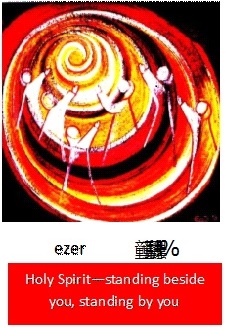
When the Lord God created the first human being, he was incomplete. It was not good for the man to be alone, God said. He needed, so Genesis tells us, a ‘helpmeet’, a companion who would be by his side to take his side. The word for ‘helper’ in Hebrew is a beautiful word, ‘ezer’.
God brought the animals to the man to see what he would call them. And the man gave the animals their names. But they were not the helpmeet the man was looking for. Maybe he was their helpmeet, their champion, their companion who could speak for them and make sure their world is a place in which they can thrive. But the animals were not a helpmeet for him.
But God put the man into a deep sleep (the first recorded instance of anaesthetics), and took from the man’s side a rib, and perhaps a grain of salt. We don’t have to take these foundation myths as literal history. They are stories that tell us the truth about ourselves. That’s why they are so important.
Creation of Eve by Paolo Veronese
From the rib, God created the first woman, and brought her to the man. She was bone of his bones and flesh of his flesh. The same but different. Equal but not the same. She was the ‘ezer’, the helpmeet the man had been looking for; someone who could be a companion and a champion, speaking up for him when he could not. That was the ideal, anyway. And the reason she could be a helpmeet when the animals could not, was that not only could she be a helpmeet for the man, he could be a helpmeet for her. There was mutuality in the relationship. “The mutual society, help and comfort that the one ought to have of the other”, as the old Prayer Book describes marriage.
Those of us who are blessed with marriage know something of what it means to have an ‘ezer’, a companion and a champion, someone who stands beside us and stands up for us. I thank God every day for the ‘helpmeet’ God has given me. And I know I am more human, a more complete human, because of Rae, because I am married. We men can be a little sub-human without our helpmeets.
And Genesis is describing not only marriage but other close friendships and partnerships. We may have an ‘ezer’ in an adult child, or in a friend we’ve had since childhood, or in someone we’ve only met recently.
People who study friendship say most of us have two or three, and at the most four or five people in our lives, who are close companions and who believe in us no matter what, and who we can speak up for too when necessary. I wonder too, whether an individual dog or horse might be an ezer for a human being. Is there a possibility of mutuality of care between species? Genesis doesn’t seem to think so, but seeing a recent program on ABC TV about dogs helping returned soldiers with PTSD made me wonder again.
The gift of a ‘helpmeet’ is a wonderful provision from God. But in the Old Testament God often describes himself as our ‘ezer’. Think of Psalm 46. ‘God is our help and strength, a very present help in trouble.’ – ‘ezer’. God promises to stand beside us and to stand up for us. He is our companion and our champion. God believes in us, and possibly the most difficult step of faith is to realise the depth to which God believes in you. God knows that you are not perfect, but he does not believe that you are therefore rubbish, he believes that you are of infinite value and worth. God will go to extraordinary lengths for you. Listen to what God says:
I have called you back from the ends of the earth, saying, ‘You are my servant.’ For I have chosen you and will not throw you away. – Isaiah 41:9
God championing us in this way makes us more human, more complete. God standing beside us and standing up for us makes us more who we are; it gives us the confidence and strength to grow into our true selves. So it makes sense to allow God to be our ‘ezer’, to stand by us in this fruitful way.
So what of Pentecost?
‘When the Helper comes,’ says Jesus, ‘the Spirit of truth, he will bear witness about me.’ (John 15:26). The Helper, the Spirit. The Holy Spirit is our ‘ezer’, and this Helper comes to abide with us, to be the ongoing companion and champion for us. Jesus reveals the name of the Helper, our ‘ezer’, it is the Spirit of Jesus, his ongoing presence with us.
And he also reveals something else: Jesus invites us into a mutuality with the Spirit. The Holy Spirit is our ‘ezer’, our Helper, and we rejoice in that wonderful presence in our lives, and he is also inviting us to be his ‘ezer’. Jesus is asking us to be his companion and his champion, to stand beside him and to stand by him in love; to speak up for him when appropriate, to make sure the world is a place where he can thrive.
Being a Christian is mutual; it is for the ‘mutual society, help and comfort’ that Christ and we have one for the other. And the more we allow the love of the Spirit, the Helper, to permeate our lives, the more human we become, the more truly human we become.
May I suggest a prayer – just a one-off, or to do regularly? You can do this by the beach, under the stars, or in the quiet of your own home, or right now as you sit in the pew. Take some moments to quiet your breath. Maybe do some controlled breathing, counting up to 30 or 40 slow breaths. Then imagine opening your whole self outwards. If you have room, you may spread your arms outwards. Then imagine the warm love of God surrounding you, and pouring into you from every side, filling you, leaving no room for anything else. This warmth is the fire of the Spirit of God. Hold onto the warmth and carry this feeling with you through the day.
*** *** ***
We dare to think that because we also agree to be Christ’s Helper, our love for Him will make him, in some mysterious way, more Christlike. Jesus continues the work that he began on the Cross through us. The Father has tasked him with bringing the world back to him, and Christ works, not by forcing his way through the evil that resists him, but by the gentle power of love, dripping like water on stone.
What we do can reduce that resistance, can open the paths of love, can help heal the pain of lovelessness, can sometimes even remove the stones that block the path of Christ. Look for acts of kindness, however small, opportunities to bring peace, and practise the way of Christ. There’s a saying attributed to St Francis of Assisi. ‘Preach the Gospel always, if necessary, use words.’
So it is extraordinary first to take in that God loves us, believes in us without reservation, and that we can allow ourselves to bear the fruits of peace, love, joy, forbearance, kindness, goodness, faithfulness, gentleness, self-control (Gal. 5:22-23) that appear in our lives just from being close to the Spirit. It is even more extraordinary to know that we are invited, as Christ’s companions, to share in his work, so that with the Spirit, he is more able to bring this world to the loving end that the Father has decreed.
It’s tough being in the desert. It doesn’t matter whether you’re on horseback, motor-bike or quad-bike. It’s particularly tough if you have to bring in a big mob. Or a mob that’s due to calve or lamb. You have to make sure you and the stock have water and feed – just enough, and a bit more. You have to keep the animals together. You have to be able to follow the faint tracks to the waterholes, because they are the life-line. And if you get to the windmill and it’s been fouled by foxes, or if the windmill has been knocked over by a mob of feral camels, you have to be able to fix the windmill, and get the water flowing again.
It takes all this to be a good stockman. You have to be tough, and capable, and resilient. You have to care about the stock, but not be a wimp. You couldn’t do the job if you didn’t care, if you weren’t committed 120% to the animals.
You know where this is heading. The word in Latin for a stockman is ‘pastor’. A good pastor, a good shepherd, is caring, tough, intelligent and committed. The desert of Judea is similar to the outback deserts of Australia. The job of stockman essentially is like the Palestinian shepherd.
‘I am the good shepherd,’ says Jesus. He made some of his fellow-Jews angry by saying ‘I am’: it sounds simple, but ‘I am’ is very close to the name for God revealed to Moses in Exodus 3: ‘I am who I am.’ He was making a claim to be God; and he was making a claim that God was at least Father and Son. Both were blasphemous claims, both were dangerous. Maybe he could be stoned to death. Better to find another excuse to have him put to death.
‘I am God, and God is a good stockman.’ That seems to be what Jesus is claiming. God cares for his mob, God is tough, resilient, capable and 120% committed to the mob. The good stockman, Jesus says, gives his life for the mob. This weekend we are surrounded by reminders of men who gave their lives for their country. But they didn’t. They gave their deaths for the country. And we express gratitude for the freedom their sacrifice has bought us. But the good stockman gives his life. He is prepared to die for his flock, but his main attribute is that all his life, for eternity, is given in the service of his people and of all creation. That’s commitment.
It is also an invitation for us in the Church to model ourselves after Jesus. Those of us who are designated pastors are called to be good stockmen and women.
The environment is tough, so no-one would set themselves up as a pastor in the Church unless they were called. And then God graces them to be tough, resilient, capable and 120% committed to the mob. Pastors follow the tracks as they dig into Scripture and lead people to nourishment in the Spirit. In our tradition they empower with Word and Sacrament, with preaching and teaching, and Holy Baptism and Holy Communion. The tracks in the desert are Word, and the waterholes are Sacrament.
The environment is tough, and most pastors in their lives have a time when those tough conditions get to them and they get hurt, or burnt out, or otherwise needing time out. When I was first ordained, priests who needed to take time off were not treated very well, and were expected back on the job as soon as possible. You know the routine: the stiff upper lip, not talk about it to anyone, just get on with it. These people often became less human and less able to pastor their people.
I was extremely lucky that after 6 months of sick leave from a parish, a friend, who was Rector of another parish, offered me a job as Associate Priest, on condition that I took my time, as much time as I needed, to get better. That generosity was great for me, and also ended up suiting the parish well, as I was able to plug some gaps over the next five years.
These days, you would hope that we can be absolutely generous with pastors, giving them as much space, time and eventually support as they need to heal so they become better human beings because of their experience, and therefore better pastors.
Not only are there individuals designated as pastors, the whole church is corporately a pastor, a good stockman, for the whole community, providing nurture and direction to the wider world. The ‘Manna and Mercy’ free dinners are a great example of this.
Just this week, a letter to ISIS came into my Inbox. It was slick communication, obviously aimed at the same young men who are attracted by the online propaganda ISIS puts out. Only this letter was a love letter from the Church, pleading with followers of ISIS to return to the ways of goodness and truth, to put aside their bloodshed and destructive ways. The letter calls the young men ‘brothers’ and acknowledges that we are all sinners before God. It wants to drench the Middle East with love, not hatred. Surely this is an example of the Church corporately being a good stockman: caring and committed in a tough environment, showing the way to true life.
As individuals, we are each called to be a good stockman or a good stockwoman, to show the way in a desert world to the oases of love that God provides to the individuals we meet.
When we look at the outback, we often choose to see only the expanses of empty unchanging desert; harsh, dry tracts of impoverished earth, dotted here and there with waterholes. Aboriginal people have learned the trick of seeing the positive image. Instead of emptiness, they see a rich network of journey-lines, song-lines, joining waterholes and leading the way through the annual cycle of hunting, gathering, and corroboree. It’s one of the reasons they can survive in the desert.
The Songlines (Bruce Chatwin)
Jesus calls us to be good stockmen and women, to see the journey-lines traced by the Bible in the desert and to be nourished by the waterholes of bread and wine. Jesus the good stockman leads us to life.
“The word of the Lord was rare in those days.” (I Samuel 3:1) That may not have been surprising. Eli was old, frail and nearly blind. He couldn’t see how corrupt his two sons were, partly because he was a doting father, and he didn’t want to believe that his offspring could be the stand-over merchants they were. His eyesight was failing, and as they say, “There are none so blind as so those who do not want to see.”
Maybe Eli’s end of life fatigue made him deaf to the word of the Lord. He wasn’t even in the Temple when the word of the Lord came, and the eternal lamp was only just flickering.
Little Samuel, on the other hand, was right inside the Temple, but he was naïve. He didn’t know what the word of the Lord was. There was nothing to hear because Samuel didn’t know then that there could be anything to hear.
So the word of the Lord was infrequent. I don’t think that means that the Lord had given up on his side. God still spoke consistently. People just listened infrequently.
We’re just human, after all. When I was about eight, my big brother said to me, “Don’t let them,” (them meaning our parents) “Don’t let them teach you how to milk the cow, or else you’ll get the job.” I never did learn how to milk a cow! We all arrange things so we won’t get called up to do some task or another, and we justify it to ourselves some way or another. But in the end, it’s avoiding the responsibility of a relationship.
Eli hadn’t taught Samuel how to listen because Eli knew what was likely in store for Samuel: a call to minister to the Lord in the Temple. But the Lord persisted, as the Lord does. The Lord woke Samuel, and Eli sent him back to bed telling him he was mistaken. He hadn’t heard a voice. How ridiculous! God doesn’t call people. The word of the Lord is rare.
Three times the Lord called. Three times Samuel answered, “Here I am, for you called me,” and three times Eli sent him back to bed.
Eli knew that both Samuel and he had to take on this responsibility. Samuel had to respond to this call from God, and Eli had to mentor him to become a spiritual leader. Both Eli and Samuel were called up to duty, to take up the responsibilities God had for them. So on the fourth occasion, Eli gave Samuel the instruction to reply, “Speak, Yahweh, Lord, for your servant is listening.” (3:9-10).
God did have something to say. It wasn’t actually the case that the word of the Lord was rare in those days. God had been calling Samuel before that night. God called Samuel repeatedly that night. God continued to call Samuel all through his life from that night on. The name “Samuel”, “Sh’muel” in the original Hebrew, means “called by God”.
Of course these days, in 2015, in our sophisticated world, the word of the Lord is rare. I mean, who would admit to hearing God speak to them?
Or might it be the case that it is our deafness, our spiritual unwillingness to listen, that is giving the impression that the word of the Lord is rare? We don’t want to hear, in case we’re called up to do a task, and get caught up in a web of relationships having to be responsible. Count me out, we pray silently. We might get the job of milking the cow every morning.
But the uncomfortable truth is that God is consistent and insistent. He continues to call people to himself.
Nathanael, in this morning’s Gospel, was called through Philip. That was the moment Nathanael responded, but he was surprised to realise that Jesus had already called him. Jesus had already called him when he was sitting under the fig-tree, presumably studying the Old Testament. (The scholars say what else would a model Israelite be doing sitting under a fig-tree?)
The fact of being called is important in itself, important enough to be recorded in the Scriptures.
God continues to call us. Not just like Samuel, at the beginning of our Christian lives, to particular life-long tasks of ministry, although those calls are still valid and immensely important. I’m no longer able to run a parish or work as a school chaplain, but I still feel strongly under the call of 40, 60 years ago to be a teacher and priest. The shape of the tasks is different; the call is still there.
Just as I am called, you are called. As a priest, the sacrament of ordination makes visible the fact that I am called. But that sacrament testifies to a God who calls his people. God has been calling you; God is calling you, God will go on calling you.
We are obviously not all called to be priests. But we are called to be with God. This aspect of being called grows in importance as we grow older. Our calling is first of all to respond in love to that love which believes enough in us to be constant in calling us to him.
Our calling is to be loved. Beyond all the tasks, beyond all the busy-ness. God calls us to allow Him to love us. Before we begin to love God, before we begin to love others, knowing that God loves us.
There’s a well-known prayer by St Ignatius of Loyola that usually goes by the name of Suscipe, the first word of the prayer in Latin. Suscipe means “Take”. The prayer goes:
“Take Lord, and receive all my liberty, my memory, my understanding, and my entire will, all that I have and possess. You have given all these to me. To You, Lord, I return it. All is Yours, dispose of it wholly according to Your will. Give me Your love and Your grace, for this is sufficient for me.”
“Give me Your love and Your grace, for this is sufficient for me.”
Take a moment now in your place to be aware that God is calling you. God has been calling you; God will continue to call you. If you are comfortable in doing so, close your eyes. … … … Be aware of your name, your Christian name, the name by which God claimed you at baptism, the name by which God welcomes you into his nearer presence, and be aware of God calling that name.
In your heart, say, “Speak, Lord, your servant is listening.”… … … In the quiet, in the silence, continue to hear that loving voice speak your name; and hear whatever else He is saying to you. … … …
1. The humble and pious already have the Kingdom of God.
2. God comforts the humble and pious when they mourn.
3. The non- violent and powerless are the rightful owners of the Promised Land (not the Romans and Zealots, and probably not Hamas and the Israeli military … )
Paraphrased from Jesus through Middle Eastern Eyes

 I’ve been encouraged in the last few days reading A Good Place to Hide, where Peter Grose tells the story of ‘How one French community saved thousands of lives in World War II’. The village of Le Chambon-sur-Lignon and its neighbours in the surrounding mountainous area hid Jews and others on the run. A small regional railway was the main access to the village which boasted a number of modest boarding houses that had been built for ‘healthy Protestant family holidays’. The village was surrounded by remote farmhouses, many of whom were willing to secrete Jews in their attics or cellars or barns, sometimes for weeks, sometimes for the duration of the war.







 Mind Journeys