I was just six years old, still young enough to be cute, yet old enough to grind down my father by simply insisting. ‘I want to climb Mount Pix with you and Jim and Len.’ The aforementioned were my oldest brothers, Jim the grand old age of 17, with a Brylcreemed slick of brown hair, and blond Len 14.
I had nagged my way into the big grey Pontiac. My father’s intention, I now think, looking back, was to park the car at the foot of the western-most peak in the Stirling Ranges, and leave me there while he and the big boys climbed their way to the top.
But I was having none of that.
From our farmhouse 30 kilometres north, Mount Pix appears a heart-stopping shade of blue. It is longer than it is high, and I have always thought its silhouette was like the cupid’s bow drawn in red on a lady’s lip.
Close up, you can still imagine the shape of the bow, but the blue has changed to the sage green of knee-high vegetation with the stolid grey of the granite sub-stratum.
Dad and the boys were each standing at a car door, leaning in to retrieve wet-weather gear, thermoses of tea, and other equipment suited for a hike in the hills. They set off along the kilometre walk to the base of the mountain.
My sandals were not suitable for the grass underfoot and leaves and stalks scratched viciously at my thighs. As I struggled to keep up, I realised quickly that the team was not about to accommodate my laggard progress. Their intent was to lose me in the early stages of the hike.
The mountain loomed before us. As the climb became steeper, the going was a bit easier. It was mainly rock at my feet and the fauna grew sparser. At 30 kilograms, I discovered my advantage over my heavier siblings. I scampered up behind them.
As I climbed, I discovered a new vantage of the mountain. It was unfolding like a vast paper toy: Mount Pix had more than one peak!
‘Stay there and we’ll collect you on the way back,’ Dad called over his shoulder. They disappeared over the first peak. I followed. For a moment, the way ahead deterred me. Beyond this first peak, the ground fell rapidly away. There was a deep valley and beyond that, an even higher peak. Was this the top of Mount Pix?
I stumbled down towards the valley, my family small sticks on the upward climb opposite. Soon, they disappeared over the top. There was another peak beyond this one.
The point and bumps of the Cupid’s bow were unfolding to be three of several peaks.
I was in fact getting tired. I remembered that Dad always fabricated a suitable hiking stick by snapping a branch off a jam tree. I looked around for a tree.
I made my stick and tested it. I was now alone in this enormous valley. Should I turn back? No, this mountain is not going to beat me. I pressed on upward with my stick working well.
The blue sky rose from the peaks either side of me. A pair of wedge-tailed eagles circled above. A willy-wagtail suddenly chatted nearby, making me jump. Something slithered in the undergrowth. My experience suggested that a bobtail or similar small lizard had produced this noise; my imagination conjured up a large snake.
I looked towards the peak, searching for the reassuring figures of my family. But they had gone over the peak. I stumbled up the hill. I thought, if I run fast enough, I will find them.
Puffing hard, I reached the next peak. From this peak, like the first, the ground fell away steeply at about 45 degrees before rising to an even higher peak. A vast empty vista of the mountain’s inside. My heart beat even faster. I wanted my Dad, but he had vanished. Can I catch up?
Then I wondered how many preparatory peaks there were before the final peak. I hadn’t thought that a mountain might go on opening up like Dad’s accordion.
If I go on, I might miss them on their return trek.
If I turn back into these huge mountain folds, I might get lost altogether. Tears ran down my face.
I will go back, I decided. I’ll pick out my outward path exactly and follow it religiously. I had to circumnavigate the slithering noise, but then I would concentrate on retracing my exact steps.
As I pushed on up the steep slope, the sky went black. I wondered if it was going to get dark, nighttime dark, but the cloud covering the mountain burst into torrents of cold rain. My t-shirt and shorts were suddenly drenched. My sandals slipped on the slick granite. My stick slipped out of my hand.
I had a picture of my body rolling down the slope, bumping and breaking bones as it went.
Suddenly, strong hands lifted me and there I was, safe up on Dad’s shoulders.
Two hours later, I was drying in front of the kitchen fire, naked. My pyjamas were in the oven, warming. Behind me, my parents’ comforting voices, an edge to my mother’s.
‘But, Roy, you couldn’t just leave him floundering while you went on. You were thoughtless. He’s only six.’
Then Dad’s calm laconic reply, ‘But he’ll learn from it, Joan. Probably remember it all his life. ‘
####
copies of my memoirs SKerricKs are still available from me: $22.50 + $15 postage in Australia. Email TedWitham1@gmail.com
The Universal Basic Income, as you will know, proposes that every citizen receives a basic income, an amount sufficient to live on. The scheme would replace most, if not all, of the support the Government provides through Centrelink and NDIS. Studies show that it would cost a similar amount to our current system.
The UBI promises to
Raise the poorest in our community out of poverty, especially those on Youth Allowance, people caring for loved ones full time and tertiary students.
Reduce inequality between the rich and the very poor, thus giving all citizens a sense of dignity.
Decrease homelessness through better distribution of wealth.
Lift productivity. People freed from meaningless work would make their contribution to society through work for which they have a passion.
The Albanese Government has the confidence of the Australian people to make bold changes to make ours a better society. Rather than tinker around the edges of the tax system, you could make a wonderful improvement to the Australian community.
They must have complained directly to the Headmaster, even though the Chapel was in my day-to-day care. It seems the anonymous complainants were offended by the ‘pounding’ and ‘shrieks’ of the rock group practising in the holy space.
I don’t remember if I gave the Music Department permission for this apparent desecration or whether it was a joint decision with the Headmaster. He did have a habit of micro-managing, and sometimes that was a helpful quality. It meant that on occasions, he accidentally took responsibility for my boo boos.
The orchestra had been playing in the Chapel for some years before, and no-one had objected to their percussion or high-pitched instruments. The first I knew about the complaint was at Assembly one Friday, the whole Senior School gathered – and all were as surprised as I was.
The hymn had been sung, the lesson had been read by the Prefect, and I had delivered my five-minute sermon, and handed the lectern to the Headmaster. Peter Moyes, in his black academic gown could look quite stern, but as we passed each other, I thought I detected a twinkle in his eye and a twitch of a smile.
Mr Moyes congratulated victorious sports teams, reminded the boys to pick up rubbish, and congratulated one of the French teachers for an award he had won. All routine.
Then he relaxed into a narrative. He did like hiding good news until the end.
‘The rock orchestra,’ he started, ‘has offended someone. I can’t tell you who it is, but they said that the band was playing too loud. The chaplain and I had both agreed they could practise in this space. My chapel, our chapel, is a great place to practise. It’s away from classrooms, it has a wonderful view of the river, which I’m sure helps our musicians make excellent music.
‘So I hired a sound engineer and asked him to investigate this problem. This engineer had a sound-meter, and he came for a couple of days over three weeks. He measured the sound that was being put out by our groups.
‘I learned from this engineer that the rock group peaked at about 87 decibels. That’s like a lawnmower hammering away. That’s loud. If you listened to 87 decibels for too long or from too close, you might cause damage to your ears.’
The Headmaster paused. I could see the boys calculating what the rock group’s fate would be if it was so damaging.
Then he continued, ‘He measured the orchestra as well. Classical music, much more civilised,’ he enthused. I knew he was a lover of orchestral music. ‘He reported to me that the orchestra peaked at 95. For volume, more like a night club than a chapel,’ he said.
Is he going to ban all musical groups from the Chapel? I formed the question in my mind. I wasn’t sure – but if there was evidence, he might…
‘And last of all, he measured the chaplain speaking and singing. Father Ted peaked at 105 decibels. I’ll tell the complainant.’ He smiled his enigmatic smile at the boys and sat down.
####
copies of my memoirs Skerricks are still available from me: $22.50 + $15 postage in Australia. Email TedWitham1@gmail.com
There was a two-roomed school in Moorine Rock, and an old weatherboard hall. There are a few other buildings, including a newly restored hotel, but there is nothing big about Moorine Rock. It’s not a town, just a tiny string of buildings along the Great Eastern Highway 400 km from Perth on the way to Southern Cross.
I was there to collect a ute. Each month for 18 months or so in the mid-1990s, I took the Prospector train to Southern Cross to lead worship in two or three centres and mentor the two farmers who were studying in the parish-based TEAM program.
The parish would organise a car for me. In an average Southern Cross weekend, I would drive several hundreds of kilometres along lonely roads, huge flat paddocks of wheat or canola my only company, in order to take services in Southern Cross and tiny settlements like Bodallin and Mount Walker, each with a half-dozen worshippers.
And on this night, a parishioner had brought me to Moorine Rock to collect my transport. It was convenient because there was a party in the hall, and I could meet some new people who weren’t churchgoers. In theory, a good idea. I thought I would be up for the social challenge, but it didn’t turn out that way.
I was nearly punched.
A line-dancing troupe from Perth had visited the school that afternoon. It stayed on to provide the music for the evening. The Principal chatted with me. Her 12 pupils were lined up on the dance floor to show their parents the moves they had learned that day.
I knew no one. I looked around the hall. There were a couple of dozen mothers chatting in twos and threes. A few of the men lounged against doorframes their fists grasping cold cans of beer. Other men were outside, all in earnest conversations. I overheard ‘wool prices’, ‘canola harvest’, ‘sheep sales’. I thought I was at home in a farming community. I thought this was like the little town where I grew up. But I knew that breaking into tightly knit conversations as a stranger was always hard. I thought I was up to the social challenge.
The music started up again after a break. The Principal called for everyone to get on the floor and join the line dancing. Two or three of the women joined in. They’d done this before. A young man from the Sons of Gwalia mine, an outsider, merrily drunk and hyperactive, took himself to the floor energetically. Not one of the farmers made a move towards the dance floor.
The Principal dragged me onto the floor. Elbows linked, we jigged in our line. The dancing was quite fun, but I noticed that the young miner and I were the only males on the floor. It seemed men didn’t dance.
I scooted back and forth for 15 minutes or so until the Principal released me. I thought I would join a conversation outside in the black night around the barbecues. I stood outside two of the groups waiting for the opportunity to jump into the conversation, either verbally, or physically. I wasn’t there it seemed.
I thought of Tambellup. It was many years since I had seen such strict apartheid: women inside, men outside.
I wandered back inside and tried to join the women’s talk. One group was more inviting and allowed me to move into their circle. But I could find nothing to contribute to their talk of babies and home duties and being a woman on these vast farms. It was on that night I learned that many women in their forties with growing families and solid farm responsibilities were not allowed access to money. Their fathers-in-law insisted that he had sole control of the bank accounts. The women were welcome to shop, but every little item had to go on the farm account – and then be accounted for.
Moorine Rock was in no danger of being liberated, it seemed.
Pretty soon, I gave up trying to socialise. I grabbed a can of Sprite and leaned against a wall: an involuntary wallflower. One of the farmers’ wives took pity and asked me who I was and what I did. The usual small talk. Very soon, we were into her rare trips to Perth. I told her about my travels. She had cruised in Europe and around Greenland. Suddenly there was a man between us, his face red.
‘Let me have my woman back.’ He said it quietly, but I could hear the menace in his voice.
‘Sorry about my husband,’ she said as he led her away.
I assumed that he was drunk and that this was a one-off situation. I still thought I could handle the social challenge.
I repeated the very same mistake five minutes later. This time the angry husband was about to hit me, but his wife restrained him.
I decided it was time to leave. I didn’t fit in. I couldn’t meet the social challenge. I headed for the front door of the hall and out into the night. I had to find the ute. I had to be able to locate the ignition. If I couldn’t succeed in those two challenges, I would have the humiliation of having to go and ask one of the men for help.
I quickly picked out the only ute. I slid into the dark cab, felt for the key slot, started the motor and flicked the headlights on. Three challenges in the pitch dark, really: one, find the ute, two, put the key into the ignition slot, and three, find the headlight switch. Three challenges met. Much easier than the social challenge.
I followed the dirt track from the hall to the highway and piloted the rattly ute to my accommodation in Southern Cross.
I was glad to be alone.
On Monday, back in Perth, I visited my physio. The boot-scooting had put my back out . Dislocated – badly.
Tyrants seek to expand their power. While I don’t live in the United States, the actions of its President over the past 100-plus days have implications for us worldwide.
Mr. Trump’s power comes in large part from his wealthy tech. friends, Elon Musk, Mark Zuckerberg, Jeff Bezos and others. Together they form an oligarchy whose talons reach right into our Facebook accounts and grab hold of our book buying on Amazon. We send a message on Messenger, we read a tweet on X and we are forced to see ads which further enrich these billionaires.
Can any one of us individuals change these abuses of power? No, but we can act together, and we can resist the coming tyranny.
Here are 8 acts of resistance that I have been taking. I invite you to join me.
Delete your account with X if you still have one. X is the most destructive platform. It allows bullies and ideologues to channel us into submission to their viewpoint.
Don’t scroll on Facebook. Post what you want to, use ‘Notifications’ to read the posts of friends, but refuse to roll down the screen. Each click puts an ad before your eyes and ears and each ad seen adds to their wealth. The oligarchs are viciously clever. They earn money from us and without our consent.
Stop calling your smart speaker, ‘Hey Google!’ I call, ‘Hey Dougal’, or ‘Hey Bugle’ when I want it to respond. The tech company is happy when you repeat its name a dozen times a day. So don’t say ‘Hey Google’ and don’t say ‘I googled it.’ Avoid the commercial name and say, I searched on the internet.
Avoid buying on Amazon if you can. I find where most books are for sale on the Australian site www.booko.com.au. I usually don’t need Amazon either to find books or to buy them.
Don’t buy a Tesla car. The boycott on Teslas is already hurting Elon Musk’s business. If you are buying electric, WA’s Royal Automobile Club is comfortable recommending a range of electric cars, like the Chinese-made MG or the European-built Jeep Avenger. You don’t need a Tesla.
Think about deleting your Instagram account. Like X, Instagram allows bullies on its platform. It also encourages viewers to have unreal expectations of themselves because it rewards performance over integrity.
Never tick ‘Accept All Cookies’. Cookies are designed to deliver your name to the advertisers. If you can reject all, do so. Otherwise, choose to manage your preferences by unchecking as many choices as the site permits you.
Choose ‘Ask App Not to Follow Across Sites’. When it pops up, this option reduces the ability of the algorithm to create a web of connections and so multiply the points of contact for advertising targeted to you.
God gives us death; the gift is nature kind. Death puts to an end the pains of old age, making space for those in the queue behind. God writes each chapter and the final page.
Species yield to species, each man to a new, Deep time sweeps all away to stubborn death. Death’s truth’s not sad, it’s merely stark worldview: Each allotted our finite store of breath.
So death spreads from past until the very end. But wait! There’s a surprise: God….! A new thing surpasses all we can know: Fresh universe of power and love to grow.
God rips death‘s fabric the curtain to transform, The new-made mystery; pristine creatures swarm. Alleluia!
- Genesis 1:20-23, & 2:7-8, John 1:1-18, Mark 15:38 - Ted Witham tssf, Easter A.D. 2025
The world is in a bad way, and sometimes it’s hard to look at it.
I see a child in Gaza, his eyes filled with horror and a question: ‘How could someone do this to us?’ So, it’s not surprising that people are turning away from the horror of the news. The Reuters Institute at Oxford University showed that fewer young people are looking at the news online; down from 89% to 76% in 2024. That’s a huge drop. The proportion of older people, those over 55, are also turning off, but at not such a fast rate, 73 to 68% in 2024.
2024 was the first time ever I’ve turned away from the news because it’s too hard to bear.
My father instilled in me the habit of news. At 7 p.m. every evening in our farmhouse everything stopped. ‘Shhh!’ my mum would say, ‘It’s time for Dad’s news.’
Reflecting on those years – the 1950s – I take a guess at why Dad insisted on listening to the news every day. On our farm our family could go days and weeks without seeing anybody; a stranger’s car was quite an event. Yet Dad wanted to know how the war in Korea was going; what the price of wool was in Albany and Fremantle; what international role Australia was playing when Labor politician Bert Evatt was President of the United Nations; and, most important of course, the cricket!
Dad reminded himself and us, every day at 7 p.m., that we were part of a much bigger world.
It’s been my habit since childhood to stop at 7 p.m. and listen to the ABC news. These days I can see the news as well as hear them read. My TV takes me straight to the Oval Office, or straight to the front in the battle for Ukraine, so the news has possibly more impact than 60 years ago.
And the news is bad. Once upon a time, an Opposition advanced opposing policies to sharpen the Government’s ideas. It was more a contest of ideas than attacking those on the other side. There is little civility now as they demean their opponents and not their policies.
The United States have become the Divided States, and the President, whether you approve of his policies or not, is a convicted criminal, a proven misogynist, a loudmouth and a bully.
Israel is carpet-bombing Gaza. It’s still happening.
Put a pin just about anywhere in the world, and the news is bad.
So I have three words to save the world.
Gratitude,
Awe, and
Kindness.
So many good things are buried under the rubbish of our contemporary life together. Most of us are loved. Most of us have food for today and the confidence that we will have food tomorrow. I live in a new house. I have more clothes than I need. I have a new car with all the latest tech. It’s a van actually, with a hoist for my wheelchair, and both the hoist and the chair are gifts from the Government, my fellow citizens caring for me.
Things work. Trains run, roads are smooth, ships bring all kinds of goods to us. We can visit friends in London or Sydney, and the trip will be safe and the aeroplane seats comfortable; well, not that comfortable.
And gratitude Is a spiritual discipline well worth cultivating. To be thankful, we need to look beneath the world’s garbage and find the good that has been provided for us. We can resolve to be thankful regularly, daily, more often.
I say a short grace before meals. ‘Bless, O Lord, this food to our use, and ourselves to your service. Help us remember those who are hungry and homeless.’ The very word, ‘grace’ means ‘thank you’; gratias in Latin, grazie in Italian. It also means ‘grace’: giving thanks is an act of grace, giving thanks embellishes, it gives style to our way of living.
Gratitude is not just a once-off thank you. It is saying thank you regularly.
Gratitude changes the world. It re-affirms our worth, both the person thanked and the person thanking.
I’m in awe of the beauty in the world. Awe is my second word to save the world.
I have stood in awe of the tingle trees and the karri forest of our southwest. They are awesome.
When we lived in Warnbro, my wife and I often made a point of driving five minutes to Warnbro Beach and watching the sun set over the Indian Ocean, in awe of the change of day to night, in awe of the golds and reds and purples and greys. In awe.
I have been stunned by the astonishing beauty of the impressionist paintings in a museum in France.
With 2,000 other music-lovers, I have stood in the Perth Concert Hall clapping the West Australian Symphony Orchestra after it played extraordinary and beautiful music.
The craft of popular artists like Taylor Swifts and TV dramas also lift morale and bring us to awe.
There is so much beauty in the world, created by our God and created by humans, which brings us to awe. That awe can lift our spirits and change the world. Awe and wonder increase the beauty in the world as they prompt us to see the beauty in other people, other scenery, other art.
Awe changes the world.
Kindness, too, will change the world.
I call them angels. I was driving my van in the Busselton Coles carpark and I turned too sharply over a high kerb, and hooked a rear wheel. I couldn’t move forwards or backwards. While I stood there scratching my head, six burly guys in hi-vis shirts and big boots came walking towards me. These tradies surrounded the car. One said, ‘One …, two …, three …, LIFT,’ and the van was free. The tradies waited while I drove off. They were making sure that I didn’t repeat my bad driving. I watched them in my rear-vision mirrors as they walked off in different directions. These kind tradies did not even know each other! They all just banded together in an act of kindness.
I remember this 10 years later. Whether we are the beneficiary, as I was, or one of the angels, or one of those watching in the carpark, when we see kindness like that, the world changes. We all feel more confident that we live in a community where people help each other out.
We see reports of people rescuing their neighbours from their flooded houses: kindness changing the world. We see people taking next door’s bin to the verge when the owner of the bin can’t manage: kindness changing the world. We see it in the smile of the teenager helping someone lift their shopping into their car: kindness changing the world.
Gratitude; awe; kindness. These three words have power. I used to worry that people might find them too touchy-feely, and of little value. But I know now that kindness, gratitude and awe are far more powerful than the demonic hatred, violence and ugliness that dominates the seven o’clock news. We still need to watch the news; we still need to know where the world is at. But when it seems that evildoing will never end, we remind ourselves that hatred, brutality and greed will come to an end as they are overcome by the more powerful forces of love. Gratitude, awe and kindness will save the world.
The badge has arrived in the mail. Although the package was quite small it may provoke savage reactions and will certainly be misunderstood.
Years ago, I was much more politically active and wore badges to signal my involvement in different causes. I have kept a cloth bag of badges made with those old, primitive badge-makers. I shake them out onto the table, and I see now I supported the Campaign Against Racial Exploitation, Amnesty International, the Wilderness Society and all the predictable leftist crusades.
But this new badge is partly to protest the media who have so manipulated our sympathy that we lose our wider view and demonise a whole group of society.
The badge is a blue star of David on a white background. I will be wearing Israel’s colours, Israel’s symbol.
But why?
It may seem perverse, then, to wear a badge proclaiming. עם ישראל חי” (om Israel chai – let Israel live): how could I show support for a nation set on the annihilation of another?
The media encourage us to make a moral calculation: on October 7th in 2023, 1,200 Israeli citizens were killed and 240 were abducted by Hamas. In defending their country, Israelis killed 1,500 Palestinian terrorists. We want to cry out, ‘Isn’t that enough killing? Isn’t an additional 40,000 Palestinian deaths and flattening of homes overkill?’
Possibly like you, I also wonder whether razing Gaza is a precursor, as President Trump advocates, for wholesale dispossession. ‘Take them somewhere nice,’ he says with a blasé smile, their fate evidently irrelevant to him.
Like you, I have long been aghast at Israel’s harassing Palestinians and clearing them from the West Bank, and the current intensification of the IDF’s activity in the refugee camps where, apparently, terrorists peek out from under every Palestinian bed.
But consider Israel. I see a nation lashing out in fear. Many Israelis are children and grandchildren of the Holocaust. They are terrified that they will again be wiped out. They feel abandoned by the Western nations that created the State of Israel 76 years ago. Their only friend seems to be the US, and that friendship under President Trump now seems brittle too.
For me, that cannot justify Israel’s behaviour in Gaza. But it goes a long way to explain it. And we have rarely seen that mortal dread expressed in the media. So I support Israel as it recoils from violence done to it. It is scared for its life.
Secondly, there is the agony of the hostages; their own agony, but also the agony of their loved ones and fellow citizens. They’ve ached for them to be returned. They’ve raged against their Government for continually prioritising the military response over bringing the hostages home. I stand with all the hostage families. They’re Israelis.
Thirdly, Israel’s Central Bureau of Statistics counts over 2 million Arab citizens. One Israeli citizen in every five is Arab or Palestinian. At least one Arab is a member of the Knesset, Israel’s parliament. These Israelis are harassed, interrogated and imprisoned if they speak a word against Israel’s actions in Gaza. But they’re Israelis.
Lastly, not all Israelis approve of their Prime Minister. They see his political calculus. He wants to cling to power. He needs to stay in power to forestall criminal proceedings against him. Ordinary Israelis feel the whole gamut of reactions to Netanyahu, from approval to active support, but also from disappointment to feeling betrayed by him. I stand with the critics of the Israeli government.
I like Jewish culture. At its best Judaism is a powerful moral and intellectual force in the world. I like the whole gamut of Jewish ritual from the blast of the shofar to Sabbath meals. It’s no accident that Jews are over-represented in fields as diverse as medicine and music. Judaism was the cradle of Christianity.
Judaism produced the extraordinary collection of books we call the Old Testament. The Jewish Scriptures contain amazing poetry, stunning philosophy and intriguing theology. I have invested years learning Hebrew and studying the pages of these fascinating books from Genesis to Malachi.
I stand with the Jews’ legacy as builders of an ethical and aesthetic civilisation.
I look into my heart. In the end, I cannot but wear the blue and white badge even it offends random observers. I cannot but stand with Israel.
In the name of the living God, + Father, Son and Holy Spirit. Amen.
Fifty years a deacon. The Church 50 years ago was a very different church. Churches around Perth were generally full on Sundays – many churches filled two times over with two services. Men still wore suits to church, and women wore Sunday best dresses. Some women wore hats, but hats were beginning to stay away. The declining attendance of hats was a sure sign that the Church was about to change.
We were still ‘The Church of England in Australia’ – our name didn’t change until 1981, and I think our English culture is only now beginning to change.
Sunday Schools around the city were huge. 70 or 80 kids and a dozen teachers turned out every Sunday at Christ Church Claremont and parishes like it. The General Board of Religious Education, set up by the Australian General Synod, produced the course book used by most Anglican Churches. Children were completely segregated from adults, and, many children were dropped off by their parents. These parents may have seen benefit in Christian education for their kids but not for themselves.
There were arguments that you might remember about whether children were really ‘people’ for the purpose of attendance numbers and statistical returns!
By 1975, the once-flourishing Y.A.F. – the Young Anglican Fellowship – had pretty much shrunk and died.
I grew up in a country church in the 1950s. You could definitely see the decline in little churches all over the southwest corner of the state. Our little church, St Mary’s in Tambellup, might cram 70 people in for Christmas services. They even put out little folding stools with canvas seats down the aisle to accommodate everyone. But the Sunday after Christmas, and for most Sundays of the subsequent year, the congregation was fewer than 15 or so. There was a little Sunday School, taught by Mrs Lorna Taylor, who also played the organ, ducking in and out of the church and the church house next door during the service. That Sunday School had less than five kids.
This was the Church five of us were called to be deacons in 1975. The church appeared to be flourishing, but there were clear signs that we were about to be pruned – enormously.
Although accurate statistics were hard to find, 8,000 or more people turned up to Anglican services across this Diocese each Sunday: more, we were reminded, than attended WAFL football matches each weekend.
The Diocese tried some big things to stop the runaway numbers. 1975 was the year of Celebration 75, a huge mission of the Diocese, culminating in 10,000 Anglicans gathering at Perry Lakes stadium for the Eucharist on Palm Sunday.
Celebration 75 was memorable because of the murder of Archbishop Janani Luwum from Idi Amin’s Uganda. Luwum was one of the bishops visiting Perth for Celebration 75. Some months after he returned to Uganda he was found in a crashed car just outside Kampala – his body riddled with bullets. ‘The blood of the martyrs,’ Tertullian said 1800 years ago, ‘are the seed of the Church.’ Maybe a little of Luwum’s blood would impact Perth Diocese!
Goals were set for our diocese – 24 new parishes to be planted in 24 months. When we young clergy spent time with Archbishop Sambell, his parlour game was to get us to state as many new suburbs as possible (Kallaroo, Mullaloo, Heathridge, Connolly, Joondalup, Currambine, Iluka, Ocean Reef). Then the Archbishop would comment: ‘And that is our mission field.’
Luke’s telling of the calling of the first disciples reminds us of three things about the ‘mission field’ – the situation which they were called into. The painting by the 14th– Century Italian painter Duccio di Buoninsegna is a sermon in itself. Buoninsegna means ‘teaches well’, and that’s what this beautiful picture does.
Duccio’s painting tells the story of the Miraculous Draft of Fish all in one image. He starts with Jesus meeting Simon and Andrew. Notice the sky is golden. When Simon and Andrew meet Jesus, we are not in the normal everyday world. Duccio paints them in heaven with its gold sky. Jesus is on the rock; Jesus is the rock. Jesus invites Simon and Andrew to step on to the rock, onto the solid ground of a new relationship with Jesus and to turn the everyday world into the glory of heaven.
I must admit that the two disciples don’t appear to be straining to haul in the heavy net of fish. With Jesus by their side, the effort is shared with Jesus and their burden becomes light. There are fish everywhere in Duccio’s picture, both in the net and outside the net. In this vision of heaven, you don’t need to be inside the net. Everyone is included in God’s love.
Duccio the painter is teaching that what is true for Simon and Andrew then is true for us now. Jesus continues to invite us into a life-giving relationship with God. Jesus calls us to the work of mission with him. We are to be encouraged that in the end, God makes sure that there is a good haul of fish – of people.
Simon’s encounter with Jesus sees him coming to terms with the way Jesus, a carpenter, told him where the fish were. Jesus told Simon to put out into the deep and put his drag net out the other side of the boat. Just imagine how Simon must have swallowed his disbelief: he may be Jesus the preacher, but really, what does he know about finding fish?
Simon puts the cumbersome net into the boat, I imagine with some reluctance, gets the oars organized, rows out to deeper water, puts the net in the water and then drags it in a half-circle from the boat; all the while expecting nothing. What difference can Jesus possibly make?
And then surprise! ‘So many fish that their nets were going to break!’ They filled two boats to the point of sinking. (Luke 5:6)
Simon is shaken. Shocked to the core. This man Jesus is like no other human being Simon has met. ‘Get away from me, Lord, for I am a sinful man!’ (Luke 5:8) Seeing Jesus in this moment makes Simon squinch and shudder. This encounter with the power of Jesus strikes Simon (and Andrew and James and John) as so massive and so stupendous that they left everything – everything! and followed him.
I assume Simon used to go to synagogue and had heard the scrolls read. He knew about the prophet Isaiah, who, like Simon, was overpowered when he was encountered by the Lord God in the Temple, and, like Simon, Isaiah’s first reaction was with dramatic words: ‘Woe is me! I am a man of unclean lips, and I dwell among a people of unclean lips.’ (Isaiah 6:5)
In this squeal of pain, Isaiah recognises that he could not stand before the living God unless God reached out and made him stand. And for Simon, the catch of fish had the same effect.
The second part of Simon being called to the ‘mission field’ was calling others to help him. To haul in so many fish Simon needed to call on his brother Andrew and their partners James and John. You need others. Jesus rarely invites single heroes to do the work of ministry. It’s too hard. It’s too big.
Jesus himself is on a fishing expedition to catch people. Luke implies that his catch, consisting of Simon and Andrew, James and John, is also a good haul. These four will make a significant difference to the ministry of Jesus.
All ministry requires hauling in people. Maybe ‘hauling in’ people is not the best image. The church is not the Ringling Bros and Barnum & Baileys, hauling suckers into the Big Tent! Rather the church’s business is inviting people respectfully and gathering them in. Even so, the church of God is a Big Tent.
Our parish’s ministry to the homeless always needs volunteers. Morning tea after church needs volunteers. Children’s ministry needs volunteers. Even the work of worship – our liturgy – needs all of us and not just the priest out front.
The third idea is to underline that ministry is always about people. Simon is called to catch people; not so much catching fish.
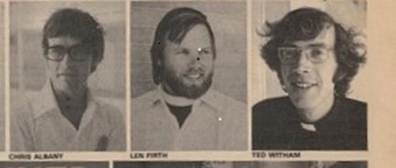
This was really underlined 50 years ago during our year as deacons. Five of us deacons and one presbyter from the Church of South India spent 1975 in the Deacon’s Training Program. This program was designed for us to experience the practicalities of every ministry in the Diocese.
We spent 10 weeks in an established parish: I was assigned to Kelmscott Parish, and then to Balga Parish north of the river. Balga was a more catholic parish, and Kelmscott an evangelical parish, so all of us participated in leading different styles of worship.
We spent 4 weeks in hospital chaplaincy, visiting patients and taking them communion.
We spent a fascinating 5 weeks in mental health. We saw the way the behaviour of acutely mentally ill people challenges the staff to care appropriately for them. We visited residential homes and wondered whether those big institutions were the right place for the severely developmentally challenged.
We spent just a few days in Industrial Chaplaincy – basically a visit to the Alcoa Refinery in Kwinana to meet John Bowyer the then chaplain!
For this Deacon’s Year, we resided at Wollaston College We each shared leadership in music and worship in that wonderful big tent Chapel. Following the Benedictine Rule, we had to do some manual work around the College, cleaning windows and pruning and sweeping paths and roads.
I’ve never been one for manual work, so I offered to restore the old harmonium which provided our music in Chapel, and I enjoyed cleaning reeds and fixing wires and bellows. It took me the whole year to complete – conveniently!
The Deacon’s Year was fast-paced. Two weeks in a country parish, where I watched with amazement Henry Tassell, a country pastor who had the rare knack of turning up on a farm at the right time, say, morning teatime during shearing. He kept overalls and work boots in the boot of the car to pitch in and help the farmer.
Two weeks in a church school.
I was anxious to be a school chaplain.
When I was about ten, I had a dream one night. After this dream, I remember rushing to my Mum and blurting out, ‘When I grow up, I’m gonna be a teacher and a priest!’ Mum advised me not to say anything about the dream.
But I did think of it every now and then. I interpreted it to mean that I would be a school chaplain. So, the Headmaster of my school Peter Moyes, even when I was still at school, had also encouraged me to be a school chaplain and before going to theological college in Melbourne, I had taught in the country for two years and enjoyed it.
So I learned a lot in those two weeks at Perth College. Teaching girls only in a classroom opened my eyes. When girls behave badly, they behave badly in big groups. Suddenly the whole class, it seems, turns on one person and bullies them, one of the girls, or the teacher. Unlike boys, you can’t just pick out the perpetrator and punish him. I had to learn strategies to deal with feminine mob rule!
But that didn’t dampen my determination to be a chaplain. I saw how the chaplain Terry Curtis conducted the Chapel services, what opportunities he had for pastoral care for the girls and for the staff – and a scary Headmistress!
Later, I had nine satisfying years as a school chaplain, one year at Hale School, and eight years at Christ Church Grammar. After those years, I discovered even more ways of being a teacher and a priest.
But back in the Deacons’ Year, we had a tough 36-hour Urban Training course We had to survive in the city without money. We pretended to be homeless, living on the streets, under stress to experience how our society looks after the needy.
A four-day Human Relations course back in Wollaston College turned out to be a deep dive into our inner psychological lives. Some of the deacons found this group work too threatening, so it was abandoned in subsequent years.
Anglicare, Anglican Homes, how to conduct weddings: at the time some of it was a blur. But the basic point was made: ministry is about people – worshippers in a parish, patients in hospitals, kids in schools, brides and grooms, people on the street, certainly neighbours and friends and families. And ministry meant making connections with hospital chaplains, diverse parish clergy, school chaplains, Government agencies, and a whole host of carers who gave us insight into other caring people in our society.
This practical year 1975 followed three years of theology study. None of my fellow deacons complained that the academics were not relevant to ‘real ministry’. I felt, and I think the others agreed, that we can only understand the purpose of practical ministry if we understand a bit about God. In our Deacons’ Year, we experienced God in the marginalised. We made sense of it with Bible study and through Church History.
Luke doesn’t tell us that Jesus ordained deacons. Jesus calls all the baptised to ministry. Jesus invites each one of us to be a deacon and serve the needy. Matthew writes a parable, you remember, about sheep and goats. When we minister to the least of these, we are loving Jesus. The ministry of service is for all of us.
Deacons, ordained deacons, some permanent deacons and all priests and bishops, we are deacons before we are priests; as ordained deacons, we are the church’s sign to itself of helping the needy. Our life of service shows that all of us rely on God to empower ministries of service. Deacons’ service in the community emphasises that the church doesn’t exist for its own sake. The church exists always for others. The great wartime Archbishop of Canterbury, William Temple, is often quoted that ‘The Church is the only society that exists for the benefit of those who are not its members.’ The church is a diaconal church, a serving church, a church of deacons, and our holy task is to love God by serving people.
Fifty years on. 2075. I won’t be around to see it, but some of you will. And I hope you experience how God keeps loving you, and you will keep loving your neighbour. Because whatever changes 2075 will bring, we will still be a deacon-shaped church – and that’s worth celebrating.
It was a cold Melbourne night in the year 2000, but we had left our coats at the door to the warm rooftop restaurant with its stunning view of city lights and the shimmering dark shape of Port Phillip Bay beyond.
Women in their best evening dresses outshone the men in suits and ties, or clergy collars. In the meetings during the day, I had been elected as Secretary of the Australian Association for Religious Education (AARE).
‘You are to sit here now that you are our Secretary,’ the Association President pointed to a seat at the top table.
A man about my age (early fifties) with a smart brown leather jacket, an open-necked shirt and a mop of grey hair was already seated.
‘Ted, meet Michael,’ the President said and rushed away to welcome other members.
In the restaurant, buzzing with the enthusiastic voices of members with a common passion, Michael was an oasis of peace. I greeted him and we shook hands.
‘Where are you from?’ he asked.
‘Perth. I work for the Churches’ Commission on Education there. Like Victoria’s CCES.’
‘Yes, I know CCES.’
‘Have you been to Perth?’ I asked.
‘I was in residence at the Chapel at Christ Church Grammar a couple of years ago,’ he replied.
I told him I had been chaplain there in the 1980s, and we chatted about people he had met, especially the then chaplain, Frank Sheehan.
Michael chuckled, ‘Frank put me up with the Wilsons in Peppy Grove.’ He invested the local name for the exclusive suburb with an ironic smile.
The Wilson family owned multilevel car parks in Perth and most other CBDs. I knew the Wilsons. Picking up on Michael’s irony, I asked,
‘The hospitality adequate?’ I asked.
‘Very,’ Michael smiled again. ‘Very comfortable, very friendly, but I couldn’t help feeling uncomfortable.’ He looked down at his dishevelled appearance, which I suspected was a conscious costume. He liked to dress down.
I probed more.
‘Peppy Grove is our wealthiest suburb,’ I said.
‘Yes,’ Michael replied, ‘and I felt sorry for the Christ Church kids. They had drunk the cordial. They believed they merited their privileges. Whether they were from Peppy Grove or Mossie Park or any of the suburbs round about.’
I was intrigued by Michael. Many of the AARE members taught at schools like Christ Church, and if they felt uncomfortable at the privileges of their students, it was impolitic to say so.
I remembered Christ Church kids reporting me to their parents because my views were so left-wing. I think the parents rather expected it of me, so no one criticised me (at least to my face).
I tried to think who this Michael might be. Frank Sheehan invited well-known thinkers to be in his residency program.
‘So I guess you don’t live in central Melbourne,’ I said.
‘I have a studio on my little farm.’ He must have realised he had given me a clue with the word ‘studio’, so he hurried on. ‘Only a few chooks, mind you. And a house. Just enough for me. All pretty rustic.’
I sensed Michael was belittling himself. Meanwhile, the President and other Executive members joined the table. The two of us continued our conversation. We were so deep in talk that others didn’t want to interrupt us.
We talked on about reforming our capitalist society and honouring the poor as Pacific oysters followed by vegetarian linguini and organic boneless chicken were served, paired by Victorian fine wines. Seppelts Riesling or 21 Coldstream Pinot Noir were offered.
‘Revolutions are out,’ he said, ‘but we need a revolution in the way we think about wealth.’ He held up his glass of white ruefully. ‘A gentle revolution,’ he chuckled, ‘just to whittle away at the rotten foundations of capitalism.’
After the main course, the President interrupted us.
‘I need you now, Michael. Ready?’
Michael nodded.
The President called for quiet.
‘Our guest speaker tonight is well known across Australia. Most of us have seen his cartoons and how he insists we think spiritually about our society. This has piqued our interest. He is the inventor of Mr Curly and Vasco Pyjama. Please welcome … Michael Leunig.’
I was dumbfounded. Or plain dumb. Because I was new to the AARE Executive, I had not been party to the planning for the AARE Dinner and I had no idea that I had chatted so earnestly to the celebrity cartoonist for twenty minutes while he had not revealed his identity. That took deep humility on his part.









 Mind Journeys