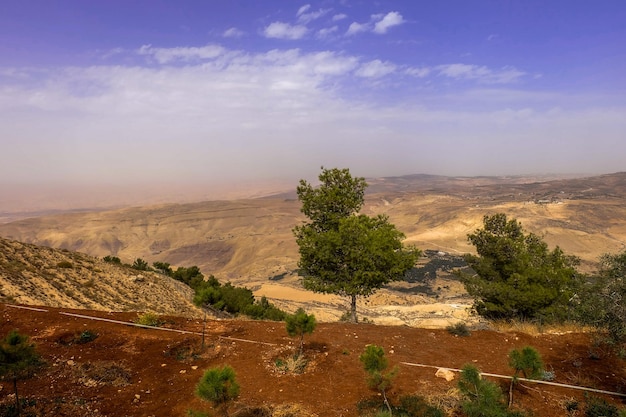
The View from Mount Nebo.


In the name of the living God, + Father, Son and Holy Spirit.

+++

Pray for the peace of Jerusalem. (Psalm 122:6a)

It’s a kind of code. The writer of the Psalm believes that if Jerusalem has peace, then the whole world will be at peace.  ‘Pray for the peace of Jerusalem’ means pray for peace in Jerusalem and everywhere.

When Moses was 120 years old, the Bible tells us, he climbed Mount Nebo, a mountain in today’s Kingdom of Jordan, about 800 metres above the Plains of Moab. There God showed him all the land that God had promised the children of Israel, from the river to the sea, the river Jordan to the Mediterranean Sea, from Dan in the far north to Gilead near Jerusalem and further south to the Negeb desert. (Deut. 34:1-5).

Then Moses died.

The last thing Moses did in his long life was to look towards the land that God was promising his people.  Moses looked forward to how blessed the tribes would be when they crossed the Jordan into Palestine. He paints a picture of how good the future will be for the children of Israel.

13b Blessed by the Lord [is] his land,
    with the choice gifts of heaven above
    and of the deep that lies beneath,
14 with the choice fruits of the sun
    and the rich yield of the months,
15 with the finest produce of the ancient mountains
    and the abundance of the everlasting hills,
16 with the choice gifts of the earth and its fullness
    and the favour of the one who dwells on Sinai.

                                                                            (Deuteronomy 33:13b-16 NRSV)

Moses could have sat around the campfire and regaled the Israelites with memories of leading his people out of Egypt. He could tell hoary tales about the 40-year trek through the wilderness, or reprise the joy, and the terror of meeting the living God in the burning bush.  But instead, he chose, after 120 years, to go to the high mountain, and to look forward to the future, to the promised land.

Moses couldn’t have prayed for the peace of Jerusalem for the simple reason that Jerusalem didn’t exist until many years later, when King David fortified a tiny Jebusite village and began building the Temple. 

What God wants for not only Jerusalem, but for the whole world’s future is peace, ‘shalom’ (שָׁלֹ֥ום). This word appears 237 times in the Old Testament, making shalom a significant concept. It means peace, and shalom is much more than absence of conflict.

Shalom means well-being in all its forms. Shalom means prosperity, but not the prosperity where only a few become wealthy, but prosperity where everyone shares their bounty with one another. Shalom is closer to communism than it is to the capitalism we experience in 2025. The prophet Isaiah reminds us that shalom is the opposite of war, which breeds hatred, fear, and scarcity. Shalom means love-in-action between people.

Pray for the peace of Jerusalem, the psalmist urges us, pray for Jerusalem’s shalom. God will bring peace for Jerusalem out of the fraught and complicated mess in the Middle East today. The promised land that Moses looked forward to stretches from the river to the sea. But today, Palestinians want to be free ‘from the river to the sea.’

These two visions of the future clash. They seem contradictory: how do we pray for the peace of Jerusalem?

How do we pray for peace for a people who were nearly exterminated a generation ago in the Holocaust? There are Palestinians and others like Hamas who say they would like to wipe out the Jewish people. Could it happen again? Never mind the politics: many Jews believe they are surrounded now by the same murderous hatred as they were in 1938.  

As Lloyd said last Sunday in his sermon, now it is important for Christians to express solidarity with Jews. Write to Temple David in Mount Lawley; or write to the Perth Hebrew Congregation. Or to both. A simple email will be genuinely appreciated.    

And how do we pray for a people who, a generation ago, were pushed out of the land their families had farmed for generations, for thousands of years?  The Palestinians believe that Jewish settlement from the river to the sea is a policy that bulldozes them out of the way, often quite literally. What should we pray? How should we support Palestinians and their allies locally? Sending money to an aid agency is one possibility. Gaza desperately needs the basics for life. Or finding out about the rallies held regularly in the city and joining them or supporting them is another.

How do we pray for the peace of Jerusalem? What would bring about the shalom of all the people of the Holy Land? This morning’s readings encourage us to pray with hope. Hope in God. The problems of the Middle East are difficult to fix. But as Christians, we know that God’s intention is for all Jews and all Palestinians to thrive, to enjoy God’s shalom. The divisions will find healing.

 We pray with hope, knowing that the future is in God’s hands. We look to the future with hope, learning with a deep confidence that God will meet us there.

Pray for the peace of Jerusalem. We can pray for the peace of Jerusalem only if we pray for peace in our own lives. We ask God to meet us in the conflicts of our families, knowing that some of those fights and divisions seem intractable to us.

We ask God to meet us in our everyday encounters. What do we need to do to foster shalom in our communities, as we encounter people serving us in shops, people on the footpaths, people at homeless respite, and neighbours of all sorts?

As Christians, we have a vocation to be makers of shalom; to be peacemakers. Saint Francis of Assisi, my favourite saint, told his followers to meet everyone with a greeting of peace.

[We should note that we Christians don’t have a monopoly on peacemaking. Jews greet each other with ‘shalom-aka’ and Muslims greet each other ‘As-salamu alaykum’; both saying, ‘peace be with you’.]

We too can make a greeting of peace a holy habit. For most of us, it might be a bit precious to say ‘peace be with you’ or ‘shalom’ every time we greet someone, but we can, for example, sign off emails or end phone conversations with the word ‘Peace’ – and mean it!

In this Eucharist, the priest greets us, ‘The peace of the Lord be with you’, and we respond, ‘And also with you.’ This morning, let us make the peace especially meaningful. Let us pray earnestly for the well-being and security of everyone we greet. Maybe greet fewer people and make sustained eye contact with each one if you can. Take two or three seconds to really see our neighbours, to remember that God delights in each one and seeks their shalom.

+++

As you know, today is the second anniversary of Lloyd’s ordination as a priest (congratulations, Father!), and it is my 50th. At the 8:30 Eucharist, Bryan Shattock marked his 42nd year of priesthood.

We as priests have a special role as a peacemakers.

Firstly, we bid the people we serve to ‘pray for the peace of Jerusalem’, and we bid the people to pray more generally for peace. Temple David replied to me that my email was appreciated because I am a priest.  My support as a priest carried your goodwill along with mine. 

So, secondly, our role in the community of faith, especially our parish priest, our bishops and the archbishop, is to be bridge-builders.

One of the titles for the Pope is Pontifex, the Latin for ‘bridge-builder’.Pope Leo has an account on X called ‘Pontifex’, and he repeated on social media his first greeting as Pope. This is what the Pontiff said:

“Peace be with you all! This is the first greeting spoken by the Risen Christ, the Good Shepherd. I would like this greeting of peace to resound in your hearts, in your families, and among all people, wherever they may be, in every nation and throughout the world.” (Pope Leo XIV on X)

I’m not saying that priests should be Popes. But like the Pope, the priest builds bridges between people and God.

One of the roles the church entrusts to priests is to speak words of absolution, either to all of us in the Eucharist, or to each of us in private in the Sacrament of Reconciliation, formally and informally. These words of absolution make space for peace with God.

This role of absolving carries with it the responsibility for us priests to make peace, to promote shalom, in the entire community we serve. We should never provoke division or hatred.

But as pontifex, as people entrusted with opening space for God, priests try to discern when to challenge people; when to ask people to fulfil roles for which they feel unworthy or not ready, or when to expose evil and hatred to the light by challenging people to do better, and by challenging, so build peace among people.

One anecdote from my time as a priest at Christ Church Claremont. A few parishioners looked with disapproval at families with young children. They stared at them critically, they shushed them, they rudely moved away from them, and they demanded that parents take their children to the crèche.

One morning during the Eucharist, I saw families being disturbed by these parishioners. There were many whispers and many scowls. I saw one mum on the brink of tears. I got very hot under my dog collar. When we came to the notices at the end, I told the congregation in what I thought were terms everyone could understand, that if they continued to treat kids like that, there would be no church left.

As I shook hands with people leaving, one woman said to me, ‘I’m so glad you said that about the children. Someone has to speak up about how badly behaved they are in church.’

So much for my discernment to challenge, to create connections and shalom between people!

So, we as priests have the privilege of promoting love between the people we serve. Priests speak well of people, knowing that God sees every person as whole, as holy, as complete. Priests who gossip or who speak badly of others are smashing those bridges between people, not building shalom. We try to be peacemakers whenever and wherever we can.

We priests have a special role in building bridges into the future. Like Moses, we look with hope to God’s church in the years ahead. It’s so easy to look at the church and be despondent.

There are fewer churchgoers, we say. There are no young people, we say. We have only seniors who don’t have the energy for organising things, we say. There are divisions tearing Anglicans apart, we say, between St Brendan’s and St Nic’s, reflecting bigger divisions between Canterbury and Sydney.  It’s easy for priests to be despondent. It’s easy for priests to think that we must come up with all the solutions.

We should be realists. God’s church is today what it is.

But as priests, we have a responsibility to remind people of a bigger story. God has been faithful to the church for 2,000 years. We have no reason to think God will not continue to grace God’s people with love and harmony, with shalom. Of course God will. God is not going to change or withdraw his love from the church.

Of course, all of us are all called to be bringers of peace, nurturing shalom. In fact, we can all do all the things priests do. But we priests are called to model peacemaking, to make space for peace, to call others to be makers of shalom. It’s a challenge for us, and it’s an extraordinary privilege.

We priests, like Moses on top of Mount Nebo, should be saying to the church:

The church’s future is blessed.

The church is blessed with the choice gifts of heaven above
and of the deep that lies beneath;
with the finest produce from the faith of those who have gone before us,

their stories, their hymns, their deep spirituality.
With the abundance of faith of those who will continue to come,

their joy, their faithfulness to Christ,
their willingness to live a life of service;
with the choicest gifts of love and shalom

And, above all, the church’s future is blessed with

the never-ending favour of the One who dwells with his people.

Pray for the peace of Jerusalem, and pray for your priests.

Peace be with you.

Slavery, Saint Francis and us


If you prefer to listen to Ted preaching this homily, click below (12 minutes):

The Holy Gospel of our Lord Jesus Christ according to Saint Luke.

Glory to you, Lord Jesus Christ.

[Luke 17:5-10]

The apostles said to the Lord, “Increase our faith!” The Lord replied, “If you had faith the size of a mustard seed, you could say to this mulberry tree, ‘Be uprooted and planted in the sea,’ and it would obey you.

7[Jesus said], “Who among you would say to your slave who has just come in from ploughing or tending sheep in the field, ‘Come here at once and take your place at the table’? Would you not rather say to him, ‘Prepare supper for me; put on your apron and serve me while I eat and drink; later you may eat and drink’? Do you thank the slave for doing what was commanded? 10 So you also, when you have done all that you were ordered to do, say, ‘We are worthless slaves; we have done only what we ought to have done!’”

For the Gospel of the Lord,

Praise to you, Lord Jesus Christ.

In the Name of the Living God, Father, Son and Holy Spirit.

The whole point of having a slave is that person can do whatever you want whenever you want.

When we were in Mauritius Rae and I used to worry about our hosts’ driver who was called Anil. Our hosts owned a sugar plantation and invited us to dinner a couple of times during our seven-week stay on the island.

They would send a message ‘Anil will pick you at 5:30.’ Anil arrived promptly at 5:30. Anil drove us back to the plantation. We had dinner, not with Anil, of course. Just with Pierre and Doris. Pierre showed us over their sugar refinery, a 24-hour operation. We talked. At 11:30 in the evening, it was time to go home.

Pierre yelled across the backyard, ‘Anil! Anil!’ Anil stumbled out of his hut, shook off his sleep and drove us home. It was an hour’s drive, and then, of course, Anil had to drive an hour back again.

Anil wasn’t a slave, but Rae and I worried that he was treated like one.

The people of Jesus’ time had slaves. The Jews had always had slaves, going back to the time of Abraham. At least, the more affluent Jews had slaves. And the whole Roman Empire depended on the labour of slaves. Apparently one third of the population was enslaved. People 2,000 years ago didn’t have the same moral objection to slaves that we have now.

And the whole point of having a slave is that person can do whatever you want whenever you want.

In this morning’s Gospel reading, Jesus invited the people of his day to try a radical thought experiment: imagine you are the owner of a slave who has been ‘working all day in the field, ploughing or tending sheep.’ (Luke 17:7) When evening comes, you allow the slave to take as much time as he wants to wash and change into clean clothes. Then the slave reclines on the best dining couch in the house. Then you, the owner, the master, serve the slave his dinner, and the slave can eat the meal quickly, or can spend four or five hours at the table chatting to friends and drinking wine. You are on call until the slave tells you he has finished his meal.

Then Jesus stops the thought experiment. No: you treat the slave as a worthless slave whose job is to serve you and not the other way around. If it doesn’t suit the slave or the slave is too tired makes no difference.

This thought experiment comes from Jesus, who as Saint Mark and Saint Matthew tell us, ‘…came not to be served but to serve and to give his life a ransom for many.’ (Mark 10:45, Matthew 20:28). Not to be served, but to be a slave.

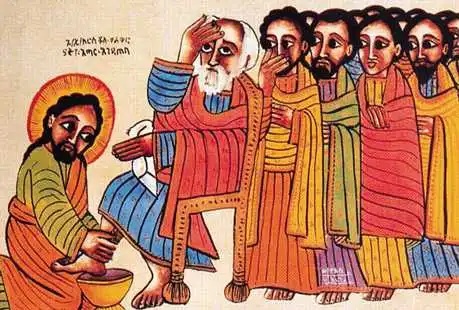
In other words, this thought experiment is not as fanciful as it sounds. Jesus himself swaps the role of Lord for that of a slave for example, when he washed the disciples’ feet (John 13:5), and really upsetting Simon Peter. ‘You will never wash my feet!’ wails Peter (John 13:8).

It’s not possible, we think. Even if you don’t own a slave, the point of having slaves is to do anything their masters want at any time. Jesus upends this idea. A slave is a human being created in the image of God, and simply because of that should be, at least, respected. But more than just respecting slaves, Jesus challenges us to serve others as if we were slaves ourselves. And especially, we should serve those who are treated as slaves.

Yesterday was the feast of Saint Francis of Assisi, a saint who means a great deal to me. Francis was the son of a cloth merchant, Pietro di Bernadone, who was growing richer and richer. Francis was privileged by having the benefit of this extreme wealth, and when he was a teenager, he made the most of the lavish lifestyle. He threw wild parties with his friends, providing the wine and food for the feasts. He gained the nickname ‘The King of The Revels’.

But he grew uncomfortable with this privilege. He was riding outside Assisi one day – and owning a horse was something like owning a Morgan Super 3 sports-car today or maybe a Rolls Royce Sweptail with a million-dollar price tag. As he rode, he saw a leper. Until then, Francis had been revolted by lepers. They were disgusting, repulsive. But on this day, Francis was moved to dismount and approach the leper and embrace him. Something changed in Francis from that moment. ‘That which was bitter had become sweet,’ he wrote later. (The Testament, 1, FAED I, 124.)

One of the first ministries Saint Francis undertook was caring for lepers; becoming their slave, their servant, looking with love on their distorted features and running sores, feeding them, keeping them safe from brigands and dressing their wounds.

Francis knew that this was how Jesus challenges us to be a slave to others. It’s a confronting idea. And we should be confronted. It goes against the way things are. It turns the world upside down.

I find it interesting that even though Francis is known for poverty, in the early years, many of his followers were queens and princesses: the Blessed Isabelle of France, Saint Louis’ sister, was a princess, and Saint Elizabeth was the wife of the future king of Hungary. Saint Clare too was from a noble family. These royals and aristocrats responded to the challenge to become a slave for others, serving the poorest, putting their lives at the service of the neediest.

I am impressed by Saint Jeanne Jugan in France just after the French revolution. She was inspired by Saint Francis to look after homeless women, eventually setting up a network of refuges throughout the east of France and becoming the Little Sisters of the Poor, who are in 2025 still serving the elderly poor. They have a house in Glendalough just north of Perth city. She too, and her sisters, respond to the challenge to be a slave to others.

And we are followers of Jesus too. The same challenge applies to us – as individuals, as the people of Saint Brendan’s. We don’t have to be the founder of a religious order, or even join one, to take up this challenge of Jesus. But if royals and aristocrats can become slaves, so can you and I.

Is there some situation where God is calling you to be a slave? Is there a person whose needs you can try to meet, but whom you avoid because you know it will be difficult? Is someone you know being held captive, ensnared in some way by someone? Is there a way to be a slave to them, to serve them in their needs? Being a slave is not about knowing you can succeed. It’s about putting aside our needs to achieve, to make a mark. Being a slave’s only about obeying the master. ‘When you have done all that you were ordered to do, say, ‘We are worthless slaves; we have done only what we ought to have done!’” (Luke 17:10)

And our ultimate Master is Jesus, and Jesus chooses to serve when others are certain it’s beneath Him.

As a parish community, we rightly hold up our ministry to the Homeless as one example where we put energy and care into serving others whatever their needs. But just because we are serving one needy group does not mean there are not others in the Warnbro/Rockingham community calling out for our service as a parish.

Today we bless our pets. The same challenge applies to animals as it does to human beings. We sometimes think of our pets as slaves. We keep them locked them up in our house or yard. We have them on a leash when we take them outside. We expect them to do emotional work for us, loving us when we come home from being away. But I am sure that we bless our cats and dogs because we know the challenge to be a slave to them too. Take note of that Lottie, and Caesar.

So this story in the Gospel about a slave coming in from a day’s work in the field is not a hypothetical. It’s a challenge. It confronts us to find ways in which serving others turns the world on its head and creates a kinder, more loving world in partnership with the One who came to serve.

Where is God calling you to be a slave today?

Scandals and faith


SERMON – ST MARY’S, BUSSELTON/ST GEORGE’S, DUNSBOROUGH

September 30/October 7, 2018.

Pentecost 19/20
Saint Francis

I Corinthians 1:17-31

Mark 9:38-50

In the name of the living God + Father, Son, and Holy Spirit. Amen.

The land where Jesus lived, the land of Palestine/Israel, consists of the Jordan Valley, which is a little bit green, and rocky hills and dry landforms. Jerusalem was the only city in Jesus’s day, so for the most part, there were no roads. Even the Roman road avoided Jerusalem and crossed the Jordan into Galilee in the northern extreme of the province.

The topsoil was thin, and there were always rocks that poked through the topsoil. If you weren’t watching, these obtruding rocks would trip you up. A rock like this was called a skandalon. We get the English word ‘scandal’ from this Greek word. A ‘scandal’ is something, like one of those rocks, that crops up unexpectedly and makes us stumble or fall. A scandal like the child abuse scandals can make us lose faith; we don’t trust the person involved anymore, we feel betrayed and we re-consider what we think of the person’s character.

38410784-rocky-hills-of-the-negev-desert-in-israel
Skandaloi – rocky hills of the Negev

In this morning’s epistle and gospel, scandals are there, but somewhat hidden in the English translation. We hear of ‘obstacles’ to faith.  We hear how Jews are stopped from believing because the signs are wrong. Gentiles are stopped from believing because they don’t think Christian preaching measures up to their sophisticated world of philosophy. Or in the original Greek, the lack of proper signs is a skandalon, a scandal for Jews, the lack of wisdom is a skandalon, a scandal for Gentiles.

The signs were an obstacle for Jews believing. They indicated the wrong sort of Messiah; the Jews wanted a political or military Messiah, the sign of the cross indicates a Messiah for whom love and forgiveness were the winning combination, not defeat of the Romans and the unity of the Jewish nation.

The Gentiles looked for wisdom, the sort of wisdom they found in debates and complex philosophy. We know that the New Testament has depths of interpretation and meaning, but the Gentiles at the time heard only a simple and direct preaching of the cross.

Having tripped up on the issue of philosophy, the Gentiles then found other factors to be scandalised about. Christians appealed to the poor and weak, not to the masters and house-holders and the powerful. How could that make sense in a patriarchal world where the more power you had the wiser you were, and the wiser you were the more powerful? Women and slaves and children had little power. They could not possibly be wise, could they?

So the question Paul poses to us 2,000 years later is this: what is skandalon for us? What crops up unexpectedly to prevent you from believing, or believing more fully? For you, it could be – I know it is for some people – that the cross is a scandal. If Jesus was exterminated like a criminal, wasn’t that losing rather than winning? For you it could be, as it is for some people, that the cross is ugly, that Jesus’s people, tax-collectors and prostitutes, are not proper advertisements for God.

What obstacle do you trip over?

Let us turn to Mark’s Gospel where Jesus paints a picture of sin creating a skandalon. If your hand is a skandalon, cut it off. We don’t need much imagination to envisage our hand becoming a scandal; imagine the sins we can do with our hands – theft, murder, assault, fiddling our tax returns.

Perhaps we have to think a little harder to imagine our eye becoming a scandal, but we know from other things Jesus said that it is not only what we look at, but how we look, that can be a scandal, an obstacle to our faith. Looking at others’ spouses sexually, with lust, looking at valuable property enviously, in other words using our eye to desire things that if we possessed them would be harmful to others and ruin ourselves – that can become a scandal.

But what is this second sort of skandalon? This is not being tripped up by our wrong expectations; this is being tripped up by our own sinful actions. Imagine someone using his hand to enter fraudulent details on the internet, then he feels guilty for stealing. He is tripped up looking at himself as a thief, as a sinner, as guilty. Uh-oh! He should cut off his hand, perhaps by restricting his internet access, then repent, repay the money and re-consider his desire to be ahead in money or material things. Otherwise he will slide into a hell of self-recrimination, self-loathing and become so self-absorbed that he is unable to be in relationship with others. The path to ruin is too easy a story to write.

Jesus makes us squirm by compelling us to ask ourselves what we trip over with the actions of our hand and our eye. What ruinous actions could be our obstacles to faith?

The gospel today gives three remedies for skandalon; three prescriptions for removing these obstacles to faith.

The first is accepting a cup of water because of our faith. If we can’t be kind to others, Jesus suggests we reflect on the kindness of others to us. What does that mean? How does that recall us to our Christian standards and believing? What does their kindness say about the possibility of Christ working through that person, and through ourselves?

The second is a little strange on the surface. Jesus says, ‘Have salt in yourselves.’ Don’t lose your saltiness. There is a cluster of good things, like salt, that we should take into ourselves that will restore us to faith.

Recall the fire, the sharp burning taste, that is in salt. Allow the fire of appropriate criticism to burn away our inclination to turn away from God. It may be a member of your family or a stranger in the street, but when someone criticises our actions, we should welcome it as from God himself.

Secondly, let the strangeness of the Gospel change us. We say we are trying to be more like Christ. The implication is that if we hear something in the Gospel or in the words of other Christians that seem strange, that may well be because it points to unfamiliar characteristics, unfamiliar because it is not yet part of us, but is part of the Gospel. Welcome the strangeness of the Gospel.

Thirdly, a little sprinkle of salt affects the taste of the whole meal. Let the Gospel spread through the whole of your life so that every aspect reflects the love of God.

Last Thursday we celebrated the Feast of Saint Francis of Assisi, a hero and mentor of mine. Francis grew up thinking the church then, 800 years ago, was a scandal. Its main focus was wealth and the power needed to protect that wealth. For example, there was a large Benedictine monastery up the hill from Assisi. When Benedictine property anywhere in the region was threatened, the monks would down their farming tools, their hoes and scythes, and pick up swords. Even the Pope had a large and busy army.

As a cloth merchant, Francis had experienced firsthand how bishops loved the finest cloth for their vestments! Many of the clergy were squeezing peasants for land rents and whatever other corruption with which they could enrich themselves.

The church then was a scandal. St Francis did three things: firstly, he embraced poverty as a way of life. This meant for him that he constantly experienced the generosity of others. Francis believed that when he experienced people’s generosity he was experiencing God’s generosity through them.

Secondly, Francis could be weird, screwy, pazzo as his fellow Italians said. From

Francis & crucifix Brisbane
Saint Francis embraces the Christ on the cross – wooden sculpture in the guest house. Society of St Francis, Brisbane

eccentric dress to over-the-top acted parables, like spinning at a crossroads until you were dizzy to decide which way ahead. But there was gospel in his madness. In dressing down like the worst beggar, Francis reminds us of our constant concern about our appearance and what it says about ourselves. Not necessary in God’s kingdom.


In spinning at a crossroads for direction, Francis reminds us how little control we have over our own decisions. For him this points to the need for greater and greater trust in God.

Thirdly Francis was constantly doing little random acts of kindness, bidding people peace, smiling, listening, leaving behind little scraps of gospel wherever he walked, salting the world with hints of Jesus.

What we need to do to hear the gospel through the scandals will be different than Francis in the 13th century. But just like Francis, just like this morning’s readings we too need to:

  • Have salt in ourselves.
  • Allow the kindness of others to reveal Christ; and when other criticise, let that reveal Christ too.
  • Scatter little signs of gospel everywhere we go.

These are the ways to peace with God and with each other.

Peace be with you!


Breath on a Feather


A hymn for Epiphany

You Lord of grace, you’re breath on a feather,
You inspire us to care, adore;
Your breath helps us to praise you together,
Our song, just our song, can make us more.

You Lord of grace, you’re barbs of a feather,
Strengthen our spirits with love’s surprise;
Your longing heart helps us to tether
Ourselves to you, with you improvise.

You Lord of grace, you’re shaft of a feather,
You hold us tall whatever the storm;
You teach us to hold your standards to treasure,
And upright in virtue our lives may transform.

You Lord of grace, you are the whole vane,
You let us fly to love’s true height;
We feel your guidance your will ascertain
And our obedience makes you shine bright.


  • Ted Witham 2017
  • 9999 St Clement, O Waly Waly.


220px-parts_of_feather_modified
Courtesy Wikipedia

Parts of a feather:

  1. Vane
  2. Rachis
  3. Barb
  4. Afterfeather
  5. Hollow shaft, calamus


Christian bird song?


Sermon preached at

St Mary’s Busselton on

October 2, 2016, for the Feast of St Francis,

at the Blessing of the Pets.

Scripture readings: 

Colossians 3:12-17
Matthew 10:8-15
**********
In the name of + the living God, Father, the Son and the Holy Spirit.
**********

You are very welcome to this service. Thanks for bringing your owners with you. I hope you enjoy being here with other animals, and you don’t find that Labrador too big, or that cat too smelly!

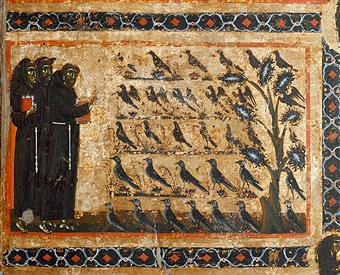
There’s a wild story about Saint Francis of Assisi, preaching and birds. Today we mark St Francis’ day, technically on October 4, and this saint, who lived 800 years ago, has a large part in our hearts. We like him partly because he seemed to have a special rapport with you animals.

The story starts with Saint Francis preaching. Saint Francis had a beautiful voice. In fact, one of the brothers, who used to be known for his elegant, resonant beautiful speaking voice, thought he was the best speaker in Italy, until he heard Saint Francis and was so spell-bound he joined the Brothers.

587493564
St Francis preaching to the birds. Bardi Chapel – Italian School, (13th century) – Santa Croce, Florence, Italy

But on this occasion Francis was having trouble. A group a swallows was making a racket. ‘Little Sisters,’ St Francis said, ‘no-one can hear the words of the Gospel because of your noise. Please be quiet until I have finished my sermon.’ And they were. And so were the people. They were so moved that they wanted to follow him, leave their town, and become wandering preachers like him.

‘Don’t be in a hurry,’ St Francis, ‘and don’t leave, and I’ll arrange everything for your life with God.’ So St Francis set up the Third Order, which consists of Christians who want St Francis as their guide in Christian living, but who, unlike the Brothers, live in their own homes and get married. This Third Order still exists. My wife Rae and I are members of it.

But after this sermon, St Francis set out on the road again. He saw ahead of him a vast throng of birds. There were thousands of birds, maybe tens of thousands, more than you could count, maybe more that you could make with computer graphics. In any case Francis was impressed with such a mob of birds.

He told his companions to stop while he went ahead to preach, this time to the birds. He told this huge crowd of birds how much God loved them, because God had created them. He told them how thankful they should be for being able to fly and for being well insulated with two or three layers of feathers. They also should thank God for the air to fly in, and for the fact that they didn’t need crops to live. ‘You don’t sow or reap, and God feeds you and gives you the rivers and springs to drink, and trees and high mountains to make safe nests.’

The birds then opened their beaks and stretched their necks and reverently bent their heads to the ground. Their singing and movement showed St Francis how much they’d understood.

St Francis then made the sign of the Cross and let them leave. They followed the Cross Francis had signed. Some went to the north, some to the south, others to the west, the rest to the east. They sang magnificent songs, marvellous songs, as they flew off.

The birds set an example to us, to live according to the Cross of Christ, and to go in every direction, thanking God that we depend only on him, like the birds, trusting God to provide enough for each day, and singing our beautiful song, the song that tells the story of Jesus.

Our beautiful song is our song, our own song. There’s a legend about an African tribe that african-art-street-a-eececce-130355-2says a pregnant woman listens to the child in the womb and learns a song that is unique to that child. She teaches the father-to-be the song, then she teaches the midwives who sing it as the child is born. As the child grows up, each time the child falls and hurts herself, the village gathers around and sings her song. When she does something wrong as an adult, she is brought face to face with those she has wronged, the villagers form a circle around her and sing her song. The song is sung at the person’s funeral, and then is never heard again.

Our own song: one that our loved ones sing when we need healing or restoring. Wouldn’t it be wonderful?

The song each bird sang as it flew in one of the directions of the Cross was its own individual song. At the same time, each song fitted in with the songs of all the other birds. It was in close harmony with the song of the community.

In the same way, our own song with its individual story of God with us, with each of us, harmonises with the song of the community with its story of Jesus who came among us to share love.

So when we sing ‘All Creatures of our God and King’, we are singing the song that was originally St Francis’ own song. It’s now the community’s song, and we sing it along with the whole community. But we also make it our song. We remember the times we have been awed by the night sky and we sing,

‘Thou silver moon with softer gleam, O praise him. …

Thou rising moon, in praise rejoice,

Ye lights of evening, find a voice. O praise him.’


When we get to,

‘And all those of tender heart,

Forgiving others, take your part, O sing ye Alleluia’,

we can remember a time in particular when we forgave another, or when we were forgiven even though we were filled with shame and remorse.

I’m now going to make the sign of the Cross over you, and your owners can watch. When you leave, at the end of the service, you can go in the direction of the Cross that is your path, thanking God for God’s provision for you, and continue loving and forgiving your humans. As you go, go singing your wonderful song.

+  As you go to the north, or to the south, or to the west, or to the east, do not be guilty of the sin of ingratitude, but travel with God’s love and with your song. Amen.

Education in Christian Character and the Dean


First published in the Anglican Messenger, March 2016.

Nearly every week from 1938 to 1972, an elegant lady clutching a music case caught a tram from Perth College. The tram trundled down Beaufort Street to the ABC then situated in the Stirling Institute buildings in the Supreme Court gardens. Dorothea Angus, Head of Music at Perth College made over 250 broadcasts for the ABC performing solo, as well as with contralto Phyllis Everett and violinist Vaughan Hanly. She played concerti with the WA Symphony Orchestra, for example under Henry Krips, Mozart’s A major piano concerto (K488).

Her night-time performances followed a long day of teaching from 7.30 a.m. to 4.00 p.m. and a practice hour until 5 p.m.

She preferred to perform Australian composers like Miriam Hyde. As a star student in Adelaide’s Elder Conservatorium she had made a compact with Hyde and other fellow-students to exchange new compositions. With advance access to Sydney-based composer Dulcie Holland’s piano music, Dorothea encouraged her students to learn Australian music for their exams.

But much more than that, Dorothea instilled in the girls at Perth College a love of music. With the WA Symphony Orchestra established properly in the 1950s, Miss Angus began a Friday night tradition of bussing girls to concerts. I was with the boarders in 1975 as they went wild for WASO’s rendition of Sibelius’ ‘Finlandia’!

Dorothea opened up a bigger world up for her students. In the classroom she talked about music around Australia, and she introduced a world expressed in beauty and art. Her own person, always elegant and fashionable, impressed the girls. The stylish Miss Angus was a fascinating contrast to the Sisters dressed always in habit, veil and wimple.

Dorothea was not a straightforward Christian. In her previous appointment in Adelaide at St Peter’s Cathedral her talents as a world-class organist appear to have been eclipsed by the internal politics of male chauvinism. When I met Dorothea towards the end of her life, I found her always willing to engage in a robust and sceptical discussion about Christian faith. She was deeply interested in it but unable to admit to a commitment to it.

At Perth College, Sister Rosalie, the Principal, often crept into Dorothea’s practice room to enjoy her playing. I can imagine her friendship with Sister Rosalie included similar discussions.

‘Gus’ or ‘Fungi’, as Miss Angus was called, is still remembered with affection by former Perth College students nearly 40 years after her death. A half-dozen still meet annually to salute her memory.

Dorothea championed Australian music to the public. As an artist, she felt a responsibility to share generously her gift with the school and the church. When I met Dorothea she was playing hymns for services in Balga Parish despite a paralysis in her left arm. Her disability frustrated her. She could easily have excused herself, but would not.

To Perth College she brought not just music skills, but education in character. Through her own forceful personality, she modelled character. She opened a wider world to the girls in her care. She chewed into Christian faith, examining it, discerning the truth for herself. Agnostic she may have been, but her respect for Christianity was imprinted on those she met.

I am more optimistic than the Dean, who argued in the December Messenger that church schools were failing in their central task of Christian formation (he and I have been chaplains to the same two church schools!) I believe that our church schools have been deeply enriched by teachers of integrity and longevity – like Miss Angus – who have imbued Christian character in their students.

*****

An article focusing more on Dorothea Angus’ musical achievements appeared in the December 2015/January 2016 issue of Limelight magazine.

Archbishop of Canterbury’s Lent Book Renews Engagement


Looking through the Cross

Graham Tomlin, Looking Through the Cross: The Archbishop of Canterbury’s Lent Book 2014, Bloomsbury Academic (2014), Paperback, 240 pages.

Good stocks at St John’s Books, Fremantle. $19.95
Kindle edition available from Amazon for $10.88

Reviewed by Ted Witham. First published in Anglican Messenger, February 2014

Being a Christian requires personal engagement – with God, with Jesus Christ, with neighbour and stranger, with truth, with good and evil. For most of us, being a Christian can be complex and demanding, but we remain committed because we believe that God is eternally committed to us.

A good Lent book refreshes this sense of personal engagement with Christian living. It should encourage, inspire and inform by taking readers both back to when they fell in love with the faith and forward by challenging readers to grow spiritually. Good Lent books are often about the Cross and Resurrection clueing us into the liturgical movement of Lent and the Paschal mystery at its climax.

Graham Tomlin’s Looking through the Cross is a very good Lent book. It is about the Cross. Tomlin tells us that his early chapters are looking at the cross, trying to understand more deeply its meaning for us, and the later chapters are looking through the cross, using the cross as a lens on the world.

In the chapter headings, ‘The Cross and Wisdom’, ‘The Cross and Evil’, ‘The Cross and Power’, ‘The Cross and Identity’, ‘The Cross and Suffering’, ‘The Cross and Ambition’, ‘The Cross and Failure’, ‘The Cross and Reconciliation’, and ‘The Cross and Life’, it is not entirely clear when we change from looking at to looking through. I am sure that ambiguity is deliberate: the cross always both teaches us about itself and reveals how it has changed God’s world.

Graham Tomlin writes clearly. Reading his book is like sitting with the most patient teacher, sharing with us his understanding of how the cross comes alive for him. His explanation of the connection between the cross of Christ and our personal sin is the clearest I’ve encountered in 40 years of reading books about Christianity. ‘Those who have perpetrated evil must be held to account,’ he writes. ‘The evil that has disrupted the world cannot simply be ignored or glossed over: it must be banished, dealt with, put right. Restoration is possible, but only when sin is somehow atoned for.’

Archbishop Rowan Williams commissioned The Reverend Dr Graham Tomlin to write this year’s Lent book. His successor in Canterbury, Justin Welby, ‘could not be more pleased’ with the choice. Centred in scripture, scholarship and pastoral experience, this book seems to me to bridge some of the divides in contemporary Anglican thinking.

The cross demands that we clearly separate Christian faith from the surrounding culture. In the powerful chapter on identity, Tomlin describes how our experience of family christenings obscures the radical change God makes in us in baptism when God gives us a new identity. Using the image of a protected witness or juvenile criminal with a new identity, he reminds us how hard it is to live out of a new identity, and how the old identity will continue to exert a pull on our lives.

But the cross is ultimately the path to life. We are made not to end in death, but in life. Tomlin reminds us of the leap in imagination we need in order to lay hold of this reality, but also rallies us with the knowledge that the new life of the cross and resurrection is ultimately God’s work and not only ours.

It is helpful if a Lent book has some guidance for its use: questions to provoke reflection or small group discussion, suggestions for art response, even a reading program. Looking through the Cross has none. This is a significant drawback in a book promoted for Lenten reading. Even without this, individual laity, clergy and groups will find Dr Tomlin’s book refreshing, challenging and clear. At the end of Lent, the book will help readers emerge at Eastertide re-engaged with their Christian faith.

As At The Dawn


As At the Dawn


Because you love them free as they are
They say you have nothing to say


Because you put on a human face
They say you’ve hidden yourself


Because you’re all heart God
They say you’ve gone to sleep


Because your Spirit cannot be grasped
They say everything has gone wrong


Because you refuse to collude with evil
They say you’re good for nothing


Because you don’t crush people
They say they haven’t called on you


Because you’re not just any God
They say you’re just anything


Because you made me in your image
You are also everything they say


Dear God won’t you take pity on me?


Original French P. Fertin “Comme à l’aurore”, Paris: Desclée, 1974, p. 17
Translated by Ted Witham 2013


Passing on the Faith?


It is a privilege to regularly post on the website of Dunsborough Anglican Church. I have just posted there today on passing on the faith. I’ve based some of the article on the ideas of Etienne Wenger and Jean Lave on communities of practice and situated peripheral learning, as I think they have a lot to offer our understandings of faith formation.

Francis the pastor


Of course the name chosen by the new Pope, Francis, has encouraged me to think that his ministry will be different from his predecessors. In his first 100 days Francis has behaved like a pastor, like a parish priest, encouraging his flock in following the Gospel.

In his informal style Francis has also used some charming and helpful images: while encouraging bishops to be exemplars to their people  of Christian living, the Pope also shows that he trusts the faithful to be the faithful: “they have the scent of the Gospel anyway,” he has said more than once. That’s refreshing.

I know that a faraway personality can become simply a blank screen on which to project our own hopes and values, I can see that his apparently off the cuff homilies are actually quite studied,  and I hear the warnings that despite the gestures of austerity, he is governing like an old-fashioned Jesuit (listening to all but making decisions by himself), and that his theology on issues I care about is still conservative (I am certain he disagrees with my views on the ordination of women, and the acceptance of LGBT people in the Church!), however, what counts is clear: Francis is a pastor encouraging all Christians in their faith.

In this address to the Cardinals Francis shows that he trusts God with the future of the church, and for that we can be encouraged:

Let us never give way to pessimism, to a sort of bitterness that the devil offers us each day; let us never give way to pessimism and discouragement: let us have the firm certainty that Holy Spirit gives to the Church, but her powerful breath, the courage to persevere and also to look for new methods of evangelism to carry the Gospel to the ends of the earth (cf Acts 1:8)

–          Pope Francis  at Rome, 15 March 2013

As an Anglican, I am in the nice position of being able to pick and choose what I like from the Pope’s leadership, and this Pope is showing forth Gospel values in his reported lifestyle and gestures, and is speaking about the Gospel from the heart. I thank God for him.