
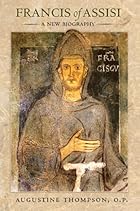
A “plain package” St Francis of Assisi


Augustine Thompson, Francis of Assisi: A New Biography, Cornell University Press (2012), Hardcover, 312 pages, $25 from online retailers.

Reviewed by Ted Witham

Augustine Thompson’s biography is “new” in the obvious sense that it is the last in a long line of biographies of St Francis going back to Paul Sabatier’s 1893 Life. Thompson’s, however, is “new” also in that it aims to go back rigorously to historical sources. This approach is in line with other historians who recently have been sifting through historical records and chipping away at the pious accretions to produce a “plain package” St Francis.

William Hugo, for example, a Capuchin formation director produced in 1996 a “Beginner’s Workbook” Studying the Life of St Francis, which invites novices to evaluate the historicity  of early writings. The Melbourne conference in 2009, out of which came Interpreting Francis and Clare of Assisi, was also historical in ambition, using a variety of academic approaches – documentary, art history and so on – to develop a more historical picture of the saints in their world.

These new studies are pushing out the older Lives of St Francis, which were either pious or interpretive: they sought either to show Francis as an exemplar of the Christian life, or they observe St Francis through a particular lens: Jacques Dalarun on Francis and power and Francis and the feminine, and Leonardo Boff on Francis and liberation offer these interpretive visions of Francis.

Augustine Thompson is a Dominican friar, and this gives him an “insider-outsider” perspective. On one hand, he knows what it is to be a friar in an Order with a  charismatic founder. On the other hand, he has greater clarity of vision when he writes about Francis than do many Franciscans in their familiarity with their founder.

Fr Thompson tells a plain story of a man who had no agenda and who could articulate no particular vision for the movement that formed and swarmed around him. Thompson’s Francis simply wanted to live the Gospel. Even at the end of his life, Francis is still surprised, Thompson claims, that “the Lord gave me brothers”.

Even poverty, the Franciscan value that many believe to be the base of Francis’s vision, is held up to question by Thompson. There’s no doubt that poverty was a part of Francis’s vision, but Francis, as Thompson emphasises, mentions the Eucharist much more often than poverty. Francis’s devotion to churches and priests is because of the celebration of the Eucharist – all to be venerated because there God comes to earth in a perceptible form.

The central insight for me in this “new” biography was precisely Francis’s lack of a programme. Francis, at least in Thompson’s telling, was a man who simply wanted to live the Gospel, to be radically available for God. This, I suspect, is one of the main reasons for Francis’s ongoing attraction.

Thompson’s book also has its attractions. It is divided into two halves. In the first Thompson tells the story of Francis simply and without frills or academic apparatus of any kind. Then follow a helpful list of the major biographies of Francis since Sabatier’s and a bibliography of documents from the 12th Century. In the second half of the book, Thompson argues in detail why he has included some details and discarded others as non-historical. These chapters may be mainly for scholars: most of us, I suspect, will be glad to read the first half as a self-standing account of Francis’s life and be refreshed by it.

Emerging Butterfly?


Peter Rollins, How (Not) to Speak of God, Paraclete Press 2006. E-Book 2012

Reviewed by

Ted Witham

The key idea of How (Not) to Speak of God is that many Christians in the “Emergent Church” movement embrace paradox. The first few chapters unpack the implicit idea in the title: that the moment we speak of God, we deny who God is. All attempts to define or describe the Christian God are doomed.

This is, of course, not a new idea, but it is unusual for evangelical Christians to push the point as hard as Rollins does. Essentially, Christians are atheists, because our God is beyond human category. At best, we can glimpse God in icons which often appear to point away from the reality of God, but which express metaphors that are self-consciously metaphors and not definitions.

Christians are defined not so much by what they believe as by how they believe; and this dynamic faith will manifest in works of mercy and restorative justice in the real world.

The second part of this encouraging book is a series of liturgies designed by the house church in the Menagerie Bar, the pub that Rollins calls his spiritual home. The themes range from Judas to Corpus Christi to Eloi Eloi Lama Sabachthani. The description of each liturgy is preceded by a reflection introducing the theme. The liturgies emphasise imagination and emotion and are described in practical detail, so that readers could use them as they are, or adapt them for their own setting.

If this is the coming, emerging church, then I would not mind belonging.

Six Complaints about “Boat-People”


Asylum seekers arrive at Christmas Island

I’ve heard many complaints about boat-people in the past few weeks, no doubt fuelled by the inflammatory statements of some politicians. Here are six of those complaints with my response to them. For each of the complaints there is,  I think, an underlying and unnecessary fear. I have listed these as well because I believe that our community will not begin to resolve these issues unless we listen intently to these fears and reassure people of our safety.

Click on the link below to open a PDF file:

6 THINGS ABOUT BOAT-PEOPLE

Killer planes and Christians


One cheer for the Americans. It is reported that a drone aeroplane killed Abu Yahya al-Libi, Al-Qaeda’s number two. Oh, and by the way, probably six other militants were killed in the same strike.

The world is probably better off without al-Libi and his like. They plot terrorist acts against Westerners, and I have no cheers for terrorists.

But our Christian moral tradition calls this extra-judicial taking of life by its proper name. It is murder. It is a violation of the sixth commandment: “You shall not kill.” It happens that my personal Christian commitment is to non-violence, and I am against all killing including killing in war and killing by the death penalty.

But I respect those who fought in wars. I think of my grandfather and the difficulty he had in re-connecting with his children after nearly three years away on the Western front. I think of my uncle Sim, his body racked with the shakes of Parkinson’s and a fragile mind, pushed to its limits by the memory of an engagement on ‘No-Man’s Land’ between trenches.

As soldiers, they were involved in killing. But they were fighting to keep our kind of society: they wanted a free society; a society where there is due process; a society where the actions of criminals are tried before punishment is pronounced.

Killing bin Laden and killing al-Libi without a trial makes a travesty of our democratic way of life. It is the behaviour not of a true democracy, but the actions of a vigilante group.  We Christians may not agree on the specifics of these targeted strikes against individuals, but we should agree on the desire for justice and the care necessary for every human being if true justice, the justice envisaged by the prophet Isaiah is to be the real experience of our society.

Do you think it was right to kill this man? And what would you say about this to President Obama if you met him … or if you decide to write to him. (Go online to http://www.whitehouse.gov/contact, or address the envelope to The White House, 1600 Pennsylvania Avenue NW, Washington, DC 20500, USA, and (from Australia) put a $2.35 stamp on it).

First posted at Dunsborough Anglican Church

Changing the World – Charles Dickens


Happy 200th Birthday, Mr Dickens.

Dickens’s reach is amazing: there would be few people alive who have not read a Dickens novel or seen an adaptation for film or stage of one of his stories. The characters of Oliver Twist (‘Please, sir, I want some more’) and A Christmas Carol, Scrooge and Tiny Tim have become part of the language.

Charles Dickens was a social reformer. He believed that he could use his fiction to bring change. I was surprised when I re-read Oliver Twist recently by the anger Dickens expresses, not so much at the poverty that children (and others) experience, but by the two facts that some middle class people couldn’t care less about poverty and that others actively exploit the poor. Dickens describes the parish system with its beadles and work-houses in the most negative terms.

Dickens did not restrict his social reforming to fiction and journalism. As he became rich, he was generous to individuals, not only giving them money, but also providing ongoing personal support for them. With the fabulously wealthy Miss Coutts he founded a Home for Fallen Women to rehabilitate prostitutes and equip them for a good life in Canada or Australia.

I’m really enjoying Claire Tomalin’s new Charles Dickens: a life, which you can borrow through the public library system.

Dickens had a conventional belief in God. He probably attended church only for weddings and funerals. It would be wrong for us Christians to claim Dickens as some kind of saint: the 19th Century did produce saints who were inspired by their Christian faith to battle poverty and injustice. Charles Kingsley and Elizabeth Fry come to mind; as does Florence Nightingale, who though a highly unconventional Christian, was deeply inspired by John’s Gospel.

However, I believe as Christians we are called to work with not only other Christians in the fight against injustice, but also to work alongside others engaged in similar work. In this light, we can celebrate Charles Dickens, social reformer, as one who translated his outrage at the treatment of the vulnerable into real change. Dickens made the world a better place, and if we hear his anger now as we read his novels, his influence can continue.

The ghost of Melchizedek


At my ordination as a priest in 1975, one of my Anglo-Catholic friends gave me a card congratulating me that I was ‘a priest for ever, after the order of Melchizedek’. This is quite a common sentiment among the more catholic of my friends; and, as far as I can judge, for many of them, is no more than a sentimental statement that priesthood is for ever, or ‘indelible’ in the jargon of sacramental theology. And for Anglo-Catholics there is the additional frisson of belonging to an ‘order’.

I know enough Hebrew to know that the Psalmist (in 110:4) was not thinking of a religious order. ‘You are a priest forever according to the word of Melchizedek,’ is the literal translation, and in this case the Hebrew dibrati דִּ֝בְרָתִ֗י (from dabar) more likely means ‘in the manner of’, than any idea of a company or group.

But to be a priest ‘for ever’ binds one psychologically in a fascinating way. From the moment Archbishop Sambell laid his hands on my head, my identity changed. From then on, whatever else I might become, I would be always a priest. That sense of being called to communicate God to people has indeed remained with me for these 36 years.

And so has Melchizedek, that strange priest-king who appears to Abram to offer him bread and wine. (The account appears in Genesis 14:18-24). Melchizedek has been haunting my prayers, not least because I am reading through Hebrews at Morning Prayer and Melchizedek has quite a role there.

When I re-read Genesis, I am struck by how little can definitely be said about this king. His name, made up of two parts, means literally ‘my king-righteousness’. Some of the Rabbis take this to mean ‘Righteousness is my King’, and I would be proud as priest (for ever) and a human being (for ever) to take this a motto.

But other commentators differ: for them, ‘Melchi-‘ refers to the priest’s actual status as a King. He is named as King of Salem. No-one knows where this ‘Salem’ is. Is it Mount Gerizim (the sacred mountain of the Samaritans), or is it what Jerusalem, Jeru-Salem, was known as before David named it? In any case, the word ‘Salem’ is related to ‘shalom’, the peace and prosperity that we will know when God restores Israel.

So for me, a priest after the manner of Melchizedek, the second connection is with ‘peace’. I am to be one who is a catalyst for God’s peace. I am called to bring people together – with each other and with God, to be a channel of God’s peace, as that wonderful Franciscan prayer expresses it.

Righteousness, peace: these accompany the ‘ghost’ of Melchizedek, and I am glad of their company.

Melchizedek offers Abraham ‘bread and wine’. These are the common tools of my priesthood too. The Eucharistic bread and wine, and the hospitality that they symbolise, are the means by which I can live in righteousness and peace. My purpose in life is to invite people to feed on the rich generosity of God Most High.

In a striking image, the Rabbis also believed that Melchizedek brought to Abram the letter he (ה֥) which completed Abraham’s name. As a priest after the manner of this Melchizedek, I may also have the opportunity to reveal to people their true name, to complete something about their self-understanding. What an extraordinary privilege! God Most High, help me discern the letter ה֥ when I need to bring it into a person’s life.

In Psalm 110, and on my Anglo-Catholic friend’s card, I was told I was a priest ‘for ever.’ That is a wonderful affirmation. For all of us, the new identities God gives us in baptism, in ordination, in confession and reconciliation are not passing gifts: they are permanent. I rejoice in the ongoing nature of my priesthood. But the text is not as clear-cut as that. ‘For ever’, in Hebrew le-olam (לְעוֹלָ֑ם) can indeed mean ‘eternal’. But is also means ‘for the Eternal one’. I can grasp too greedily at God’s gifts. God is generous and will not revoke his gifts; but it’s not all about me and my status before God. My service as a priest is for God, le-olam, and it is God who benefits first from it.

Melchizedek sits with me in my prayer-room recalling me to the generosity of the Most High. His presence speaks to me of:

• The righteousness and peace that I receive from God and am to channel in the service of God’s people.
• The hospitality I am invited to bring to others; in some people’s lives, maybe even bring the letter that will complete their name; and
• the privilege of serving the Eternal one.

May I be grateful that the Most High calls me to be a priest for ever in the manner of Melchizedek.

Moved by Priest’s First Love


Glynn Young, Dancing Priest, Dunrobin Publishing, 2011

ISBN-13: 978-0983236351, paperback 380 pages (from $AUD14.15),
Kindle $US2.99

Reviewed by Ted Witham

I was surprised at how much this first novel moved me. The two main characters, Michael Kent and Sarah Hughes, are attractive young people who have fallen in love with each other, but who believe that Sarah’s lack of faith is keeping them apart.

Michael Kent is charismatic, an Olympic cyclist, and a theology student in Edinburgh. His life keeps turning out for the better and the better, even despite tragedy at the Olympics and other obstacles in his way. He is also good at dancing. Sarah, too, is talented as an artist, and gains recognition for her paintings late in the book.

Of course, I identified strongly with the main character: I was once a young theological student, and I once fell in love. Reading the book recaptured a lost and idealised youth.

The story is set primarily in Edinburgh, Athens and San Francisco. The sense of place was strongest in the descriptions of California and the topography of San Francisco, particularly from a cyclist’s view point. All cities, however, are exotic enough to be interesting.

Glynn Young writes about faith in a believable way, sympathetically capturing an evangelical mind-set in thought and action, and describing well the dynamics of a parish staff.

I had been so disappointed by US ‘Christian’ novels in the past, where ‘Christian’ equates to avoiding swear words and sex, but Dancing Priest is a refreshing change. Here ‘Christian’ equates to thoughtful prayer and care of others.

I had some quibbles with the Anglican aspects of this novel, the worst of which surrounded Michael’s ordination at St Paul’s cathedral in London. In most dioceses I know, the days before ordination are spent in retreat: playing tourist is a poor preparation for such a major step. (It may be that the Church of England is different precisely because it does gather candidates from all over England, some of whom may not have visited the capital). More jarring was the fact that Michael was not ordained deacon before his priestly ordination. Two-step ordination is fundamental to Anglicanism.

For the most part, however, the picture of a church that was like the real Anglican Communion, but not like it, with splits and tensions like the current ones, but not quite the same, was stimulating and entertaining.

Young’s writing has reminded another reviewer of Madeleine l’Engle, and I see the connection. But in the fresh characters, the way the plot invites the reader onwards from page to page, I was more reminded of C.S. Lewis in his Space Trilogy, only with more open emotions.