Hymns – traditional hymns – have sculpted my theological and spiritual landscape. I’m happy to worship with Dan Schutte (“Holy Darkness‘), Graham McKendrick (‘Beauty for Brokenness’), George Bullock (‘The Power of Your Love‘), and all the other contemporary praise-singers, but they have not dripped steadily, obsessively and repetitively into my heart over 60 and more years as hymns have done.
There was a time in my life when I knew the number of every hymn in Hymns Ancient & Modern Revised. If I saw the number 372 on a bus or number plate, I would immediately think ‘Almighty, Invisible, God only Wise’, and often involuntarily blurt it out – to the amusement of friends.
Many hymns have been with me since childhood. I remember beefing out ‘For Those in Peril on the Sea’ (A&MR 165) at Tambellup Primary School Anzac Day services, and singing – very slowly, with my Mum on the harmonium, ‘Holy, Holy, Holy’ (A&MR 160) in the little church of St Mary in Tambellup.
But there are other hymns that I remember by the person who introduced me to them: Irvin Phillips, organist extraordinaire at St Matthew’s, Armadale, thought my repertoire was incomplete without the tune ’Lucius’ and the lovely words of community that accompany it: ‘All praise to our redeeming Lord, // who joins us by his grace, // and bids us, each to each restored, // together seek his face.’ (TiS 442(i)).
David Overington, my mentor in the Franciscan Third Order, was surprised I did not know the tune ‘Blaenwern’. Together in Song suggests that we should sing ‘What a friend we have in Jesus’ to ‘Blaenwern’,(TiS 590) and, David was right, it adds a depth to that old crusade song that you don’t find with the usual tunes. David also recommended singing ‘Once to every man and nation // comes the moment to decide’ to this tune; and it certainly gives the words a drive towards decision that the curly Welsh tune ‘Ton y Botel’ lacks.
Michael Pennington, Rector of Applecross when I was his curate, introduced me to Samuel Stanley’s great hymn of re-dedication: ‘O thou who camest from above // the pure celestial fire to impart…’ Michael chose it for the 25th anniversary of his ordination to the priesthood, now 15 years ago. It deeply touched my own determination to continue as a priest, offering my life as a sacrifice and knowing that service brings its own reward. ‘Still let me guard the holy fire,// and still stir up the gift in me, // ready for all thy perfect will.’ (TiS 527)
I probably will never know the depth of spirituality that hymns have given me. I will continue to explore new worship music, and I will try to give new life, by giving new words, to old tunes. But it is the old hymns I credit with sustaining my faith through difficulties (‘Great is your faithfulness,’ – TiS 154) and joys (‘Hail thee festival day’, or ‘Christians, lift up your hearts’ in TiS – 423).
May the Lord grant me the joy of continuing to sing hymns; I do hope that they will be one of the options for praise in the eternal worship of the saints.
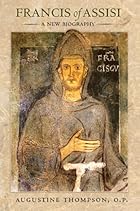
Augustine Thompson, Francis of Assisi: A New Biography, Cornell University Press (2012), Hardcover, 312 pages, $25 from online retailers.
Reviewed by Ted Witham
Augustine Thompson’s biography is “new” in the obvious sense that it is the last in a long line of biographies of St Francis going back to Paul Sabatier’s 1893 Life. Thompson’s, however, is “new” also in that it aims to go back rigorously to historical sources. This approach is in line with other historians who recently have been sifting through historical records and chipping away at the pious accretions to produce a “plain package” St Francis.
William Hugo, for example, a Capuchin formation director produced in 1996 a “Beginner’s Workbook” Studying the Life of St Francis, which invites novices to evaluate the historicity of early writings. The Melbourne conference in 2009, out of which came Interpreting Francis and Clare of Assisi, was also historical in ambition, using a variety of academic approaches – documentary, art history and so on – to develop a more historical picture of the saints in their world.
These new studies are pushing out the older Lives of St Francis, which were either pious or interpretive: they sought either to show Francis as an exemplar of the Christian life, or they observe St Francis through a particular lens: Jacques Dalarun on Francis and power and Francis and the feminine, and Leonardo Boff on Francis and liberation offer these interpretive visions of Francis.
Augustine Thompson is a Dominican friar, and this gives him an “insider-outsider” perspective. On one hand, he knows what it is to be a friar in an Order with a charismatic founder. On the other hand, he has greater clarity of vision when he writes about Francis than do many Franciscans in their familiarity with their founder.
Fr Thompson tells a plain story of a man who had no agenda and who could articulate no particular vision for the movement that formed and swarmed around him. Thompson’s Francis simply wanted to live the Gospel. Even at the end of his life, Francis is still surprised, Thompson claims, that “the Lord gave me brothers”.
Even poverty, the Franciscan value that many believe to be the base of Francis’s vision, is held up to question by Thompson. There’s no doubt that poverty was a part of Francis’s vision, but Francis, as Thompson emphasises, mentions the Eucharist much more often than poverty. Francis’s devotion to churches and priests is because of the celebration of the Eucharist – all to be venerated because there God comes to earth in a perceptible form.
The central insight for me in this “new” biography was precisely Francis’s lack of a programme. Francis, at least in Thompson’s telling, was a man who simply wanted to live the Gospel, to be radically available for God. This, I suspect, is one of the main reasons for Francis’s ongoing attraction.
Thompson’s book also has its attractions. It is divided into two halves. In the first Thompson tells the story of Francis simply and without frills or academic apparatus of any kind. Then follow a helpful list of the major biographies of Francis since Sabatier’s and a bibliography of documents from the 12th Century. In the second half of the book, Thompson argues in detail why he has included some details and discarded others as non-historical. These chapters may be mainly for scholars: most of us, I suspect, will be glad to read the first half as a self-standing account of Francis’s life and be refreshed by it.
It’s Trinity Sunday again. I regard this feast as a tipping point in the church’s year. It’s our last chance until Advent Sunday to celebrate the life of God, God’s coming in Jesus Christ, and God’s ongoing presence in Holy Spirit. From Trinity Sunday on, we turn green and turn our attention to growing in the grace of Holy Spirit.
Trinity Sunday then marks a turn from God to humanity. On Trinity Sunday, we celebrate God as Three and God as One. We know that though God’s Threeness and Oneness may be logically incompatible, they say something important about God.
Trinity Sunday sends us back to the beginning. And for us humans, the beginning is described in Genesis 1 and 2. We humans, we are told, are made in the image of God. If God is Three and God is One, then there is also an aspect of our lives that make us a Trinity too.
The great African Saint Augustine of Hippo taught that human beings are three in one. We are made, Augustine said, of memory, will, and love.
As far as we know, human beings are the only creatures who have a past to remember. Our memories are vital to us. We often hear people say that if their house were burning down, the first thing they would rescue would be their photo albums, because ‘they contain our memories’. Our memories, we say, make us who we are.
We are also the only creatures with a sense of the future, and the knowledge that, through our wills, we can affect the future. Our will partly determines the experiences we will have from this point on. Our will and our desires are deep parts of ourselves.
But memories can be bitter. Good times of the past can be locked up by our sinful actions. To be truly human, we need more than memories: we need love. Love will lead us to be grateful for our memories. Love will empower us to forgive and be forgiven, so that our memories will shine with goodness.
The future can be uncertain. We can be horrified that our wilful actions can turn out to be destructive. At the same time, we know how little effect our wills have on the future. We can live in fear of what is going to happen. So our will needs to be coloured by love too. Love will give us the grace to will that which is good. Love will give us the confidence to go on in faith rather than in fear.
Love is what makes us truly human. It is the jigsaw piece that fits in between our memory and our will.
In the Creed each week we make the amazing affirmation that in Jesus, God became “truly human.”.Jesus carries in him the memory of all our pasts. Through his death and resurrection, Jesus has opened up for us a future that is life and not death, glory and not shame. His love, memory and will, makes him truly human too, and makes us like God, “partakers in God’s nature”.
So let us celebrate the human trinity of memory, will and love. They are a way to God.
1974 Theological College – (Trinity College, Melbourne)
A fellow theological student and I were arguing ferociously. I was 25, and presented the Left’s view of Aboriginal rights in the sharply political terms I had learned from the Campaign for Racial Equality.
‘Come back and talk to me when you can argue as a Christian,’ my friend told me.
~~~~ ~~~~ ~~~~
I remember clearly the challenge he put to me that day, although I know he looks back on that statement with embarrassment at the priggishness of his former self.
Unless Christ is central, goes the argument, it’s not Christian. And unless Christ is central to your thoughts about any subject, then they are sub-Christian. All these decades later, I am still challenged by this position, and even more so by my reading of Joseph Ratzinger’s The Theology of History in Bonaventure.
I have wanted for some time to read this exploration of Bonaventure, and I am enjoying the experience. Ratzinger is learned and lucid, a teacher whose range is so wide that he includes the reader by providing enough backstory. For example, he shows how Bonaventure differed from Thomas Aquinas in his treatment of Aristotle, because Bonaventure wanted to preserve the primacy of Christ in his philosophy. Ratzinger delights by showing not only where they disagreed but the courtesy with which Bonaventure attacks the arguments and never the person of Thomas.
And the central challenge Bonaventure throws to us is to argue for a radically Christian view of history, in which Christ is the central point, and in this age of the Holy Spirit, we are returning to the Father. As Ratzinger diagrams it: Father > egressus > Christus > regressus > Father. (To read Ratzinger, your Latin needs to be reasonably tuned.)
In our age, we have become so used to secular versions of history and time, notably the past-centred view of conservatives; the apocalyptic view of ruptured time promoted by the Green movement and the various views of time implicit in scientists’ narratives around cosmic and biological origins.
Bonaventure’s challenge to us is to see history in God’s terms. The victory of Jesus on the cross and his sending of the Spirit change the direction of history – not just salvation history, but political history, human history and the history of creation. Bonaventure is a medieval scholar; he does play with different schema of sevens (seven days of Creation, seven days of Redemption, seven aeons of the new Creation), threes (Creation, Redemption, New Creation), and twos (Old and New), but these elaborate and fascinating frameworks all point back to the centre-point who is Christ.
We are rightly enthusiastic for inter-faith dialogue and the ways other faiths can deepen our own. But how do I deal with Bonaventure’s insistence that the final word is Christ’s? We fear ecological destruction, but does the confidence of our return to Christ sharpen our concern or bolster our hopes for the future? We worry about the imbalance of the world between a wealthy West, a rising China and poverty and violence. Do Bonaventure’s certainties reduce those worries?
Sometimes the Pope’s present pronouncements seem to come from another world. Maybe they do. His love for Bonaventure and the place of the Franciscans in history indicate that Ratzinger’s views have been heavily shaped by the ‘other world’ – that of medieval theology.
I am glad to be challenged again to argue as a Christian, and to place Christ at the centre in all my thinking.
John Warner, We Believe: studies in the Nicene Creed, Perth: John Warner, 2011
(available from St John’s Books, Fremantle) 68 pages, A4 paperback
Reviewed by Ted Witham
The Rev’d John Warner believes that “Christians should say what they mean and mean what they say”. The question raised by these substantial Lenten studies is whether most Anglicans do have a spiritual and intellectual grasp on the Nicene Creed, or whether we rattle it off Sunday by Sunday unheeding of its meaning.
One school of thought says that we don’t need to understand all the philosophical ramifications of our central statement of faith. It is expressed in the philosophical categories of the 3rd Century, not in a contemporary framework, so we should recite the Creed believing that we believe the same things about God as Christians did 1,700 years ago. There is a grain of truth in this, but if we rely on it as a reason for not trying to understand the Creed better, then Fr Warner would say we are guilty of hypocrisy – not to mention sloth.
Fr Warner divides the Creed into 30 days collected into 5 sections of various lengths. At the end of each section is a series of discussion starters. The sections are traditional — Belief in: God the Father, God the Son, the saving work of Jesus, God the Holy Spirit, and The Church and the Last Things.
The teaching for each day is both solid and solidly orthodox: meat and right for Lent. The teaching is seasoned with some helpful analogies, metaphors and anecdotes. Fr Warner is aiming to reach thoughtful parishioners, though some readers may need a little encouragement and support to get the most of out the materials.
(On a personal note, I was Associate Priest in Claremont parish when John was Rector. We have worked together in study groups and in Education for Ministry (EfM), so I am accustomed to John’s teaching style.)
The five sets of discussion starters will stimulate worthwhile discussion both on the intellectual understanding of the Creed and on the practical and spiritual implications for life in the Church. I would have preferred more discussion starters and more guidance on how best to use these materials in a group, but restricting the amount of questions will keep group participants focused on the Creed.
There are too few educational materials directing us to know and understand the central teachings of our faith. John Warner’s new studies fill a real need. I hope many parishes will want to use them this Lent.
Shaped 2011: A (Abilities)
Readings:
Exodus 35:30 – 36:3
Psalm 18:30-37
I Corinthians 3:5-15
The Holy Gospel of our Lord Jesus Christ according to St Matthew, the eleventh chapter, beginning at verse 28:
Glory to you, Lord Jesus Christ.
28 Come to me, all who labour and are heavy laden, and I will give you rest. 29 Take my yoke upon you, and learn from me, for I am gentle and lowly in heart, and you will find rest for your souls. 30 For my yoke is easy, and my burden is light.”
For the Gospel of the Lord:
Praise to you, Lord Jesus Christ.
At different times in the history of God’s people, there has been a task. For the people of Israel settling in the city of Jerusalem, the task was to build a temple. Before that, in the civil war that tore Israel apart for many years, the task was for David to survive and to defeat Saul. In the years after the death and resurrection of Jesus the task for God’s people was to spread the Good News that Jesus rising from the dead had made a difference.
Each of the tasks required God’s people to get on board, to offer themselves for the task, to work to implement God’s will. God invites us to share in the work that God is doing. Many of the tasks set for God’s people, perhaps most of the tasks, are beyond the capacity of human beings. But the story of God’s people shows us again and again that God equips God’s people to carry out these tasks.
Expert jewellers and fine craftsman were required to finish off the Temple. They were called, empowered by the Holy Spirit, and commissioned for the task. The final product – the first Temple of Solomon – was extraordinary. Bishop Gregory of Tours listed it as one of the Seven Wonders of the Ancient World. Bezalel and Oholiab and the other craftsmen evidently did their job well! Solomon's Temple
Before there could be a capital city for David, there had to be a peace settlement. David rebelled against King Saul, and spent twenty years waging guerrilla war against Saul. I find East Timor an intriguing parallel, because José Ramos Horta and Xanana Gusmao, who both started out as theological students, compared their guerrilla war with that of David against Saul. Gusmao modelled himself directly on David, describing himself as a poet-warrior like his hero. Xanana Gusmao
For guerrilla war, you need warriors, and not just any warriors but warriors equipped for a dirty war in the harsh terrain of Palestine: warriors with the agility of mountain goats and deer; warriors trained to wait on a higher rock and pounce from above on their enemy; warriors who could handle the crossbow, the most high-tech weapon of the time; warriors who could outrun their enemies with sure footing on slippery, winding paths.
I’m not sorry that God’s people don’t need warriors now. The idea is repugnant to our era. But they needed them then, and God, through David, called them, equipped them and used them.
Paul knew that God’s message of risen love needed messengers to tell it, and we can pick this attitude out from the messy controversy that Apollos seems to have caused. You don’t need to take sides: I’m with Paul; I’m with Apollos. What you do need are more messengers. And although we now don’t know the whole context, Paul is calling for specialisation. If he has built the foundation, they now needed some messengers to consolidate those foundations, others to build on them, others to take them further afield.
These are just some of the Biblical accounts of how God’s people challenged with a task found that God raised up and equipped people with the right abilities.
You know that I am a fan of St Francis of Assisi. St Francis was born into a Europe that was changing. Trade was bringing into existence the first Eurozone. As a boy, Francis travelled with his father on trips from Assisi in central Italy across the Alps into France to buy cloth. In Francis’ time, cash money – coins – was just becoming the currency of choice. St Francis noted, for example, that the wealthy held onto the first-rate coins and the poor tended to have the poorly minted coins which lost their value. The rich could become richer, and the poor even more destitute.
St Francis marries Lady Poverty
The task for God’s people was to challenge this greed, and St Francis, with his radical message of voluntary poverty had the particular abilities needed for this task. I think if St Francis were alive today he would have been occupying Wall Street. He would have understood how greed distorted the money system and unjust men could rip off others. But notice a crucial difference: the means by which the bankers have been ripping off the poor in America is by sub-prime lending. St Francis would probably not be the man to confront today’s task of calling out greed; someone else whose abilities are related to today’s injustices is being called and equipped and commissioned for the task of God’s people. No doubt St Francis would be a great inspiration for that person.
During World War II, God’s people were called on to resist Nazism. This task split the Lutheran church and caused great tensions in the Roman Catholic Church, which are still there today. Was Pope Pius XII hero or collaborator?
The Lutheran theologian Dietrich Bonhoeffer found himself with the abilities needed to resist Hitler. He first challenged the myth of the superior Aryan by nurturing a non-violent community in his underground theological seminary at Finkenwalde. He was involved in two plots to kill Hitler, and we might debate whether he was morally right to go down this path. He was imprisoned and hanged a month before the capitulation of the Nazis.
What can’t be debated is the mix of skills and background that Bonhoeffer brought to the task. He was a fine theologian; his family were the cream of Berlin society with all the connections that implied; he was articulate in person and in writing and a man of courage.
Pastor Bonhoeffer
In the series of SHAPED 2011, we are today at the letter ‘A’ for ‘Abilities’. You remember that we started two weeks ago with ‘S’ for ‘Spiritual Gifts’. The foundational fact is that we are loved by God. This is the most basic spiritual gift. Being loved means we know that we are worthwhile, that God can use us to work with him. Being loved enlarges our capacity in turn to love others. We are given a heart for God’s work. Last week’s word was ‘H’ for ‘Heart’ or ‘Passion’.
David, St Paul, St Francis of Assisi and Dietrich Bonhoeffer are all mighty examples of people who knew how deeply God loved them, and who responded with heart and passion to that love. We will see next week under the letter ‘P’ for ‘Personality’ that God used people’s unique personality to set about his plans. Each of us has a unique combination of talents and potentials. No one is like you, and it is precisely your uniqueness that God uses.
For this week, however, our focus on ‘A’ for ‘Abilities’ is an encouragement that God provides the abilities needed for the tasks of God’s people. All the talent this congregation needs to perform the tasks God asks of us is here.
Some questions for you to ruminate on then: what are the tasks of mission God is calling St Mary’s Busselton to? What talents, skills, platform – abilities – are needed to carry out these tasks? Do some of these abilities seem too hard for the people God has on hand? And what are the talents you bring? What are the abilities God will find in you to foster and encourage and use for God’s glory?
Let us pray: Loving God, you give to those ask the ability to carry out the tasks that you have set your people: Give us insight, we pray, to know what mission you are calling this parish to.
Show us the abilities needed to fulfil this mission.
Stir our hearts to ask you for the abilities we need,
and give us the courage and confidence to use those abilities in your service,
through Jesus Christ our Lord. AMEN.



 Mind Journeys