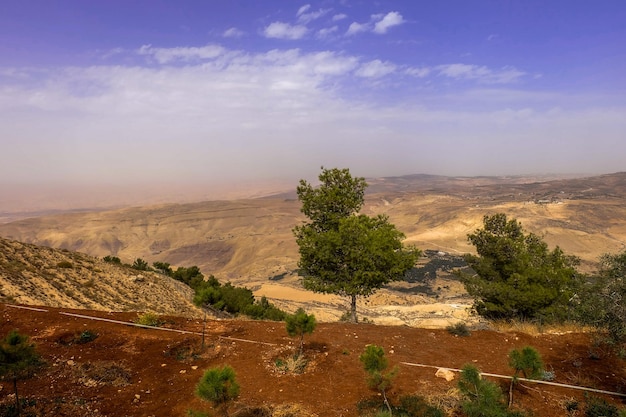
The View from Mount Nebo.


In the name of the living God, + Father, Son and Holy Spirit.

+++

Pray for the peace of Jerusalem. (Psalm 122:6a)

It’s a kind of code. The writer of the Psalm believes that if Jerusalem has peace, then the whole world will be at peace.  ‘Pray for the peace of Jerusalem’ means pray for peace in Jerusalem and everywhere.

When Moses was 120 years old, the Bible tells us, he climbed Mount Nebo, a mountain in today’s Kingdom of Jordan, about 800 metres above the Plains of Moab. There God showed him all the land that God had promised the children of Israel, from the river to the sea, the river Jordan to the Mediterranean Sea, from Dan in the far north to Gilead near Jerusalem and further south to the Negeb desert. (Deut. 34:1-5).

Then Moses died.

The last thing Moses did in his long life was to look towards the land that God was promising his people.  Moses looked forward to how blessed the tribes would be when they crossed the Jordan into Palestine. He paints a picture of how good the future will be for the children of Israel.

13b Blessed by the Lord [is] his land,
    with the choice gifts of heaven above
    and of the deep that lies beneath,
14 with the choice fruits of the sun
    and the rich yield of the months,
15 with the finest produce of the ancient mountains
    and the abundance of the everlasting hills,
16 with the choice gifts of the earth and its fullness
    and the favour of the one who dwells on Sinai.

                                                                            (Deuteronomy 33:13b-16 NRSV)

Moses could have sat around the campfire and regaled the Israelites with memories of leading his people out of Egypt. He could tell hoary tales about the 40-year trek through the wilderness, or reprise the joy, and the terror of meeting the living God in the burning bush.  But instead, he chose, after 120 years, to go to the high mountain, and to look forward to the future, to the promised land.

Moses couldn’t have prayed for the peace of Jerusalem for the simple reason that Jerusalem didn’t exist until many years later, when King David fortified a tiny Jebusite village and began building the Temple. 

What God wants for not only Jerusalem, but for the whole world’s future is peace, ‘shalom’ (שָׁלֹ֥ום). This word appears 237 times in the Old Testament, making shalom a significant concept. It means peace, and shalom is much more than absence of conflict.

Shalom means well-being in all its forms. Shalom means prosperity, but not the prosperity where only a few become wealthy, but prosperity where everyone shares their bounty with one another. Shalom is closer to communism than it is to the capitalism we experience in 2025. The prophet Isaiah reminds us that shalom is the opposite of war, which breeds hatred, fear, and scarcity. Shalom means love-in-action between people.

Pray for the peace of Jerusalem, the psalmist urges us, pray for Jerusalem’s shalom. God will bring peace for Jerusalem out of the fraught and complicated mess in the Middle East today. The promised land that Moses looked forward to stretches from the river to the sea. But today, Palestinians want to be free ‘from the river to the sea.’

These two visions of the future clash. They seem contradictory: how do we pray for the peace of Jerusalem?

How do we pray for peace for a people who were nearly exterminated a generation ago in the Holocaust? There are Palestinians and others like Hamas who say they would like to wipe out the Jewish people. Could it happen again? Never mind the politics: many Jews believe they are surrounded now by the same murderous hatred as they were in 1938.  

As Lloyd said last Sunday in his sermon, now it is important for Christians to express solidarity with Jews. Write to Temple David in Mount Lawley; or write to the Perth Hebrew Congregation. Or to both. A simple email will be genuinely appreciated.    

And how do we pray for a people who, a generation ago, were pushed out of the land their families had farmed for generations, for thousands of years?  The Palestinians believe that Jewish settlement from the river to the sea is a policy that bulldozes them out of the way, often quite literally. What should we pray? How should we support Palestinians and their allies locally? Sending money to an aid agency is one possibility. Gaza desperately needs the basics for life. Or finding out about the rallies held regularly in the city and joining them or supporting them is another.

How do we pray for the peace of Jerusalem? What would bring about the shalom of all the people of the Holy Land? This morning’s readings encourage us to pray with hope. Hope in God. The problems of the Middle East are difficult to fix. But as Christians, we know that God’s intention is for all Jews and all Palestinians to thrive, to enjoy God’s shalom. The divisions will find healing.

 We pray with hope, knowing that the future is in God’s hands. We look to the future with hope, learning with a deep confidence that God will meet us there.

Pray for the peace of Jerusalem. We can pray for the peace of Jerusalem only if we pray for peace in our own lives. We ask God to meet us in the conflicts of our families, knowing that some of those fights and divisions seem intractable to us.

We ask God to meet us in our everyday encounters. What do we need to do to foster shalom in our communities, as we encounter people serving us in shops, people on the footpaths, people at homeless respite, and neighbours of all sorts?

As Christians, we have a vocation to be makers of shalom; to be peacemakers. Saint Francis of Assisi, my favourite saint, told his followers to meet everyone with a greeting of peace.

[We should note that we Christians don’t have a monopoly on peacemaking. Jews greet each other with ‘shalom-aka’ and Muslims greet each other ‘As-salamu alaykum’; both saying, ‘peace be with you’.]

We too can make a greeting of peace a holy habit. For most of us, it might be a bit precious to say ‘peace be with you’ or ‘shalom’ every time we greet someone, but we can, for example, sign off emails or end phone conversations with the word ‘Peace’ – and mean it!

In this Eucharist, the priest greets us, ‘The peace of the Lord be with you’, and we respond, ‘And also with you.’ This morning, let us make the peace especially meaningful. Let us pray earnestly for the well-being and security of everyone we greet. Maybe greet fewer people and make sustained eye contact with each one if you can. Take two or three seconds to really see our neighbours, to remember that God delights in each one and seeks their shalom.

+++

As you know, today is the second anniversary of Lloyd’s ordination as a priest (congratulations, Father!), and it is my 50th. At the 8:30 Eucharist, Bryan Shattock marked his 42nd year of priesthood.

We as priests have a special role as a peacemakers.

Firstly, we bid the people we serve to ‘pray for the peace of Jerusalem’, and we bid the people to pray more generally for peace. Temple David replied to me that my email was appreciated because I am a priest.  My support as a priest carried your goodwill along with mine. 

So, secondly, our role in the community of faith, especially our parish priest, our bishops and the archbishop, is to be bridge-builders.

One of the titles for the Pope is Pontifex, the Latin for ‘bridge-builder’.Pope Leo has an account on X called ‘Pontifex’, and he repeated on social media his first greeting as Pope. This is what the Pontiff said:

“Peace be with you all! This is the first greeting spoken by the Risen Christ, the Good Shepherd. I would like this greeting of peace to resound in your hearts, in your families, and among all people, wherever they may be, in every nation and throughout the world.” (Pope Leo XIV on X)

I’m not saying that priests should be Popes. But like the Pope, the priest builds bridges between people and God.

One of the roles the church entrusts to priests is to speak words of absolution, either to all of us in the Eucharist, or to each of us in private in the Sacrament of Reconciliation, formally and informally. These words of absolution make space for peace with God.

This role of absolving carries with it the responsibility for us priests to make peace, to promote shalom, in the entire community we serve. We should never provoke division or hatred.

But as pontifex, as people entrusted with opening space for God, priests try to discern when to challenge people; when to ask people to fulfil roles for which they feel unworthy or not ready, or when to expose evil and hatred to the light by challenging people to do better, and by challenging, so build peace among people.

One anecdote from my time as a priest at Christ Church Claremont. A few parishioners looked with disapproval at families with young children. They stared at them critically, they shushed them, they rudely moved away from them, and they demanded that parents take their children to the crèche.

One morning during the Eucharist, I saw families being disturbed by these parishioners. There were many whispers and many scowls. I saw one mum on the brink of tears. I got very hot under my dog collar. When we came to the notices at the end, I told the congregation in what I thought were terms everyone could understand, that if they continued to treat kids like that, there would be no church left.

As I shook hands with people leaving, one woman said to me, ‘I’m so glad you said that about the children. Someone has to speak up about how badly behaved they are in church.’

So much for my discernment to challenge, to create connections and shalom between people!

So, we as priests have the privilege of promoting love between the people we serve. Priests speak well of people, knowing that God sees every person as whole, as holy, as complete. Priests who gossip or who speak badly of others are smashing those bridges between people, not building shalom. We try to be peacemakers whenever and wherever we can.

We priests have a special role in building bridges into the future. Like Moses, we look with hope to God’s church in the years ahead. It’s so easy to look at the church and be despondent.

There are fewer churchgoers, we say. There are no young people, we say. We have only seniors who don’t have the energy for organising things, we say. There are divisions tearing Anglicans apart, we say, between St Brendan’s and St Nic’s, reflecting bigger divisions between Canterbury and Sydney.  It’s easy for priests to be despondent. It’s easy for priests to think that we must come up with all the solutions.

We should be realists. God’s church is today what it is.

But as priests, we have a responsibility to remind people of a bigger story. God has been faithful to the church for 2,000 years. We have no reason to think God will not continue to grace God’s people with love and harmony, with shalom. Of course God will. God is not going to change or withdraw his love from the church.

Of course, all of us are all called to be bringers of peace, nurturing shalom. In fact, we can all do all the things priests do. But we priests are called to model peacemaking, to make space for peace, to call others to be makers of shalom. It’s a challenge for us, and it’s an extraordinary privilege.

We priests, like Moses on top of Mount Nebo, should be saying to the church:

The church’s future is blessed.

The church is blessed with the choice gifts of heaven above
and of the deep that lies beneath;
with the finest produce from the faith of those who have gone before us,

their stories, their hymns, their deep spirituality.
With the abundance of faith of those who will continue to come,

their joy, their faithfulness to Christ,
their willingness to live a life of service;
with the choicest gifts of love and shalom

And, above all, the church’s future is blessed with

the never-ending favour of the One who dwells with his people.

Pray for the peace of Jerusalem, and pray for your priests.

Peace be with you.
Slavery, Saint Francis and us


If you prefer to listen to Ted preaching this homily, click below (12 minutes):

The Holy Gospel of our Lord Jesus Christ according to Saint Luke.

Glory to you, Lord Jesus Christ.

[Luke 17:5-10]

The apostles said to the Lord, “Increase our faith!” The Lord replied, “If you had faith the size of a mustard seed, you could say to this mulberry tree, ‘Be uprooted and planted in the sea,’ and it would obey you.

7[Jesus said], “Who among you would say to your slave who has just come in from ploughing or tending sheep in the field, ‘Come here at once and take your place at the table’? Would you not rather say to him, ‘Prepare supper for me; put on your apron and serve me while I eat and drink; later you may eat and drink’? Do you thank the slave for doing what was commanded? 10 So you also, when you have done all that you were ordered to do, say, ‘We are worthless slaves; we have done only what we ought to have done!’”

For the Gospel of the Lord,

Praise to you, Lord Jesus Christ.

In the Name of the Living God, Father, Son and Holy Spirit.

The whole point of having a slave is that person can do whatever you want whenever you want.

When we were in Mauritius Rae and I used to worry about our hosts’ driver who was called Anil. Our hosts owned a sugar plantation and invited us to dinner a couple of times during our seven-week stay on the island.

They would send a message ‘Anil will pick you at 5:30.’ Anil arrived promptly at 5:30. Anil drove us back to the plantation. We had dinner, not with Anil, of course. Just with Pierre and Doris. Pierre showed us over their sugar refinery, a 24-hour operation. We talked. At 11:30 in the evening, it was time to go home.

Pierre yelled across the backyard, ‘Anil! Anil!’ Anil stumbled out of his hut, shook off his sleep and drove us home. It was an hour’s drive, and then, of course, Anil had to drive an hour back again.

Anil wasn’t a slave, but Rae and I worried that he was treated like one.

The people of Jesus’ time had slaves. The Jews had always had slaves, going back to the time of Abraham. At least, the more affluent Jews had slaves. And the whole Roman Empire depended on the labour of slaves. Apparently one third of the population was enslaved. People 2,000 years ago didn’t have the same moral objection to slaves that we have now.

And the whole point of having a slave is that person can do whatever you want whenever you want.

In this morning’s Gospel reading, Jesus invited the people of his day to try a radical thought experiment: imagine you are the owner of a slave who has been ‘working all day in the field, ploughing or tending sheep.’ (Luke 17:7) When evening comes, you allow the slave to take as much time as he wants to wash and change into clean clothes. Then the slave reclines on the best dining couch in the house. Then you, the owner, the master, serve the slave his dinner, and the slave can eat the meal quickly, or can spend four or five hours at the table chatting to friends and drinking wine. You are on call until the slave tells you he has finished his meal.

Then Jesus stops the thought experiment. No: you treat the slave as a worthless slave whose job is to serve you and not the other way around. If it doesn’t suit the slave or the slave is too tired makes no difference.

This thought experiment comes from Jesus, who as Saint Mark and Saint Matthew tell us, ‘…came not to be served but to serve and to give his life a ransom for many.’ (Mark 10:45, Matthew 20:28). Not to be served, but to be a slave.

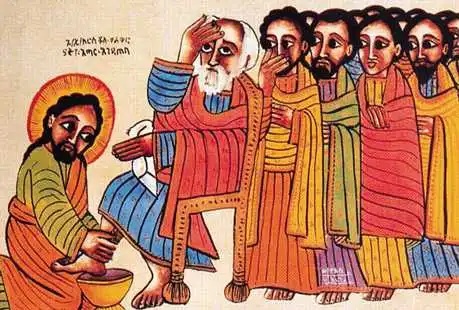
In other words, this thought experiment is not as fanciful as it sounds. Jesus himself swaps the role of Lord for that of a slave for example, when he washed the disciples’ feet (John 13:5), and really upsetting Simon Peter. ‘You will never wash my feet!’ wails Peter (John 13:8).

It’s not possible, we think. Even if you don’t own a slave, the point of having slaves is to do anything their masters want at any time. Jesus upends this idea. A slave is a human being created in the image of God, and simply because of that should be, at least, respected. But more than just respecting slaves, Jesus challenges us to serve others as if we were slaves ourselves. And especially, we should serve those who are treated as slaves.

Yesterday was the feast of Saint Francis of Assisi, a saint who means a great deal to me. Francis was the son of a cloth merchant, Pietro di Bernadone, who was growing richer and richer. Francis was privileged by having the benefit of this extreme wealth, and when he was a teenager, he made the most of the lavish lifestyle. He threw wild parties with his friends, providing the wine and food for the feasts. He gained the nickname ‘The King of The Revels’.

But he grew uncomfortable with this privilege. He was riding outside Assisi one day – and owning a horse was something like owning a Morgan Super 3 sports-car today or maybe a Rolls Royce Sweptail with a million-dollar price tag. As he rode, he saw a leper. Until then, Francis had been revolted by lepers. They were disgusting, repulsive. But on this day, Francis was moved to dismount and approach the leper and embrace him. Something changed in Francis from that moment. ‘That which was bitter had become sweet,’ he wrote later. (The Testament, 1, FAED I, 124.)

One of the first ministries Saint Francis undertook was caring for lepers; becoming their slave, their servant, looking with love on their distorted features and running sores, feeding them, keeping them safe from brigands and dressing their wounds.

Francis knew that this was how Jesus challenges us to be a slave to others. It’s a confronting idea. And we should be confronted. It goes against the way things are. It turns the world upside down.

I find it interesting that even though Francis is known for poverty, in the early years, many of his followers were queens and princesses: the Blessed Isabelle of France, Saint Louis’ sister, was a princess, and Saint Elizabeth was the wife of the future king of Hungary. Saint Clare too was from a noble family. These royals and aristocrats responded to the challenge to become a slave for others, serving the poorest, putting their lives at the service of the neediest.

I am impressed by Saint Jeanne Jugan in France just after the French revolution. She was inspired by Saint Francis to look after homeless women, eventually setting up a network of refuges throughout the east of France and becoming the Little Sisters of the Poor, who are in 2025 still serving the elderly poor. They have a house in Glendalough just north of Perth city. She too, and her sisters, respond to the challenge to be a slave to others.

And we are followers of Jesus too. The same challenge applies to us – as individuals, as the people of Saint Brendan’s. We don’t have to be the founder of a religious order, or even join one, to take up this challenge of Jesus. But if royals and aristocrats can become slaves, so can you and I.

Is there some situation where God is calling you to be a slave? Is there a person whose needs you can try to meet, but whom you avoid because you know it will be difficult? Is someone you know being held captive, ensnared in some way by someone? Is there a way to be a slave to them, to serve them in their needs? Being a slave is not about knowing you can succeed. It’s about putting aside our needs to achieve, to make a mark. Being a slave’s only about obeying the master. ‘When you have done all that you were ordered to do, say, ‘We are worthless slaves; we have done only what we ought to have done!’” (Luke 17:10)

And our ultimate Master is Jesus, and Jesus chooses to serve when others are certain it’s beneath Him.

As a parish community, we rightly hold up our ministry to the Homeless as one example where we put energy and care into serving others whatever their needs. But just because we are serving one needy group does not mean there are not others in the Warnbro/Rockingham community calling out for our service as a parish.

Today we bless our pets. The same challenge applies to animals as it does to human beings. We sometimes think of our pets as slaves. We keep them locked them up in our house or yard. We have them on a leash when we take them outside. We expect them to do emotional work for us, loving us when we come home from being away. But I am sure that we bless our cats and dogs because we know the challenge to be a slave to them too. Take note of that Lottie, and Caesar.

So this story in the Gospel about a slave coming in from a day’s work in the field is not a hypothetical. It’s a challenge. It confronts us to find ways in which serving others turns the world on its head and creates a kinder, more loving world in partnership with the One who came to serve.

Where is God calling you to be a slave today?

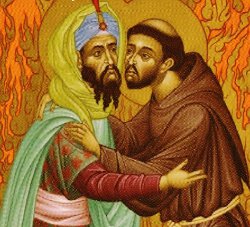
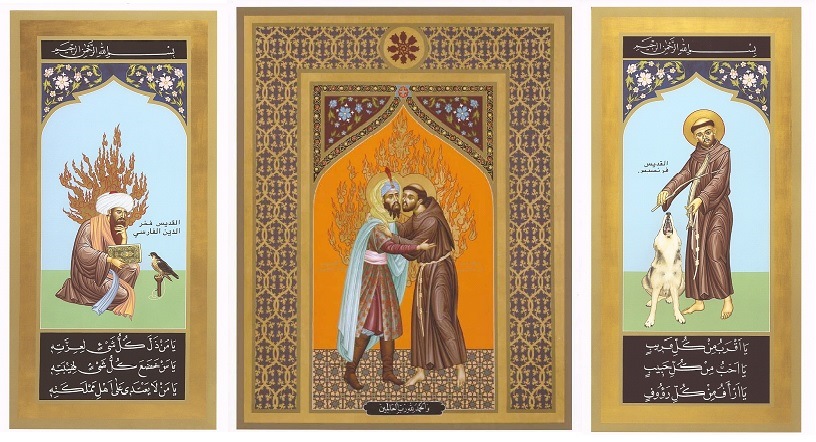
THE SULTAN PREACHES TO SAINT FRANCIS, AD 1219


 THE SULTAN PREACHES TO SAINT FRANCIS, AD 1219

The Sufi Path of Love – Saint Francis and the Sultan

David Lord, Franciscan priest


David Lord (may he rest in peace and rise in glory) was a Third Order Franciscan. The letters TSSF meant a lot to David. I know he valued Franciscan spirituality and he appreciated being part of our WA Region fellowship.

For various reasons – mainly because David was such a big character, ‘Big David’ as his family nicknamed him – his Franciscan commitment was not mentioned at his funeral.

David was a dear friend, a fellow priest and a fellow Tertiary.

I had the privilege of walking beside David when he was a novice. He told me how his three months at the Franciscan International Study Centre in Canterbury shaped him both spiritually and intellectually as a Franciscan. The inspiring stories of Francis and Clare were unpacked at the FISC in challenging ways. David realised that the question for us Tertiaries is not how to live like Clare and Francis, but how their faith journeys could inspire his.

Like all of us in wealthy Australia, Clare’s utter poverty confronted David. How could Clare’s uncompromising poverty inform our lives? He saw that many decisions that he had made in life were to create and maintain a comfortable life.

He and Lyn went to the Philippines and India for several years in a row, and they saw there that their contribution through ‘Pilgrimage’ was to find ways of alleviating the shocking poverty they encountered there. Yet all the while, as they provided loving and educational experiences for the children they met, like those living on rubbish tips at the edges of the large metropolis, David and Lyn claimed that the children enriched them more.

I suspect that this is real poverty – knowing how others enrich us!

David was disappointed that the Study Centre in Canterbury was closed. He was in the last cohort of students. He was angry that the Centre was moving in a new direction which privileged Roman Catholics above students from other denominations. David felt that this was a betrayal of the spirit of St Francis. David always understood God as love; God as embracing all people and creatures. Putting up territorial boundaries always riled David as it did St Francis.

When we began coming to St Brendan’s when David was Rector, we noted how animals, dogs in particular, were always welcome at church. No fuss was made of them; they were just part of the congregation.

When David was interviewed for the role of Rector at Saint Brendan’s, the nominators asked him whether he would be okay with the parish’s Homelessness Respite ministry. Not only did he approve, he said, but it was also one of the main attractions of the role!

He made Homelessness Respite a priority of his week, visiting every Friday and many Fridays even when he was ill. He chatted and laughed with both guests and volunteers. Watching him, I saw how much he enjoyed it: he was enriched by the guests as he was enriched by the children he met on ‘Pilgrimage’. David was a mirror of the joy of St Francis and the joy of Jesus.

May we reflect the same encompassing inclusiveness that David embraced.

  • Ted Witham tssf
  • Post updated 30/9/23.

Moses foreshadows the Cross

This is how it has always been:
Christ upturning the cosmos, mingling the darkness of death
With the ever-burning promise of life


The Feast of the Stigmata – on the 15th Sunday after Pentecost 2023


Moses stretches his hands wide across the Stop Signed Red Sea.
The prophet is backlit by the pillar of cloud and fire
(The double defence cleaving the hosts of Egypt from the hosts of Israel.)
His arms cast a vast shadow on the dark billowing waters.
The shadow is a cross leaning forward centuries and cross countries
Through forty ages of wilderness and desire
The pillar of fire with its mass of deaths behind – the cream of Pharaoh’s army
Separated from the joyful fire of the feasting masses ahead.

This is how it has always been:
Christ upturning the cosmos, mingling the darkness of death
With the ever-burning promise of life; sifting through the expiration
of tohu and bohu* which is death
He forever speaks into existence the tenacity of fresh life:
And on the steep mountain top near Assisi, Saint Francis sees with his eyes within
The truth of this eternal intermingling when only life can win

Ted Witham tssf. Feast of the Stigmata 2023

Genesis 1:2. ‘And the earth was tohu and bohu’ (formless and void)

We all like sheep are gone astray (Isaiah 53:6)


One of the tragedies of our times is the war on animals, the war we have been waging for two or three centuries, seizing their territory and subjecting them to ever more inhumane conditions.

Human activity was one of the causes of this year’s bushfires in the Eastern States which took away from koalas much of their habitat. Iconic species such as the Bengali tiger and the white rhinoceros are on the brink of extinction. Presumably the thylacine (the Tasmanian tiger) and the dodo would still be thriving in Tasmania and Mauritius if human beings had not ravaged their living space.

Only a few wild animals thrive under the relentless expansion of human activity. Mobs of kangaroos near my town relish in the green pasture and endless water supplies human beings have created.

We clobber our domestic animals too. In the past decades, more and more cattle have been squeezed into feed-lots, unable to exercise and terrified by their imprisonment. Battery hens are confined to less than a square metre and never see the sky or scratch in the fresh air.

We use horses and dogs for sport. Not only do they strain to entertain us, but our society allows some of their keepers to inflict on them excruciating pain when they are away from public view.

Our treatment of animals shames us human beings.  We are given no licence by Scripture to dominate the environment and crush our fellow-creatures. There is no Biblical excuse for setting ourselves up as gods destroying whatever we will.

We consider ourselves superior to other creatures, but the evidence shows that we do not make a good shepherd. We are cruel and despotic in our treatment of the environment.

In today’s Gospel, John teaches us two things about animals and salvation. The first is that Jesus is the good shepherd. No creature, including us human beings, can put ourselves above other creatures. Jesus is our shepherd, caring for us, and he is the shepherd of all creation, restoring all things, not only the human world.

Secondly, we are called to be part of the community of creatures, living together with animals and ecosystems as our brothers and sisters. This is the great vision of Saint Francis of Assisi: to live in harmony with all life as part of the community of creation.

The Good Shepherd proclaims to us that God will draw into a community all his creation and that we will live in harmony with death adders and scorpions, both of them wild animals Jesus ’was with in the wilderness’ (Mark 1:13a), as we will with cats, horses, and especially dogs, the animals who have co-evolved with us and who are our familiars. 

There are many signs of new life. Most farmers I know are concerned about any animal cruelty and do all in their power to care for their animals. WWF and other organisations keep on reminding us of the plight of the non-human world and establish programs to restore habitat and rescue species. More and more middle-class people express real care for pets. Our Jack Russell Lottie is our little sister, a member of our family. There are new ways of feeding the hungry that do not exploit animals, so I have hope that lifting the poor out of poverty will be done ethically.

The Peaceable Kingdom, Edward Hicks, 1834

[‘We have like sheep gone astray.’ (Isaiah 53:6). Quoted in I Peter 2:25, and in the Introduction to Evening Prayer in the 1662 Book of Common Prayer]

“He Died Singing” – the Transitus of Saint Francis


“He died singing, in the forty-sixth year of his age, and the twenty-fifth of his conversion”.

Today, October 3, we mark the Transitus of Saint Francis. May your Transitus be filled with blessings.

His biographers were keen to show that Saint Francis died happy, and we will repeat this line during the marking of his Transitus tonight. “He died singing.” Joy accompanies the “crossing over” of Saint Francis from this world to eternal life on October 3, 1226.

This cheery approach to dying can be off–putting. A Jesuit admirer of Saint Francis, Gerard Manley Hopkins, was heard whispering throughout the day of his death, June 9, 1889, “I am so happy! I am so happy!” Even my dear friend Father John Wardman with whom I spent hours in the weeks before he died, was inspiring in his eagerness to step into the next page of the adventure God had for him.

For most of us, our own Transitus will not be so uncomplicated. We are circled with images of difficult dying: Will we die lonely in a nursing home? Will we die in pain? Will we die in an instant in a terror attack? These ways of dying are statistically unlikely, but even so it is hard to avoid these negative predictions of the way in which we will die.

But the cheery approach shown by saints to their death also has its problems. My main sadness about my dying is the break that it will mean with my beloved wife, children, grandchildren and others close to me. While I am dying, I am sure the disruption of my loves will cause me much grief. While I am convinced that dying is a door to a wider life than this present one, free from pain and full of praise, it is not unmitigated joyfulness.

The point about the Transitus of Saint Francis, the point about learning from saints how to die, is to restore the balance of our expectations about death. Because we love, we will grieve, but St Francis, poet Hopkins, John Wardman, and all the other happy deaths keep reminding us that we can make a good death.

When I was eight years old, I sang “There’s a friend for little children above the bright blue sky”, and believed that heaven was just above that blue dome. [Or was it just behind the blue altar curtain in St Mary’s, Tambellup?]  Now I think of heaven in more existentialist terms, a state of being in the presence of God eternally, and I look back and see the many ways in which my concept of the afterlife has grown more sophisticated. The sense of mystery about it has also grown. The more complex my conception of it, the more it is shrouded in a sense of unknowing.

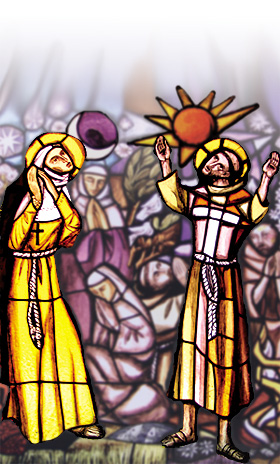
StainGlassFranClareSo part of making a good death is constantly interrogating one’s picture of the afterlife and updating it as we update our understanding of God and how completely his love covers our existence.

Practising for a good death includes taking now every opportunity for joy and praise. For me as a musician, singing must be part of my preparation for dying.

Preparing for a good death also includes being conscious of those we love and continuing to work at those relationships, not to increase our grief, but to celebrate the great love which God shares with us.

So while it may be true that I will die in some sadness at leaving behind those I love, I also dare to hope that those with me in those last hours will also be able to say, “He died singing”.

In marking the Transitus of Saint Francis today, we can resolve to turn our attention, however old we are, to preparing to die singing, held by love.

Hymn for the Feast of the Stigmata


I wrote this hymn for the Stigmata (17 September) 10 years ago in 2007, and I offer it again as a resource for you.

When singing this hymn, it really suits the tune ‘Kremser’ best. If you use ‘The Ash Grove’ you need to align the number of lines of music with the number of lines of text – not difficult!

Here it is for your meditation:

When Francis our father received the stigmata,
he climbed up Averna and prayed from the heart.
With all his believing, he now is receiving
the marks on his body of being in Christ.

So first there is Moses, who on our God closes
by opening his life to the power of the law.
He follows obeying, and does what God’s saying:
the marks on his body of being in Christ.

And next there is Jesus who brightness releases.
On Carmel he’s climbing and shines in the light.
The truth that he’s revealing, with serving we’re sealing
the marks on our body of being in Christ.

So when our Saint Francis on Averna dances,
He turns to the Lord and is won by the Cross.
Obeying and seeing, and turning and freeing
the marks on his body of being in Christ.

Now we who are living find joy in thanksgiving.
We seek out a place to pause and to pray.
The love that we’re gaining is expressed with pain in
the marks on our body of being in Christ.

  • Ted Witham © 2007

***

This hymn was inspired by Moses’ experience of the glory of God when he climbed Mount Sinai. This is described in Exodus 24:12-18 set for the Old Testament reading for the Stigmata (in the Australian Third Order Manual).


Puncturing Trump’s Power


If the idea of the weakness of God in the world of Trump offends you, please read on. The President of the United States has vowed to ‘make America great again’, and logically America’s greatness must be at the expense of the rest of the world. He wants to use his power to decrease the life-chances of Mexicans, Syrian refugees and the environment.

It seems that this is a man using excessive power to accumulate more power. He can bully everyone from a Prime Minister to a girl in the backrooms of the White House. Be sure, the psychologists tell us, that a man like that who can use his power over others will display that power.

The response to Mr Trump portrayed in both traditional media and social media is often hysterical. ‘When will someone exterminate that man?’, one exasperated Facebook post asked. ‘This Crazy Man,’ writes another, ‘will provoke Iran into war.’ Or another typical reaction, ‘I’m terrified for the world.’

For those of us, white Western males in particular, who think we have power in this world, Mr Trump is a challenge. We want to use our power to change Mr Trump’s thoughts and actions., just as we use our power more locally. We are accustomed to our politicians responding to our emails, to bending the way of the people, and to honouring the democratic will every three or four years.

We tell ourselves that we can change things. We fantasise that we are staffers in the TV series The West Wing. We ‘speak truth to power’, and power listens.

But Mr Trump reminds us that we delude ourselves. I think we should take some care how we respond to him for fear of setting off damaging reactions. To bring power against Mr Trump, however great that power, will result in a reaction of more power. We threaten Mr Trump and the violence ratchets up. His Acting Attorney-General defied him on his Executive Order regarding immigration. He sacked her. His Generals advised him of the power of Al-Qaeda in Yemen. Mr Trump used a drone to kill 30 human beings.

It seems to me that we Franciscans have a contribution to make here. Particularly when a power-oriented President is breathing out fire.

We believe that the Divine way is the way of littleness, the path of humility.

Mr Trump, were he to encounter the concept of littleness, would not understand it. For him, being little is the worst kind of weakness.

The path of littleness eschews using all power over others. The path of littleness sees ourselves as fallible pilgrims seeking a way forward that will nurture those around us. The path of humility sees the other as the focus of my concern and not myself. If I have wealth it is at the disposal of others, not myself. If I have earthly power, it is to promote the needs and wants of the least in this world. (And as Australians, as whites, and as males, whatever we say we do have wealth and power).

This way of littleness was incarnated by Jesus. He ‘took the form of a servant and emptied himself’ (Phil. 2:7). He made no claims to overthrow the Roman yoke, or even to get stuck into reforming the Sadducean hierarchy. For us as for Jesus, the way of littleness leads to the greatest of power; but this kind of power is the power of love, not the power of violence.

My resolution – for myself – is to hold back from trying to use my little bit of power to change Mr Trump through outraged blog posts and emails to the White House and to pressing “LIKE” to affirm the violent language of my friends.

I see only two responses I can make: one is satire (but I have no doubt that satire is a form of power), and the other is modelling the humility that seeks to put others first. I think of certain pupils at Christ Church Grammar School, I think of Jews in Auschwitz modestly trying to create a mini-world of care and kindness in the harshness of their surrounds. That’s what will change the world.


Gift in love: Saint Francis


Our joy in fervent prayer and stately dances,
In full-sung hymns and full-heart confession,
in earnest emotional expression,
all diverse ways to celebrate St Francis.

Liturgical wealth but poverty deep,
In all, radical Godward dependence,
Tangled in matter we find transcendence;
The sole way integrity to keep.

More in story than godly abstraction:
The Pope gives the Order’s permission,
The lepers’ care and pairs for mission,
In mutual prize and always loving action.

Thank God for blessings and seeing all in joy,
Our gifting for love we hurry to employ.