Jodie How is a fellow-writer in our Busselton-based writing group, Just Write. Jodie blogs at Motions and Musings and has tagged me to blog about my writing. I will then tag a couple of others to carry on the assignment!
What am I working on at the moment?
As usual, I am working on several pieces. I have just drafted a feature article on Australian musician Dorothea Angus. Dorothea was the Head of Music at Perth College for 32 years. She was also one of Australia’s best performers on piano and organ, regularly appearing on ABC Radio.
I have started a hymn for the competition for the 150th Anniversary of St Paul’s Cathedral in Melbourne. I’d better get a wriggle on, because I think the closing date is the end of this month!
I’m also sitting on a romance I have just finished exploring grief when an older man is widowed. I’m waiting for a magazine or competition wanting a short story of a 1,000 words.
How does my work differ from others in my genre?
The honest feedback I get on my poems is twofold. One: people enjoy their musicality, their wordplay and rhymes. Two: they find them too dense in thought, and wonder whether I should put my thoughts more simply.
My stories tend to show detail of landscape and character where other writers leave more to readers’ imaginations.
Like most writers, I struggle to see myself as writing in a preferred genre. I write some fantasy, some SF, even a little romance, some political drama: I see myself writing stories.
Why do I write what I do?
I write about my interests. [I try to be interested in everything.] But I do want my writing to do more than entertain: I want to engage readers. I want them not just to read my hymns, but to sing them. I want them not just to appreciate my point of view in a blog post, but to re-consider their own. I write to persuade; or at least to lay out a viewpoint for real consideration.
I write stories that show characters responding with honesty to challenges that require love and truth. I show people not always being able to rise to challenges, but who can grow to be honest with themselves about their lack of courage or love. I try to avoid the Hollywood solution of bringing a good ending by violent means.
How does my writing/creative process work?
An idea presents itself to me, and I churn it in my head, and it keeps churning until it turns into a story or a poem or blog piece. If it needs research, I research.
There are exceptions: I do write sermons when I am on a roster; I do look for poems to translate. In those cases, the passion comes as I go about the task of uncovering the heart of what I must write.
I write best when I first walk in the morning either along the beach or around the wetlands of Broadwater. I enjoy walking in the quiet of the moment with an empty meditative mind. As I approach the actual writing of the piece, the words gather in my mind to the rhythm of my walking.
Then I sit at my computer and type for an hour and two. I like silence when I write. When I have finished a draft, I go back and edit and re-write until I am reasonably satisfied with the piece.
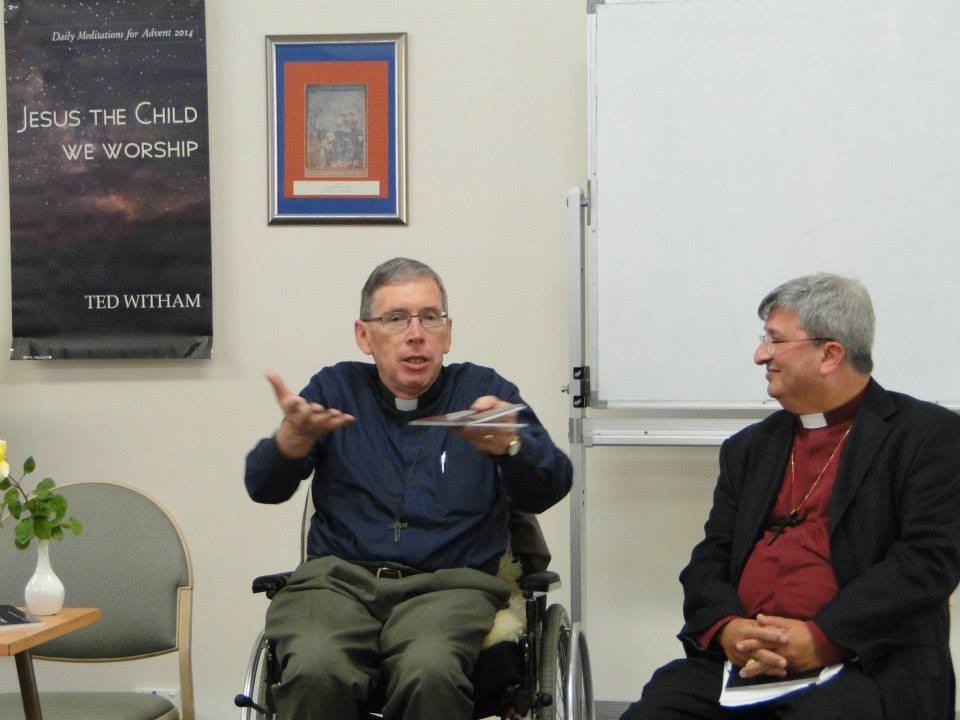
Archbishop Roger Herft launches Ted’s 2014 book of Advent devotions (Photo courtesy Sally Buckley)
61 years ago on the veranda of the Infants’ Class Room at Tambellup School, I called Valma Eades ‘a black boong’. I remember the year precisely because the Infants’ (Year I) Room was separate from the rest of the school, and I sought out Valma on the veranda. This veranda was up two steps from a bitumen path. I was a skinny five-year-old white boy, and Valma must have been seven. She loomed over me.
But where on earth did I find the expression ‘black boong’? It was not a term that our family used. I think I had heard the town kids whispering it, and I wondered what the reaction would be if I used it directly on an Aboriginal person, so one play-time, I sought out Valma Eades and I called her ‘a black boong’. Her reaction was instant and strong. Her fist landed under my jaw and lifted me off the veranda into the air. I landed on my back on the bitumen path.
In that instant of painful encounter first with Valma’s fist and then the hard bitumen path, I learned that Valma was right and I was wrong. Even though I was only five, I learned that it was wrong to use racist names against Aboriginal people. Even though issues between children should not be resolved through violence, in this case, Valma was right to give me a swift, sharp lesson.
You see, I lived on a 4,000 acre (2,000 hectare) family farm that until 100 years before had been the summer range of Valma’s great-grand-parents and their family group. On our farm was a freshwater lake that we called Lake Toolbrunup. Each year for forty, maybe fifty thousand years until just the end of the 19th Century, large groups of Noongar people had gathered at Lake Toolbrunup at the end of summer to enjoy its water,the freshwater crayfish they called ‘gilgies’ and cool shade. Now it supported our sheep.
How this farm had come into the possession of our family, and the white people from whom we had bought it, neither Valma and I had any idea.
Valma, on the other hand, lived with her parents and brothers and sisters in a canvas tent, 6 foot by 4 foot, on a reservation on the edge of town. A trough at the end of the line of tents boasted one cold water tap between two tents. Their only heating in the bitter Tambelllup winters was an outdoor wood fire. To keep warm, kids burrowed into the sand near the fire. Valma’s mother cooked over this fire.
There were Aboriginal children at the Tambellup school who camped with their families on our farm, as on other farms. They lived in tents and brush shelters. Their diet was kangaroo, sheep and damper. We knew, vaguely as six-year-olds, that the feared Mister A.O. Neville, Protector of Aborigines, had prescribed the places where Aboriginal families could live and who they could live with.
However this exchange of land had taken place, Valma and I were brushed with this history. There was unfathomable sorry business between us. And this history was, and is still, inscribed on every Australian girl and boy. None of us can escape the fact that we live in the shadow of a gigantic land swap.
White Australians booing Adam Goodes is always wrong, just as calling Valma Eades ‘a black boong’ was always wrong. And if Adam Goodes is strong enough to stand up and fight back, it hurts, just as Valma Eades’ uppercut hurt. So it should.
You never seem to come to an end to this reading from St John’s Gospel.
When I was about nine years old, I discovered a book on my grandparents’ shelves called The Robeby Lloyd C. Douglas… or was it A.J. Cronin’s The Keys of the Kingdom? The book explained the miracle of the feeding by suggesting that the little boy sharing his lunch shamed all the people into sharing the picnics they had brought with them.
And maybe that’s part of what John is saying to us: that when we recognise that people are hungry, we should share the little we have with our friends and neighbours and that will encourage a spirit of sharing in the community, and there will be enough to go around and more.
I think I knew even at nine that this explanation was a brush-off. Obviously sharing is a good thing, far better than the alternative, but a little disappointing if that was all Jesus was teaching. All the sharing that has happened since then has not made a dent in world hunger, and in any case, the people in the story were hungry, not for food, but for teaching and for a leader, a Messiah.
This is a story about two shocking events: a man who can feed 5,000 with virtually nothing, and who can walk on water. The story is firstly about who Jesus is, not about our puny efforts to feed the world.
I don’t know what to make of the two events. I don’t do miracles. But that in fact is the point. John is introducing a person who does things that cannot be done; a person who doesn’t fit the normal world we live in. We can’t go back in a time-machine and see exactly what happened, but we can be sure that Jesus was so far out of the ordinary that John shocks us into a new recognition: Jesus is no ordinary man. I may not do miracles; but I have spent my life trying to come to terms with who this Jesus is.
On the basis of John’s evidence, I can’t come to an honest conclusion. Jesus continues to escape my understanding. But if he feeds human beings with bread, and, not only with fish and bread, but with symbolic bread, himself, his presence, then, like the crowds, I want to keep following him. If his presence in stormy seas makes the journey more bearable, then, like the disciples, I’m glad to invite him aboard.
The crowds couldn’t pin Jesus down. They saw the signs he had been doing on the sick. These signs pointed to something important, something good, but exactly what Jesus was doing when you closely examined the signs was a bit harder to grasp. Not universal health-care; not every human being without health problems, but a sign that God’s kingdom was breaking in in a new way. While it may seem that evil and disease have the upper hand, the signs Jesus were doing on the sick were pointing to a different reality, and therefore worth following up, worth finding out more.
Maybe he was the Messiah who had come to throw off the Roman yoke. Jesus organised the crowd into men and women. In Mark’s version, they were in companies of 100 and 50, just like an army.
It’s a three-day forced march from Galilee to Jerusalem. There were, presumably, Roman spies in such a large crowd. The crowd acclaimed Jesus as the Prophet, and calculated that they could get to Jerusalem before spies could get to Roman headquarters at Caesarea and alert the Roman legion there, who would take many hours to prepare and then two days to march from Caesarea to Jerusalem.
A popular uprising could just work on that timetable. On the other hand, an uprising like that could be violently put down too. As soon as Jesus saw the way the crowd was thinking, he disappeared. He was not a political Messiah.
If not a political Messiah, then something else. The disciples stuck around to find out.
They were intrigued by Jesus’ handling of the fragments. Twelve baskets full. And of course John, as a master story-teller, is well aware of the symbolism. By the time John writes his Gospel, the Temple has been destroyed, the Jewish nation has been smashed, and only fragments are scattered throughout the Middle East. The twelve new tribes, the twelve fragments, so carefully and lovingly picked up by Jesus, are the new Israel, the followers of Jesus, the Church.
So is Jesus the new Moses? Like Moses he distributes bread to people in the wilderness. Like Moses he teaches on a mountain. As with Moses, the Passover is at hand. Jesus is to lead his people out of slavery to a new promised land. However, this cannot be a geographical Exodus. So what will this new Moses mean? What will his Exodus look like?
John doesn’t tell us that Jesus is God. He doesn’t make the equivalence. But he does tease us, and shock us, into asking the question, well, if not, what? If not God, what is Jesus? If not a political Messiah, what sort of Messiah? If not a new Moses, what sort of Moses? If not only a healer, then what sort of healer?
As I said earlier, I don’t have an answer. Of course, you can’t turn five barley loaves and two fish into bread for five thousand with twelve baskets left over. Of course, you can’t walk on water. But the response of the crowds, and the response of the disciples tells me that Jesus did things that cannot be done, and just like them, I want to know more.
In nearly 50 years of trying to find out who Jesus is, I have found that he feeds me. I gain an enormous amount spiritually and personally from exploring the scriptures and from sharing the Eucharist with you, my brothers and sisters. I have found that when life is hard, frightening, worrying, then in the midst of that, Jesus is there, and suddenly, I am through the storm.
And who Jesus is keeps just out of reach. I need to keep on following someone so intriguing whose only attitude to me is one of enormous love and goodwill.
Mark 5:21-43 – Gospel for Sunday 28 June 2015 (Pentecost 5)
Preached at St George’s, Dunsborough
These stories are partly about two women’s ability to have children. The girl is twelve years old. On her next birthday she would have been old enough to marry and bring a baby into the world. As modern Western people we recoil from this whole business of treating a girl as a commodity to be sold. Bride price, dowry, physical attributes, and then the sheer hard work of bearing babies and keeping house – and keeping to the house – for the rest of their lives. To us, the customs of those times were as repugnant as the Taliban’s are now.
But her age is mentioned for that reason. Jesus restores her to her life prospects as wife and mother.
The older woman has had a bleed for 18 years. It doesn’t specify what sort of bleed, and that leads most scholars to suggest that it was related to her womb, not a stomach ulcer. With the medical care of those days, there is no way she could have children. There is no way she could be a wife under the Jewish Holiness code. Her life as a wife and mother was on hold at the least, probably finished, dead.
Jesus restores both women to life; and that includes to restore the possibility of their cultural role as wives and mothers. Whatever we think would have been best for them, being wife and mother was what they would have known and wanted, and certainly better than being dead!
But as Mark tells us the story, he insists on two words which take the restoring of these women far beyond those cultural expectations. The two words:
life and
daughter
The woman has spent everything she had on cures. ‘Everything she had’: the Greek work is ‘bios’ which we know in English words like ‘biology’. She had spent her whole ‘bios’, her whole ‘life’, her whole ‘living’ on doctors and cures. At one level, it just means, she had spent all she had chasing a cure. But if you’ve ever had a complex medical problem, you know it’s not just the monetary cost. We are so blessed in Australia with Medicare, cost is not usually the problem. But we can find ourselves with so many appointments and treatments, visits to the pharmacist and physio as well as to the GP and specialists, not to mention waiting on the phone to make those appointment, that our whole life starts to revolve around our medical issues. Our life is in danger of becoming our medical impairments. There are times when we could easily spend our whole life on chasing a cure. It’s not good. That’s where this woman was.
Jesus healed her. Jesus gave her her life back.
Jairus’s daughter was dead. The professional mourners were already in place, and laughing at Jesus for thinking he could achieve anything. Her life was gone. There was nothing left but her pious burial. Jesus raised her from the dead. He gave her her life back.
Of course, both of these resuscitations are prefiguring the resurrection. And they are also mirrors to us. If we reach out to Jesus, just touch the hem of his robe, just taste his power in the Eucharist, then he may give us our life back. That’s what Jesus wants to do. There is no person, no thing, so far from God, who cannot be restored, who cannot receive their life back.
What that will mean will vary from person to person, just as it was different for the woman with the bleed and Jairus’s daughter, so it will be for you. But Mark is telling us the Good News that Jesus considers every person – even women in his society – should be able to live her life to the full, and that she can do that if she allows Jesus to restore life to her. Or him.
That’s more than the cultural script of being a wife and mother. That’s a gift of life that is wide open to all good possibilities.
The second word that Mark uses is ‘daughter’. Each of the women healed in these stories is called a daughter, because each is unconditionally loved. Jesus calls the woman he heals by the name of ‘Daughter’: ‘Daughter, your faith has made you well. Go in peace, and be healed of your disease.’ (Mark 5:34). And then immediately follows the rest of the other story. ‘While he was still speaking there came from the house some who said, “Your daughter is dead”.” (5:35) Whose daughter? It is ambiguous, because she is both Jairus’s much loved ‘little daughter’, and a daughter to Jesus too.
I am blessed to have a wonderful daughter. I remember the day in 1983 when she was born. I remember a lot more of her childhood than she might like me to. I am so proud of her now as a young mother of three, working at an interesting job part-time. She is a lovely and accomplished young woman. Everyone knows that. But only Rae and I can call her ‘Daughter’. We have the privilege of loving her especially. The love that I have for Clare, and the love that I know is returned, is a real joy.
Jesus emphasises with the women in these stories that the Father loves each daughter just like, and even more, than a human father loves his daughter. Daughters, you are loved, you are loved by God, with a love that gives you your life and goes on giving you your life back. Sons, you are loved, you are loved, too, by the Father, but sometimes, even in this 21st Century after Jesus, the daughters need to be told more intensely, more Intentionally, that God’s love is for them in this way of deep joy.
But for all of us, daughters and sons, can we in reality imagine what Jesus is offering to us?
the fulfilment of our lives up to our expectations so that we can do what God wants us to do in this world, as the two women were given the opportunity to be wives and mothers;
secondly, to get our lives back richer than we can imagine and better than we can imagine: this is Christ’s gift to us. As we open ourselves to Christ, so we are being transformed into new people, leaving the old one behind, becoming the person God intended us to be from the beginning, and discovering more and more joy in that. This is why for me being fed with the bread and wine, Christ’s body and blood is so important, as it feeds us on that journey of transformation.
and thirdly, knowing ourselves deeply loved as God’s children. God has loved us from the beginning and will love us eternally.
This is good news. It takes time to seep into us. It can be hard to hear this good news. God took human flesh in Jesus of Nazareth to show us what God is like. And this is what God is like. This is what God delights in doing for people.
Sin is when we refuse to let this love, the love of Christ penetrate more and more deeply into our hearts and lives, when we refuse to connect to Christ. Christ for his part continues to offer us our lives back, renewed and better than before.
Out of our poverty, we become rich, as Paul said in this morning’s epistle (2 Cor. 8:9) – and what wealth it is. What Good News it is! And what good news we become for others as this transformation takes place.
If you think I am being too idealistic, I plead with you to go back to the reading and see again what the gift is that Jesus gives to the woman and to Jairus’ daughter, and then to resolve to go about your lives knowing that it is true. God loves you through and through for eternity. Let him change you into his glory bit by bit.
I’m a proud Noongar woman. I belong to this country. And I know how to open the gnamma hole to get water. I know what to sing to the spirits. I shout loudly to tell them that I’m coming. “Kaya! Ngany nidja!” I call, “Hello! I am here! Woolah! Ngany nidja!” I’m about to throw sand down the gnamma hole to purify the water, when this wadulah man appears.
He’s a wadulah and he’s a man. He thinks he knows everything and he thinks he owns our country.
But he waits, back where I called the spirits, and says to me, respectful-like: ‘Can you get me some water, Aunty?’
I’m a bit surprised. I’ve never heard a wadulah ask before. For anything. If they know where the gnamma hole is they rip the top off and help themselves. I’m a bit suspicious too. ‘What wadulah asks a Noongar woman to get him a drink?’ I ask.
‘If you knew who was asking you,’ he says, ‘you would ask him for living water.’
‘Where would you get living water?’ I ask him, ‘You got no gnamma hole and you got no spirits here. Our ancestors told us how the gnamma hole was made, and how the Wagul passed through the country. You’re not greater than the ancestors, are you?’
He said, ‘When you drink your water you get thirsty again. But whoever drinks the water I give will never get thirsty again. The water I give will be a water-hole gushing up to eternal life.’
I didn’t know whether to laugh or run away from this wadulah. ‘You’d better give me some of your water,’ I says, ‘so I don’t have to come out to the gnamma hole to get it no more.’
So he said to me, ‘Go and get your husband and come back here.’
‘Ain’t got no husband.’
He says, ‘Too right you’ve got no husband. You’ve had five husbands. But the man you’re living with now is not your Law husband.’
I swallowed. ‘Uncle, you must be a prophet. Our ancestors called on the spirits on this mountain and you wadulahs say people should worship in church.’
He replied, ‘Believe me, Aunty, time is coming when you will worship the Father not on this hill nor in church. You worship spirits you do not know. We worship God because he brings salvation. But time is coming when true worshippers will worship the Father in a real true spirit. The Father is looking out for people to be his true worshippers. God is spirit.’
I says, ‘The Mission told us Christ will come and when he comes, he will tell us everything.’ Then he turns to me and puts it to me: ‘I, this one talking to you, I am he. ‘
Just then, his followers came back. They looked shocked to see him talking to me, but they didn’t say to me, ‘What are you after?’ or to him ‘Why are you speaking with her?’ I dropped my water-can and ran down into the camp shouting to everyone, ‘I’ve met someone who’s told me everything I’ve ever done. Could he be Christ? Whoever he is, he’s made me proud of being me!’
Kids join Islamic State (ISIS) because they are hungry for a passion. In the grey world created for them by their adults, they want something exciting to believe in, some dramatic good they can achieve, something great they can create, a cause to give their whole life to. Of course they do. They are adolescents.
ISIS online
And they are also ignorant.
Teenagers these days know so many things, and they can google what they don’t know, but we have failed them dismally in teaching them about religion and about the religions expressed in cultures around the world. For various reasons, we have been afraid to have any religion taught in schools, and yet this is the very learning area that would prevent the radicalisation of young people.
I mean, of course, religion taught well, and taught by competent teachers. This is so urgent as to be the fourth ‘R’ of the 21st Century: young people need to know about religion alongside reading, writing and ‘rithmetic.
They need to know why billions have embraced religion and found that religion provides wisdom, comfort and direction for their lives. They need to know what motivated Mother Theresa of Calcutta, and what produced the luscious religious art of the Renaissance. In a word, they need to know something of the passion, commitment and engagement in life that religion brings to many people.
They also need to know why millions reject religion. Religion is not just passion. It’s not just a response of the heart. It requires thought and discernment as well. Agnostics have reasons for questioning, and atheists have reasons for believing that religions have got it wrong, and students need to grapple with those reasons and see if they too are convinced.
It’s our fault that our young people don’t know about religion, don’t know its complexities, don’t know how rule of law, democracy, and science all came about through the work of devout Jews, Christians and Muslims, and how the modern world could not have come into existence without religion.
Eid – a time of joy and peace for families after the fasting of Ramadan
They have not been introduced to the proposition that morality, morality like reverence for life, arises from the pages of the scriptures of the great religions.
It’s our fault as a community. Rectifying that error will not be easy. When he was Minister for Education forty years ago, Kim Beazley Senior proposed a National Curriculum with nine Learning Areas, one of which was Religion. He foresaw that Religion needs firstly to be taken seriously as a curriculum area.
Countries such as Denmark that seem to be doing better in embracing minorities, including Muslims, are currently strengthening their ‘identity-carrying subjects’ such as history and Christian studies. Australia will get a similar result through serious teaching about all religions.
Politicians, principals and academics should publicly champion the teaching of Religion Studies as a national priority.
The Year 11 and 12 courses that now exist like ‘Religion and Life’ in WA need boosting into greater visibility in order to create a bigger demand.
We need to identify competent teachers to mentor other teachers who, though highly trained in other areas, feel inadequate to teach religion. There are such master teachers, particularly in church schools and in professional associations like the Australian Association for Religious Education.
Universities should review teacher training programs to make sure that they prepare teachers thoroughly to teach Religion. Sadly, the Universities I know have dropped successful courses because administrators have been indifferent. That should change!
The aim should be to make the teaching and learning of Religion as engaging and fascinating as religion – and the debates about it – are.
Schools need to make sure that there is sensible space in the time-table for Religion. Students cannot take seriously a subject that is allowed only 45 minutes a week. Imagine if Science or Maths had only one period in a week! ISIS has had runaway success in meeting its educational aims. As a community we can do better than ISIS.
In other words, our community needs a plan to end the ignorance by creating and nurturing a new, a ninth, Learning Area. Every student who sees through the extremism of ISIS because she learns that Islam is something different altogether is a treasure saved for Australia.
Ted Witham is Immediate Past President of the Australian Association for Religious Education and a retired Religious Educator.
Why would anyone travel to Broome in December? Well, in December 2005, my wife Rae and I had an excuse. We decided we would use Frequent Flyer points to celebrate the 25th anniversary of our marriage with a few days in the far north of Western Australia. We flew into Broome for three days. On the first day it was 35 degrees and the humidity around 90 percent. Without a car, every journey to find a meal or to walk to Cable Beach was an unpleasant sweaty exertion.
That evening, we booked a day trip out of Broome along Gibb River Road. We figured that even if we saw little in the way of scenery, we would have two meals provided in air-conditioned comfort.
Comfort, however, is not the first word that describes the all-terrain military carrier vehicle, the Hummer, which bumped into our apartment carpark at 6 a.m. Even on hard tarmac, the Hummer rides like an ill-tempered camel. We bumped along at 120-130 km/h inland to Derby, arriving at about 10 a.m., as the temperature steadily rose. At a certain point, the heat overwhelmed the air-conditioning, and it gave out, leaving us to be conditioned only by the hot easterly air gusting through open windows.
As the temperature increased, however, the interest of the journey also rose. On a long straight stretch of road, the driver suddenly stopped the bus, jumped down and ran flat out. He returned two minutes later with a frill-necked lizard in his bleeding, bitten hands: the angry, frightened frill-necked lizard gave a wonderful display of his neck, large and red with emotion.
The Hummer bounced along the gravel corrugations of the famed Gibb River Road. On our left, the sheer jagged cliffs of the Napier Range rose abruptly where Bunuma resistance hero Jandamarra had hidden out in the 1880s and 90s.
Well after 1 p.m. we struggled through a darkened gorge, and swam in the deliciously cool water-hole at the far end of Tunnel Creek. Refreshed, and relieved not to meet a snake in the water with us, we enjoyed sandwiches and drinks from the car fridge, and turned back for Broome.
A red cloud of dust haunted the Hummer as the sun started to sink in the west. We stopped at Windjana Gorge, where a skittish posse of freshwater crocs played chasey with each other in the upper reaches of the sandy beach. ‘Don’t get between them and the water,’ advised our guide. It seemed to us tourists that wherever we stood we were between the metre-long reptiles and the water. However beautiful the place, we elected not to stay too long.
Darkness fell about 8 p.m. Back on the bitumen we stopped for a barbecue dinner, and with the Hummer’s lights turned off, visibility was nil. Rae and I walked off hand in hand into the darkness for the weird experience of seeing showy diamond stars piercing the ebony canopy but not being able to see our own hands or the tarmac beneath our feet.
The Hummer trundled into Broome after midnight. The driver said he would be up at 5 a.m. to re-fuel and repeat the experience with a new group of tourists. We could sleep in.
Next morning, however, another surprise blew into our wedding anniversary. The humidity woke us at about 9 o’clock. It was almost unbearable, even in air-conditioning. ‘The Build-up’, the locals call this time of year, and it makes people do strange things. The weather too.
The wind picked up, first from the north, then, it seemed, from every direction. Round and round like a whirlpool. A cyclone, which the day before had been over Darwin, was now threatening Broome. We prepared to leave for Perth.
Qantaslink staff hurried us through the airport and on to the plane. It was the quickest loading and take-off I have experienced. Forget security. As we circled over the town, we saw trees bending in half to the wind and felt the plane struggling to bank smoothly.
The speaker hissed. ‘We will be the last flight out of Broome until the cyclone has passed,’ announced the pilot. Rae and I sat back in our seats and smiled at each other. ‘I enjoyed our wedding anniversary,’ I said to my wife, ‘but now I need a rest in a cool quiet place.’ ‘Yes,’ she agreed, ‘without reptiles.’
Todd Sampson reminded me on ABC TV last night that I can Re-design my Brainwhen it comes to my chronic pain. The three principles that I should meditate on for ten minutes a day are:
This pain will pass,
The pain can’t hurt me, and
This pain won’t stop my body doing all (or most) of what I want.
The first principle is for those times when the pain flares up and is an invitation to live in the present. It is a reminder that in the future, I won’t have this pain. The future may be after I have slept tonight. The future may be after I have pulled the emergency cord and taken a pain holiday by consuming what my GP calls any “uh-zepam” drug. The future may be the next general anaesthetic I will some day have. The future may be after my death. It doesn’t matter how rare the future or how far out into the future, just the fact that there is a future where the pain changes for the better.
This pain will pass. Hang on to that.
This pain can’t hurt me. If I break my arm and then lift a heavy suitcase, that will hurt me. But my constant companions, the pains in my back and feet are not the result of new tissue damage or broken bones. I don’t have to limp because of my sciatic legs. The pain is just there, and movement will not make anything worse. In fact, movement may make things better.
Better to move than seize up. This pain can’t hurt me.
My body, considering all the things that are wrong with it, works very well. I can feel the wind on my face and see the waves down at the beach. I can hear the magpies sing their joyful carols. I can embrace those I love, and set my grandchildren on my knee and take them riding in my wheelchair. I walk three kilometres five mornings a week. I enjoy three meals a day. I can sit and type and engage my brain and fingers setting devious crosswords and writing stories.
Yes, I do have to work around the limitations of mobility that pain imposes on me. But my body can do most of the things I want to do.
Whenever I begin to be distressed by my pain, I can remind myself of these three statements of fact:
This pain will pass,
The pain can’t hurt me, and
This pain won’t stop my body doing what I want.
These devious affirmations will change my brain’s perception of pain, and I will carry on.
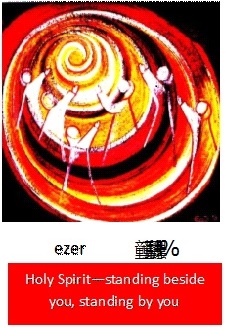
When the Lord God created the first human being, he was incomplete. It was not good for the man to be alone, God said. He needed, so Genesis tells us, a ‘helpmeet’, a companion who would be by his side to take his side. The word for ‘helper’ in Hebrew is a beautiful word, ‘ezer’.
God brought the animals to the man to see what he would call them. And the man gave the animals their names. But they were not the helpmeet the man was looking for. Maybe he was their helpmeet, their champion, their companion who could speak for them and make sure their world is a place in which they can thrive. But the animals were not a helpmeet for him.
But God put the man into a deep sleep (the first recorded instance of anaesthetics), and took from the man’s side a rib, and perhaps a grain of salt. We don’t have to take these foundation myths as literal history. They are stories that tell us the truth about ourselves. That’s why they are so important.
Creation of Eve by Paolo Veronese
From the rib, God created the first woman, and brought her to the man. She was bone of his bones and flesh of his flesh. The same but different. Equal but not the same. She was the ‘ezer’, the helpmeet the man had been looking for; someone who could be a companion and a champion, speaking up for him when he could not. That was the ideal, anyway. And the reason she could be a helpmeet when the animals could not, was that not only could she be a helpmeet for the man, he could be a helpmeet for her. There was mutuality in the relationship. “The mutual society, help and comfort that the one ought to have of the other”, as the old Prayer Book describes marriage.
Those of us who are blessed with marriage know something of what it means to have an ‘ezer’, a companion and a champion, someone who stands beside us and stands up for us. I thank God every day for the ‘helpmeet’ God has given me. And I know I am more human, a more complete human, because of Rae, because I am married. We men can be a little sub-human without our helpmeets.
And Genesis is describing not only marriage but other close friendships and partnerships. We may have an ‘ezer’ in an adult child, or in a friend we’ve had since childhood, or in someone we’ve only met recently.
People who study friendship say most of us have two or three, and at the most four or five people in our lives, who are close companions and who believe in us no matter what, and who we can speak up for too when necessary. I wonder too, whether an individual dog or horse might be an ezer for a human being. Is there a possibility of mutuality of care between species? Genesis doesn’t seem to think so, but seeing a recent program on ABC TV about dogs helping returned soldiers with PTSD made me wonder again.
The gift of a ‘helpmeet’ is a wonderful provision from God. But in the Old Testament God often describes himself as our ‘ezer’. Think of Psalm 46. ‘God is our help and strength, a very present help in trouble.’ – ‘ezer’. God promises to stand beside us and to stand up for us. He is our companion and our champion. God believes in us, and possibly the most difficult step of faith is to realise the depth to which God believes in you. God knows that you are not perfect, but he does not believe that you are therefore rubbish, he believes that you are of infinite value and worth. God will go to extraordinary lengths for you. Listen to what God says:
I have called you back from the ends of the earth, saying, ‘You are my servant.’ For I have chosen you and will not throw you away. – Isaiah 41:9
God championing us in this way makes us more human, more complete. God standing beside us and standing up for us makes us more who we are; it gives us the confidence and strength to grow into our true selves. So it makes sense to allow God to be our ‘ezer’, to stand by us in this fruitful way.
So what of Pentecost?
‘When the Helper comes,’ says Jesus, ‘the Spirit of truth, he will bear witness about me.’ (John 15:26). The Helper, the Spirit. The Holy Spirit is our ‘ezer’, and this Helper comes to abide with us, to be the ongoing companion and champion for us. Jesus reveals the name of the Helper, our ‘ezer’, it is the Spirit of Jesus, his ongoing presence with us.
And he also reveals something else: Jesus invites us into a mutuality with the Spirit. The Holy Spirit is our ‘ezer’, our Helper, and we rejoice in that wonderful presence in our lives, and he is also inviting us to be his ‘ezer’. Jesus is asking us to be his companion and his champion, to stand beside him and to stand by him in love; to speak up for him when appropriate, to make sure the world is a place where he can thrive.
Being a Christian is mutual; it is for the ‘mutual society, help and comfort’ that Christ and we have one for the other. And the more we allow the love of the Spirit, the Helper, to permeate our lives, the more human we become, the more truly human we become.
May I suggest a prayer – just a one-off, or to do regularly? You can do this by the beach, under the stars, or in the quiet of your own home, or right now as you sit in the pew. Take some moments to quiet your breath. Maybe do some controlled breathing, counting up to 30 or 40 slow breaths. Then imagine opening your whole self outwards. If you have room, you may spread your arms outwards. Then imagine the warm love of God surrounding you, and pouring into you from every side, filling you, leaving no room for anything else. This warmth is the fire of the Spirit of God. Hold onto the warmth and carry this feeling with you through the day.
*** *** ***
We dare to think that because we also agree to be Christ’s Helper, our love for Him will make him, in some mysterious way, more Christlike. Jesus continues the work that he began on the Cross through us. The Father has tasked him with bringing the world back to him, and Christ works, not by forcing his way through the evil that resists him, but by the gentle power of love, dripping like water on stone.
What we do can reduce that resistance, can open the paths of love, can help heal the pain of lovelessness, can sometimes even remove the stones that block the path of Christ. Look for acts of kindness, however small, opportunities to bring peace, and practise the way of Christ. There’s a saying attributed to St Francis of Assisi. ‘Preach the Gospel always, if necessary, use words.’
So it is extraordinary first to take in that God loves us, believes in us without reservation, and that we can allow ourselves to bear the fruits of peace, love, joy, forbearance, kindness, goodness, faithfulness, gentleness, self-control (Gal. 5:22-23) that appear in our lives just from being close to the Spirit. It is even more extraordinary to know that we are invited, as Christ’s companions, to share in his work, so that with the Spirit, he is more able to bring this world to the loving end that the Father has decreed.