God and Chronic Pain


I wrote this back in 2009 – and thought it worth sharing again:

The worst thing that the Western church has done is that we have turned God into a man. Ask any six-year-old to draw God, and she will emulate Michelangelo and draw an old man with a white beard. The orthodox Christians, the Jews and Muslims have taken much more notice of the second commandment: “Thou shall not make of the Lord thy God any graven image.” (Exodus 20:4).

And God said…

We may not believe that God is literally a human being, but we picture a transcendent God in physical terms. Children may believe God is the “Friend for little children//Above the bright blue sky” in an absolute literal sense, and adults often believe transcendence describes God’s distance from the physical creation.

It’s true that the Bible often anthropomorphosises God: God walks out before the armies of Israel; God picks up and cuddles the human person, like a mother and baby (Hosea 11:3-4). In general, however, the Bible has a sophisticated notion that God is (a) holy, that is set apart from his creation, and (b) intimately involved in creation.

God is a wind (Genesis 1:3), an unseen and uncontrollable energy that stirs up of the raw materials of creation. God “sits above” the thunder and lightning (Psalm 39), more powerful than the raw energy of the storm. God stills the seas (Psalm 65:7), not with a giant hand, but with an irresistible will.

If you have chronic pain, your picture of God matters. If you think God is a sophisticated human upgrade, if you make God in the image of human beings, your God will not be strong enough to make a difference to your pain. Your picture of God will limit your ability to receive the powerful healing God wants for you.

In the last ten or so years, my picture of God has changed radically.

Sometimes this journey has been dangerous. I have wondered if I have lost my faith. The God I had believed in was not big enough, and certainly not powerful enough to positively affect my pain, and I had to let go of that picture of God.

In Peter Jackson’s 2001 film, The Lord of the rings: the Fellowship of the Ring, an underground sequence has the wizard Gandalf confronting a Balrog on a crumbling rock bridge. The hobbits run as fast as possible to get to safety. Gandalf falls with the monster to their death. Growing your faith in God is like that rush across the bridge of Khazad-dûm. When you let go of your picture of God, everything crumbles and precious ideas die.

But let me encourage you. The only way to have a picture of God adequate to your pain is to stop believing in the God you think you know. There is a well-trodden path to this believing atheism, and it is the path of mysticism.

1. Any picture of God you have is by definition too small. To continue to believe in it is to commit idolatry. You have no choice but to let go your picture of God.

2. When you let go of God in this way, you become an atheist in the sense that you have no God to hang on to. What you must then believe is that God is hanging on to you. You cannot know what manner of God this is, you need to trust only that you are being held.

“Blessed be the Lord day by day,

who bears us as his burden;

he is the God of our deliverance,” says the Psalmist (68:19)

3. As this trust develops, so you may begin to grope towards a new understanding of the God who is holding you. You may for example, begin to find new metaphors to describe God. God is energy; God is universal heartbeat, God lives as the tiniest cell in living things. These God-cells begin a process of healthy change in your body, and your pain is reduced.

4. But these are again pictures of God. The irony is that the process of letting go of your new pictures of God must continue.

I invite you to image a Spirit, a larger reality and to open yourself to encounter this Spirit. In this process, you may experience the reality of how deeply you are loved, how surely you are held, and how extraordinary is your future in this compassionate universe. This is what I call, and only for convenience’ sake, “contemplation”, the experience beyond muscle relaxation and centring.

I invite you to relax further into this journey into the Unknown God. I encourage along the only path through deeper atheism, which as it unfolds leads to a deeper experience of the power of God in healing your mind/body.

Anzac re-visited


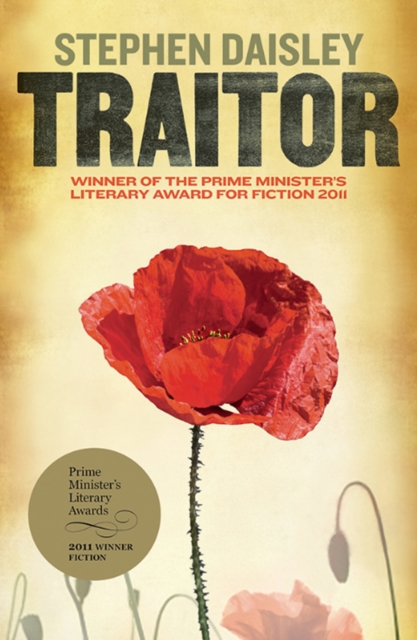
Stephen Daisley, Traitor, Melbourne: Text Publishing 2011, paperback 291 pages

from $AUD16 online

Reviewed by Ted Witham

Traitor is a sensitive exploration of the Anzac myth through the life of David Monroe, hero of Gallipoli and the trenches of France. While wounded, David takes it on himself to guard a young Turkish doctor, Mahmoud, who had been captured when the two of them were trying to save the life of an Australian boy. He forms a deep friendship with Mahmoud, who teaches him about Sufism and the poetry of Rumi. He decides to help Mahmoud escape to his home village, but they are betrayed by their Greek boatman. David is sentenced to death for desertion, but the war ends and he is pardoned.

David then returns to the quiet life of a shepherd in New Zealand, unable to ever make good in a society which never completely forgives him for his ‘treachery’.

Traitor is Daisley’s first novel, and was shortlisted for the NSW Premier’s Literary Award in 2011. Daisley is a West Australian writer who delves deeply into the Australian psyche. I found myself coming back to the book again and again, unable to put it down. The story begins with David being questioned by intelligence officers, a scene with a Kafkaesque edge, and then unfolds as the past impinges on the present.

I was impressed by the lightness of touch in the story-telling: it is beautifully crafted, and the reader is rarely aware of the mechanics of the story. I felt I was in David’s world, and that the little things in his present really did touch off his memories. I felt I could taste the cold in the New Zealand air and smell the after-birth as he moved about the lambing flats, and I felt nauseated by his descriptions of death in the trenches, and genuinely moved by his love for Mahmoud and the woman he could never marry, Sarah.

I am looking forward to diving into Stephen Daisley’s second novel, Coming Rain.

Blessed be God for the animals!


Sermon for St Francis’ Day

October 4, A.D. 2015 St Mary’s, Busselton

Readings: Genesis 2:4-20a            Mark 11:1-11

In the + Name of the Creator, the Redeemer and the Sustainer, Amen.

This story about Jesus and a mule comes from one of the apocryphal Gospels, one of the writings that didn’t make it into the New Testament. But I’d like to imagine it tells us about how Jesus thought and felt about animals. Here’s the story:

They came across a man with a pack-mule. But the animal had fallen because its load was too heavy, and the owner beat it so much it started bleeding. So Jesus said to him, ‘Friend, why are you beating your animal? Can’t you see that it is not strong enough for its load, and don’t you know that it feels pain?’

But the man replied, ‘What is that to you? I can beat it as much as I want to, because it is my property and I paid a lot of money for it.’ …

But the Lord said, ‘Can’t you see it bleeding? Can’t you hear its cries of pain? ‘

But he said, ‘No. Can’t hear a thing.’

And the Lord was sad and exclaimed, ‘That’s bad news, that you can’t hear it complaining to its Creator in heaven, and crying to you for mercy. Very bad news for those it complains about in its distress.’ And the Lord touched the animal. It got up – its wounds healed!

Jesus then said to its owner, ‘Now carry on your way and don’t beat the animal anymore, so that you too will find mercy.’

No one here would treat their pet like that mule owner.

I’ve been impressed by those dogs which have earned a medal in the war in Afghanistan for their bravery in sniffing out hidden explosive devices, bombs and mines, before they blow up and maim and kill people. I think the Army awards the medals because they know that the dogs are brave. The dogs understand the danger, and the dogs do their dangerous job to protect their humans. It’s quite wonderful.

War is a strange place to start on St Francis’ Day. St Francis thought that trying to get peace by going to war was a bizarre idea, like hammering stones to turn them into water: wrong tool, wrong method, wrong materials. Yet St Francis spent at least three months with the Crusaders in the Nile Delta, nursing the wounded and the soldiers who had succumbed to mosquito-borne diseases. He caught malaria himself during this time. He looked war straight in the face. War is part of the human experience. St Francis cared about soldiers because he knew that God cared about them.

I don’t think, though, that there were dogs helping the soldiers in the Fifth Crusade in Egypt. To have dogs helping in war, you need to know how intelligent they are and how people can bond with them, so that man and dog become a team to accomplish a task. Of all the thousands of knights and soldiers at Damietta, Christian and Muslim, I guess St Francis was the only one who really knew that it was possible for animals and humans to have such a strong bond. We’ve learned a lot from St Francis.

There’s a legend that St Francis tamed a wolf that was terrorising the village of Gubbio. Now, that may have been only a legend, or the baddie in the legend may have been a human bandit or terrorist nicknamed Il Lupo, ‘the Wolf’, but it is possible that it was a real wolf. There are people who have such a connection with animals, like St Francis, that simply by his calm presence, the wolf sensed that Francis was friend, not out to chase and kill him.

The idea back in Genesis where Adam names the animals is that in the beginning we had that close rapport with animals. We are supposed to feel a connection with them. When a pet comes into our home, we give it a name. That’s what we’re supposed to do. It’s more than a childish game.

I grew up with animals on a farm, and our parents emphasised on the one hand that we shouldn’t make pets of our sheep and cows, but on the other hand, they treated the animals with care. They knew that they felt pain. Dad knew that if the sheep were spooked in the shearing shed one year, they would remember and be frightened the next year. It simply made good sense to treat them well.

Montage of wedge tailed eagles in full flight on blue sky with copy space

And when we meet a wild animal, a lizard or a kangaroo, say, our first instinct should be to acknowledge it. The way St Francis did this was by calling every creature his sister or brother. The pair of wedge-tail eagles we sometimes see over our back fence at Novacare are magnificent, and they come from God. They are our brother and sister.

The more we learn about animals, the more we should respect their complexity. We know that dogs and cats communicate, and they learn more ways of communication to fit in with their human companions. But ‘chooks’, hens, also communicate. When they are out foraging and scratching, one always stands guard, and she has a different squawk to indicate a predator over-head or good food underfoot. And it’s vital that her mates understand her straightaway. Scientists have done experiments to show that fishes feel pain, and they give sophisticated intelligence tests to octopuses!

Animals are not dumb. They share our planet as our sisters and brothers, so we bring our pets for blessing, thanking God for all they give to us, whether they are domesticated pets like cats or dogs, working animals like the donkeys Jesus borrowed to ride into Jerusalem, or whether they are wild animals with no human contact. We thank God for them all – and welcome pet rocks, cart-horses and orcas, and everything in between, for a blessing today..

But St Francis went a step further. In his Canticle of the Sun, he calls the sun and moon, the earth and wind and weather, all the inanimate things that make up the environment, that support life, he calls all those things brother and sister too. Because we are all connected. Our bodies are made up of mud and oxygen – water, earth and wind. The trace elements that make the subtle difference and bring us really alive come from Brother Sun and the other stars.

One place to read more about this is in Pope Francis’s latest encyclical Laudato Si’. The Pope even takes the name from The Canticle of the Sun, ‘Laudato Si’’ means ‘Praise be’ and is the first two words of every verse of the Canticle.

The writer of Genesis saw the garden, the river, the trees and the animals, and the humans, as a whole, a gift from God, to be cared for and nurtured. Blessing pets is not just something nice to do: it’s a commitment to care for each other, for every living thing, and for everything that supports life, to the glory of the Creator.

The mystery of love


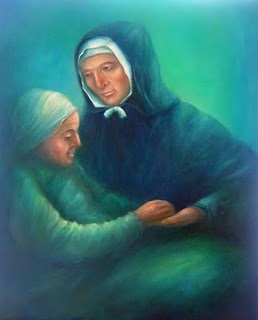
Now love is primarily a sharing: letting oneself be hurt by someone else’s distress, putting oneself at their side, living with, suffering with, begging with. She naturalises herself as one of the poor: this is where love works. And this process of sharing liberates the power of love to change the world; by her astonishingly fruitful activity, she contributes to changing the world. This is the very mystery of Mercy.

  • Paul Milcent on Saint Jeanne Jugan, founder and first Sister of the Little Sisters of the Poor.

St Jeanne Jugan

Moral Leadership?


I am glad the Australian Government has finally agreed to take more refugees. But what a missed opportunity for moral leadership! The politicians were dragged to it by a community shouting our willingness to respond compassionately and sensibly to the crisis in the Middle East and Europe.

Country towns like Katanning and Albany offering to re-settle asylum seekers, and householders with spare bedrooms reaching out to integrate new people into the Australian community have put the Government to shame.

Instead of leading with compassion and with sensible plans for bringing people to this continent, the Government have played politics firstly with numbers – can we stretch to 10,000 or 20,000? – and secondly with cherry-picking those considered in greater need than others.

At this point in the crisis, both limiting numbers and having the luxury to choose between desperate people are irrelevant. Sure, we need to be practical: Australia cannot take 800,000 refugees in a year like Germany, but there is no danger of that happening. Any discrimination in favour of one group, whether it is Christians or Yazidi, will inevitably be perceived as discrimination against other groups. This morning Muslims are complaining, and rightly so, that yet again, our Government is treating Muslims as less than human.

As citizens, we should thank the Government for their willingness to consider increasing our humanitarian intake and encourage the Prime Minister to stretch his imagination to be as generous as possible. (https://www.pm.gov.au/contact-your-pm)

We should also encourage those who express generosity and offer practical help to them if we are able to provide it (Katanning Shire President: alan@katfurn.com ; Albany Mayor http://www.albany.wa.gov.au/?receiver=146&page=feedback ).

We should also look around the facilities that are ours with the same generous imagination. Is there anything we can do as individual families, churches or community groups to welcome refugees, and what action do we need to take to initiate that welcome?

Saint Louis – patron saint, not patronising


Today being the Feast of St Louis, I re-post my 2013 review of Jacques LeGoff’s excellent book on the king and saint of France.

Ted Witham's avatarThoughts Provocateurs

Jacques LeGoff, Saint Louis, University of Notre Dame Press 2009, Hardcover (ISBN 9780268033811) $80 online

Reviewed by Ted Witham

The name of Saint Louis is often evoked as a patron saint of the Third Order. I realised this year that I had been a tertiary for 30 years and have a rough knowledge of Saint Elizabeth of Hungary and perhaps a better knowledge of the Mother of our Lord, but knew almost nothing about our third patron saint.

France’s finest medieval historian Jacques LeGoff was director of studies at l’École des Hautes Études en Sciences Sociales in Paris. He has a particular interest in Saints Francis and Clare and the spread of their movement through Europe in the 12th Century. His studies into money and Saint Francis and medieval culture and the church not only provide new insights into Francis, but are also inspirational for Franciscan living. Surely…

View original post 1,262 more words

Boat People


This morning I came face to face with an illegal immigrant, and I felt compelled to expostulate:

Rabbit kitten just was sittin
In the grass as I passed:
Ears were flappin, heart was tappin –
this the question that it asked:

‘Immigration made this nation.
Came in boats that scarcely float:
rabbit pest turned out best
at forcing owners to be donors.

‘These the dangers from the strangers
Stealing terra bloodbath terror,
seize the riches, spread diseases;
chalk it up as holy error.

So small rabbit, who inhabit
second-hand wide brown land?
Put the queries, hear the theories.
For shame who shake at all we take?’

Rabbit plague
Terra nullius?

Two Women and the Whole Armour of God


ST GEORGE’S ANGLICAN CHURCH, DUNSBOROUGH

SERMON 23 AUGUST, 2015

I’d like to introduce you to two women I’ve been spending a lot of time with lately. Two women who wore the whole armour of God in very different ways.

They are the Australian musician Dorothea Angus and the founder of the Little Sisters of the Poor, Frenchwoman Jeanne Jugan.

I am researching both women and writing feature articles on each, hopefully to get them published in suitable magazines.

Dorothea was British-born but came to Adelaide with her parents when she was six just after World War I. She got a scholarship to study piano at the Elder Conservatorium, probably enrolling in 1928 alongside Miriam Hyde, who turned out to be a famous composer.

The classmates made a pact to swap their new compositions with each other every year; and they kept to this pact for decades. Dorothea made more than 250 broadcasts and recordings on the ABC, and many of them were pieces by Miriam Hyde.

Dorothea’s piano teacher, Brewster Jones, died, and her scholarship ended. Her new teacher was the noted organist John Horner. Under his tutelage, Dorothea fell in love with the organ, and in 1938 was giving recitals in Adelaide and Sydney and enthusiastically received as ‘Australia’s top organist’. But getting a job was harder.

St Peter’s Cathedral in Adelaide, it seems somewhat reluctantly, eventually appointed Dorothea in 1936 as ‘Assistant to the Precentor.’

Now the organist at St Peter’s was J.M. Dunn who had been Cathedral organist since 1891 – a run of 45 years! The year Dorothea was appointed to the staff Mr Dunn died. His assistant Canon Horace Percy Finnis became the new organist. But this priest was also the Precentor and Bishop’s Vicar. It’s not hard to imagine the talented Dorothea, frequently, but anonymously, being called to the organ keyboard, or to lead choir practice, and for Canon Finnis to take all the credit.

Dorothea Angus 2_webIn any case, Dorothea’s mentor, John Horner, was on a visit to Perth, and heard that Perth College was looking for someone to play the organ for Chapel and to teach all the music in the school, and he persuaded the Principal, Sister Rosalie and Archbishop LeFanu that Dorothea was the right person for the job.

Dorothea arrived in 1938 and found the music at Perth College to be chaotic and was desperate to go back to Adelaide. Two things stopped her: the coming war, and a growing friendship with Sister Rosalie. This was a friendship of opposites: Dorothea was always stylishly and fashionably turned out, Sister Rosalie was an old-fashioned Anglican nun always in habit with veil and wimple.

Sister would often slip into the Studio late in the afternoon while Dorothea practised and sit quietly in a corner. The two women had big personalities and big ambitions. From my interactions with Dorothea, I imagine they talked about faith in an energetic and purposeful way. Dorothea was always a little prickly; always ready to take down an opponent in argument.

Later on in life, she was sick in hospital, and I visited her. As soon as she caught sight of my collar across the ward, she yelled, ‘I don’t want a stupid priest. I’m not dead.’ I enjoyed the banter. But it was sad that such a talented woman had put up such a defensive shell around her, an armour that was not really the armour of God, but armour that came from being so hurt by the church that she dared not let it happen again.

Jeanne Jugan also experienced being silenced by the church. Jeanne was born in 1801 in a small fishing village in Brittany. She nearly married in her twenties, but told her mother, ‘There is some work that God has for me to do that has not yet been revealed.’

In her forties, she was sharing a house with two other woman in the beginnings of a prayer community. One day Jeanne found an elderly blind woman and brought her back home. She carried her up the steep spiral stairs to their apartment and gave the old woman her bed. Jeanne slept in the attic. She had discovered the work she was called to do: in community care for the elderly who would otherwise be on their own.

To support this ministry, Jeanne took a basket and began walking and begging money for her elderly people. People responded to Jeanne’s request by giving generously. The work grew. In only three or four years, they had opened several houses around Brittany. Women were being attracted to be part of this ministry.

The three founding women were working out a Rule of Life for their little community. A shiny new parish priest Auguste le Pailleur arrived in their village. He became spiritual director to the other two women. When the Rule of Life, which was partly a Constitution, was put into action, there was an election for Superior. Jeanne Jugan was elected without question. She was in everyone’s mind the one who had started this work.

Father le Pailleur used his authority as parish priest and deposed her, and put Marie, one of the other women, in her place. He then had himself declared as sole Founder of the Order.

The Sisters acquired a large property for their motherhouse where they could train the large number of young women coming to join. The property was called La Tour. Le Pailleur decreed that Jeanne would no longer go about begging for the order, but would live at La Tour-St Joseph among the postulants and novices, with no rank or recognition. Jeanne stayed there until her death 27 years later.

When they had completed their Chapel, the Bishop came and they had a large celebration. After the Mass, the Bishop sat with all the Sisters around him in a large circle. He spoke. Then Father Le Pailleur spoke. He talked about their beginnings. He mentioned all the founding Sisters by name, one by one, all except Jeanne. It was as if she wasn’t there, and had never been there.

Only once in that 27 years was there any official recognition of her presence. The Sisters had been given the chance to earn rent from one of their properties. A rich benefactor had warned them that they really needed to make up their mind about this because their identity depended on it. The Sisters were divided. Some argued that the rents were God’s way of making sure they were provided for. Others believed that if they came to rely on rents they would forget that they were dependent every day on God.

Someone remembered Jeanne Jugan in the novice house. They called her to the meeting, even though she wasn’t formally part of the council; she hadn’t even formally been professed as a full member of her own Order. They gave Jeanne the casting vote, and her signature appears on that one document. Significantly Father le Pailleur’s signature is not on that document.

Then Jeanne returned to the novice house. Those who remembered Jeanne afterwards remember an old tall peasant women with piercing blue eyes. They remember how joyful she was. They remembered how she joined in their work and their recreation. They remembered the advice she gave them about being ‘little’: if they were going to be of real help to the old people in their care, they had to be genuinely little with the little people, not be ladies condescending to do good.

In her forced retirement, being pushed away into the ranks of the least important members of the Order, Jeanne discovered how to put on the whole armour of God. She refused to be bitter, as most of us would be tempted to. Instead, she went into that silence, that withdrawal, to find God, to find joy. Then, with a twinkle in her eye, she discovered she was actually in a position to pass on her values to every new member of the Order as they came through the Novice house.

She died on St Joseph’s Day 1879, which was also Father le Pailleur’s feast day, so there was no announcement of her death. The next day, Father le Pailleur sent out a circular letter to all the houses of the Little Sisters of the Poor, thanking them for their good wishes and congratulations on his feast day. There was no mention of the death of the Founder of the Order.

The story does end well. The villain of the piece, Auguste le Pailleur, was eventually removed from his position as Superior and sent to a convent in Rome for the rest of his days. One wonders whether he found the same joy in his forced confinement as Jeanne had in hers.

Jeanne was recognised by 1902 as the Founder and first Sister of the Order. She was beatified by Pope John Paul II in 1982 and Pope Benedict made her a Saint in 2009.

You and I are unlikely to be beatified and canonised. We are the wrong denomination, for a start. But Jeanne Jugan reminds us to use the whole armour of God not as a defence against the world, but as a way of turning the world’s attacks into new opportunities for being close to God.

Why and How I Write


Jodie How is a fellow-writer in our Busselton-based writing group, Just Write. Jodie blogs at Motions and Musings and has tagged me to blog about my writing. I will then tag a couple of others to carry on the assignment!

What am I working on at the moment?

As usual, I am working on several pieces. I have just drafted a feature article on Australian musician Dorothea Angus. Dorothea was the Head of Music at Perth College for 32 years. She was also one of Australia’s best performers on piano and organ, regularly appearing on ABC Radio.

I have started a hymn for the competition for the 150th Anniversary of St Paul’s Cathedral in Melbourne. I’d better get a wriggle on, because I think the closing date is the end of this month!

I’m also sitting on a romance I have just finished exploring grief when an older man is widowed. I’m waiting for a magazine or competition wanting a short story of a 1,000 words.

How does my work differ from others in my genre?

The honest feedback I get on my poems is twofold. One: people enjoy their musicality, their wordplay and rhymes. Two: they find them too dense in thought, and wonder whether I should put my thoughts more simply.

My stories tend to show detail of landscape and character where other writers leave more to readers’ imaginations.

Like most writers, I struggle to see myself as writing in a preferred genre. I write some fantasy, some SF, even a little romance, some political drama: I see myself writing stories.

Why do I write what I do?

I write about my interests. [I try to be interested in everything.] But I do want my writing to do more than entertain: I want to engage readers. I want them not just to read my hymns, but to sing them. I want them not just to appreciate my point of view in a blog post, but to re-consider their own. I write to persuade; or at least to lay out a viewpoint for real consideration.

I write stories that show characters responding with honesty to challenges that require love and truth. I show people not always being able to rise to challenges, but who can grow to be honest with themselves about their lack of courage or love. I try to avoid the Hollywood solution of bringing a good ending by violent means.

How does my writing/creative process work?

An idea presents itself to me, and I churn it in my head, and it keeps churning until it turns into a story or a poem or blog piece. If it needs research, I research.

There are exceptions: I do write sermons when I am on a roster; I do look for poems to translate. In those cases, the passion comes as I go about the task of uncovering the heart of what I must write.

I write best when I first walk in the morning either along the beach or around the wetlands of Broadwater. I enjoy walking in the quiet of the moment with an empty meditative mind. As I approach the actual writing of the piece, the words gather in my mind to the rhythm of my walking.

Then I sit at my computer and type for an hour and two. I like silence when I write. When I have finished a draft, I go back and edit and re-write until I am reasonably satisfied with the piece.

Ted launches his book of Advent devotions (2014)
Archbishop Roger Herft launches Ted’s 2014 book of Advent devotions (Photo courtesy Sally Buckley)

Sticks and Stones: Adam Goodes and Australian Racism


First published on Starts at Sixty website, August 12, 2015.

I’ve never told anybody this story before. 

61 years ago on the veranda of the Infants’ Class Room at Tambellup School, I called Valma Eades ‘a black boong’. I remember the year precisely because the Infants’ (Year I) Room was separate from the rest of the school, and I sought out Valma on the veranda. This veranda was up two steps from a bitumen path. I was a skinny five-year-old white boy, and Valma must have been seven. She loomed over me.

But where on earth did I find the expression ‘black boong’? It was not a term that our family used. I think I had heard the town kids whispering it, and I wondered what the reaction would be if I used it directly on an Aboriginal person, so one play-time, I sought out Valma Eades and  I called her ‘a black boong’. Her reaction was instant and strong. Her fist landed under my jaw and lifted me off the veranda into the air. I landed on my back on the bitumen path.

In that instant of painful encounter first with Valma’s fist and then the hard bitumen path, I learned that Valma was right and I was wrong. Even though I was only five, I learned that it was wrong to use racist names against Aboriginal people. Even though issues between children should not be resolved through violence, in this case, Valma was right to give me a swift, sharp lesson.

You see, I lived on a 4,000 acre (2,000 hectare) family farm that until 100 years before had been the summer range of Valma’s great-grand-parents and their family group. On our farm was a freshwater lake that we called Lake Toolbrunup. Each year for forty, maybe fifty thousand years until just the end of the 19th Century, large groups of Noongar people had gathered at Lake Toolbrunup at the end of summer to enjoy its water,the freshwater crayfish they called ‘gilgies’ and cool shade. Now it supported our sheep.

How this farm had come into the possession of our family, and the white people from whom we had bought it, neither Valma and I had any idea.

Valma, on the other hand, lived with her parents and brothers and sisters  in a canvas tent, 6 foot by 4 foot, on a reservation on the edge of town. A trough at the end of the line of tents boasted one cold water tap between two tents. Their only heating in the bitter Tambelllup winters was an outdoor wood fire. To keep warm, kids burrowed into the sand near the fire. Valma’s mother cooked over this fire.

There were Aboriginal children at the Tambellup school who camped with their families on our farm, as on other farms. They lived in tents and brush shelters. Their diet was kangaroo, sheep and damper. We knew, vaguely as six-year-olds, that the feared Mister A.O. Neville, Protector of Aborigines, had prescribed the places where Aboriginal families could live and who they could live with.

However this exchange of land had taken place, Valma and I were brushed with this history. There was unfathomable sorry business between us. And this history was, and is still, inscribed on every Australian girl and boy. None of us can escape the fact that we live in the shadow of a gigantic land swap.

White Australians booing Adam Goodes is always wrong, just as calling Valma Eades ‘a black boong’ was always wrong. And if Adam Goodes is strong enough to stand up and fight back, it hurts, just as Valma Eades’  uppercut hurt. So it should.