
Hope for Palestinians


Michelle Cohen Corasanti, The Almond Tree, Reading, UK: Garnet Publishing

Paperback from $AUD 11.22 (online) or Kindle E-book: $US 3.49

Reviewed by Ted Witham

I wept frequently while reading this outstanding first novel.

The Almond Tree tells the story of Ichmad Hamid, a gifted Palestinian boy whose family home is destroyed to make way for Jewish settlers. They lose their orchard and, after some years in a tent, are able to build a one-room cement-block house on the tiny patch of land the Israelis leave for them. Ichmad’s beloved Baba is sent to prison for 14 years after 12-year-old Ichmad helps radicals bury weapons in their backyard.  Their small home and all its possessions are again destroyed by Israeli soldiers.

In his father’s absence, Ichmad takes on the role of provider for his family, working on Israeli settler construction sites for far less wages than the suspicious Iraqis and Russians who work with him. Following his father’s advice Ichmad tries to choose always the way of peace, and despite endless provocations, not to return hatred for hatred.

Teacher Mohammad offers to tutor the gifted boy every evening after work. Ichmad wins a scholarship in Maths and Physics to Hebrew University, and sets out on a stellar academic career. He collaborates with his Professor, a bitter Jew whose family was murdered in Auschwitz. Eventually the two become close friends and win the Nobel Prize jointly for their work on nanotechnology.

Ichmad continues to support his family on his Professor’s wage at Harvard, and maintains close contact with his village. He identifies with their life-giving almond tree with its roots deep in Palestinian soil. At every turn in his story  he encounters tragedy, much of it caused by the brutality of Israeli occupation, and Ichmad’s desire to choose peace almost always – eventually – turns the tragedies into something deeper and positive for his people and his family.

This is a powerful first novel by a courageous Jewish-American woman. I did not need to be persuaded that the occupation of Palestine is anything but a disaster for the Palestinians. It would be wonderful if this novel helped others to see the human cost of providing a secure and secular state for the Jewish people. It may just be sufficiently powerful to do so.

 

Death in Paris


This blog honours St Bonaventure, the Seraphic Doctor and seventh Minister-General of the Franciscan Order. Mind Journeys is taken from the title of Bonaventure’s work on mysticism, Itinerarium Mentis in Deum (The Journey of the Mind into God).

I also hope that I honour Bonaventure with Death in Paris: A Fiction which appears in this month’s issue of Lacuna, the online journal of historical fiction. In this entertainment, one Brother Giovanni works with Brother Thomas d’Aquino to solve a murder threatening the French king. It’s that sort of story, and I think, one of my best.

Click here to read the story.

Easter Lights


Lueurs pascales – Easter Lights

 A poem by Brother Roger of Taizé (with translation)

Toi, le Christ,
tu te charges de ce qui nous charge,
au point que,
débarrassés de ce qui alourdit notre existence,
nous reprenions à tout moment
la marche légère
de l’inquiétude vers la confiance,
de l’ombre vers la clarté de l’eau vive,
de notre volonté propre
vers la vision du Royaume qui vient.
Alors, bien que nous osions
à peine l’espérer,
tu offres à chaque être humain
d’être un reflet de ton visage.
(Le défunt Frère Roger Schutz de la Communauté de Taizé, dans Reff, Sylvie et Stern, André. Soleil de prières. Editions Albin Michel, 1989).
Prières à Taizé
You, dear Christ,
take all our burdens on yourself,
to the point that,
released from all in our lives that weighs us down,
at every moment we may step lightly again
from anxiety to confidence,
from the shadows to bright living water,
from self love
towards the vision of the coming Kingdom.
So, even though we scarcely dare to hope that it may be,
you offer each human being
to be a reflection of your face.[The late Brother Roger  – translation by Ted Witham]

Piaget le péager


Pour mes amis les professeurs francophons  – par rigolade.

A bit of fun for my French speaking friends who are teachers:

Piaget le péager
a théorisé que les enfants poussent
par des phases invariantes, distinctes et déterminées,

Piaget le péager
a terrorisé les esprits des profs
pendant une centaine d’années.

Ted Witham

Keeping alive the rumour of God


One of the few vestiges of “Establishment” in the Anglican Church of Australia is the authority of clergy to act as Commissioners for Declarations. [This authority is unlikely to be withdrawn as it is one of the requirements of Marriage Celebrants.] Several times a year fellow residents of our retirement village ask me to witness their signatures on legal documents. I am glad to oblige. I have even had a stamp made to save me from having to write by hand “The Reverend Edward Peter Witham, Registered Minister of Religion W-ZZZZ.

As a CD, my responsibility is to witness that people have correctly signed their documents. For that I need to know the form of the document – will, passport photo, statutory declaration, bank business, etc. – but not the content. However, most people when they come to sign want to share the background to the document. For my part, I assure them of confidentiality.

So people in the Village do know now that I am a priest – or at least, a handy person for witnessing their signature!

However, when we moved into this village five years ago, we decided we would downplay our faith. We had heard an anecdote about one of the village owners who apparently declared that a public area in the Village Centre would be ideal “for Bible Study or the like”. This remark evoked a strong reaction, almost outrage, among some people.

We thought that if there are people outraged by the thought of Bible study, being public Christians in the village could be counter-productive.

We have discovered the other church-goers in the Village, and we encourage one another in conversation and with cards at Easter and Christmas. We continue all our practice of Christianity outside the Village, both in church attendance and in our involvement in the Franciscan Third Order.

But I treat the Village as though it were a country where wearing distinctive religious garb is banned. I have only once worn my dog-collar in the Village or twice, if you count my performance as the Vicar in the murder mystery one year! I rarely advertise church events within the Village, and if I do, I do it discreetly.

Our stance of being so coy about our faith has been challenged. Once a colleague at church loaned us a DVD of a Passion Play performed in the gardens of Government House. We watched it in our house. When we returned the DVD to our friend, he asked why we had not had a public showing of it in the Village cinema. That was his idea of evangelism. I tried to explain that it might be seen, in our Village, not as an invitation to the Gospel but as an intrusion.

Inspired by Charles de Foucauld and the Little Brothers and Sisters of Jesus, we just try to keep alive the idea of God in our village. The challenge in that is to evangelise simply by presence requires great holiness. If I am not steeped in prayer, and if my lifestyle lacks integrity and sacrifice, then keeping my Christianity quiet in our relatively benign environment may just be an excuse not to talk about Jesus Christ at all.

I am encouraged that people ask me to witness them signing legal documents, and in doing so, to witness something of their trials and difficulties, but, as Lent begins, I am conscious that I have to use my praying and my decisions to be more transparent to God and the Gospel. Brother Charles de Foucauld has set a very high standard!

The Last Words of Clare of Assisi


The body of St Clare in her basilica in Assisi

As she lay dying, St Clare of Assisi spoke to herself:

“Go securely and in peace, my blessed soul. The One who created you and made you holy has always loved you tenderly as a mother her dear child. And you, Lord, are blessed because You have created me.”

Legend of St Clare in Regis J. Armstrong, Clare of Assisi – The Lady: Early Documents, New City Press, 2006, 46.

Women in orchestras


Image
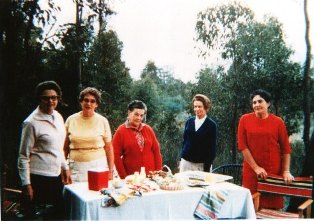
Mrs Marj Bowman (centre) and her musical sisters, all members of the Pether family.

The ABC’s Limelight magazine on classical music rejoiced that most orchestras had as many women as men. and wondered why. I think I have part of the answer, and my letter was published in the February issue as the letter of the month.

*****

Dear Mr Merson

There may be a reason why most orchestras in our post-patriarchal world have 50% women (Limelight, December 2012). I have just researched the musical life of my childhood music teacher Mrs Bowman. As Marjorie Pether, she was a foundation cellist in the WASO’s predecessor, the Perth Symphony Orchestra from its 1931inception. By 1941 she was seated in the first cellist’s chair. She always used to tell me modestly that she was promoted to first cellist because ‘the men had gone off to war’.

However, in the archives of the J.S. Battye Library in Perth, there is a note that women in orchestras were exempt from the ban on married women in paid positions in the public service. Photos from the 1930s show about 40% women in the PSO, in any case a more generous proportion than other contemporary institutions and work-places.

Their early history must have made it easier for orchestras to build to 50:50 women and men. Woman musicians started out in strength and continued in that key.

[My article on Marjorie Pether “Music in the Bush” (working title) will be in the Mar/Apr or May/Jun 2013 edition of Inside History.]

Ted Witham

Broadwater, Western Australia

Christians need more than tolerance


The Government intends to make no changes to the exemptions for religious organisations in employing people. Today the Australian Christian Lobby’s Jim Wallace boasted that the Prime Minister told him that she will not change these exemptions. Hardly something to boast about: the idea that the churches have a right to discriminate is arrogant and disappointing.

Secular views on tolerance may seem closer to a genuine Christian position. Jeff Sparrow assumes that the exemption is essentially against homosexuals in religious schools and hospitals. This commentator notes, “What message does this legislative loophole send, other than that discrimination against gays and lesbians doesn’t matter as much as other forms of bigotry? It’s a statement that homophobia is still OK; that gays and lesbians can still be bullied and harassed, in a way that wouldn’t be tolerated in respect of anyone else.” (Jeff Sparrow, “Religious Freedom Beats Your Rights at Work”, http://www.abc.net.au/unleashed/4467310.html?WT.svl=theDrum, 16 January 2013.)

Many Christians have more sympathy for this than for Mr Wallace’s position. But for Christians it is essentially an empty position; a position which is nothing more than opposition to the ACL and groups like it.

I believe that churches should aspire to a higher standard than the community’s. Jesus included the unacceptable, the unclean and the immoral: the women who had had five relationships, the Roman centurion (and his ambiguously described ‘lad’), tax collectors and prostitutes. We should actively embrace many more people than a typical corporation.  Mr Wallace believes some people should be excluded. I cannot defend that view. But Mr Sparrow’s view that no-one should be excluded comes nowhere near the Gospel paradigm that everyone should be included.

St Francis embraces the leper

That there should be no discrimination is a secular standard, the best we can agree on in a diverse society. But the Church seeking to include every last person requires much more moral effort, and indeed, demands that we be receptive to much more of God’s grace.

We Christians should welcome any move to remove the exemptions for religious organisations. The church should be pleased in this case to submit to secular virtue.

Whether or not the law changes, Christian employers should choose to act according to higher standards and be as inclusive as possible. Of course, the specifics of each employment decision do not simply flow automatically from the principle of maximum inclusion; Christian employers must still wrestle with CVs and references to match the best person for each job. But I believe maximum inclusion is closer to the Gospel, and will be seen in our complex society as closer to the Gospel. We Christians are not merely tolerant, as the Government claims to be; we follow the Lord who is “loving unto every man and woman”. (Psalm 145:9)

Generosity


Generosity

Forget your poverty for a moment,
let us think of the world’s hospitality –
the son of Mary will bring you prosperity,
and every guest will have their share.
Often what is given away comes back
to the generous hand,
and what is kept back disappears altogether.
O living God!

— St Columba
Paraphrased from Franciscans Day by Day December 17

[Franciscans Day by Day is a set of short readings for the year prepared by the JPIC (Justice, Peace and Integrity of Creation) group of the Third Order, Society of Saint Francis in the Province of the Americas.]