Resisting Tyranny in 2025


Tyrants seek to expand their power. While I don’t live in the United States, the actions of its President over the past 100-plus days have implications for us worldwide.

Mr. Trump’s power comes in large part from his wealthy tech. friends, Elon Musk, Mark Zuckerberg, Jeff Bezos and others. Together they form an oligarchy whose talons reach right into our Facebook accounts and grab hold of our book buying on Amazon. We send a message on Messenger, we read a tweet on X and we are forced to see ads which further enrich these billionaires.

Can any one of us individuals change these abuses of power? No, but we can act together, and we can resist the coming tyranny.

Here are 8 acts of resistance that I have been taking. I invite you to join me.

  1. Delete your account with X if you still have one. X is the most destructive platform. It allows bullies and ideologues to channel us into submission to their viewpoint.
  2. Don’t scroll on Facebook. Post what you want to, use ‘Notifications’ to read the posts of friends, but refuse to roll down the screen. Each click puts an ad before your eyes and ears and each ad seen adds to their wealth. The oligarchs are viciously clever. They earn money from us and without our consent.
  3. Stop calling your smart speaker, ‘Hey Google!’ I call, ‘Hey Dougal’, or ‘Hey Bugle’ when I want it to respond. The tech company is happy when you repeat its name a dozen times a day. So don’t say ‘Hey Google’ and don’t say ‘I googled it.’ Avoid the commercial name and say, I searched on the internet.
  4. Avoid buying on Amazon if you can. I find where most books are for sale on the Australian site www.booko.com.au. I usually don’t need Amazon either to find books or to buy them.
  5. Don’t buy a Tesla car. The boycott on Teslas is already hurting Elon Musk’s business. If you are buying electric, WA’s Royal Automobile Club is comfortable recommending a range of electric cars, like the Chinese-made MG or the European-built Jeep Avenger. You don’t need a Tesla.
  6. Think about deleting your Instagram account. Like X, Instagram allows bullies on its platform. It also encourages viewers to have unreal expectations of themselves because it rewards performance over integrity.
  7. Never tick ‘Accept All Cookies’. Cookies are designed to deliver your name to the advertisers. If you can reject all, do so. Otherwise, choose to manage your preferences by unchecking as many choices as the site permits you.
  8. Choose ‘Ask App Not to Follow Across Sites’. When it pops up, this option reduces the ability of the algorithm to create a web of connections and so multiply the points of contact for advertising targeted to you.  

The dangerous badge


The badge has arrived in the mail. Although the package was quite small it may provoke savage reactions and will certainly be misunderstood.

Years ago, I was much more politically active and wore badges to signal my involvement in different causes. I have kept a cloth bag of badges made with those old, primitive badge-makers. I shake them out onto the table, and I see now I supported the Campaign Against Racial Exploitation, Amnesty International, the Wilderness Society and all the predictable leftist crusades.

But this new badge is partly to protest the media who have so manipulated our sympathy that we lose our wider view and demonise a whole group of society.

The badge is a blue star of David on a white background. I will be wearing Israel’s colours, Israel’s symbol.

But why?

It may seem perverse, then, to wear a badge proclaiming. עם ישראל חי” (om Israel chai – let Israel live): how could I show support for a nation set on the annihilation of another?

The media encourage us to make a moral calculation: on October 7th in 2023, 1,200 Israeli citizens were killed and 240 were abducted by Hamas. In defending their country, Israelis killed 1,500 Palestinian terrorists. We want to cry out, ‘Isn’t that enough killing? Isn’t an additional 40,000 Palestinian deaths and flattening of homes overkill?’

Possibly like you, I also wonder whether razing Gaza is a precursor, as President Trump advocates, for wholesale dispossession. ‘Take them somewhere nice,’ he says with a blasé smile, their fate evidently irrelevant to him.

Like you, I have long been aghast at Israel’s harassing Palestinians and clearing them from the West Bank, and the current intensification of the IDF’s activity in the refugee camps where, apparently, terrorists peek out from under every Palestinian bed.

But consider Israel. I see a nation lashing out in fear. Many Israelis are children and grandchildren of the Holocaust. They are terrified that they will again be wiped out. They feel abandoned by the Western nations that created the State of Israel 76 years ago.  Their only friend seems to be the US, and that friendship under President Trump now seems brittle too.

For me, that cannot justify Israel’s behaviour in Gaza. But it goes a long way to explain it. And we have rarely seen that mortal dread expressed in the media. So I support Israel as it recoils from violence done to it. It is scared for its life.

Secondly, there is the agony of the hostages; their own agony, but also the agony of their loved ones and fellow citizens. They’ve ached for them to be returned. They’ve raged against their Government for continually prioritising the military response over bringing the hostages home. I stand with all the hostage families. They’re Israelis.

Thirdly, Israel’s Central Bureau of Statistics counts over 2 million Arab citizens. One Israeli citizen in every five is Arab or Palestinian. At least one Arab is a member of the Knesset, Israel’s parliament. These Israelis are harassed, interrogated and imprisoned if they speak a word against Israel’s actions in Gaza. But they’re Israelis.

Lastly, not all Israelis approve of their Prime Minister. They see his political calculus. He wants to cling to power. He needs to stay in power to forestall criminal proceedings against him. Ordinary Israelis feel the whole gamut of reactions to Netanyahu, from approval to active support, but also from disappointment to feeling betrayed by him. I stand with the critics of the Israeli government.

I like Jewish culture. At its best Judaism is a powerful moral and intellectual force in the world. I like the whole gamut of Jewish ritual from the blast of the shofar to Sabbath meals. It’s no accident that Jews are over-represented in fields as diverse as medicine and music. Judaism was the cradle of Christianity.

Judaism produced the extraordinary collection of books we call the Old Testament. The Jewish Scriptures contain amazing poetry, stunning philosophy and intriguing theology.  I have invested years learning Hebrew and studying the pages of these fascinating books from Genesis to Malachi.

I stand with the Jews’ legacy as builders of an ethical and aesthetic civilisation.

I look into my heart. In the end, I cannot but wear the blue and white badge even it offends random observers. I cannot but stand with Israel.

Lamenting Leunig


Michael

It was a cold Melbourne night in the year 2000, but we had left our coats at the door to the warm rooftop restaurant with its stunning view of city lights and the shimmering dark shape of Port Phillip Bay beyond.

Women in their best evening dresses outshone the men in suits and ties, or clergy collars. In the meetings during the day, I had been elected as Secretary of the Australian Association for Religious Education (AARE).

‘You are to sit here now that you are our Secretary,’ the Association President pointed to a seat at the top table.

A man about my age (early fifties) with a smart brown leather jacket, an open-necked shirt and a mop of grey hair was already seated.

‘Ted, meet Michael,’ the President said and rushed away to welcome other members.

In the restaurant, buzzing with the enthusiastic voices of members with a common passion, Michael was an oasis of peace. I greeted him and we shook hands.

‘Where are you from?’ he asked.

‘Perth. I work for the Churches’ Commission on Education there. Like Victoria’s CCES.’

‘Yes, I know CCES.’

‘Have you been to Perth?’ I asked.

‘I was in residence at the Chapel at Christ Church Grammar a couple of years ago,’ he replied.

I told him I had been chaplain there in the 1980s, and we chatted about people he had met, especially the then chaplain, Frank Sheehan.

Michael chuckled, ‘Frank put me up with the Wilsons in Peppy Grove.’ He invested the local name for the exclusive suburb with an ironic smile.

The Wilson family owned multilevel car parks in Perth and most other CBDs. I knew the Wilsons. Picking up on Michael’s irony, I asked,

‘The hospitality adequate?’ I asked.

‘Very,’ Michael smiled again. ‘Very comfortable, very friendly, but I couldn’t help feeling uncomfortable.’ He looked down at his dishevelled appearance, which I suspected was a conscious costume. He liked to dress down.

I probed more.

‘Peppy Grove is our wealthiest suburb,’ I said.

‘Yes,’ Michael replied, ‘and I felt sorry for the Christ Church kids. They had drunk the cordial. They believed they merited their privileges. Whether they were from Peppy Grove or Mossie Park or any of the suburbs round about.’

I was intrigued by Michael. Many of the AARE members taught at schools like Christ Church, and if they felt uncomfortable at the privileges of their students, it was impolitic to say so.

I remembered Christ Church kids reporting me to their parents because my views were so left-wing. I think the parents rather expected it of me, so no one criticised me (at least to my face).

I tried to think who this Michael might be. Frank Sheehan invited well-known thinkers to be in his residency program.

‘So I guess you don’t live in central Melbourne,’ I said.

‘I have a studio on my little farm.’ He must have realised he had given me a clue with the word ‘studio’, so he hurried on. ‘Only a few chooks, mind you. And a house. Just enough for me. All pretty rustic.’

I sensed Michael was belittling himself. Meanwhile, the President and other Executive members joined the table. The two of us continued our conversation. We were so deep in talk that others didn’t want to interrupt us.

We talked on about reforming our capitalist society and honouring the poor as Pacific oysters followed by vegetarian linguini and organic boneless chicken were served, paired by Victorian fine wines. Seppelts Riesling or 21 Coldstream Pinot Noir were offered.  

‘Revolutions are out,’ he said, ‘but we need a revolution in the way we think about wealth.’ He held up his glass of white ruefully. ‘A gentle revolution,’ he chuckled, ‘just to whittle away at the rotten foundations of capitalism.’

After the main course, the President interrupted us.

‘I need you now, Michael. Ready?’

Michael nodded.

The President called for quiet.

‘Our guest speaker tonight is well known across Australia. Most of us have seen his cartoons and how he insists we think spiritually about our society. This has piqued our interest. He is the inventor of Mr Curly and Vasco Pyjama. Please welcome … Michael Leunig.’

I was dumbfounded. Or plain dumb. Because I was new to the AARE Executive, I had not been party to the planning for the AARE Dinner and I had no idea that I had chatted so earnestly to the celebrity cartoonist for twenty minutes while he had not revealed his identity.  That took deep humility on his part.

Mum would be 110 today (19th October, 2024)


Mum was born in 1914, while her Dad was away fighting in France. She became a teacher at South Newdegate School, and met and married Dad in 1938. She had five children.

Mum chose the life of a farmer’s wife. She worked hard all her life, raising us with love and practicality. She and Dad had a strong moral core which she transmitted to us. She encouraged our ambitions, ‘Aim for the stars and you’ll hit the moon,’ was one of her sayings.

I think of Mum often and I am thankful for her life.

I’ll be voting Yes.


The Voice: Justice, Race and Responsiveness

The current life conditions for the First Nations of Australia are poor compared to the rest of us. They die younger than the rest of us; they are imprisoned in greater numbers than the rest of us; they fail to thrive in schools. This inequality has been brought about by chronic injustice, first through frontier conflict throughout the 19th Century and then through White Australia and other discriminatory policies in the 20th Century. As Prime Minister Keating said,

We took the traditional lands and smashed the traditional way of life. We brought the diseases and the alcohol. We committed the murders. We took the children from their mothers. We practised discrimination and exclusion. It was our ignorance and our prejudice. And our failure to imagine that these things could be done to us”.

Recognising First Nations in the Constitution is an appropriate way of recognising this injustice and will go some way to make a more equal platform for all Australians.

Far more than this, the mention of the First Nations in the Constitution will be a source of our national pride. Theirs is a rich, complex and dazzling culture that is at least 60,000 years old. The song lines, the rock art, the fish traps, even bread-making, are Australian inventions.

Secondly, the Voice isn’t about race. As a Christian, I do not accept the concept of separate races. There is one race, the human race, Adam’s race. And if the idea of race does creep into the Old Testament before Christ, it is quite clear from Saint Paul that ‘in Christ Jesus, there is … neither Jew nor Greek.’ We Christians are blind to race… or should be!  

Our post-colonial world usually defines race against whiteness. Being a European is seen as the norm; if you differ in any way, you are cast as less. This is a nasty concept. Blacks, Asians, Africans, Inuit, may have different histories, they may even have different physical features, but we are all one race.  

So recognising the Voice in the Constitution is not racist. It will acknowledge a different history. They are the First Peoples. They were here before European colonisation. But we are one race.

First Nations history has accounts of megafauna, of changes in landforms and seascapes, with the record of deep time in kinship structures, even crafts learned over aeons like making boomerangs or weaving dillybags. How wonderful it will be to be able to say, This is our history.  

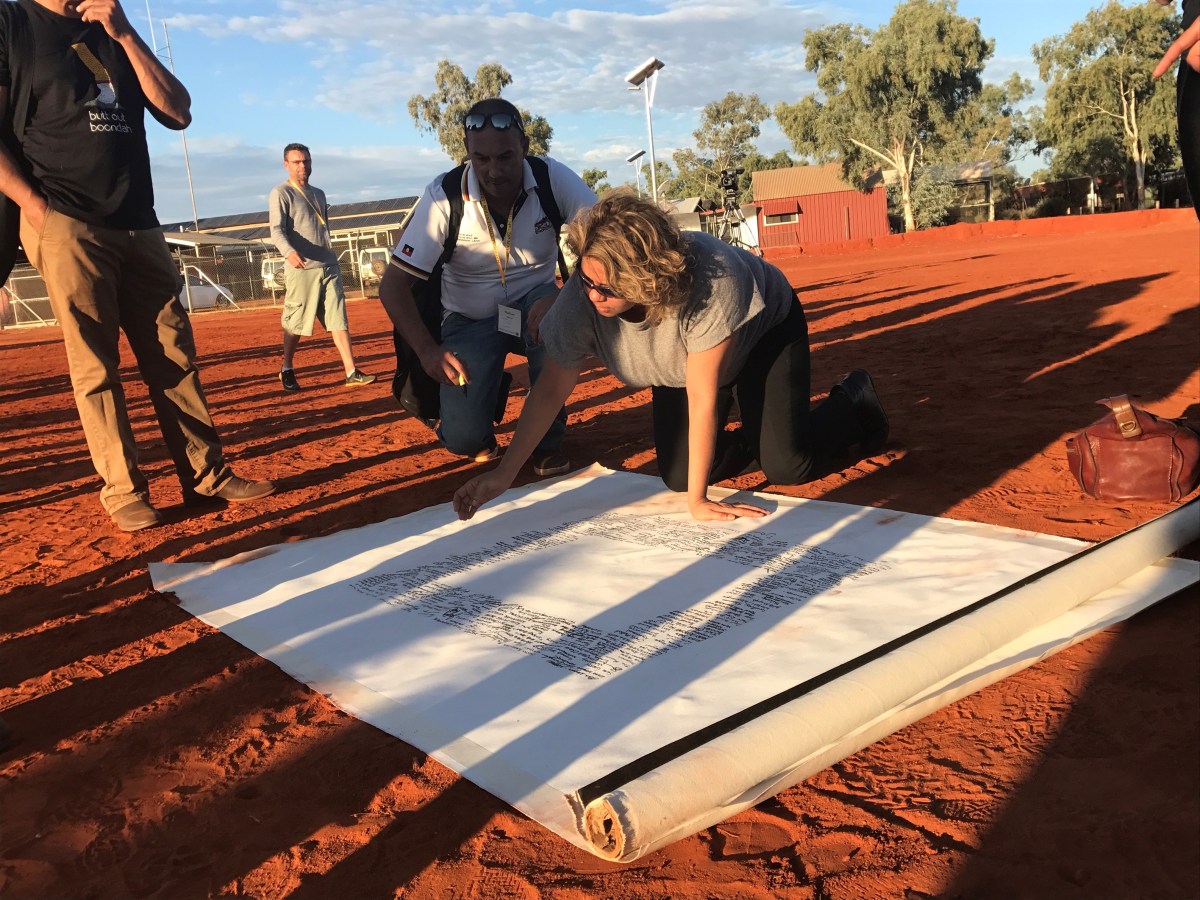
The invitation from the Uluru Statement from the Heart is to add their 60,00-year history to the history of the settlers, to make the Dreaming as important for us Australians as Aristotle or Confucius. The Uluru Statement is not asking whitefellas to give up anything; it is an offer to bestow on all Australians another stream of thought and culture.

As Christians, we take seriously that the referendum arises from an invitation. We are people who value relationship. We prioritise love. We proclaim that God is love. Invitations come, not from a place of anger, or from a desire to dominate, but from the hope to connect.

As those ‘coming from all points of the southern sky’ have reached out to the whole Australian community, I, for one, want to respond with hope and love, and say Yes to this gracious invitation.  

I look forward with excitement to the new future it will bring for all Australians.  

Celebrating the Real World


Celebrating ….

In a world where rockets are landing, their lethal voice muffled by the sour scream of air-raid sirens;

in this world where loved ones – a lover, a beautiful daughter, a wise father, a jocular aunt – are missing, covered by rubble and rocks;

in this world where food comes only when rare aid trucks come through;

in this world where the flimsy plastic of a bottle carries life-saving water;

in this freezing world, where, even wrapped in rescuers’ blankets, the minus ten-degree nights are passed shivering awake;

in this world where the task of restoring home and family seems herculean;

in this world, there is hope, still hope.

Celebrating the love shown by neighbours and strangers when worlds fall to dust.

Celebrating the strength and care of first responders whose own homes are in peril too.

Celebrating the hope of a world without violence, a world of peace, a world where billions now spent on rockets and fighter jets are spent on food security, on clean water, on sturdier houses.

In a world where famine lacerates the stomachs of the poor;

In a world where babies languish dying for want of mother’s milk or formula;

In a world where potentates, indifferent to their fellow citizens’ lives, dwell in indecent luxury;

In a world where food crops fail when crops for First World profits have ravaged the earth;

In a world where exhausted men and children, desperate to eat, burrow into dark and unsafe tunnels for minerals for Westerners’ phones;

In this world where you watch your loved ones slowly shrink then obscenely swell with malnutrition before they die;

In this world, there is hope, still hope.

Celebrating the hope of a world where our food, even now abundant, is shared equitably;

Celebrating the hope of a world where all people enjoy the dignity of providing rightly for their families;

Celebrating the hope of a world where all women, men and children can find joy in feasting and laughter;

Celebrating the hope of a world where humans delight in caring for this beautiful world of waterfalls, and butterflies, and stupendous Uluru.

In a world where rampaging floods overwhelm towns and farms;

In a world where animals bleat and drown in the unrelenting watery flow;

In a world where loved ones, like my Great-Granny Bridgeman, are swept away from their kin for ever;

In a world where livelihoods go under in the spreading floods;

In a world where life-giving water goes rogue and kills;

In this world where people try in vain to stay afloat;

In this world, there is hope, still hope.

Celebrating the hope of a world where nature and humanity are in harmony;

Celebrating the hope of a world where the kindness of neighbours is life-saving and life-giving;

Celebrating the hope of a world where the development of cities and towns is driven by concern for each other and the environment;

Celebrating the rainbow which shines its seven-fold spectrum in hope for a more lovely and loving world.

Seven times seven


Seven times seven

I don’t remember Australia Day in 1949. But Mum told me it was a sunny day, tennis day in Lake Grace. I was nine weeks old, and rapidly losing weight through pyloric stenosis. It was also a Sunday, so at 3 p.m., the tennis players walked from the courts still dressed in their whites to Saint Anne’s Church (now the church hall) for the baptism of three babies, including me.

I assume my Dad was there, supporting Mum. Dad was not a churchgoer. I didn’t know what Dad believed until, when I was about 10, he crouched in a ploughed paddock, picked up a handful of soil, and poured it slowly back onto the ground. Dad believed in the beauty and fecundity of nature.

Driving around the farm, he would point out with reverence birds in their trees, lovingly remarking on their colours and their habits, or showing us handsome plants and lizards, or pretty patterns of clouds.

The baptism ceremony went well. It was only after, as the certificates were being signed, that my most recent food reappeared. Pyloric stenosis causes projectile vomiting, and the milk and blood regurgitated can be sprayed up to 3 metres. My vomit splashed over the certificates and the ink smudged on my baptism certificate remains as evidence of the power of projectile vomiting.

Splattered milk and smudged ink, however, did not camouflage the importance of the day: this was the day God promised that God’s Spirit would hold me for ever.

I do have a memory of my confirmation in St Mildred’s in Tenterden. It was the first time I wore long pants, long scratchy grey serge pants. I was just 12 years and 9 days old on November 21 in 1960, and Mum asked me to wear my uniform for Christ Church Grammar School where I was starting as a boarder in the New Year.

Bishop Hawkins preached on duty to Mother, duty to Mother Church and duty to Mother Country (in 1960, that still meant England, I think). Mum reminded me frequently, with a small smile, of Bishop Ralph’s sermon.

My Nan had prepared me for my Confirmation. Every Wednesday of my Grade 7 year, during Scripture period she and I withdrew into the boys’ shelter shed where Nan walked me through the Catechism, explaining how God had come into the world as Jesus Christ, and still loves us through the Holy Spirit.

Even as a 12-year-old, I wondered how much the bishop’s sermon had to do with the Christian faith that Nan had expounded. I voted for Nan!

After the rite of Confirmation, I received Holy Communion for the first time. The power of the bread and wine grows over time. In 1960, I took it because Nan and Mum told me so. But now, after maybe 5,000 occasions on which I have received this sacrament, I strongly appreciate its power. Through it, God turns my natural laziness into love for others and gratitude for all God gives.

I marvel at the variety of places God has come to me in the Eucharist: in churches like St Mary’s in Tambellup, and Christ Church in Claremont and St David’s in Applecross, and, in the past two years, at St Brendan’s in Warnbro: with splendid music in St George’s Cathedral; in the Chapel at Christ Church Grammar School with its stunning backdrop of Freshwater Bay; in the bush accompanied by birdsongs; in Italian and French in historical Roman Catholic churches in Europe; in Uniting Churches, with the Baptists and Churches of Christ; in French in St Thomas’s in Beau-Bassin, Mauritius; cramped onto tiny tables in hospital; in our homes and the homes of friends and parishioners; chaotically in nursing homes; so many places, so much grace.  

It was almost as if I was ticking off the seven sacraments: Baptism and Holy Communion are the two ‘Dominical sacraments’. Our Lord (Noster Dominus) had commanded those two explicitly. According to the catholic theology Anglicans inherited, confirmation was the first of five lesser sacraments. So that made three of the seven!

At the end of 1969, my fourth year at University, I was in major pain and waiting both for my final exams and surgery on my back. As a resident at Saint George’s College, I was part of the Chapel community. Chaplain Ian George prepared a group of us over several weeks for the Sacrament of Holy Unction. We learned how Jesus had healed the sick, and how James had told sick people to call the elders for the laying on of hands and the administration of oil.

We learned how that developed into Holy Unction and how, sadly, Unction was associated more frequently with the dying. It should be a robust prayer for healing in all situations – including mine.

So Ian George duly laid hands on my head with prayer and anointed my forehead with blessed oil. As I knelt at the communion rail in the Chapel, I felt a heavy load lifted: I knew, whatever happened in my surgery, God healed me. It was a wonderful boost to my faith and the confidence it gave me never left through weeks of rehabilitation.  

In 1975, after three years of study, Archbishop Geoffrey Sambell ordained me: deacon on February 9 and priest on Advent Sunday, November 30. Before each ordination, the candidates, Chris Albany, Len Firth, Peter McArthur, Geoff Newby and I, were sequestered for a four-day retreat. These intense days of prayer and addresses invited us deeper into the mystery of God.  

A pattern was developing: preparation, then sacrament. I was beginning to learn that these sacraments were not so much about empowering me (though they do have that effect); sacraments are much more a statement about God and how God continues to work through frail fallible human beings.

In 1978, I fell in love with my dearest Rae. We were engaged on August 6, the feast of the Transfiguration, when everything changes for the better. Our parish priest, Michael Pennington and Archbishop Sambell both played their part in preparing Rae and me for the Sacrament of Holy Matrimony.

The Archbishop married us on December 9 in 1978 in St David’s Church in Ardross. Michael Pennington celebrated the Nuptial Eucharist. Our families and friends crowded St David’s. Two of our friends played Grieg’s ‘Wedding Day at Troldhaugen’ and Bach’s ‘Wachet Auf’ for oboe and organ as our wedding present. Aunty Jean Witham presented us with her stunning tapestry version of Michelangelo’s ‘Last Supper’. (It still hangs on my study wall.) Our wedding was another declaration of God’s determination to go on loving us.

Rae and I were not content just with the sacraments we had received. In 1979, we started our formation as Franciscan tertiaries and were professed in 1983. It’s not hard to draw a straight line between my Dad’s celebration of nature and me grasping St Francis’ appreciation of all creation.

It is not my tradition to make a formal regular confession; even so, I have used Sacrament Number 7, the Sacrament of Reconciliation, on many occasions. It, too, is a wonderful affirmation that, whatever stupidity and evil I have done – and I have been stupid and evil at times (often simultaneously)  – God still loves me. God is still prepared to treat me as though I had a clean slate, just like I had before I vomited all over my baptism certificate.

What is God like?


What is God like?

Reflection on the Gospel Luke 20:27-38

One of my favourite lecturers at theological college was Max Thomas. Dr Thomas was an expert in Orthodox spirituality, and he often enthused about how much Anglicans can learn from our Eastern brothers and sisters.

Max was closely involved in our student lives. Most days he chose to eat lunch with us where his presence provoked lively theological discussion. Even though Max was way ahead of us intellectually, he still needed that kind of interaction.

A year or two after my return to WA, Max was appointed Bishop of Wangaratta in Victoria. It was not a happy appointment. We heard that he was an idiosyncratic bishop, and his clergy were not too sure how to take him.

For example, when he visited a parish on a Sunday, he chose not to robe and lead the service, but to sit in the back row and take notes on the sermon. He told me that the biggest fault in the sermons he heard was that they were not theological enough. By this, Max meant that the preachers did not explore and explain what God is like.

Sermon critique, however, was perhaps not the best form of pastoral care!

Max would have rejoiced in today’s gospel with its lively theological discussion between Jesus and the Sadducees. In this discussion, they refer to the Bible. They discuss subjects relevant to everyday life. Above all, they argue about what God is like.

The Sadducees try to wedge Jesus with their question. If Jesus tries to answer their question, ‘Whose wife is she?’, he will end up contradicting himself because the question is phrased in such a way that there can be no logical answer. If he denies that the seven brothers and their serial wife will be ‘in the resurrection’, the Sadducees have trapped Jesus into agreeing with them that there is no life after death.

But Jesus avoids the wedge. The real issue, he says, is not about sex in the afterlife. The real issue is not even about the afterlife. Nor is the real issue about the extent of the Bible, whether the first five books are the only authoritative ones, as the Sadducees claimed, or whether the prophets and the writings also speak to us of God.

The real issue, says Jesus, is God and what God is like. (Max Thomas’s question!) God’s life and influence extend beyond any of those things. The ‘God of the living’ is the living God, and we all live in God. The patriarchs, Abraham, Isaac and Jacob live, because God gives them life and goes on giving them life. ‘Before Abraham was, I AM’, Jesus claimed (John 8:58).

There is no limit to God. God transcends anything human minds can comprehend, and we human beings are embraced by God’s ongoing life. The issue in this passage is not life after death, but life with God, ongoing life, life now and for ever.  The difference is crucial.

Three attempts to catch Jesus out

The heart of God


Read Wisdom 6:1-11

“He will search out your works and inquire into your plans.” (Wisdom 6:3b NRSV)

Deep under Duke University in a series of fluorescent-lit rooms, lies a whole different world. If you enter from the Divinity School library and take the elevator down to these “stacks”, you wander from room to room. Eventually, you leave the Divinity School library and meet the subterranean rooms of the main University library. In total, the Duke libraries contain 6 million volumes.

On a few occasions, I spent an afternoon searching for books and journals in this lower world. Because it is so vast, I found myself losing my orientation. I was drawn more and more deeply into the search: from this book, to this author, to this journal, to this Dewey number. It was a totally immersive experience: I felt pleasantly swallowed by the library.

As Christians, we seek the same immersive relationship with God, not necessarily through books, but through our lives, reflection on Scripture and conversations with fellow believers. We are drawn more deeply into who God is, experiencing more fully God’s love, God’s joy and God’s compassion for ourselves and others. We even experience a sense of dislocation, like wandering in the underground parts of Duke Library, never quite sure of the God who is ultimately beyond our understanding.

The writer of Wisdom reminds us of the surprising truth that this deep searching is reciprocated. Not only do we have the opportunity to search into the depths of God, but God searches us out and “inquires into our plans”. God loves us so dearly that he wants to know us through and through, intimately and passionately. God immerses Godself in us, roaming in our lives and tenderly exploring each part as he finds it. And as God discovers more and more who we are, so God’s searching love transforms this, then that, aspect of our lives. 

As we search the depths of God, and God searches our depths, so we become more like God, forgiven and free to be loving, joyful and compassionate.

God is open to our searching. God invites our immersion

in God’s life. God rejoices in our deepening understanding of his nature. We too must decide to open ourselves to God’s searching, knowing that there is no part of us that God cannot redeem, and knowing too that God is determined to know as and to transform us.

Thought: God seeks to know us so he can love us more deeply. We seek to know God so we can love God and all God’s creatures more deeply.

Prayer: Open our hearts, God of Wisdom, and come into our lives and change us into your glory. Amen.

The edited post as published in the Upper Room is at https://www.upperroom.org/devotionals/en-2022-03-26t

Transfigured

Our face completely mirroring his features.


Paul Claudel, Commentary on the Gospel according to Saint Mark (Mk 9:2-10)

Transfiguration:15th Century ikon, Theophanes the Greek, Gallery Tretiakov

Mark 9:2-10

Six days later, Jesus took with him Peter and James and John, and led them up a high mountain apart, by themselves. And he was transfigured before them, and his clothes became dazzling white, such as no one on earth could bleach them. And there appeared to them Elijah with Moses, who were talking with Jesus. Then Peter said to Jesus, “Rabbi, it is good for us to be here; let us make three dwellings, one for you, one for Moses, and one for Elijah.” He did not know what to say, for they were terrified. Then a cloud overshadowed them, and from the cloud there came a voice, “This is my Son, the Beloved; listen to him!” Suddenly when they looked around, they saw no one with them any more, but only Jesus.

As they were coming down the mountain, he ordered them to tell no one about what they had seen, until after the Son of Man had risen from the dead. So they kept the matter to themselves, questioning what this rising from the dead could mean.

  • New Revised Standard Version (NRSV)

………………..

“Let us go up to Tabor with him: Jesus is ready. The host is going to be elevated for an instant, we come to the heart

of the Sacred Mysteries.

The perfect man in the Christ fulfils his perfect

appearing,

And by themselves, his feet are separated

from the earth.

The grain is hard, the grape is swollen, it is summer. The time has come when God at last crowns

His entire creature.

Human beings are perfect animals, Jesus is the

consummate human being,

Every living form in Him attains His paragon

supreme.

His clothing becomes like snow,

his flesh shines like light.

The Law and the Prophets suddenly appear in his

presence.

Like the iris where the sun is reflected, and like the Son

when the Father is present:

“You are my well-loved Son to whom I have given my

consent.”

Do we understand that at this moment our Brother

has changed us?

His face, his eyes, – his heart; – his feet that

we have touched?

Our face completely mirroring

His features.”

  • Paul Claudel, Poetic Breviary, Paris, LGF, the “Livre de Poche” collection, 1971, pages 153-155.
  • Translation : Ted Witham tssf, 2022
  • Paul Claudel (1868-1955) was a French Roman Catholic playwright, poet, exegete and diplomat.