Transfiguration


Transfiguration

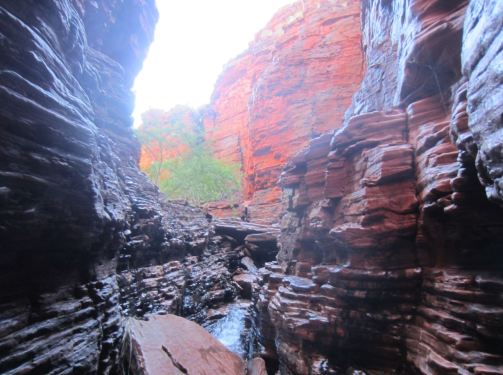
I walk this distant red gorge path alone.
My feet seek strength but I fear its sheer side,
I reach out searching for my God: unknown.
I touch nothing and weep; my faith has died.

I trudge on with the bread and blood and Word
These connect me to the church not to God.
“Scriptura sola” is literally absurd
My only joy is that others have trod

This way; and overstepped the bounds of linking.
I’ve lost the power to feel where God creates,
Abandoned zeal, fearing downfall, am sinking —
Instead of love, my worship isolates.

I falter, fall, free-fall down the chasm deep,
I faithless, God grasps me, who makes the leap.

  • Luke 9:28-36 (February 7, 2016)
    “Scriptura sola” – Latin tag meaning “Scripture alone”.

red-layered-rock

Image courtesy http://www.australiasnorthwest.com/Destinations/The_Pilbara

Sonnets for the Wedding at Cana


1

Wedding at Cana

Press the infinity loop, the Moebius strip,
Christ’s incarnation, two become one, yes,
alloy of connubial companionship,
Wife and spouse bless each other’s tenderness.

Six large pitchers to purify the night –
How much purity do bride and husband need?
No! Throw out the rules of restricting rite,
let newly-weds on love’s infinity feed.

The love of lovers cannot be pegged or clipped.
It flows like cabernet through crypted cellars,
Flooding, spreading like a tide over-tipped,
Baffling gift of Bible’s story-tellers.

Each gives all, receives all, sets each other free,
Bridegroom, Lover, Bride in Holy Trinity.

  • Isaiah 62:1-5, Psalm 36:5-10, John 2-1-11
  • Ted Witham

OLYMPUS DIGITAL CAMERA

2

Cana 2

Mary’s there, Jesus’ mother – and his friends,
(called disciples in pious prophecy.)
There’re some servants whom Jesus sends
With transformed water for the maître-d’.

The maître-d’ drinks deep and calls the host,
The bashful bridegroom takes the praise to heart.
It seems a full cast for the wedding: most
strangely the groom has mislaid his sweetheart.

Good wine, once it’s started, must be consumed,
So starts a party now and for always.
And the Bride herself is forced to be assumed
The attentive Reader prayerfully obeys.

So, dear Reader, put on your wedding gown and ring,
And go to Jesus your spouse, and with him dance and sing!

Ted Witham

the-wedding-feast-at-cana-detail-1304-1306

Christ’s Body is my body


Poem by Symeon the New Theologian(949-1022), Hymn 15 in his Hymns of Divine Love

We awaken in Christ’’s body,
As Christ awakens our bodies
There I look down and my poor hand is Christ,
He enters my foot and is infinitely me.
I move my hand and wonderfully
My hand becomes Christ,
Becomes all of Him
I move my foot and at once
He appears in a flash of lightning.

Do my words seem blasphemous to you?
— Then open your heart to him.
And let yourself receive the one
Who is opening to you so deeply.
For if we genuinely love Him,
We wake up inside Christ’’s body
Where all our body all over,
Every most hidden part of it,
Is realized in joy as Him,
And He makes us utterly real.
And everything that is hurt, everything
That seemed to us dark, harsh, shameful,
maimed, ugly, irreparably damaged
Is in Him transformed.
And in Him, recognized as whole, as lovely,
And radiant in His light,
We awaken as the beloved
In every last part of our body.


Quoted by Richard Rohr, pp. 219-20 in Things Hidden

Epiphany


Epiphany

Arise, ablaze because your light now beams,
Godly light, insight to eternal aims.
The darkness that would cover earth still dreams
Of battle victory in Satanic games.

The poverty of the poor brought to nought,
The dryness of the drought be drowned in rain,
The violence of the vicious be stopped short,
The upright once disgraced honoured again.

So yes: God’s mystery wise has been revealed,
the Gospel locked in sepulchre set free,
and Jesus master of this battle-field
is fruiting flower of frankincense tree.

For darkness has no means of quenching light:
Wise men blaze in the beacon of Twelfth Night.

  • Isaiah 60:1-6, Psalm 72:1-7,10-14, Ephesians 3:1-12, Matthew 2:1-12
  • Ted Witham Epiphany 2016
  • tumblr_nz0tpgzlvt1qbm4heo1_500

New Year 2016

Sonnet to welcome the new year


New Year, A.D. 2016

  • Readings for Christmas 2: John 1:1-18, Jeremiah 31:7-14, Sirach 24:1-12

The Word became our flesh and dwelt with us,
so the cosmos was by God itself restored,
the past is healed, the future bright for us,
Jesus’ poor birth revealed, humanity awed.

With pleas for mercy I will lead them back,
says our Lord, I will make them walk by streams,
I’ll keep my people on the straightest track,
the blind, the lame, I will fill full their dreams.

Wisdom for my homing, mercy’s teacher,
comb through heaven’s reaches and the depths’ abyss,
destination of God’s every creature –
Heart of the Universe accomplish this:

Last grain, and God’s letter spaced to kern,
Made from star-dust, to stars we will return.

Ted Witham 2016


Charles de Foucauld’s original prayer of abandonment


The prayer of abandonment usually attributed to Brother Charles de Foucauld was in fact put together by Little Sister Magdeleine Hutin from de Foucauld’s writings.

To honour the feast day of Brother Charles (who died December 1, 1916), I offer this translation from the French of his original prayer.

****

My Father
I place myself again into Your hands ;
My Father
I entrust my life to You;
My Father
I abandon myself to You;

My Father,
Do with me what You will;
Whatever You do with me, I thank You for it;
Thank you for everything,
I am ready for everything:
I accept everything:

Thank you for everything;
provided that Your Will is done in me, my God,
provided that Your Will is done in all Your creatures,
in all Your children,
in all those loved by Your Heart;
I desire nothing but my God;
I place my soul into Your hands;
I give it to You, my God,
with all the love of my heart,
because I love You,
and because I have a need to give myself in love,
to put myself in Your hands with total openness;
I place myself again in Your hands, with infinite trust,
for You are my Father.

Astrapi for kids


Astrapi is a Paris-based French-language magazine for 7-11 year olds. They distributed a two page supplement in clear language to help the kids of Paris.

It’s common sense, and although a couple of the references are specifically to Paris and France, I thought it was so well thought out that I have translated into English to help anyone respond at a personal level to the attacks. Just click on the link below.

Astrapi on Paris attacks

Buying into violence

We Christians need cool heads to not be caught up in the fear and so fuel the violence: remember André Trocmé and the villagers of Le Chambon


Russia and France have intensified their bombing of Raqqa. ISIL are rejoicing. This is the war they want, the violence they have provoked, whether or not they are the masterminds behind the bombings over Sinai, in Beirut and most recently in Paris.


They want violence to bring in their caliphate. When the West obliges by responding with violence to its violence, the West is playing into its hands. Fighting fire with fire means that everyone gets burnt.


9781742376141I’ve been encouraged in the last few days reading A Good Place to Hide, where Peter Grose tells the story of ‘How one French community saved thousands of lives in World War II’. The village of Le Chambon-sur-Lignon and its neighbours in the surrounding mountainous area hid Jews and others on the run. A small regional railway was the main access to the village which boasted a number of modest boarding houses that had been built for ‘healthy Protestant family holidays’. The village was surrounded by remote farmhouses, many of whom were willing to secrete Jews in their attics or cellars or barns, sometimes for weeks, sometimes for the duration of the war.


Le Chambon is near the Swiss border, and the people of the village opened up a ‘pipeline’ smuggling Jews into neutral Switzerland. Teenagers became expert ‘passeurs’, people-smugglers, risking their lives for others.


This whole operation which saved probably 3,000 Jews, more than Schindler’s List, had its heart in the network of Protestant pastors in the Plateau area. The Huguenot people had a history of sheltering dissidents, whether they were Protestant, Catholics or Jews, and those displaced by World War II were equally welcomed and hid or smuggled out.


The pastor at Le Chambon, André Trocmé, made known his views on non-violence from the beginning of the war. Pastor Trocmé believed that even against the evils of the Nazi regime the only weapons allowed to Christians are the ‘weapons of the Spirit’. Even when the Resistance began to form around him, Trocmé continued to speak out for non-violent methods, including openly protecting foreign Jews and others wanted by the Gestapo. He agreed to go into hiding only when he was persuaded that staying would likely result in a violent Gestapo attack on his family.


The story of Trocmé, his colleagues and parishioners, is inspiring for our time.


We are daily being tempted to back the rush to more and more violence. Pastor Trocmé provides an example of someone who consistently refused to go along with violence as a solution to violent provocation.


We are daily being encouraged to pull the welcome mat away from vulnerable asylum seekers. ‘Maybe they are more a security risk than we first thought.’ The people of Le Chambon reminds us that there are only people – not Muslims or Jews or Christians – to be welcomed to our place.


When the Gestapo came to arrest Trocmé, he wasn’t home. His wife offered them a meal while they waited. They looked for opportunities to see the occupiers as human beings too, even when it made them unpopular with other French people. We cannot excuse or overlook the wanton violence of ISIL, but maybe we can see that those being radicalised are gawky young men looking for a place to belong – not monsters.


It suits the politicians to ramp up the fear following Beirut and Paris. But it suits ISIL more. We Christians need cool heads to not be caught up in the fear and so fuel the violence: remember André Trocmé and the villagers of Le Chambon.


God and Chronic Pain


I wrote this back in 2009 – and thought it worth sharing again:

The worst thing that the Western church has done is that we have turned God into a man. Ask any six-year-old to draw God, and she will emulate Michelangelo and draw an old man with a white beard. The orthodox Christians, the Jews and Muslims have taken much more notice of the second commandment: “Thou shall not make of the Lord thy God any graven image.” (Exodus 20:4).

And God said…

We may not believe that God is literally a human being, but we picture a transcendent God in physical terms. Children may believe God is the “Friend for little children//Above the bright blue sky” in an absolute literal sense, and adults often believe transcendence describes God’s distance from the physical creation.

It’s true that the Bible often anthropomorphosises God: God walks out before the armies of Israel; God picks up and cuddles the human person, like a mother and baby (Hosea 11:3-4). In general, however, the Bible has a sophisticated notion that God is (a) holy, that is set apart from his creation, and (b) intimately involved in creation.

God is a wind (Genesis 1:3), an unseen and uncontrollable energy that stirs up of the raw materials of creation. God “sits above” the thunder and lightning (Psalm 39), more powerful than the raw energy of the storm. God stills the seas (Psalm 65:7), not with a giant hand, but with an irresistible will.

If you have chronic pain, your picture of God matters. If you think God is a sophisticated human upgrade, if you make God in the image of human beings, your God will not be strong enough to make a difference to your pain. Your picture of God will limit your ability to receive the powerful healing God wants for you.

In the last ten or so years, my picture of God has changed radically.

Sometimes this journey has been dangerous. I have wondered if I have lost my faith. The God I had believed in was not big enough, and certainly not powerful enough to positively affect my pain, and I had to let go of that picture of God.

In Peter Jackson’s 2001 film, The Lord of the rings: the Fellowship of the Ring, an underground sequence has the wizard Gandalf confronting a Balrog on a crumbling rock bridge. The hobbits run as fast as possible to get to safety. Gandalf falls with the monster to their death. Growing your faith in God is like that rush across the bridge of Khazad-dûm. When you let go of your picture of God, everything crumbles and precious ideas die.

But let me encourage you. The only way to have a picture of God adequate to your pain is to stop believing in the God you think you know. There is a well-trodden path to this believing atheism, and it is the path of mysticism.

1. Any picture of God you have is by definition too small. To continue to believe in it is to commit idolatry. You have no choice but to let go your picture of God.

2. When you let go of God in this way, you become an atheist in the sense that you have no God to hang on to. What you must then believe is that God is hanging on to you. You cannot know what manner of God this is, you need to trust only that you are being held.

“Blessed be the Lord day by day,

who bears us as his burden;

he is the God of our deliverance,” says the Psalmist (68:19)

3. As this trust develops, so you may begin to grope towards a new understanding of the God who is holding you. You may for example, begin to find new metaphors to describe God. God is energy; God is universal heartbeat, God lives as the tiniest cell in living things. These God-cells begin a process of healthy change in your body, and your pain is reduced.

4. But these are again pictures of God. The irony is that the process of letting go of your new pictures of God must continue.

I invite you to image a Spirit, a larger reality and to open yourself to encounter this Spirit. In this process, you may experience the reality of how deeply you are loved, how surely you are held, and how extraordinary is your future in this compassionate universe. This is what I call, and only for convenience’ sake, “contemplation”, the experience beyond muscle relaxation and centring.

I invite you to relax further into this journey into the Unknown God. I encourage along the only path through deeper atheism, which as it unfolds leads to a deeper experience of the power of God in healing your mind/body.

Anzac re-visited


Stephen Daisley, Traitor, Melbourne: Text Publishing 2011, paperback 291 pages

from $AUD16 online

Reviewed by Ted Witham

Traitor is a sensitive exploration of the Anzac myth through the life of David Monroe, hero of Gallipoli and the trenches of France. While wounded, David takes it on himself to guard a young Turkish doctor, Mahmoud, who had been captured when the two of them were trying to save the life of an Australian boy. He forms a deep friendship with Mahmoud, who teaches him about Sufism and the poetry of Rumi. He decides to help Mahmoud escape to his home village, but they are betrayed by their Greek boatman. David is sentenced to death for desertion, but the war ends and he is pardoned.

David then returns to the quiet life of a shepherd in New Zealand, unable to ever make good in a society which never completely forgives him for his ‘treachery’.

Traitor is Daisley’s first novel, and was shortlisted for the NSW Premier’s Literary Award in 2011. Daisley is a West Australian writer who delves deeply into the Australian psyche. I found myself coming back to the book again and again, unable to put it down. The story begins with David being questioned by intelligence officers, a scene with a Kafkaesque edge, and then unfolds as the past impinges on the present.

I was impressed by the lightness of touch in the story-telling: it is beautifully crafted, and the reader is rarely aware of the mechanics of the story. I felt I was in David’s world, and that the little things in his present really did touch off his memories. I felt I could taste the cold in the New Zealand air and smell the after-birth as he moved about the lambing flats, and I felt nauseated by his descriptions of death in the trenches, and genuinely moved by his love for Mahmoud and the woman he could never marry, Sarah.

I am looking forward to diving into Stephen Daisley’s second novel, Coming Rain.