50 Years a Deacon


In the name of the living God, + Father, Son and Holy Spirit. Amen.

Fifty years a deacon. The Church 50 years ago was a very different church. Churches around Perth were generally full on Sundays – many churches filled two times over with two services. Men still wore suits to church, and women wore Sunday best dresses. Some women wore hats, but hats were beginning to stay away. The declining attendance of hats was a sure sign that the Church was about to change.

We were still ‘The Church of England in Australia’ – our name didn’t change until 1981, and I think our English culture is only now beginning to change.

Sunday Schools around the city were huge. 70 or 80 kids and a dozen teachers turned out every Sunday at Christ Church Claremont and parishes like it. The General Board of Religious Education, set up by the Australian General Synod, produced the course book used by most Anglican Churches. Children were completely segregated from adults, and, many children were dropped off by their parents. These parents may have seen benefit in Christian education for their kids but not for themselves.

There were arguments that you might remember about whether children were really ‘people’ for the purpose of attendance numbers and statistical returns!

By 1975, the once-flourishing Y.A.F. – the Young Anglican Fellowship – had pretty much shrunk and died.  

I grew up in a country church in the 1950s. You could definitely see the decline in little churches all over the southwest corner of the state. Our little church, St Mary’s in Tambellup, might cram 70 people in for Christmas services. They even put out little folding stools with canvas seats down the aisle to accommodate everyone. But the Sunday after Christmas, and for most Sundays of the subsequent year, the congregation was fewer than 15 or so. There was a little Sunday School, taught by Mrs Lorna Taylor, who also played the organ, ducking in and out of the church and the church house next door during the service. That Sunday School had less than five kids.

This was the Church five of us were called to be deacons in 1975. The church appeared to be flourishing, but there were clear signs that we were about to be pruned – enormously.

Although accurate statistics were hard to find, 8,000 or more people turned up to Anglican services across this Diocese each Sunday: more, we were reminded, than attended WAFL football matches each weekend.

The Diocese tried some big things to stop the runaway numbers. 1975 was the year of Celebration 75, a huge mission of the Diocese, culminating in 10,000 Anglicans gathering at Perry Lakes stadium for the Eucharist on Palm Sunday.

Celebration 75 was memorable because of the murder of Archbishop Janani Luwum from Idi Amin’s Uganda. Luwum was one of the bishops visiting Perth for Celebration 75.  Some months after he returned to Uganda he was found in a crashed car just outside Kampala – his body riddled with bullets. ‘The blood of the martyrs,’ Tertullian said 1800 years ago, ‘are the seed of the Church.’ Maybe a little of Luwum’s blood would impact Perth Diocese!

Goals were set for our diocese – 24 new parishes to be planted in 24 months. When we young clergy spent time with Archbishop Sambell, his parlour game was to get us to state as many new suburbs as possible (Kallaroo, Mullaloo, Heathridge, Connolly, Joondalup, Currambine, Iluka, Ocean Reef). Then the Archbishop would comment: ‘And that is our mission field.’

Luke’s telling of the calling of the first disciples reminds us of three things about the ‘mission field’ – the situation which they were called into. The painting by the 14th– Century Italian painter Duccio di Buoninsegna is a sermon in itself. Buoninsegna means ‘teaches well’, and that’s what this beautiful picture does.

Duccio’s painting tells the story of the Miraculous Draft of Fish all in one image. He starts with Jesus meeting Simon and Andrew. Notice the sky is golden. When Simon and Andrew meet Jesus, we are not in the normal everyday world. Duccio paints them in heaven with its gold sky. Jesus is on the rock; Jesus is the rock. Jesus invites Simon and Andrew to step on to the rock, onto the solid ground of a new relationship with Jesus and to turn the everyday world into the glory of heaven.  

I must admit that the two disciples don’t appear to be straining to haul in the heavy net of fish. With Jesus by their side, the effort is shared with Jesus and their burden becomes light. There are fish everywhere in Duccio’s picture, both in the net and outside the net. In this vision of heaven, you don’t need to be inside the net. Everyone is included in God’s love.

Duccio the painter is teaching that what is true for Simon and Andrew then is true for us now. Jesus continues to invite us into a life-giving relationship with God. Jesus calls us to the work of mission with him. We are to be encouraged that in the end, God makes sure that there is a good haul of fish – of people.

Simon’s encounter with Jesus sees him coming to terms with the way Jesus, a carpenter, told him where the fish were. Jesus told Simon to put out into the deep and put his drag net out the other side of the boat. Just imagine how Simon must have swallowed his disbelief: he may be Jesus the preacher, but really, what does he know about finding fish?

Simon puts the cumbersome net into the boat, I imagine with some reluctance, gets the oars organized, rows out to deeper water, puts the net in the water and then drags it in a half-circle from the boat; all the while expecting nothing. What difference can Jesus possibly make?

And then surprise! ‘So many fish that their nets were going to break!’ They filled two boats to the point of sinking. (Luke 5:6)

Simon is shaken. Shocked to the core. This man Jesus is like no other human being Simon has met. ‘Get away from me, Lord, for I am a sinful man!’ (Luke 5:8) Seeing Jesus in this moment makes Simon squinch and shudder. This encounter with the power of Jesus strikes Simon (and Andrew and James and John) as so massive and so stupendous that they left everything – everything! and followed him.

I assume Simon used to go to synagogue and had heard the scrolls read. He knew about the prophet Isaiah, who, like Simon, was overpowered when he was encountered by the Lord God in the Temple, and, like Simon, Isaiah’s first reaction was with dramatic words: ‘Woe is me! I am a man of unclean lips, and I dwell among a people of unclean lips.’ (Isaiah 6:5)

In this squeal of pain, Isaiah recognises that he could not stand before the living God unless God reached out and made him stand. And for Simon, the catch of fish had the same effect.

The second part of Simon being called to the ‘mission field’ was calling others to help him. To haul in so many fish Simon needed to call on his brother Andrew and their partners James and John. You need others. Jesus rarely invites single heroes to do the work of ministry. It’s too hard. It’s too big.

Jesus himself is on a fishing expedition to catch people. Luke implies that his catch, consisting of Simon and Andrew, James and John, is also a good haul.  These four will make a significant difference to the ministry of Jesus.

All ministry requires hauling in people. Maybe ‘hauling in’ people is not the best image. The church is not the Ringling Bros and Barnum & Baileys, hauling suckers into the Big Tent! Rather the church’s business is inviting people respectfully and gathering them in. Even so, the church of God is a Big Tent.

Our parish’s ministry to the homeless always needs volunteers. Morning tea after church needs volunteers. Children’s ministry needs volunteers. Even the work of worship – our liturgy – needs all of us and not just the priest out front.

The third idea is to underline that ministry is always about people.  Simon is called to catch people; not so much catching fish.

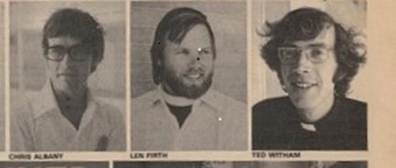
This was really underlined 50 years ago during our year as deacons. Five of us deacons and one presbyter from the Church of South India spent 1975 in the Deacon’s Training Program. This program was designed for us to experience the practicalities of every ministry in the Diocese.

We spent 10 weeks in an established parish: I was assigned to Kelmscott Parish, and then to Balga Parish north of the river. Balga was a more catholic parish, and Kelmscott an evangelical parish, so all of us participated in leading different styles of worship.

We spent 4 weeks in hospital chaplaincy, visiting patients and taking them communion.

We spent a fascinating 5 weeks in mental health. We saw the way the behaviour of acutely mentally ill people challenges the staff to care appropriately for them. We visited residential homes and wondered whether those big institutions were the right place for the severely developmentally challenged.

We spent just a few days in Industrial Chaplaincy – basically a visit to the Alcoa Refinery in Kwinana to meet John Bowyer the then chaplain!

For this Deacon’s Year, we resided at Wollaston College We each shared leadership in music and worship in that wonderful big tent Chapel. Following the Benedictine Rule, we had to do some manual work around the College, cleaning windows and pruning and sweeping paths and roads.

I’ve never been one for manual work, so I offered to restore the old harmonium which provided our music in Chapel, and I enjoyed cleaning reeds and fixing wires and bellows. It took me the whole year to complete – conveniently!

The Deacon’s Year was fast-paced. Two weeks in a country parish, where I watched with amazement Henry Tassell, a country pastor who had the rare knack of turning up on a farm at the right time, say, morning teatime during shearing. He kept overalls and work boots in the boot of the car to pitch in and help the farmer.

Two weeks in a church school.

I was anxious to be a school chaplain.

When I was about ten, I had a dream one night. After this dream, I remember rushing to my Mum and blurting out, ‘When I grow up, I’m gonna be a teacher and a priest!’ Mum advised me not to say anything about the dream.

But I did think of it every now and then. I interpreted it to mean that I would be a school chaplain. So, the Headmaster of my school Peter Moyes, even when I was still at school, had also encouraged me to be a school chaplain and  before going to theological college in Melbourne, I had taught in the country for two years and enjoyed it.

So I learned a lot in those two weeks at Perth College. Teaching girls only in a classroom opened my eyes. When girls behave badly, they behave badly in big groups. Suddenly the whole class, it seems, turns on one person and bullies them, one of the girls, or the teacher. Unlike boys, you can’t just pick out the perpetrator and punish him. I had to learn strategies to deal with feminine mob rule!

But that didn’t dampen my determination to be a chaplain. I saw how the chaplain Terry Curtis conducted the Chapel services, what opportunities he had for pastoral care for the girls and for the staff – and a scary Headmistress!

Later, I had nine satisfying years as a school chaplain, one year at Hale School, and eight years at Christ Church Grammar. After those years, I discovered even more ways of being a teacher and a priest.

But back in the Deacons’ Year, we had a tough 36-hour Urban Training course We had to survive in the city without money. We pretended to be homeless, living on the streets, under stress to experience how our society looks after the needy.

A four-day Human Relations course back in Wollaston College turned out to be a deep dive into our inner psychological lives. Some of the deacons found this group work too threatening, so it was abandoned in subsequent years.

Anglicare, Anglican Homes, how to conduct weddings: at the time some of it was a blur. But the basic point was made: ministry is about people – worshippers in a parish, patients in hospitals, kids in schools, brides and grooms, people on the street, certainly neighbours and friends and families. And ministry meant making connections with hospital chaplains, diverse parish clergy, school chaplains, Government agencies, and a whole host of carers who gave us insight into other caring people in our society.

This practical year 1975 followed three years of theology study. None of my fellow deacons complained that the academics were not relevant to ‘real ministry’. I felt, and I think the others agreed, that we can only understand the purpose of practical ministry if we understand a bit about God. In our Deacons’ Year, we experienced God in the marginalised. We made sense of it with Bible study and through Church History.

Luke doesn’t tell us that Jesus ordained deacons. Jesus calls all the baptised to ministry. Jesus invites each one of us to be a deacon and serve the needy. Matthew writes a parable, you remember, about sheep and goats. When we minister to the least of these, we are loving Jesus.  The ministry of service is for all of us.

Deacons, ordained deacons, some permanent deacons and all priests and bishops, we are deacons before we are priests; as ordained deacons, we are the church’s sign to itself of helping the needy. Our life of service shows that all of us rely on God to empower ministries of service. Deacons’ service in the community emphasises that the church doesn’t exist for its own sake. The church exists always for others. The great wartime Archbishop of Canterbury, William Temple, is often quoted that ‘The Church is the only society that exists for the benefit of those who are not its members.’ The church is a diaconal church, a serving church, a church of deacons, and our holy task is to love God by serving people.

Fifty years on. 2075. I won’t be around to see it, but some of you will. And I hope you experience how God keeps loving you, and you will keep loving your neighbour.  Because whatever changes 2075 will bring, we will still be a deacon-shaped church – and that’s worth celebrating.

Blessed are Christians through the Pandemic

We Christians will be stronger and our faith will be deeper – we will be more blessed – because of living through this moment.


Irene Alexander and Christopher Brown (editors), To Whom Shall We Go? Faith responses in a time of crisis, Cascade 2021

Paperback ISBN 9781725289550
Hardback ISBN 9781725289567
eBook ISBN 9781725289574

Available from the publishers, Koorong, or from the authors at holyscribblers.blogspot.com

Hardback $40, eBook and Paperback $25

Reviewed by Ted Witham

Part of us wants to pretend the Coronavirus pandemic has not happened, and that the Church can go back to its old ways after the worst of this is over. I have no doubt, however, that there will be enduring changes, not least in the way Church organisations use technology.

The collective of Christian writers behind To Whom Shall We Go, who call themselves the “Holy Scribblers”, are also convinced of permanent change. Their interest, as shown in this series of eleven essays, is in changes to our spiritual lives more than technology.

The book is loosely structured around the Beatitudes and this structure gives the book an optimistic feel: we Christians will be stronger and our faith will be deeper – we will be more blessed – because of living through this moment. Their grounds for optimism are historical. We have before lived through past pandemics and challenges and emerged changed and stronger.

The authors are an eclectic mix of academics and thinkers who are looking for thoughtful Christian readers, clergy and lay. Two Franciscan Tertiaries, Terry Gatfield and Charles Ringma, are among the contributors. As is always the case with essays from diverse authors, individual readers will find some essays stronger than others. For example, Chris Mercer’s explorations of Desert Father Evagrius’ “eight deadly thoughts” (gluttony and lack of thankfulness for food, sexual lust, sadness, boredom and apathy, vainglory and pride) resonate for me.

I have some quibbles with the structure of the book. Each section gave rise to prayers and questions for reflection. The reflection questions were at the very end of the book. In the eBook format, especially without hyperlinks, this rendered the questions almost useless.

The prayers were crafted along quite traditional lines, so some could be used or adapted, for example, for intercessions at the Eucharist. I found them a bit too stolid, with none of the creativity of the stunningly beautiful prayers of another Australian, Craig Mitchell, in his recent Deeper Water (Mediacom).  

To Whom Shall We Go is a timely book and will stimulate lively thinking about where God is now leading God’s Church.

B.E.L.L.S. without whistles for mission


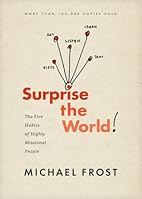
Surprise the World: The Five Habits of…


Reviewed by Ted Witham

Under $10 online. $6.95 from Christ’s Church, Anglican Parish of Mandurah. Digital version at Exponential (free)

ISBN 9781631465161

Michael Frost, Surprise the World: the five habits of missional people, Colorado Springs: NavPress, 2016.

Insanity, they say, is doing the same thing over and over and expecting a different result. We Christians at the beginning of the 21st Century should recognise that kind of insanity: if we expect our usual patterns of worship, however contemporary and relevant,  to continue to draw people into Christ, then we shall continue to be disappointed by the Church.

There is a place for ministry to Baby Boomers using traditional worship, but every member of the congregation is aware that the mean age of our fellow church-goers is increasing. In other words, Baby Boomers are aging, dying and not being replaced by younger people. Older people in their eighties continue trying to keep up the level of Christian activity that had when younger, and are experiencing burnout and disillusionment.

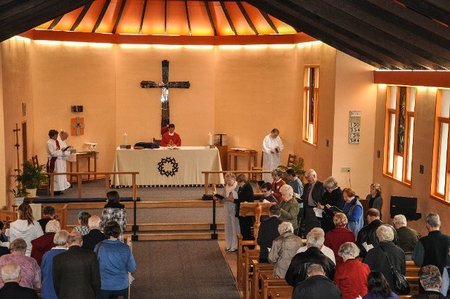
Photo courtesy St John the Divine Anglican Church, 
Courtneay, British Columbia 

The answer is not more of the same. The Anglican pattern of gathering everyone for the Sunday Eucharist is only 60 years old, going back to the Parish and People Movement of the 1950s. We can dare to envisage new ways of being church.

Bunbury’s new Bishop, Ian Coutts, has been circulating copies of Surprise the World! as he visits parishes in his diocese. Bishop Ian states that responding to the Good News of Christ is pretty simple, really. Loving each other so that we want to reach out and love others.

He has chosen a book that all Anglicans can use and act on. The book is about “shar[ing] your faith in surprisingly simple ways.”
Australian evangelist Michael Frost, Co-founder of the Forge Mission Training Network, encourages us to follow his model of B.E.L.L.S.: “We BLESS people, both inside and outside the church.  We EAT together, sharing meals with believers and non-believers alike.  We LISTEN to the … Holy Spirit. We intimately LEARN CHRIST, … [and] we see ourselves as SENT by God to everywhere life takes us.”

The strength of this model is that it does not assume that every Christian is a gifted evangelist. Few Christians are: most of us are to live our lives so that they provoke questions, “living a questionable life”, and answer them simply and directly as they arise out of our mixing with nonbelievers.

Frost emphasises that the B.E.L.L.S. model is not a one-off program, but the cultivation of life-long habits that will feed this evangelistic lifestyle. The model as described is not difficult or complicated, and it sounds fun, social justice will be practised and beauty will be encountered.

I am impressed by this little book. As a Franciscan tertiary, my first aim is to “make Christ known and loved everywhere”. These habits will speed my steps to opening doors to conversations about the Good News.

I am also in ongoing pain, a misfiring of my nervous system. Pain is closely related to depression: if you have pain, the pain will eventually make you depressed. Two spiritual strategies to defeat the depression, and so modulate the pain, are to reach out to others in need and put yourself out in the community (and not hide away in dangerous isolation). B.E.L.L.S. gives me means to do that (BLESSing and EATing) and also shows how to nurture these activities through prayer and Bible study (LISTENing and LEARNing Christ).

There are questions for discussion for each chapter of Surprise the World! These will help readers take in what they have discovered and put the five habits into practise.

I am delighted that Bishop Ian recommended the book to me, and that he is encouraging others to discover B.E.L.L.S. and whistles (no whistles actually!) I read the book in three hours. Now I want to find three people to meet with, discuss the book, and get busy. Hopefully, B.E.L.L.S. will lead away from insanity!

Taxing the church


I grow tired of the Atheist Foundation and others whingeing that the churches don’t pay tax. Their claim is false.For me it’s personal.

I received a salary from the church for 30 years. This salary was the major portion of parishioners’ donations to the church. I was very happy to pay tax out of this salary. At a quick calculation, I contributed between $150,000 and $200,000 to the nation’s tax revenue over those 30 years. The Australian Bureau of Statistics (God bless them) put the number of ministers of religion in Australia in 2001 as just over 12,000. If we count these as 6,000 full-time equivalent employees, then their contribution to Australia’s tax revenue over 30 years is between 9 and 12 billion dollars.

The churches do pay tax.

The Anglican Church, as a responsible employer, put aside part of my salary into superannuation. Our super fund started before the Super Guarantee, and enabled me later in my career to put additional savings into the fund. This means now in retirement I live partly off my super. Without super, I would be receiving a bigger pension. My super fund makes a contribution by saving the expenditure of tax.

The parishes where I worked have parish centres with rooms that community groups use, either for free or at much less than the commercial rate. While it is true that the parishes were partially exempt from rates, they made a contribution to the community through the sharing of their facilities – again saving the expenditure of rates and taxes. Many self-help groups, political clubs and community organisations could not meet if it were not for the churches.

The churches do save tax.

It’s true that the tax situation of the churches is complex; there may be some unfair exemptions for the churches; there are churches that rort the system. If our community were designing this from scratch they would almost certainly do it differently. But we can only live with our history.

From 1788 Australia has had a ‘love-hate’ relationship with religion. Many convicts and early settlers had good reason to dislike the church. On the other hand, most Australians in the 19th and 20th Century considered themselves believers. Australian Governments look to the churches to provide services that the churches can offer more cheaply and hopefully with more compassion than Government bureaucracy.

Section 116 in our Constitution does not declare Australia to be a secular nation. Rather it acknowledges the existence of both church and state and proclaims that they are to be kept distinct, but not necessarily for the church to be kept out of public life. The church’s contribution to our public life is different from the state’s.

And in the meantime, we can get our facts straight. The churches do pay tax, and they do save taxes.

mi-cd959_aussie_p_20140714165237

Presentation


Presentation

Bush church of my childhood: see server and priest
In tiny vestry; vestment-chest of oak,
White robes laid out immaculately creased,
Christ’s purity, and his mother’s, evoke.

The albs are bordered in fine crafted lace,
Stole and chasuble crisply ironed and laid,
Emptied of sound, in silence of place
The server hears as his precursors prayed.

Inside the small church a reed organ sounds,
On, into the sanctuary the server leads on,
He bashful bows deep then processes ‘round,
He offers water and wine: the Dreaming’s white swan.

My mother and grandma with pride are stilled;
They watch from the pews the now and the willed.

  • Malachi 3:1-4, Psalm 84, Luke 2:22-40


In Native American stories, Dragonfly persuades Swan to surrender to the power of the river so that she can, in a state of grace, be taken into the future. (http://www.swansongs.org/who-we-are/swan-mythology/)
altar-boy-solo

Image courtesy Joe Laufer’s Blog – Memories of a Life Adventure https://burlcohistorian.wordpress.com/2011/02/12/it-takes-a-village-part-ii/

Archbishop of Canterbury’s Lent Book Renews Engagement


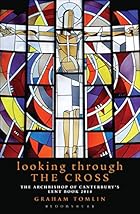
Looking through the Cross

Graham Tomlin, Looking Through the Cross: The Archbishop of Canterbury’s Lent Book 2014, Bloomsbury Academic (2014), Paperback, 240 pages.

Good stocks at St John’s Books, Fremantle. $19.95
Kindle edition available from Amazon for $10.88

Reviewed by Ted Witham. First published in Anglican Messenger, February 2014

Being a Christian requires personal engagement – with God, with Jesus Christ, with neighbour and stranger, with truth, with good and evil. For most of us, being a Christian can be complex and demanding, but we remain committed because we believe that God is eternally committed to us.

A good Lent book refreshes this sense of personal engagement with Christian living. It should encourage, inspire and inform by taking readers both back to when they fell in love with the faith and forward by challenging readers to grow spiritually. Good Lent books are often about the Cross and Resurrection clueing us into the liturgical movement of Lent and the Paschal mystery at its climax.

Graham Tomlin’s Looking through the Cross is a very good Lent book. It is about the Cross. Tomlin tells us that his early chapters are looking at the cross, trying to understand more deeply its meaning for us, and the later chapters are looking through the cross, using the cross as a lens on the world.

In the chapter headings, ‘The Cross and Wisdom’, ‘The Cross and Evil’, ‘The Cross and Power’, ‘The Cross and Identity’, ‘The Cross and Suffering’, ‘The Cross and Ambition’, ‘The Cross and Failure’, ‘The Cross and Reconciliation’, and ‘The Cross and Life’, it is not entirely clear when we change from looking at to looking through. I am sure that ambiguity is deliberate: the cross always both teaches us about itself and reveals how it has changed God’s world.

Graham Tomlin writes clearly. Reading his book is like sitting with the most patient teacher, sharing with us his understanding of how the cross comes alive for him. His explanation of the connection between the cross of Christ and our personal sin is the clearest I’ve encountered in 40 years of reading books about Christianity. ‘Those who have perpetrated evil must be held to account,’ he writes. ‘The evil that has disrupted the world cannot simply be ignored or glossed over: it must be banished, dealt with, put right. Restoration is possible, but only when sin is somehow atoned for.’

Archbishop Rowan Williams commissioned The Reverend Dr Graham Tomlin to write this year’s Lent book. His successor in Canterbury, Justin Welby, ‘could not be more pleased’ with the choice. Centred in scripture, scholarship and pastoral experience, this book seems to me to bridge some of the divides in contemporary Anglican thinking.

The cross demands that we clearly separate Christian faith from the surrounding culture. In the powerful chapter on identity, Tomlin describes how our experience of family christenings obscures the radical change God makes in us in baptism when God gives us a new identity. Using the image of a protected witness or juvenile criminal with a new identity, he reminds us how hard it is to live out of a new identity, and how the old identity will continue to exert a pull on our lives.

But the cross is ultimately the path to life. We are made not to end in death, but in life. Tomlin reminds us of the leap in imagination we need in order to lay hold of this reality, but also rallies us with the knowledge that the new life of the cross and resurrection is ultimately God’s work and not only ours.

It is helpful if a Lent book has some guidance for its use: questions to provoke reflection or small group discussion, suggestions for art response, even a reading program. Looking through the Cross has none. This is a significant drawback in a book promoted for Lenten reading. Even without this, individual laity, clergy and groups will find Dr Tomlin’s book refreshing, challenging and clear. At the end of Lent, the book will help readers emerge at Eastertide re-engaged with their Christian faith.

Passing on the Faith?


It is a privilege to regularly post on the website of Dunsborough Anglican Church. I have just posted there today on passing on the faith. I’ve based some of the article on the ideas of Etienne Wenger and Jean Lave on communities of practice and situated peripheral learning, as I think they have a lot to offer our understandings of faith formation.

Francis the pastor


Of course the name chosen by the new Pope, Francis, has encouraged me to think that his ministry will be different from his predecessors. In his first 100 days Francis has behaved like a pastor, like a parish priest, encouraging his flock in following the Gospel.

In his informal style Francis has also used some charming and helpful images: while encouraging bishops to be exemplars to their people  of Christian living, the Pope also shows that he trusts the faithful to be the faithful: “they have the scent of the Gospel anyway,” he has said more than once. That’s refreshing.

I know that a faraway personality can become simply a blank screen on which to project our own hopes and values, I can see that his apparently off the cuff homilies are actually quite studied,  and I hear the warnings that despite the gestures of austerity, he is governing like an old-fashioned Jesuit (listening to all but making decisions by himself), and that his theology on issues I care about is still conservative (I am certain he disagrees with my views on the ordination of women, and the acceptance of LGBT people in the Church!), however, what counts is clear: Francis is a pastor encouraging all Christians in their faith.

In this address to the Cardinals Francis shows that he trusts God with the future of the church, and for that we can be encouraged:

Let us never give way to pessimism, to a sort of bitterness that the devil offers us each day; let us never give way to pessimism and discouragement: let us have the firm certainty that Holy Spirit gives to the Church, but her powerful breath, the courage to persevere and also to look for new methods of evangelism to carry the Gospel to the ends of the earth (cf Acts 1:8)

–          Pope Francis  at Rome, 15 March 2013

As an Anglican, I am in the nice position of being able to pick and choose what I like from the Pope’s leadership, and this Pope is showing forth Gospel values in his reported lifestyle and gestures, and is speaking about the Gospel from the heart. I thank God for him.

Keeping alive the rumour of God


One of the few vestiges of “Establishment” in the Anglican Church of Australia is the authority of clergy to act as Commissioners for Declarations. [This authority is unlikely to be withdrawn as it is one of the requirements of Marriage Celebrants.] Several times a year fellow residents of our retirement village ask me to witness their signatures on legal documents. I am glad to oblige. I have even had a stamp made to save me from having to write by hand “The Reverend Edward Peter Witham, Registered Minister of Religion W-ZZZZ.

As a CD, my responsibility is to witness that people have correctly signed their documents. For that I need to know the form of the document – will, passport photo, statutory declaration, bank business, etc. – but not the content. However, most people when they come to sign want to share the background to the document. For my part, I assure them of confidentiality.

So people in the Village do know now that I am a priest – or at least, a handy person for witnessing their signature!

However, when we moved into this village five years ago, we decided we would downplay our faith. We had heard an anecdote about one of the village owners who apparently declared that a public area in the Village Centre would be ideal “for Bible Study or the like”. This remark evoked a strong reaction, almost outrage, among some people.

We thought that if there are people outraged by the thought of Bible study, being public Christians in the village could be counter-productive.

We have discovered the other church-goers in the Village, and we encourage one another in conversation and with cards at Easter and Christmas. We continue all our practice of Christianity outside the Village, both in church attendance and in our involvement in the Franciscan Third Order.

But I treat the Village as though it were a country where wearing distinctive religious garb is banned. I have only once worn my dog-collar in the Village or twice, if you count my performance as the Vicar in the murder mystery one year! I rarely advertise church events within the Village, and if I do, I do it discreetly.

Our stance of being so coy about our faith has been challenged. Once a colleague at church loaned us a DVD of a Passion Play performed in the gardens of Government House. We watched it in our house. When we returned the DVD to our friend, he asked why we had not had a public showing of it in the Village cinema. That was his idea of evangelism. I tried to explain that it might be seen, in our Village, not as an invitation to the Gospel but as an intrusion.

Inspired by Charles de Foucauld and the Little Brothers and Sisters of Jesus, we just try to keep alive the idea of God in our village. The challenge in that is to evangelise simply by presence requires great holiness. If I am not steeped in prayer, and if my lifestyle lacks integrity and sacrifice, then keeping my Christianity quiet in our relatively benign environment may just be an excuse not to talk about Jesus Christ at all.

I am encouraged that people ask me to witness them signing legal documents, and in doing so, to witness something of their trials and difficulties, but, as Lent begins, I am conscious that I have to use my praying and my decisions to be more transparent to God and the Gospel. Brother Charles de Foucauld has set a very high standard!

Christians need more than tolerance


The Government intends to make no changes to the exemptions for religious organisations in employing people. Today the Australian Christian Lobby’s Jim Wallace boasted that the Prime Minister told him that she will not change these exemptions. Hardly something to boast about: the idea that the churches have a right to discriminate is arrogant and disappointing.

Secular views on tolerance may seem closer to a genuine Christian position. Jeff Sparrow assumes that the exemption is essentially against homosexuals in religious schools and hospitals. This commentator notes, “What message does this legislative loophole send, other than that discrimination against gays and lesbians doesn’t matter as much as other forms of bigotry? It’s a statement that homophobia is still OK; that gays and lesbians can still be bullied and harassed, in a way that wouldn’t be tolerated in respect of anyone else.” (Jeff Sparrow, “Religious Freedom Beats Your Rights at Work”, http://www.abc.net.au/unleashed/4467310.html?WT.svl=theDrum, 16 January 2013.)

Many Christians have more sympathy for this than for Mr Wallace’s position. But for Christians it is essentially an empty position; a position which is nothing more than opposition to the ACL and groups like it.

I believe that churches should aspire to a higher standard than the community’s. Jesus included the unacceptable, the unclean and the immoral: the women who had had five relationships, the Roman centurion (and his ambiguously described ‘lad’), tax collectors and prostitutes. We should actively embrace many more people than a typical corporation.  Mr Wallace believes some people should be excluded. I cannot defend that view. But Mr Sparrow’s view that no-one should be excluded comes nowhere near the Gospel paradigm that everyone should be included.

St Francis embraces the leper

That there should be no discrimination is a secular standard, the best we can agree on in a diverse society. But the Church seeking to include every last person requires much more moral effort, and indeed, demands that we be receptive to much more of God’s grace.

We Christians should welcome any move to remove the exemptions for religious organisations. The church should be pleased in this case to submit to secular virtue.

Whether or not the law changes, Christian employers should choose to act according to higher standards and be as inclusive as possible. Of course, the specifics of each employment decision do not simply flow automatically from the principle of maximum inclusion; Christian employers must still wrestle with CVs and references to match the best person for each job. But I believe maximum inclusion is closer to the Gospel, and will be seen in our complex society as closer to the Gospel. We Christians are not merely tolerant, as the Government claims to be; we follow the Lord who is “loving unto every man and woman”. (Psalm 145:9)