Tell the wild tale with vim and with panache
Chorus line of shepherds; veiled discerning
Mystics bringing gifts while earth’s cultures clash
To a baby: He our whole life’s learning.
Ring the bells, all people, stop! Now attend
to whispers of angels, meditations
Of mystics, fresh wisdom to us commend,
kindness of giving, godly fascinations.
Light the candle, we illuminati
with peace, earning goodwill to God’s masses,
Minding the child (He the celebrity)
with lambs and cows and companion asses.
All creation whispers the tale with awe,
All souls are responsive to His divine draw.
Bless the Lord, O my soul!
O Lord my God, you are very great!
You are clothed with splendour and majesty,
covering yourself with light as with an overcoat,
stretching out the heavens like a deep blue dome.
He lays cloud-streets as rafter beams for the sky;
he makes cumulus clouds his chariot;
he rides on the wings of the wind;
he makes his messengers winds,
he makes his ministers a flaming fire.
He set the earth on its foundations,
so that it should never be moved.
You covered it with the deep waters like a cloak;
the waters stood above the mountains.
At your rebuke they fled;
at the sound of your thunder they took to flight.
The mountains rose, the valleys sank down
to the place that you appointed for them.
You set a boundary that they may not pass,
so that they might not again cover the earth.
You make springs gush forth in the valleys;
they flow between the hills;
they give drink to every animal in the wild;
the wallabies quench their thirst.
Beside them live the magpies;
they sing carols among the branches.
From your lofty home you water the mountains;
the earth is satisfied with the fruit of your work.
You make grass to grow for the livestock
and plants for people to cultivate,
that they may bring forth food from the earth
and wine to gladden people’s hearts,
olive oil to make their face shine
and bread to strengthen their hearts.
The trees of the Lord are watered abundantly,
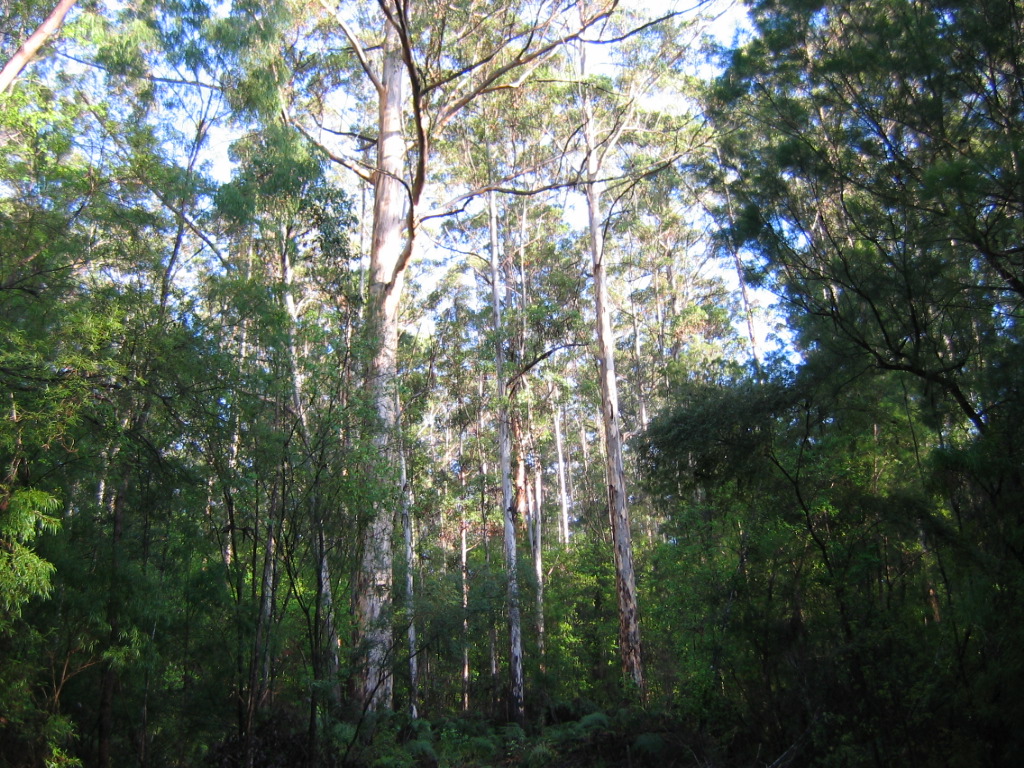
the great karri trees of the south-west that he planted.
In them the birds build their nests;
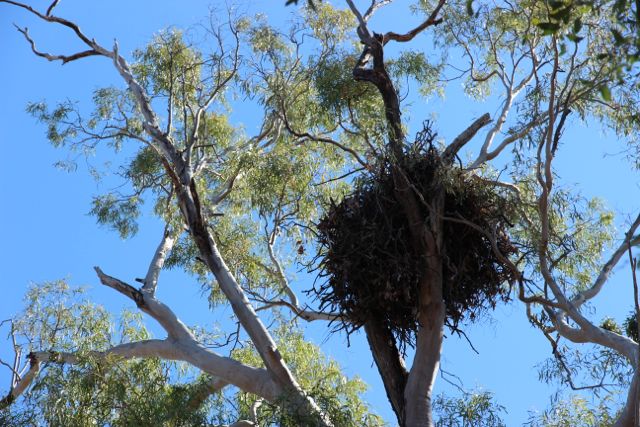
the wedgetail has her home in the great gum trees.
The high mountains are for the mygalomorph spiders;
the rocks are a refuge for the skinks.
He made the moon to mark the seasons;
the sun knows its time for setting.
You make darkness, and it is night,
when all the wild animals creep about.
The dingoes howl for their prey,
seeking their food from God.
When the sun rises, they steal away
and lie down in their dens.
People go out to their work
and to their labour until the evening.
O Lord, how manifold are your works!
In wisdom have you made them all;
the earth is full of your creatures.
Here is the sea, great and wide,
which teems with creatures innumerable,
living things both small and great.
There go the cruise ships,
and the blue whale, which you formed as your playmate.
These all look to you,
to give them their food in due season.
When you give it to them, they gather it up;
when you open your hand, they are filled with good things.
When you hide your face, they are dismayed;
when you take away their breath, they die
and return to their dust.
When you send forth your Spirit, they are created,
and you renew the face of the ground.
May the glory of the Lord endure forever;
may the Lord rejoice in his works,
who looks on the earth and it trembles,
who touches the Stirlings and the mist moves on the mountains!1
I will sing to the Lord as long as I live;
I will sing praise to my God while I have my being.
May my meditation be pleasing to him,
for I rejoice in the Lord.
Bless the Lord, O my soul!
Praise the Lord!
Thus says God, the Lord,
who created the heavens and stretched them out,
who spread out the earth and what comes from it,
who gives breath to the people on it
and spirit to those who walk in it:
6 “I am the Lord; I have called you in righteousness;
I will take you by the hand and keep you;
I will give you as a covenant for the people,
a light for the nations,
7 to open the eyes that are blind,
to bring out the prisoners from the dungeon,
from the prison those who sit in darkness.
8 I am the Lord; that is my name;
my glory I give to no other,
nor my praise to carved idols.
9 Behold, the former things have come to pass,
and new things I now declare;
before they spring forth
I tell you of them.”
10 Sing to the Lord a new song,
his praise from one side of Australia to the other,
you who go down to the Indian Ocean, and its leviathan surf,
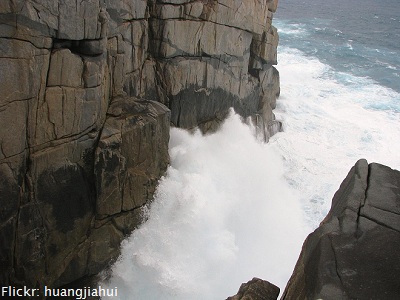
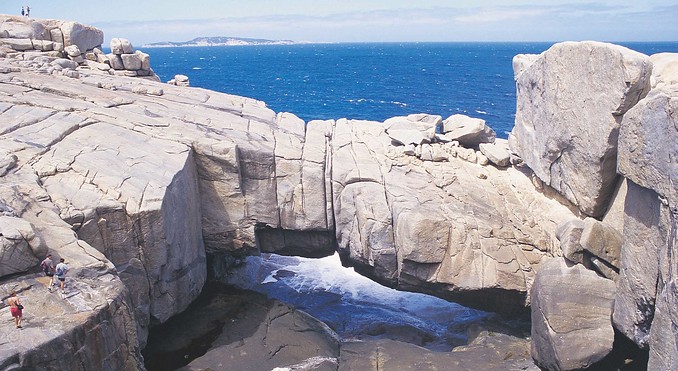
you who explore the wave-carved gaps and blow-holes of Torndirrup National Park.
11 Let the Sandy Desert and places up north raise their voice,
the towns of the Great Western Woodlands cry out to God;
let the wild-flowers of the south-west sing for joy,
let the climbers shout from the top of the Stirling Ranges.
12 Let us give glory to the Lord,
and declare his praise in Geographe Bay.
When Israel came into the Great South Land:
and the People of God among a people of an alien tongue.
Torndirrup became his sanctuary:
and Walyunga his domain.
The sea saw that, and fled:
Derbal Yiragan was driven back.
Pualaar Miial skipped like a ram:
and the foothills like young sheep.
What ailed you, O sea, that you fled:
O Yiragan, that you were driven back?
O Bluff Knoll, that you skipped like a ram?:
O little hills like young sheep?
Tremble, O Noongar country, at the Lord’s presence:
at the presence of the God of gods.
Who turned the rock into a billabong:
and threw sand into the waterhole to make it safe.
***
(Acknowledging Professor David Frost’s version of Psalm 114 in A Prayer Book for Australia)
Torndirrup – the National Park on the south coast at Albany with the Gap and Natural Bridge.
Walyunga – National Park on the Darling Range near Perth with many sacred places associated with the Waagyl.
Derbal Yiragan – Swan River
Pualar Miial – Bluff Knoll (tallest peak in the Stirling Ranges)
Throwing sand – When Noongars arrive at a water-hole or river, they throw sand into the water so as not to disturb the Waagyl and make the water safe for drinking and swimming.
The Gap, Torndirrup National Park, courtesy pleasetakemeto.com
My heart is fixed, O God, my heart is fixed:
I will sing and make melody.
Awake, my soul, and awake, sticks and didj:
for I will awake the morning.
I will play the didj, O Lord, among the peoples:
its circle buzzing breathes our gratitude.
I will chip your clapping sticks among the nations:
its clicking claims your eternal praise.
For the dawn in the east rises in gold and scarlet:
robes of Easter and Pentecost overwhelm the sky.
Your faithfulness reaches to the clouds:
and the land is a body painted with white and ochre dreamings.
Be exalted, O God, above the southern skies:
and let your glory shine over Noongar country;
That all whom you love may be delivered:
Noongars and wedulahs, O save us by your right hand, and answer us.
***
(Acknowledging Professor David Frost’s version of Psalm 108 in A Prayer Book for Australia)
The ‘didj’ (didgeridoo) was technically not a part of Noongar culture before the arrival of Europeans, but they have adopted it since contact with ‘wedulahs’ (white fellas) has brought them into contact with other Indigenous groups.
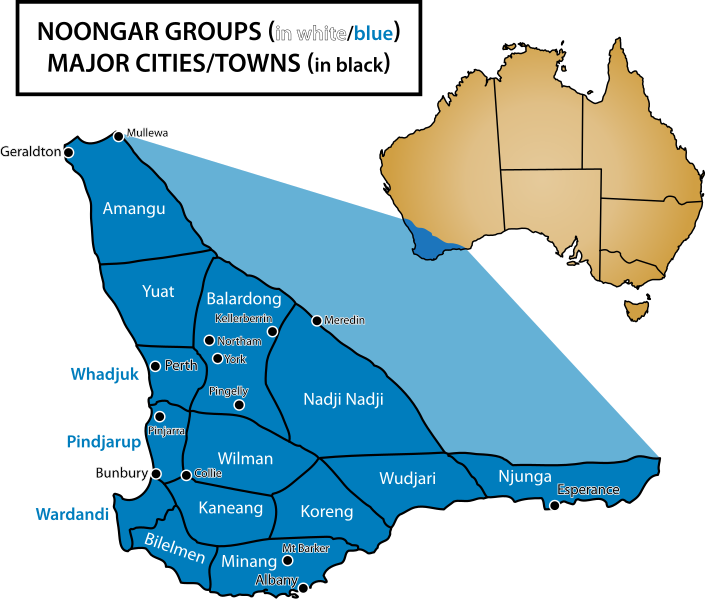
My country of origin is Koreng country. I now live in Wardandi country.
Praise the Lord. Praise the Lord from heaven:
praise him from the heights of Toolbrunup.
Praise him, all his angels:
O praise him all his hosts.
Praise him, sun and moon, rippling staircase across the sea:
praise him, all you stars of light.
Praise him you highest heaven:
and you Cross bright against the dark of night.
Let them praise the name of the Lord:
for he commanded and they were made.
He established them for ever and ever:
he made an ordinance which shall not pass away.
O praise the Lord from the earth:
praise him you golden super-pit and caves of glistening stalactites.
Bush-fire and hail, cyclone and heat:
and willy-willies fulfilling his command.
Mountains of iron and giant ant-hills:
gum-trees, and grass-trees, and grey-green plains of spinifex.
Dingoes and kangaroos:
creeping things and long loping emus.
Elders of tribes, and many nations:
refugees and boat-people, and all who’ve crossed the seas.
Young folk and children:
Seniors and toddlers together,
Let them praise the name of the Lord:
for his name alone is exalted.
His glory is above earth and heaven:
and he has lifted high the stocks of his people.
Therefore he is the praise of all his servants:
of the children of the West, a people that is near him. Praise the Lord.
(Acknowledging Professor David Frost’s version of Psalm 148 in A Prayer Book for Australia)
* Toolbrunup – second highest peak (1,052 metres above sea level) in the Stirling Range in the Great Southern region of WA
* Staircase of the Moon – in Broome and Meelup in February and March the rising full moon shines over the east-facing beach to create a spectacular light effect like a staircase.
* super-pit – open-cut gold mine near Kalgoorlie 3.5 x 1.5 km and 600 metres deep.
* willy-willy – local word for dust-storm or mini-tornado.
* spinifex – properly called Triodia, these arid grasses are endemic to outback Australia.
I know nothing about surfing or fishing. My ignorance about boats is profound. So I shouldn’t say anything about the recent fatal shark attacks, except to state how appalling they are for the families of the men killed.
I can’t help remembering that during the Middle Ages, animals that killed people were brought to court and tried. They were led into the court room on a leash. If they played up, further charges of affray were laid against them.
They were always executed: pigs and dogs that attacked their masters whatever the provocation, frightened horses that had trodden people to death, circus animals that escaped and ate for hunger.
It was a farce, of course. Magistrates could not take into account the animal’s intentions. If the animal had responded to one too many whippings, there was no charge of justifiable homicide. If horses trampled people because there were no exits in a crowded barn, the court didn’t care.
But the people probably felt better when the animal was killed. The taking of the animal’s life satisfied somehow the outrage at the human death. Old Testament justice was served: ‘An eye for an eye, a tooth for a tooth, and a life for a life.’
We no longer bring animals to trial. We look back at the medieval practice with amazement that people’s thinking could be so defective. Animals don’t form criminal intentions. And even if they do, they cannot defend themselves in a human court. They can’t talk, you know.
Proposals to punish sharks that that take human beings by killing individual sharks or culling sharks generally are not so different from medieval animal courts.
Firstly there seems to be a problem of identity, being sure that you capture the shark that did the killing. Without that certainty why kill any shark that happens to be nearby? Even if you are certain that this shark killed a man, killing the shark certainly guarantees that that individual will not kill again. But scientists know little about the reasons for shark attacks. Is there a reason to think that this shark will attack again if left alive?
Neither can we know enough about bonds between sharks to know whether killing one shark will provoke a family member to kill in retaliation.
Scientists say they do not know why sharks kill. They do not have a clear picture of how many great white sharks there are around the south and west coasts of Australia. They do not know how they interact with top predators like orcas off Bremer Bay. Our ignorance is great. So we can have little confidence in the effectiveness of any intervention. We simply do not know what effect any of our actions will have.
We do know that the ocean is the sharks’ home. I object to a worldview that claims first place for human beings whatever the cost to other species. It seems to me to be arrogance to demand that the oceans be safe for human beings. We are responsible for own actions. We know the ocean has dangers, and it falls on us to take prudent precautions if we enter the sharks’ habitat.
To drive sharks out of the ocean for our comfort is to change the ocean into something with less value, and may have unintended results of changing our environment into something less liveable for all creatures – including ourselves.
So by all means let’s grieve appropriately for those taken by sharks, but let’s also pause before behaving with the same muddled logic as our medieval forebears and executing sharks for murder, because that’s all the sense I can make of polices of ‘capture and kill’ and culling.
Pieces of God strewn sparking
across the white-gold star-field of galaxies,
word-spells: breathings and vowels, shutters and consonants,
meaning and yearning –
God uttering creation into being.
God created the seas and all that swims and swarms in them
ii. Prayer of the Manta Ray
She stepped deeper. Her ankle was now covered. She shivered even though the sea water was warm and the sun shone. A wisp of warm breeze caressed her. “Prescience of joy,” whispered an angel, as the black disc, the manta ray, circled his way to shore. He delicately manoeuvred his sharp sting away from her tiny ankle and stroked the pale skin with his white under-body. The whole Indian Ocean came flooding into her like a gentle all-powerful tide.
As the manta ray glided back into the depths, not all the tide receded. Her body remained one with the water.
‘…the birds of the air…’
iii. Life after
(Sonnet)
I stand heart-still on bush-edge trail.
Puny next to high bunched boughs
of sage green gums. The great wedge-tail
eagle soars: all before it stoops, bows.
My eye zooms: the bird has stalled:
gravity forgot; upheld by thermal.
All potential at rest, just the air mauled
by fierce talons; wings held formal.
Then, straight down from pin-head highs
the eagle drops, wings tucked, a grey stone-streak.
The lizard struck and killed, in cold eye’s
wink. Wings wide as Passion Week.
For all of us in God’s surprise
are taken alive in Christ’s dear beak.




 Mind Journeys