
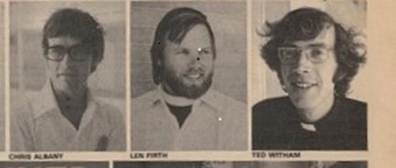
50 Years a Deacon


In the name of the living God, + Father, Son and Holy Spirit. Amen.

Fifty years a deacon. The Church 50 years ago was a very different church. Churches around Perth were generally full on Sundays – many churches filled two times over with two services. Men still wore suits to church, and women wore Sunday best dresses. Some women wore hats, but hats were beginning to stay away. The declining attendance of hats was a sure sign that the Church was about to change.

We were still ‘The Church of England in Australia’ – our name didn’t change until 1981, and I think our English culture is only now beginning to change.

Sunday Schools around the city were huge. 70 or 80 kids and a dozen teachers turned out every Sunday at Christ Church Claremont and parishes like it. The General Board of Religious Education, set up by the Australian General Synod, produced the course book used by most Anglican Churches. Children were completely segregated from adults, and, many children were dropped off by their parents. These parents may have seen benefit in Christian education for their kids but not for themselves.

There were arguments that you might remember about whether children were really ‘people’ for the purpose of attendance numbers and statistical returns!

By 1975, the once-flourishing Y.A.F. – the Young Anglican Fellowship – had pretty much shrunk and died.  

I grew up in a country church in the 1950s. You could definitely see the decline in little churches all over the southwest corner of the state. Our little church, St Mary’s in Tambellup, might cram 70 people in for Christmas services. They even put out little folding stools with canvas seats down the aisle to accommodate everyone. But the Sunday after Christmas, and for most Sundays of the subsequent year, the congregation was fewer than 15 or so. There was a little Sunday School, taught by Mrs Lorna Taylor, who also played the organ, ducking in and out of the church and the church house next door during the service. That Sunday School had less than five kids.

This was the Church five of us were called to be deacons in 1975. The church appeared to be flourishing, but there were clear signs that we were about to be pruned – enormously.

Although accurate statistics were hard to find, 8,000 or more people turned up to Anglican services across this Diocese each Sunday: more, we were reminded, than attended WAFL football matches each weekend.

The Diocese tried some big things to stop the runaway numbers. 1975 was the year of Celebration 75, a huge mission of the Diocese, culminating in 10,000 Anglicans gathering at Perry Lakes stadium for the Eucharist on Palm Sunday.

Celebration 75 was memorable because of the murder of Archbishop Janani Luwum from Idi Amin’s Uganda. Luwum was one of the bishops visiting Perth for Celebration 75.  Some months after he returned to Uganda he was found in a crashed car just outside Kampala – his body riddled with bullets. ‘The blood of the martyrs,’ Tertullian said 1800 years ago, ‘are the seed of the Church.’ Maybe a little of Luwum’s blood would impact Perth Diocese!

Goals were set for our diocese – 24 new parishes to be planted in 24 months. When we young clergy spent time with Archbishop Sambell, his parlour game was to get us to state as many new suburbs as possible (Kallaroo, Mullaloo, Heathridge, Connolly, Joondalup, Currambine, Iluka, Ocean Reef). Then the Archbishop would comment: ‘And that is our mission field.’

Luke’s telling of the calling of the first disciples reminds us of three things about the ‘mission field’ – the situation which they were called into. The painting by the 14th– Century Italian painter Duccio di Buoninsegna is a sermon in itself. Buoninsegna means ‘teaches well’, and that’s what this beautiful picture does.

Duccio’s painting tells the story of the Miraculous Draft of Fish all in one image. He starts with Jesus meeting Simon and Andrew. Notice the sky is golden. When Simon and Andrew meet Jesus, we are not in the normal everyday world. Duccio paints them in heaven with its gold sky. Jesus is on the rock; Jesus is the rock. Jesus invites Simon and Andrew to step on to the rock, onto the solid ground of a new relationship with Jesus and to turn the everyday world into the glory of heaven.  

I must admit that the two disciples don’t appear to be straining to haul in the heavy net of fish. With Jesus by their side, the effort is shared with Jesus and their burden becomes light. There are fish everywhere in Duccio’s picture, both in the net and outside the net. In this vision of heaven, you don’t need to be inside the net. Everyone is included in God’s love.

Duccio the painter is teaching that what is true for Simon and Andrew then is true for us now. Jesus continues to invite us into a life-giving relationship with God. Jesus calls us to the work of mission with him. We are to be encouraged that in the end, God makes sure that there is a good haul of fish – of people.

Simon’s encounter with Jesus sees him coming to terms with the way Jesus, a carpenter, told him where the fish were. Jesus told Simon to put out into the deep and put his drag net out the other side of the boat. Just imagine how Simon must have swallowed his disbelief: he may be Jesus the preacher, but really, what does he know about finding fish?

Simon puts the cumbersome net into the boat, I imagine with some reluctance, gets the oars organized, rows out to deeper water, puts the net in the water and then drags it in a half-circle from the boat; all the while expecting nothing. What difference can Jesus possibly make?

And then surprise! ‘So many fish that their nets were going to break!’ They filled two boats to the point of sinking. (Luke 5:6)

Simon is shaken. Shocked to the core. This man Jesus is like no other human being Simon has met. ‘Get away from me, Lord, for I am a sinful man!’ (Luke 5:8) Seeing Jesus in this moment makes Simon squinch and shudder. This encounter with the power of Jesus strikes Simon (and Andrew and James and John) as so massive and so stupendous that they left everything – everything! and followed him.

I assume Simon used to go to synagogue and had heard the scrolls read. He knew about the prophet Isaiah, who, like Simon, was overpowered when he was encountered by the Lord God in the Temple, and, like Simon, Isaiah’s first reaction was with dramatic words: ‘Woe is me! I am a man of unclean lips, and I dwell among a people of unclean lips.’ (Isaiah 6:5)

In this squeal of pain, Isaiah recognises that he could not stand before the living God unless God reached out and made him stand. And for Simon, the catch of fish had the same effect.

The second part of Simon being called to the ‘mission field’ was calling others to help him. To haul in so many fish Simon needed to call on his brother Andrew and their partners James and John. You need others. Jesus rarely invites single heroes to do the work of ministry. It’s too hard. It’s too big.

Jesus himself is on a fishing expedition to catch people. Luke implies that his catch, consisting of Simon and Andrew, James and John, is also a good haul.  These four will make a significant difference to the ministry of Jesus.

All ministry requires hauling in people. Maybe ‘hauling in’ people is not the best image. The church is not the Ringling Bros and Barnum & Baileys, hauling suckers into the Big Tent! Rather the church’s business is inviting people respectfully and gathering them in. Even so, the church of God is a Big Tent.

Our parish’s ministry to the homeless always needs volunteers. Morning tea after church needs volunteers. Children’s ministry needs volunteers. Even the work of worship – our liturgy – needs all of us and not just the priest out front.

The third idea is to underline that ministry is always about people.  Simon is called to catch people; not so much catching fish.

This was really underlined 50 years ago during our year as deacons. Five of us deacons and one presbyter from the Church of South India spent 1975 in the Deacon’s Training Program. This program was designed for us to experience the practicalities of every ministry in the Diocese.

We spent 10 weeks in an established parish: I was assigned to Kelmscott Parish, and then to Balga Parish north of the river. Balga was a more catholic parish, and Kelmscott an evangelical parish, so all of us participated in leading different styles of worship.

We spent 4 weeks in hospital chaplaincy, visiting patients and taking them communion.

We spent a fascinating 5 weeks in mental health. We saw the way the behaviour of acutely mentally ill people challenges the staff to care appropriately for them. We visited residential homes and wondered whether those big institutions were the right place for the severely developmentally challenged.

We spent just a few days in Industrial Chaplaincy – basically a visit to the Alcoa Refinery in Kwinana to meet John Bowyer the then chaplain!

For this Deacon’s Year, we resided at Wollaston College We each shared leadership in music and worship in that wonderful big tent Chapel. Following the Benedictine Rule, we had to do some manual work around the College, cleaning windows and pruning and sweeping paths and roads.

I’ve never been one for manual work, so I offered to restore the old harmonium which provided our music in Chapel, and I enjoyed cleaning reeds and fixing wires and bellows. It took me the whole year to complete – conveniently!

The Deacon’s Year was fast-paced. Two weeks in a country parish, where I watched with amazement Henry Tassell, a country pastor who had the rare knack of turning up on a farm at the right time, say, morning teatime during shearing. He kept overalls and work boots in the boot of the car to pitch in and help the farmer.

Two weeks in a church school.

I was anxious to be a school chaplain.

When I was about ten, I had a dream one night. After this dream, I remember rushing to my Mum and blurting out, ‘When I grow up, I’m gonna be a teacher and a priest!’ Mum advised me not to say anything about the dream.

But I did think of it every now and then. I interpreted it to mean that I would be a school chaplain. So, the Headmaster of my school Peter Moyes, even when I was still at school, had also encouraged me to be a school chaplain and  before going to theological college in Melbourne, I had taught in the country for two years and enjoyed it.

So I learned a lot in those two weeks at Perth College. Teaching girls only in a classroom opened my eyes. When girls behave badly, they behave badly in big groups. Suddenly the whole class, it seems, turns on one person and bullies them, one of the girls, or the teacher. Unlike boys, you can’t just pick out the perpetrator and punish him. I had to learn strategies to deal with feminine mob rule!

But that didn’t dampen my determination to be a chaplain. I saw how the chaplain Terry Curtis conducted the Chapel services, what opportunities he had for pastoral care for the girls and for the staff – and a scary Headmistress!

Later, I had nine satisfying years as a school chaplain, one year at Hale School, and eight years at Christ Church Grammar. After those years, I discovered even more ways of being a teacher and a priest.

But back in the Deacons’ Year, we had a tough 36-hour Urban Training course We had to survive in the city without money. We pretended to be homeless, living on the streets, under stress to experience how our society looks after the needy.

A four-day Human Relations course back in Wollaston College turned out to be a deep dive into our inner psychological lives. Some of the deacons found this group work too threatening, so it was abandoned in subsequent years.

Anglicare, Anglican Homes, how to conduct weddings: at the time some of it was a blur. But the basic point was made: ministry is about people – worshippers in a parish, patients in hospitals, kids in schools, brides and grooms, people on the street, certainly neighbours and friends and families. And ministry meant making connections with hospital chaplains, diverse parish clergy, school chaplains, Government agencies, and a whole host of carers who gave us insight into other caring people in our society.

This practical year 1975 followed three years of theology study. None of my fellow deacons complained that the academics were not relevant to ‘real ministry’. I felt, and I think the others agreed, that we can only understand the purpose of practical ministry if we understand a bit about God. In our Deacons’ Year, we experienced God in the marginalised. We made sense of it with Bible study and through Church History.

Luke doesn’t tell us that Jesus ordained deacons. Jesus calls all the baptised to ministry. Jesus invites each one of us to be a deacon and serve the needy. Matthew writes a parable, you remember, about sheep and goats. When we minister to the least of these, we are loving Jesus.  The ministry of service is for all of us.

Deacons, ordained deacons, some permanent deacons and all priests and bishops, we are deacons before we are priests; as ordained deacons, we are the church’s sign to itself of helping the needy. Our life of service shows that all of us rely on God to empower ministries of service. Deacons’ service in the community emphasises that the church doesn’t exist for its own sake. The church exists always for others. The great wartime Archbishop of Canterbury, William Temple, is often quoted that ‘The Church is the only society that exists for the benefit of those who are not its members.’ The church is a diaconal church, a serving church, a church of deacons, and our holy task is to love God by serving people.

Fifty years on. 2075. I won’t be around to see it, but some of you will. And I hope you experience how God keeps loving you, and you will keep loving your neighbour.  Because whatever changes 2075 will bring, we will still be a deacon-shaped church – and that’s worth celebrating.
The Prayers that never were


I prepared the Prayers of the People for the Eucharist this morning – only to discover that they weren’t needed.

There is so much talk on social media about the dire state of the world and the possible end of the world, that I feel it is incumbent of us Christians to recall that Christian faith brings hope not despair.

Below is what I would have prayed:

The response for this morning’s intercessions is:  

God of hope and assurance, 

We thank you and we bless you. 

God of peace, we thank you for those who bring peace to their neighbour and turn their despair and grief to hope and determination; 

Empower those who are in negotiations for peace in Palestine and in Ukraine. Give them diplomacy, skill and a vision for the future.  

Strengthen the leaders who are turning their word of peace into action.  

God of hope and assurance, 

We thank you and we bless you. 

Lord of the Church, we thank you for those who show us the way of the Gospel, for our teachers in the faith as they assist us to work and pray.  

We thank you for our ministry of encouragement one to another.  

We praise you for your world-wide Church and the ways it witnesses to peace and kindness.  

God of hope and assurance, 

We thank you and we bless you. 

God, you are the author of all healing. We thank you for all who care for the sick: for nurses and doctors, for care workers and researchers, for hospital staff and volunteers. We bless you for their ministry.  

We thank you for parents and adult children who take time to care for their loved ones and nurture them back to health. 

We thank you for all who are restored to health, and especially we thank you for Milton as he recovers from surgery. 

God of hope and assurance, 

We thank you and we bless you. 

God, you call us into community. We bless you for the love of all who build and maintain community. We thank you for politicians and councillors as they work to make a more loving community. We thank you for each other as we contribute to the solidarity of our parish community. 

God of hope and assurance, 

We thank you and we bless you. 

God, the author of all life, we praise you that you have called us into this life. We thank you for the joys and blessings of life, for those who love us, for our gifts well-used. We confidently praise you for leading us to a marvelous and eternal life.  

God of hope and assurance, 

We thank you and we bless you. 

Seven times seven


Seven times seven

I don’t remember Australia Day in 1949. But Mum told me it was a sunny day, tennis day in Lake Grace. I was nine weeks old, and rapidly losing weight through pyloric stenosis. It was also a Sunday, so at 3 p.m., the tennis players walked from the courts still dressed in their whites to Saint Anne’s Church (now the church hall) for the baptism of three babies, including me.

I assume my Dad was there, supporting Mum. Dad was not a churchgoer. I didn’t know what Dad believed until, when I was about 10, he crouched in a ploughed paddock, picked up a handful of soil, and poured it slowly back onto the ground. Dad believed in the beauty and fecundity of nature.

Driving around the farm, he would point out with reverence birds in their trees, lovingly remarking on their colours and their habits, or showing us handsome plants and lizards, or pretty patterns of clouds.

The baptism ceremony went well. It was only after, as the certificates were being signed, that my most recent food reappeared. Pyloric stenosis causes projectile vomiting, and the milk and blood regurgitated can be sprayed up to 3 metres. My vomit splashed over the certificates and the ink smudged on my baptism certificate remains as evidence of the power of projectile vomiting.

Splattered milk and smudged ink, however, did not camouflage the importance of the day: this was the day God promised that God’s Spirit would hold me for ever.

I do have a memory of my confirmation in St Mildred’s in Tenterden. It was the first time I wore long pants, long scratchy grey serge pants. I was just 12 years and 9 days old on November 21 in 1960, and Mum asked me to wear my uniform for Christ Church Grammar School where I was starting as a boarder in the New Year.

Bishop Hawkins preached on duty to Mother, duty to Mother Church and duty to Mother Country (in 1960, that still meant England, I think). Mum reminded me frequently, with a small smile, of Bishop Ralph’s sermon.

My Nan had prepared me for my Confirmation. Every Wednesday of my Grade 7 year, during Scripture period she and I withdrew into the boys’ shelter shed where Nan walked me through the Catechism, explaining how God had come into the world as Jesus Christ, and still loves us through the Holy Spirit.

Even as a 12-year-old, I wondered how much the bishop’s sermon had to do with the Christian faith that Nan had expounded. I voted for Nan!

After the rite of Confirmation, I received Holy Communion for the first time. The power of the bread and wine grows over time. In 1960, I took it because Nan and Mum told me so. But now, after maybe 5,000 occasions on which I have received this sacrament, I strongly appreciate its power. Through it, God turns my natural laziness into love for others and gratitude for all God gives.

I marvel at the variety of places God has come to me in the Eucharist: in churches like St Mary’s in Tambellup, and Christ Church in Claremont and St David’s in Applecross, and, in the past two years, at St Brendan’s in Warnbro: with splendid music in St George’s Cathedral; in the Chapel at Christ Church Grammar School with its stunning backdrop of Freshwater Bay; in the bush accompanied by birdsongs; in Italian and French in historical Roman Catholic churches in Europe; in Uniting Churches, with the Baptists and Churches of Christ; in French in St Thomas’s in Beau-Bassin, Mauritius; cramped onto tiny tables in hospital; in our homes and the homes of friends and parishioners; chaotically in nursing homes; so many places, so much grace.  

It was almost as if I was ticking off the seven sacraments: Baptism and Holy Communion are the two ‘Dominical sacraments’. Our Lord (Noster Dominus) had commanded those two explicitly. According to the catholic theology Anglicans inherited, confirmation was the first of five lesser sacraments. So that made three of the seven!

At the end of 1969, my fourth year at University, I was in major pain and waiting both for my final exams and surgery on my back. As a resident at Saint George’s College, I was part of the Chapel community. Chaplain Ian George prepared a group of us over several weeks for the Sacrament of Holy Unction. We learned how Jesus had healed the sick, and how James had told sick people to call the elders for the laying on of hands and the administration of oil.

We learned how that developed into Holy Unction and how, sadly, Unction was associated more frequently with the dying. It should be a robust prayer for healing in all situations – including mine.

So Ian George duly laid hands on my head with prayer and anointed my forehead with blessed oil. As I knelt at the communion rail in the Chapel, I felt a heavy load lifted: I knew, whatever happened in my surgery, God healed me. It was a wonderful boost to my faith and the confidence it gave me never left through weeks of rehabilitation.  

In 1975, after three years of study, Archbishop Geoffrey Sambell ordained me: deacon on February 9 and priest on Advent Sunday, November 30. Before each ordination, the candidates, Chris Albany, Len Firth, Peter McArthur, Geoff Newby and I, were sequestered for a four-day retreat. These intense days of prayer and addresses invited us deeper into the mystery of God.  

A pattern was developing: preparation, then sacrament. I was beginning to learn that these sacraments were not so much about empowering me (though they do have that effect); sacraments are much more a statement about God and how God continues to work through frail fallible human beings.

In 1978, I fell in love with my dearest Rae. We were engaged on August 6, the feast of the Transfiguration, when everything changes for the better. Our parish priest, Michael Pennington and Archbishop Sambell both played their part in preparing Rae and me for the Sacrament of Holy Matrimony.

The Archbishop married us on December 9 in 1978 in St David’s Church in Ardross. Michael Pennington celebrated the Nuptial Eucharist. Our families and friends crowded St David’s. Two of our friends played Grieg’s ‘Wedding Day at Troldhaugen’ and Bach’s ‘Wachet Auf’ for oboe and organ as our wedding present. Aunty Jean Witham presented us with her stunning tapestry version of Michelangelo’s ‘Last Supper’. (It still hangs on my study wall.) Our wedding was another declaration of God’s determination to go on loving us.

Rae and I were not content just with the sacraments we had received. In 1979, we started our formation as Franciscan tertiaries and were professed in 1983. It’s not hard to draw a straight line between my Dad’s celebration of nature and me grasping St Francis’ appreciation of all creation.

It is not my tradition to make a formal regular confession; even so, I have used Sacrament Number 7, the Sacrament of Reconciliation, on many occasions. It, too, is a wonderful affirmation that, whatever stupidity and evil I have done – and I have been stupid and evil at times (often simultaneously)  – God still loves me. God is still prepared to treat me as though I had a clean slate, just like I had before I vomited all over my baptism certificate.

Attractive snapshots of the Christian family: review of Greg Sheridan’s new book, Christians.

…an attractive portrayal of Christianity for those who do not share the faith


Greg Sheridan, Christians: The urgent case for Jesus in our world, Allen & Unwin, 2021.

From $26. Paperback.
Available from St John’s Books, Fremantle

Reviewed by Ted Witham

First published in Anglican Messenger, Perth, October 2021.

Greg Sheridan introduces his new book on the people of Christianity with his cheerful description of our faith:

‘On the inside, Christianity is full of feast days and family, full of fellowship, full of friendship. And everyone is welcome, surely never more so than at Christmas. It’s full of care for the sick and elderly, and for infants. It’s full of sport and play, hard work and rest. It’s full of good music and laughter, happy rituals and lots and lots of food (it’s very big on food). It is the principle of human solidarity. It’s the search for decency. It’s a conversation with each other and with God. As John Denver might have put it, in Christianity you routinely speak to God and rejoice at the casual reply.’ (Page 11)

Christians is Greg Sheridan’s second book in defence of Christianity. Sheridan writes of a large Christianity, catholic in the widest way. One of his principal arguments, first advanced in his 2018 God is Good for You, is that it is more reasonable to believe in God than not. The first book was mainly a rejoinder to the new atheists. In it, he took on writers like Richard Dawkins and Christopher Hitchens and showed how much bigger Christianity is than the caricature Dawkins and Hitchens attack.

In this second book, Sheridan tells stories: the stories of Jesus, Mary and the remarkable Paul. Stories of the faith of Scott Morrison, Alpha’s Nicky Gumbel and the Melbourne Anglican founder of Converge, Jenny George. He tells the story of China’s Christians, and the difference they may make to the future of China. In London, he compares the neighbouring churches of Holy Trinity Brompton (HTB) and the Brompton Oratory, where traditional and informal liturgies, high classical church music and Matt Redman’s Gospel songs are all quite different and all nourish believers.

Christians compresses Christianity to its simple heart. For a reader like me, Sheridan sometimes makes Christianity seem too simple. But his purpose is to provide an attractive portrayal of Christianity for those who do not share the faith. In that, Christians reminds me of C.S. Lewis’ Mere Christianity,and Christians is a more entertaining read than Lewis.

Greg Sheridan’ s writing is compelling and accessible. He works as foreign editor for the Australian newspaper. In Christians, he is open about his political stance (he describes himself as centre-right). In a throwaway line, he suggests that Christians are likely to be centre-right or centre-left in their politics. Extremes are likely to lack love.

Christians is endorsed by well-known journalists and by church leaders as diverse as Russell Evans from Planetshakers International, Peter Comensoli, Catholic Archbishop of Melbourne and Pastor Samuel Rodriguez, President of the US National Hispanic Christian Leadership Conference.

It is a book that can be shared both with non-Christians and Christians alike. Those unfamiliar with our faith will find an attractive picture of how Christian faith is lived, and Christians will be encouraged that such a positive book will speak to such a challenging time.   

The Witness


Genesis 22:1-14

The story of the (near) sacrifice of Isaac is foundational for Jews, Christians and Muslims. Abraham’s faith is proved. It is a mysterious story with many threads. I have written the story The Witness to highlight one of those threads.

The Witness

The climb up Yahweh-Jireh in the wastelands of Moriah brought me to the edge of insanity, but I honestly don’t think it shook my faith in Lord Yahweh, blessed be his Name.

The lands of Moriah are barren and windswept, bad lands where even sheep don’t bother to go. They are dotted by rounded steep hills which at first glance look identical to each other. Actually each one is slightly different in height and shape. It’s a maddening place to find your way through. You are never sure of landmarks, and even the sun casts shadows in unpredictable directions off and around those hillocks. A place to lose your way and your mind.

The only place to go when God asks you to weigh up what you value most: your faith or your son. How can you make such a value choice? My faith gives me life; my son is the brightness of my life. Everything I have comes from God, and I acknowledge that by faith. Everything I am, and everything that I have produced, is summed up in my son.

I think I would die of grief and emotion if my son was taken from me by disease or accident. I know I would die from the spirit down if my faith was taken from me. Yet here was I being asked to take the initiative in killing off one or the other. Your son or your faith. This was not the thief’s choice of

“your money or your life”.

This was the no-win choice of

“your life … or your life”.

We set off, travelling light. Just two servants, young men who would not awkward questions, new workers for whom I hadn’t yet built up that lifelong sense of mutual loyalty. But I travelled with that heavy-heart of dread that drags a man down, dreading the moment when Isaac and I had to leave them and go on on our own.

Isaac could ask awkward questions. He always had that sense of freedom with me. I encouraged it, indulged him, if I tell the truth, because he was the son of my old age, the miracle of God’s provision. You can’t believe the joy of knowing that one time in my life when I was capable of fathering a son, and the even more intense joy that that son turned out to be Isaac. Don’t blame an old man for spoiling his son, for idolising what God had given, when his faith had proved him right.

Yet for all my errors, God was never faithless. God never let me down. You might feel it was cruel of God to place that ultimate test before me: stand and deliver, man; hand over your faith or your son. Your life or your life.

It was hard to bear, I can tell you that. My throat cramped with pathos at Isaac’s innocent question. “Father, the fire and the wood I see for a burnt offering, but where is the lamb?” I choked out my reply, “Yahweh Jireh” … God will provide. No logic in my answer, but it was the deepest statement I could give. With my whole being, I knew it in my depths. Yahweh Jireh. God will provide.

But I was caught, like a ram caught in a drafting race. I had to go through with it: The fascinating horror of it all drew me on. I built the altar on the desolate hill-top. My hands carried stone after stone, building what I thought was his tomb. Isaac was eager to help. “Father, let me carry that large stone,” he kept saying, each offer a stiff blow to my chest.

Numb to the core, I motioned to my lovely son to lie on the wood on top of our altar. I tied him there with a rope, forcing myself to look into the beautiful eyes consenting strangely with patience and trust to this ultimate violation.

As he lay, his head fell back a little, not fully supported by the dry branches. His throat was exposed. I raised the monstrous knife, my eyes affixed to that new skin, not yet stubbled with a man’s beard, and my brain seemed to explode as I brought down the knife thrusting to kill God’s most precious gift.

After that appalling moment, I opened my eyes. Isaac was alive. My hand was still above my head, still poised, but there was no purpose left in it. The knife hung slack like a broken question mark. My head was light, almost dizzy. I vaguely realised that a sacrifice was about to take place, and there, caught in a thicket of thorn bushes, was a ram. A most pleasing subject for a burnt offering. Yahweh Jireh. The Lord had provided. The feeling in the depth of my being was right: deeply and marvellously right and in tune with the heartbeat of the Universe: In the most desperate, the most threatening, the most tearing apart experiences, trust and wait. Yahweh Jireh.


Filippo Brunelleschi (1377-1446)

God knows what that choice is like. God also sent his son to a wasteland – the loveless, lifeless, sad place that Israel was under Roman occupation – and took his lovely son Jesus up the hill of Calvary and broke his heart too.

God, though, completed what I couldn’t complete. He allowed the sacrifice of his only Son, his only hope for the future. He killed him off. From my experience I can whisper of some of the pain which that caused God. Some of his grief, some of his extreme agony. God brought that knife down and took the breath away from the son whom he loved as his own life.

But my experience also tells me of the deep hope that runs strongly underneath even in that nightmare time. The knowledge – far deeper than wishful thinking, far more real than casual hoping – the sure knowledge that Yahweh Jireh – it will be provided.

Surely Yahweh himself had that deep knowledge as he waited for the resurrection of Jesus – Yahweh himself must have shouted with joy on the first Easter Sunday, “Yahweh Jireh” – my son is given back to me!

Surely each one of you, though you may not, as I was, be driven to the edge of madness, but simply as you live, as you cope with joy and sorrow, as you experience the attainment of relationships and their breaking-up, as your career paths open and close, with all that makes up life, you too can shout with the deep knowledge “Yahweh Jireh” – in God’s providence, it will be provided.

The Desires & Disappointments of Being a Missionary: Betty Hay TSSF

Missionaries, especially those in the tradition of Betty Hay, leave the comfort of family and home culture to carry the Good News to people in different places and of different cultures and make sacrifices and are prone to deep disappointments.


The recent death of Betty Hay in Denmark is an important milestone for Australia’s Anglican Third Order Franciscans. Betty was the first Tertiary to be noviced in the Australian Province in 1958. Her admission to the Third Order took place while she was a missionary nurse in Papua New Guinea.

It seems appropriate to re-publish my review of Betty’s memoir, named for the call-sign of their plane and the initials of her vocations: Nurse, Pilot, Missionary.

+++

Betty Hay tssf, November Papa Mike: Nurse, Pilot & Missionary, 2014.

ISBN 978 1 74052 315 8

Available in paperback (200 pages) and hardback.

Reviewed by Ted Witham tssf

We Franciscan Tertiaries should pray for missionaries. Our first Aim is to make Our Lord known and loved everywhere, and praying for missionaries is an expression of our solidarity with others working to make our God loved and known.
Missionaries, especially those in the tradition of Betty Hay, leave the comfort of family and home culture to carry the Good News to people in different places and of different cultures and make sacrifices and are prone to deep disappointments.

The late Archdeacon John Wardman is mentioned favourably by Betty Hay in this fascinating memoir. Preaching on the 50th Anniversary of his priesthood Fr John expressed intense disappointment and sadness at the doors closed to him when he wanted to return from Papua New Guinea to parish ministry in Perth. I felt blessed by his honesty and tears in the pulpit.

Betty Hay, too, shares not only her deep desire from early in life to be a missionary, but nearly burst with disappointment when, after only four years, her fragile health forced her to withdraw from the rigorous mission environment. Like Fr John, the drive to share the Gospel did not stop when Betty came back to civilisation: she continued to work strenuously, first to support the logistics of the mission work from Port Moresby, and then, on return to Victoria, as a Child Health nurse.

Betty tells her story charmingly. Born in Western Australia, she grew up near Perth and trained as a nurse. As the vocation to the mission field started to grow, Betty realised she needed more training than Perth could then provide, so moved East, where she accumulated every nursing certificate available, a pilot’s licence and married her flying instructor.

Betty and Bob applied to ABM for missionary work as a couple, and ABM placed them in the north of PNG. The building of the health service offered by Bob and Betty alongside a small team was an extraordinary feat.

Betty describes in fascinating detail her treks into the highlands on foot and by canoe, her living conditions both on her journeys and at the mission. Their wide skill sets of both pilot-nurse and engineer-pilot were stretched by God’s grace to meet the needs of both locals and ex-pats.

I did wonder how well prepared the missionaries were to understand and work with the local culture. For example, Betty over-rode the custom of not naming children and insisted on being told the name of each child she cared for and recording it.

The Australian Province of the Third Order marks its beginning from the time that Betty started as a novice in the Third Order in 1958. Her memoir is a wonderful illustration of one Tertiary’s long journey making our Lord known and loved, living simply and in harmony with others.

Laugh-out-loud descendant of Don Quixote


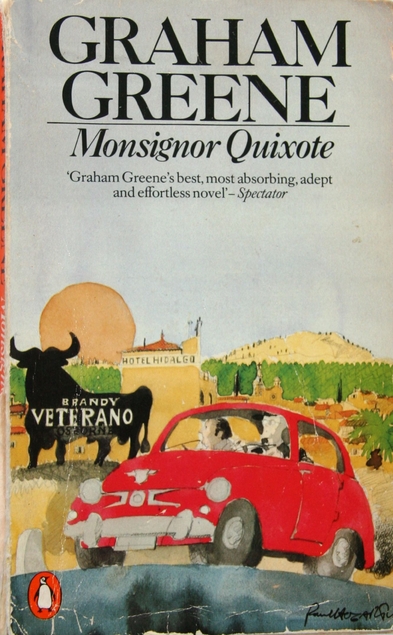
Graham Greene, Monsignor Quixote, London: Penguin Books, 1982.

In public library system.

256 pages, paperback. New $15, Used $10, online

Reviewed by Ted Witham

Graham Greene’s modern take on Don Quixote made me laugh out loud. The way simple parish priest Father Quixote becomes a Monsignor is delightfully unbelievable. With a vague ideathat he is like his ancestor Don Quixote, the new Monsignor sets out on adirectionless road-trip with deposed Communist mayor ‘Sancho’ Panza. He nameshis ancient Seat motor car Rocinante after Don Quixote’s steed.

Fortified by a few sausages and a great deal of wine of La Mancha, the priest and the mayor, old friends and sparring partners, find themselves hilariously tilting at the Guardia Civil, the modern equivalent of windmills.

The two friends discuss faith and communism, friendship and authority, and sleep off the wine. The exploration of these deep topics is playful but insightful.

Greene’s writing is lucid and engaging. I don’t know how I missed this, Greene’s ‘best novel’ according to the Spectator, but it was great fun.

Sing for your faith


1462742661-01-_sx142_sy224_sclzzzzzzz_Keith and Kristyn Getty, Sing! How Worship Transforms your Life, Family and Church, Nashville TN: B&H Books, 2017. 176 pages hardback.

ISBN:  9781462742660. Not yet in Public Libraries.
Online $15 second-hand, $17 new. (My second-hand copy in new condition cost $7)

Reviewed by Ted Witham

What an encouragement to be told that Christians must sing: for the Gettys, congregational singing is both privilege and obligation. They point to many places in the Bible where we are commanded to sing, and, while conceding a place in worship for song as performance, their focus in Sing! is on the central place of congregational singing.

The Gettys make a living from writing and performing songs and encouraging the Body of Christ in music. Many of us have sung their In Christ Alone, an example of a singable melody and strong Biblical content. The chapter headings of Sing! assert that we are created to sing, commanded to sing and compelled to sing. We are to sing with heart and mind, with our family and with our local church. They write of the radical witness when congregations sing, and in a series of ‘bonus tracks’ provide checklists for pastors and elders, for worship and song leaders, for musicians and for songwriters and ‘creatives’.

Each chapter is followed by questions for reflection or discussion in a study group. Sing! would work well as a book club discussion, or a study for the whole congregation.

Sing! invites Christians to consider the first principles of congregational singing. It critiques performances that do not help the congregation to sing. The Gettys affirm the wisdom of a familiar repertoire, limiting the number of new songs and hymns.

In many congregations the idea that singing is compulsory will be controversial. As a musician and priest, however, I am pleased that the case for singing is put so strongly. How much stronger in faith singing congregations can be. How much stronger in faith are families and individuals who sing or listen to the songs and hymns they have sung in church on Sunday. And how much joy is evoked by the beauty and artistry of good music and poetry.

Sing! is not primarily for pastors and worship leaders. They don’t need convincing. A resource for all Christians Sing! will encourage all of us to sing more heartily.

Prime Ministers and Christianity


2018_08_24_52341_1535102868-_large
Photo: Courtesy Agence France

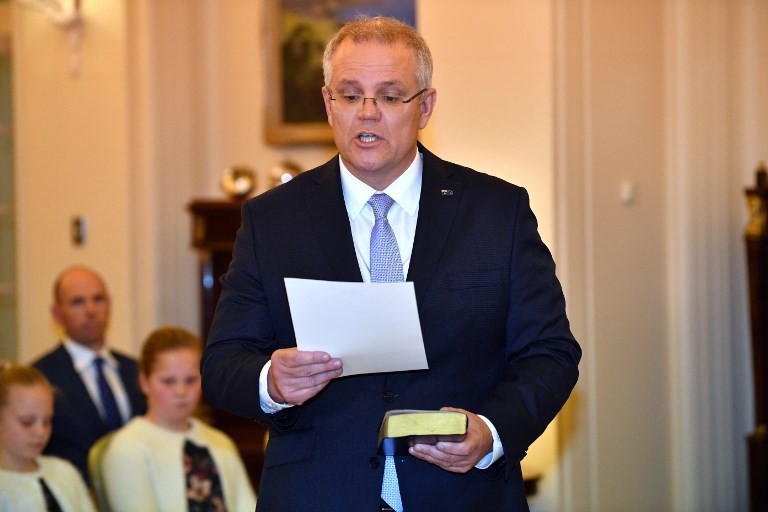
In Church this morning, someone thanked God for our new Christian Prime Minister. I felt disappointed by this rush of enthusiasm. Before I lose my readers, let me state that I am very happy that Mr Morrison is a regular church-goer. I rejoice that God calls Christians to the vocation of politics: our country needs them. However, I reject the implied criticism of Mr Turnbull. For Scott Morrison’s faith to be a welcome novelty is simultaneously a judgement that Malcolm Turnbull is not one.

Mr Turnbull converted to Roman Catholicism. He chose not to politicise his faith.  In his recent book God is Good For You, in interviews with Malcolm Turnbull, journalist Greg Sheridan ‘was astonished at the depth of his knowledge of Catholic theology.’ Sheridan comments that Turnbull ‘affirms his belief if asked, nonetheless doesn’t talk publicly about religion all that much, but he very frequently makes reference to love. Perhaps he uses the word ‘love’ more than any previous prime minister.’ (p. 175)

Turnbull’s use of the word ‘love’ is significant as the way he parlayed his faith into the public realm. Even his enemies have noticed this intensely theological language. In fact, one of his detractors mocked his use of ‘love’ in the wake of his defeat.  But Turnbull chose not to use his faith as the public face of his policy making. He believed that arguments in the public sphere must stand on their own merits and not on their theological rationale.

Bill Shorten, too, is a convert, in his case from Catholicism to Anglicanism, the faith of his wife Chloe. Shorten is a product of a Jesuit school. Sheridan, no Labor apologist, is impressed by Mr Shorten’s’ serious knowledge’ of Christianity. Shorten takes into the public realm a quote from the legendary Jesuit Pedro Arrupe, ‘to be men for others’ as a key theological virtue. But like Malcolm Turnbull, Bill Shorten disciplines the boundary between his faith and public life.

The stance of Turnbull and Shorten may even make us question politicians who let their faith be known because it is good politics. It may (or may not) increase Mr Morrison’s vote, but it won’t justify the decisions he makes a Prime Minister.

So, all power to PM ‘ScoMo’. I will pray for him as duty bound, and with added interest because he is a fellow-believer. But I thank God for Mr Turnbull too, and for all who choose to serve the community as politicians. It’s a hard job, and they need all the help they can get.

Believing: a tangled skein


I heard of a priest who was asked recently, ‘Do you ever have moments of doubt about your Christian faith?’ The priest replied, ‘On some days I have moments of faith.’

I am intrigued by atheists who seem to think that if they can knock one argument out from under a Christian, they will have of necessity knocked the person off their Christian stool. Comedian Ed Byrne, for example, talking to agnostics, ‘If you haven’t heard God speak to you in a sunset or a beautiful landscape by the time you’re 40, you’re an atheist.’ His assumption appeared to be that just one thing could make the difference between being a Christian or not.

I experience being a Christian not as a series of skittles to be knocked over, but as a tightly tangled skein of meaning-making, experiences and fellowship. Included among my persuasions are doctrines, ethics and aesthetics, the ever-fascinating engagement with the Bible, my identity and my incorporation into particular parts of Christ’s Church.

So atheists sometimes try to win the argument by asking what I would believe it were proved that some bones were definitively identified as the remains of Jesus. The empty tomb is only one little part of my believing, so, depending on the day, my answer is either a confident argument from logic, ‘It will never happen’, or an answer from conviction, ‘It would make no difference to my foundational belief.’

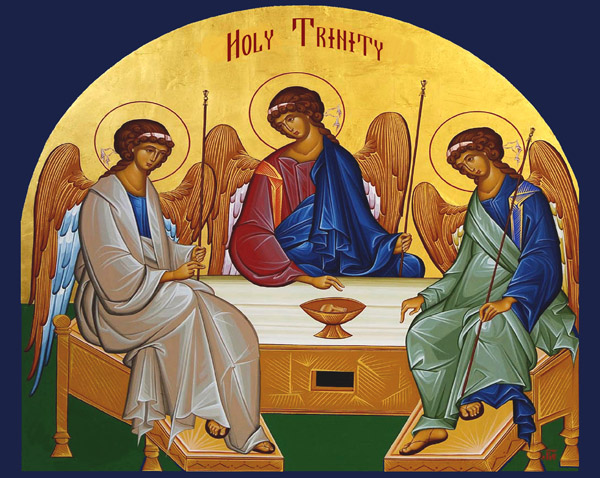
Some Christians trip over philosophical wires by trying to solve the puzzles of the 2nd and 3rd Centuries. What does it mean to call God a Trinity? The Prophet Mohammed was one person for whom the doctrine of the Trinity disproved Christian faith. He founded a new religion with monotheism front and centre. Five times a day, his followers now proclaim the Shahada, ‘There is no God but Allah.

trinityflyer‘One God in three persons’ makes less sense for our times because of the philosophical assumptions at the time the Creeds were written. Faith that God is one in three is always faith, however, and Christians can choose simply to believe it, or like Catherine La Cugna or Karl Rahner in the 20th Century devise completely new philosophical pre-suppositions for the doctrines of Trinity.

Other Christians recite the Creed each Sunday, ‘We believe in One God’ – the Trinity – as a statement of the historical faith of the Church. This is the Church and its beliefs in which I choose to belong, even while holding lightly to the details of these dogmas.

I have many moments of not believing or understanding how Jesus Christ can be completely human and completely divine: there are just too many paradoxes in the doctrine to contemplate at once. However an atheist who shows me how irrational this belief is will not therefore persuade me out of being a Christian.

Bedrock to my faith is the person of Jesus, yet many atheists join me at the core of acclaiming Jesus as a provocative teacher of good living, although some atheists try to make Jesus interchangeable with other gurus and guides.  I do stick to the uniqueness of Jesus. This comes partly from my ongoing fascination with the Hebrew and Christian Scriptures. Many atheists find they can reject Christian faith without reading the Bible. I find its books more and more intriguing as I read them, whether it’s unravelling the insights of Wisdom literature or attempting to interpret the Book of Revelation.

123166-004-87cb3f17
Saint Jerome – courtesy brittanica.com

As I read the Gospels, I find more and more to surprise me. In the ‘Good Samaritan’, Jesus tips the world of loving upside down. Unlike his peers, Jesus calls us loving outsiders as equal a duty as loving our families. Another surprise: Being a neighbour is not so much about those whom I can help, but about who I allow to be neighbourly to me.

Much of my experience of being a Christian comes from the Church which has shaped me, paid for my theological education, and which continues to give me support. Just this fortnight with my wife away, I am experiencing the practical help of the local congregation bringing me meals. Of course, such do-gooding is not limited to Church people, but the fact that it is Church people living out charity as part of their faith reinforces my Christian identity too.

I cannot undo my experiences. I have discovered God in the music of Olivier Messaien. I can try to explain it away in psychological terms, but nothing can change what Messaien has revealed to me.

There are days when I try to persuade myself out of faith, but it can’t be done, I don’t think, because my faith is too vigorous a garden and grows by weeding and digging out old growth. One-punch atheists don’t get the complexity of religious faith as they believe it is a single flower.

I offer this short piece as one flower of my thinking as a Christian.

m