Slavery, Saint Francis and us


If you prefer to listen to Ted preaching this homily, click below (12 minutes):

The Holy Gospel of our Lord Jesus Christ according to Saint Luke.

Glory to you, Lord Jesus Christ.

[Luke 17:5-10]

The apostles said to the Lord, “Increase our faith!” The Lord replied, “If you had faith the size of a mustard seed, you could say to this mulberry tree, ‘Be uprooted and planted in the sea,’ and it would obey you.

7[Jesus said], “Who among you would say to your slave who has just come in from ploughing or tending sheep in the field, ‘Come here at once and take your place at the table’? Would you not rather say to him, ‘Prepare supper for me; put on your apron and serve me while I eat and drink; later you may eat and drink’? Do you thank the slave for doing what was commanded? 10 So you also, when you have done all that you were ordered to do, say, ‘We are worthless slaves; we have done only what we ought to have done!’”

For the Gospel of the Lord,

Praise to you, Lord Jesus Christ.

In the Name of the Living God, Father, Son and Holy Spirit.

The whole point of having a slave is that person can do whatever you want whenever you want.

When we were in Mauritius Rae and I used to worry about our hosts’ driver who was called Anil. Our hosts owned a sugar plantation and invited us to dinner a couple of times during our seven-week stay on the island.

They would send a message ‘Anil will pick you at 5:30.’ Anil arrived promptly at 5:30. Anil drove us back to the plantation. We had dinner, not with Anil, of course. Just with Pierre and Doris. Pierre showed us over their sugar refinery, a 24-hour operation. We talked. At 11:30 in the evening, it was time to go home.

Pierre yelled across the backyard, ‘Anil! Anil!’ Anil stumbled out of his hut, shook off his sleep and drove us home. It was an hour’s drive, and then, of course, Anil had to drive an hour back again.

Anil wasn’t a slave, but Rae and I worried that he was treated like one.

The people of Jesus’ time had slaves. The Jews had always had slaves, going back to the time of Abraham. At least, the more affluent Jews had slaves. And the whole Roman Empire depended on the labour of slaves. Apparently one third of the population was enslaved. People 2,000 years ago didn’t have the same moral objection to slaves that we have now.

And the whole point of having a slave is that person can do whatever you want whenever you want.

In this morning’s Gospel reading, Jesus invited the people of his day to try a radical thought experiment: imagine you are the owner of a slave who has been ‘working all day in the field, ploughing or tending sheep.’ (Luke 17:7) When evening comes, you allow the slave to take as much time as he wants to wash and change into clean clothes. Then the slave reclines on the best dining couch in the house. Then you, the owner, the master, serve the slave his dinner, and the slave can eat the meal quickly, or can spend four or five hours at the table chatting to friends and drinking wine. You are on call until the slave tells you he has finished his meal.

Then Jesus stops the thought experiment. No: you treat the slave as a worthless slave whose job is to serve you and not the other way around. If it doesn’t suit the slave or the slave is too tired makes no difference.

This thought experiment comes from Jesus, who as Saint Mark and Saint Matthew tell us, ‘…came not to be served but to serve and to give his life a ransom for many.’ (Mark 10:45, Matthew 20:28). Not to be served, but to be a slave.

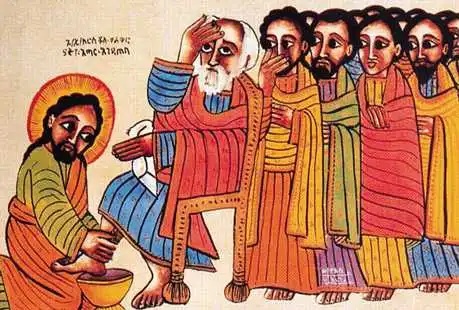
In other words, this thought experiment is not as fanciful as it sounds. Jesus himself swaps the role of Lord for that of a slave for example, when he washed the disciples’ feet (John 13:5), and really upsetting Simon Peter. ‘You will never wash my feet!’ wails Peter (John 13:8).

It’s not possible, we think. Even if you don’t own a slave, the point of having slaves is to do anything their masters want at any time. Jesus upends this idea. A slave is a human being created in the image of God, and simply because of that should be, at least, respected. But more than just respecting slaves, Jesus challenges us to serve others as if we were slaves ourselves. And especially, we should serve those who are treated as slaves.

Yesterday was the feast of Saint Francis of Assisi, a saint who means a great deal to me. Francis was the son of a cloth merchant, Pietro di Bernadone, who was growing richer and richer. Francis was privileged by having the benefit of this extreme wealth, and when he was a teenager, he made the most of the lavish lifestyle. He threw wild parties with his friends, providing the wine and food for the feasts. He gained the nickname ‘The King of The Revels’.

But he grew uncomfortable with this privilege. He was riding outside Assisi one day – and owning a horse was something like owning a Morgan Super 3 sports-car today or maybe a Rolls Royce Sweptail with a million-dollar price tag. As he rode, he saw a leper. Until then, Francis had been revolted by lepers. They were disgusting, repulsive. But on this day, Francis was moved to dismount and approach the leper and embrace him. Something changed in Francis from that moment. ‘That which was bitter had become sweet,’ he wrote later. (The Testament, 1, FAED I, 124.)

One of the first ministries Saint Francis undertook was caring for lepers; becoming their slave, their servant, looking with love on their distorted features and running sores, feeding them, keeping them safe from brigands and dressing their wounds.

Francis knew that this was how Jesus challenges us to be a slave to others. It’s a confronting idea. And we should be confronted. It goes against the way things are. It turns the world upside down.

I find it interesting that even though Francis is known for poverty, in the early years, many of his followers were queens and princesses: the Blessed Isabelle of France, Saint Louis’ sister, was a princess, and Saint Elizabeth was the wife of the future king of Hungary. Saint Clare too was from a noble family. These royals and aristocrats responded to the challenge to become a slave for others, serving the poorest, putting their lives at the service of the neediest.

I am impressed by Saint Jeanne Jugan in France just after the French revolution. She was inspired by Saint Francis to look after homeless women, eventually setting up a network of refuges throughout the east of France and becoming the Little Sisters of the Poor, who are in 2025 still serving the elderly poor. They have a house in Glendalough just north of Perth city. She too, and her sisters, respond to the challenge to be a slave to others.

And we are followers of Jesus too. The same challenge applies to us – as individuals, as the people of Saint Brendan’s. We don’t have to be the founder of a religious order, or even join one, to take up this challenge of Jesus. But if royals and aristocrats can become slaves, so can you and I.

Is there some situation where God is calling you to be a slave? Is there a person whose needs you can try to meet, but whom you avoid because you know it will be difficult? Is someone you know being held captive, ensnared in some way by someone? Is there a way to be a slave to them, to serve them in their needs? Being a slave is not about knowing you can succeed. It’s about putting aside our needs to achieve, to make a mark. Being a slave’s only about obeying the master. ‘When you have done all that you were ordered to do, say, ‘We are worthless slaves; we have done only what we ought to have done!’” (Luke 17:10)

And our ultimate Master is Jesus, and Jesus chooses to serve when others are certain it’s beneath Him.

As a parish community, we rightly hold up our ministry to the Homeless as one example where we put energy and care into serving others whatever their needs. But just because we are serving one needy group does not mean there are not others in the Warnbro/Rockingham community calling out for our service as a parish.

Today we bless our pets. The same challenge applies to animals as it does to human beings. We sometimes think of our pets as slaves. We keep them locked them up in our house or yard. We have them on a leash when we take them outside. We expect them to do emotional work for us, loving us when we come home from being away. But I am sure that we bless our cats and dogs because we know the challenge to be a slave to them too. Take note of that Lottie, and Caesar.

So this story in the Gospel about a slave coming in from a day’s work in the field is not a hypothetical. It’s a challenge. It confronts us to find ways in which serving others turns the world on its head and creates a kinder, more loving world in partnership with the One who came to serve.

Where is God calling you to be a slave today?
Surprised by shock inclusion


Sermon for Pentecost 18, 2022

Sermon – St Brendan’s By The Sea, Warnbro

26th Sunday in Ordinary Time, October 9, 2022

Jeremiah 29:1, 4-7

Luke 17:11-19

The Holy Gospel of our Lord Jesus Christ according to Luke.

Glory to you, Lord Jesus Christ.

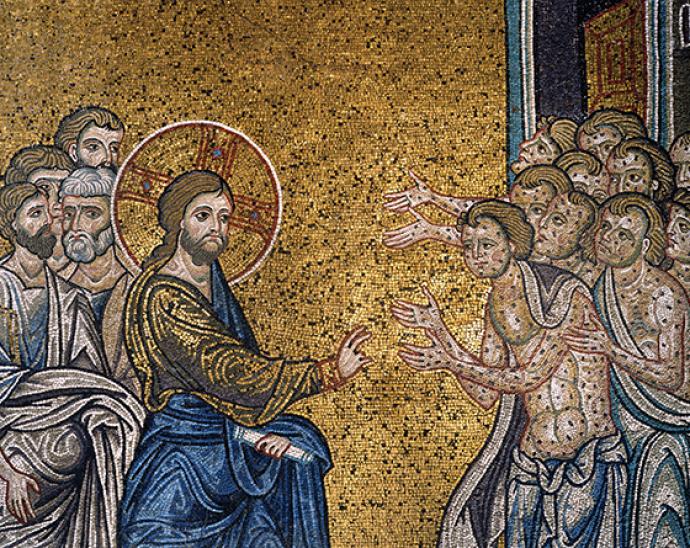
11 On the way to Jerusalem Jesus was going through the region between Samaria and Galilee. 12 As he entered a village, ten men with a skin disease approached him. Keeping their distance, 13 they called out, saying, ‘Jesus, Master, have mercy on us!’ 14 When he saw them, he said to them, ‘Go and show yourselves to the priests.’ And as they went, they were made clean. 15 Then one of them, when he saw that he was healed, turned back, praising God with a loud voice. 16 He prostrated himself at Jesus’s feet and thanked him. And he was a Samaritan. 17 Then Jesus asked, ‘Were not ten made clean? So where are the other nine? 18 Did none of them return to give glory to God except this foreigner?’ 19 Then he said to him, ‘Get up and go on your way; your faith has made you well.’

The Gospel of the Lord.

Praise to you, Lord Jesus Christ.

In the name of the living God, Father, Son and Holy Spirit. Amen.

I want to start with an unpleasant thought experiment.

So, before that, a joke.

An old Irishman walks into a bar, hauls his bad leg over the stool, and asks for a whisky. ‘Hey,’ he says, looking down the bar, ‘is that Jesus down there?’ The bartender nods, so the Irishman orders Jesus one too.

An ailing Italian with a humpback walks in, shuffles up to the bar, and asks for a glass of Chianti. Noticing Jesus, the Italian orders Him a glass of Chianti too.

A redneck swaggers in and hollers, ‘Barkeep, set me up a cold one! Hey! Is that God’s Boy down there?’ The bartender nods, so the redneck orders Him a bottle of beer.

As Jesus gets up to leave, He touches the Irishman and says, ‘For your kindness, you are healed!’ The Irishman jumps up and dances a jig.

Then Jesus touches the Italian and says, ‘For your kindness, you are healed!’ The Italian’s humpback straightens, and he does a flip.

Just then the redneck yells, ‘Hey! Don’t touch me. I’m on disability pension!’

So this is the thought experiment:

What is the worst kind of person you can think of? They may be so morally depraved that even thinking of them makes you feel disgusted, even a bit dirty. They may be so lacking in empathy that there is no lid on their violence; they are happy to lash out with fist or weapon at anyone, child or adult, ordinary citizen or officer of the law.

They may be so different from you that you feel you can’t understand them and their culture. You wouldn’t want your granddaughter to marry one, or even get friendly with one.

I remember my Dad and others of his generation talking about the Japanese as Nips who were both cruel and not real men. Thankfully, that intolerance has gone away as memories of the war have faded.

During the dangerous times of Covid-19, people were intolerant of those who wouldn’t be vaccinated. In fact, some people thought anti-vaxxers should be segregated from the rest of us, like lepers. And I heard anti-vaxxers say similar things about Government officials and employers.   

In some parts of the community, people think of refugees in that way; not as terrified folk fleeing for their lives, but as terrorists and opportunists coming to take our land and our children’s jobs. But in most surveys church people in Australia welcome refugees. So, we in this room are less likely to hold that prejudice.

You may have thought of sex offenders, nasty folk who prey on children and other vulnerable people. Maybe you want a separate town where these people are sent to live; or their addresses known so you can tell kids which houses to avoid.

You may have thought of dictators. There are some at the moment, one or two, who I feel the world would be better without. Put them on an island in the South Pacific, I say, without their armies and nuclear weapons and their egos, and let them get on with each other. Just so long as they don’t threaten our peace.

Whoever this group of people is, your desire is to exclude them from society. One way or another, you want them gone.

Ordinary people in Jesus’ time thought that way about lepers. Whether or not the skin disease in the Bible was the modern Hansen’s disease, the lepers then had severe disfigurements, difficult to look at. It was better to put them out of the towns and villages so you didn’t have to look at their deformed faces, running sores, or twisted bodies.  Living with a leper in close quarters, washing them, having them cough over you, over a period of months you may catch it. Better to separate them from the rest of us.

Even 1300 years later in Europe, in the time of Saint Francis of Assisi, people still felt that way about leprosy.  Push lepers away from society, avoid all contact with them, let them survive on the fringes of the community with the bandits and the very poor.

So, for Jesus to get near enough to lepers to talk to them would have seemed totally unadvisable. Not only might Jesus catch the disease, it gave the wrong message. Don’t encourage them to think they can get better.

Even so, it didn’t seem to bother Jesus. Saint Matthew tells us of another occasion when a leper knelt before Jesus and Jesus ‘stretched out his hand and touched him.’ (Matthew 8:3) Actually touched him. Like hugging a pedophile. Disgusting.

So the unpleasant thought experiment boils down to the question, ‘Who is your leper? Who would you put out of the community?’

Jesus’ actions are astonishing. He approaches lepers. He speaks kindly with them. He blesses them. He heals them. Once the priests certify that they are clean, they can pay their thank-offering. They can go back to their family, to their community. Jesus doesn’t just heal their disease, but he gives them their whole world back.

Imagine your lepers. Imagine Jesus blessing your lepers. Because, be assured, that is what Jesus does. He accepts and embraces the very people you and I can’t stand.

And we are challenged to see that acceptance as Good News. We are invited into a world in which your lepers and mine are included, blessed, healed, welcomed by Jesus.

The Gospel goes a step further. It invites us to emulate Jesus, to copy his way of loving. Not only are we to rejoice that Jesus welcomes those terrible people, but also Jesus dares us to reach out to them in love, and so heal them and reconcile them back into our community.

I mentioned Saint Francis, because he changed his mind. He admits that he was disgusted by lepers. Seeing a leper one day as he rode by, he dismounted, walked over to the leper and embraced him. Then, Francis recalled later, everything changed. Everything that ‘had seemed bitter to me was turned into sweetness of soul and body.’ (The Testament, 1, FAED I, 124.) In fact it was so transformative that Francis realised later that he had embraced Jesus.

With his brothers, Saint Francis went on to set up a rough hospice for lepers, risking contagion and finding joy in nursing them. Saint Francis encourages us: if we are willing to imagine a way to bless our lepers, and act on the imagining, that action will bless us in return.

We can start by praying for them – regularly, every day. It’s amazing how holding our lepers up to God helps us see them as God sees them, as whole, healed human beings.

We can imagine their lives; how they’ve got to where they are now. How their disability or twisted personality has cost them relationships; how they miss out on love because of how others see them, maybe because of the way you see them. Once we know their name, and their story, we see them as an individual, and when we have seen their unique personality, their special contribution to the world, we can’t unsee it. They change from ‘them’ to ‘you’.

When we see them as people, we might risk reaching out to them. What do they most need? We all need to know we are loved. What practical things can we do to ensure that our lepers know they are loved by God?

Gary Chapman is a Baptist pastor and author from North Carolina in the US. He speaks of five ‘love languages’, five practical ways we can express love to other human beings.

The first love language is ‘words of affirmation’. Encouraging and supporting people builds their self-esteem.

The second love language is ‘quality time’. You express how valuable a person is to you by giving the gift of your attentive time.

The third language is ‘receiving gifts’. Physical gifts are symbols of our love. Using this language is as much about the humility of receiving gifts as it is about giving them.

The fourth is ‘acts of service’; doing tasks for a person that will make their life easier.

And last of all is ‘physical touch’, because we all need more than FaceTime and Zoom. We need to feel the bodily presence of a person to know they care about us.

  • Words of affirmation.
    • Quality time.
    • Receiving gifts.
    • Acts of service.
    • Physical touch.

If you haven’t heard of the Five Languages of Love, it’s worth searching on the internet for ‘Gary Chapman, Five Love Languages’. (https://www.supersummary.com/the-5-love-languages/summary/)

With your leper, you don’t have to do all five aspects of practical loving. Start with one of the languages. One may be enough to turn them from despised to esteemed.

There’s one more surprise twist in this morning’s Gospel.  

Samaritans were hated by Jews: pious Jews travelling from Galilee to Jerusalem refused to travel through Samaria, which was the straight and easy route. They crossed the Jordan and travelled down on the Transjordan side before crossing back to get to Jerusalem: a longer trip, and through more desert country than the Samaritan route.

Not Jesus. Luke makes a point of telling us that Jesus was travelling through Samaria. Jesus was taking his disciples the quick way to Jerusalem, through the territory of the despised neighbours, the Samaritans. And the only leper who turned back to give thanks to Jesus was a foreigner, a dirty foreigner, a darky, a Nip, a loathed Samaritan.   

This Samaritan, this ex-leper, give thanks, and Jesus commends him for it. This foreigner gets it right, the other nine miss this step.

How hard it must have been for the disciples to hear that a Samaritan got it right with God. We too have been welcomed, blessed, healed and restored by God, just like the Samaritan, and this despised alien shows us how we should respond to Jesus. Our lives, like his, should be lives of gratitude.

Bryan spoke last week of faith. We already have it. The answer to every prayer, Bryan said, is ‘I am with you.’ Our faith is real. And our faith is that the marvelous healer Jesus continues to be involved in our lives. What can we say to that except ‘Thank you’, and go on saying ‘Thank you’?

The Samaritan is the model of Christian spirituality. Not a Jew. Not St Peter who recognizes Jesus as the Son of the Living God. But a Samaritan. Just as the Samaritan earlier in Luke showed us how to love our neighbour. Our leper shows us how to love God. We should be surprised. And we should go on giving thanks. We will know the sweetness of soul and body as we are embraced by Jesus.   

Blessings

Being blessed, for Jesus, is owning your need. You are blessed if you know you need God’s mercy and safety, because God is present with love and protection.


Matthew 5:1-12

The bombers fly over. At this height, you can see that some are your Government’s air force, others come from one of the superpowers, Russia or the U.S.A., both, as far as you are concerned, as bad as the other. The noise and the dust when a bomb hits the apartment block next to yours is overwhelming. You utter a prayer of thanksgiving that, this time, you have survived. As soon as the drone of the bombers’ engines disappears, you sprint down into the street, looking for your brother, his wife and children. All are gone. Grief fills you like rushing water.

Devastation in Syria – AFP Photo

You go back to your apartment. Your family is there, thank God, but there is no water or electricity. The shops are bombed out, so there is no food. You pack up what you can, photos, documents, a few clothes, in a couple of suitcases and, with your family, start the long walk out of your city towards somewhere, anywhere, that it is safer.

That evening, you take out your tattered Bible and read Matthew 5:1-12. It takes a moment for you to realise that Jesus is directly addressing you: you, grieving the violent deaths of loved ones; you, with your nice life collapsed into rubble; you, without a home or a country you can call your own; you, you are blessed.

Matthew wrote his gospel for a community just like this. The Romans sacked Jerusalem in A.D. 70, killed many of the inhabitants, razed the beautiful Temple to the ground, and hounded the citizens out of the city. Jewish refugees spread out across the Empire looking for somewhere safer, the tiny group of Christians swept along with them.

Matthew believes Jesus’ Sermon on the Mount applies to these shell-shocked refugees with no possessions or place of their own.  They are blessed. Jesus turns upside down the usual idea of blessing. Normally, we think of blessings as things we have – family, personal talents, possessions, a peaceful life – but Jesus re-defines the blessed as poor in spirit, mourning, meek, lacking justice, wanting to make peace, above all, persecuted.

The Temple destroyed – fallen stones from the southwestern wall.

Being blessed, for Jesus, is owning your need. You are blessed if you know you need God’s mercy and safety, because God is present with love and protection. You are blessed if you know that you need to make peace with the world around you, because your neighbours too want to reach out and make peace with you. You are blessed if you know that you don’t have it all and God and God’s creation will provide for you.

For most of history, most of the world has lived in poverty and insecurity. 21st Century Australia, with our prosperity and peace, is an exception. Because we have so much, the power of the Beatitudes doesn’t register strongly with us.

I take these words of Jesus as an invitation, firstly, to enter imaginatively into the lives of the many who are fleeing danger, the many who are hungry, the many who have no shelter. They are more blessed than I am, according to Jesus: is there something I can do to incarnate that blessing for them? Can I use my power and prosperity to help provide safety, food, water, housing?

Secondly, I take Jesus’ words as a warning to me: in my comfortable life, I become complacent. I, too, can learn to see that I cover up my real needs with material comfort. I ask God to show my where are my needs, my lacks, my shortcomings, so that I can learn gratitude for all his blessings.

Love, only Love

Love God. Love your neighbour. In this volatile environment, the Great Commandment asks new action from me.


Matthew 22:34-40

Over the last couple of decades I have lost my confidence in taking part in a robust debate. I fear that my opponent and I will not be able to learn from one another, let alone find a solution that benefits both of us.

I have different conversations about live sheep exports with my farming family and with my animal activist acquaintances. Apart from a vague desire not to be cruel to animals, I find it frustratingly difficult to get one ‘side’ to hear the viewpoint of another.

And to have a conversation on climate change with people who disagree with you is bound to end in shouting or tears; yet this conversation, perhaps more than any other, is where we need to listen to opposing views, to learn from them, and to find win-win remedies.

We are learning how Facebook and other social media divide us even further. They manipulate us into an echo chamber where we hear only our views reverberate around us. They disgust us with outbursts of hateful trolling which cement our dislike of the trolls.

Jesus has a radical prescription for a society divided like ours: ‘Love God with all your strength… and love your neighbour as yourself.’ The two parts of the Great Commandment come from the Hebrew Scriptures (Deuteronomy 6:4-6 and Leviticus19:18) and were familiar to Jesus’ hearers.

The Jewish teachers defined love not as a feeling, but as an active commitment to better the lives of others. On that, they and Jesus agreed.

Jesus teaches in the Temple – St Vladmir Orthodox Icon

But Jesus made two profound changes to the Summary of the Law: firstly, he linked loving God with loving neighbour so that they always come together. Love God and you inevitably love your neighbour. Loving your neighbour is a way of loving God.

Secondly, he extended the idea of ‘neighbour’ beyond the circle of family and everyday friends. For Jesus, a neighbour is anyone you meet, anyone near you. It even includes your enemy!

For many Jews, that was a challenge too far. How could you love the Roman occupiers? It’s an affront for us too: how can we love the terrorist who beheads a teacher? How can we love the drunk driver who kills our daughter?

Love God. Love your neighbour. In this volatile environment, the Great Commandment asks new action from me. Loving the neighbour who disagrees with me means taking the effort to maintain a strong connection with her or him, building a friendship on things other than our disagreement.

Loving my neighbour means being careful about joining ‘tribes’. I resist the pressure to join a political party, not because I want to reduce its influence, but because my joining will be perceived as taking sides and not being open to new truth.

Loving my neighbour means I take great precautions around Facebook. It is seriously addictive; and it is designed to divide people from each other. It may be that I should close my account.

Loving God means seeing the humanity in people who disagree with me. It means being loved by God so that I may have the grace to love radically as Jesus did.

Day Labour

This is a moment in history when we should stop treating people just as expedient labour and build a more just and caring community.


Matthew 20:1-16

For me to really get it, I had to be taken at 6 a.m. to the Post Office in Durham, North Carolina. The sun was up, and the day was already hot and humid. On the Post Office steps groups of men, about 30 in total, stood around, waiting. My guide said, ‘These are undocumented Mexicans. Some people joke that they are people who don’t exist.’

Eventually a farm pick-up truck drove by, pointed to two or three of the men, ‘You! You! You!’ and the men who were beckoned scrambled onto the back of the truck. Some minutes later, another truck arrived, and the same procedure followed. The rest of the men waited, waited. At about 7:30 a.m., the street began to wake up as workers on their way to air-conditioned offices glared at the men. It was time to disperse. Those remaining were unlucky that day.

These men were all desperate to feed themselves and their families. The picked workers would be given cash, $15 or $20, at the end of a ten-hour shift in the oppressive humidity of summer. This was day labour, southern U.S. style. I imagine that, 30 years on from then, day labour is still employed in much the same way.

The men were treated, not as human beings with needs, but as what they were worth to the employers. They were exploited.

Post Office, Durham NC

Jesus tells the story of an employer who goes back again and again throughout the day to the Post Office steps, employing as many workers as he can, and then insisting on paying them according to their need, not his economic advantage. No wonder he encountered resistance – from the workers who had ‘borne the burden of the day and the scorching heat’ (Matthew 20:12b), and most probably from other employers too.

This employer’s actions seem revolutionary. What he had done was to defy the economic realities which ignore the dignity of human beings. He treated the workers with worth and generosity.

Today’s news reminds us that Covid-19 has made many more people vulnerable, looking for a little work just to survive. Let us bear them in prayer and offer a practical hand to them when we can.

We also note that there are executives who ‘earn’ annual salaries of millions of dollars. These amounts cannot equate to value for work done, nor do they relate to people’s needs. Our economic system is currently not producing a fair society.

Eventually the world will get through this pandemic. Let us ask our leaders to re-build a world where people are not grudgingly de-valued, but where every person is treated with worth and generosity. We should encourage the Government to continue and expand programs like JobKeeper and JobSeeker. We should invite politicians to seriously look at new ways of caring for every member of society like, for example, Universal Basic Income schemes.

This is a moment in history when we should stop treating people just as expedient labour and build a more just and caring community.

Being a kintsugi pot

Our prayer and our goal should always be to undertake the emotional work of bridging those divides and of mending those broken friendships in Christ.


Matthew 18:15-20

Kintsugi is the Japanese art of repairing broken pottery with lacquer and gold. The idea is that the whole history of the pot is valuable. The gold (or silver or platinum) draws attention to the points of breakage. The places of healing are important, and the scars are to be celebrated, not to be hidden.

Jesus shares a vision of the church as a place where the work of reconciliation is ongoing. When there is a breakdown in relationships between believers, Jesus lays out a pathway to heal the fellowship. First, try to reconcile privately, then in a small circle of witnesses, then in the wider church. Only then might the church take the extraordinary step of expelling a member.

This is not a series of ‘reconciliation tasks’ to be ticked off as an excuse to get rid of a difficult member, rather the opposite. This is a picture of people taking time, over and over, to heal breakdowns in relationships, a church where the healing is valued. This is a community busy with creating and maintaining fellowship.

Scars show and they are valued.

A constant temptation of the church is to be nice, to substitute niceness for the emotional  work of ongoing reconciliation. There is nothing wrong with niceness, as far as it goes, but being nice is not enough to keep believers together through conflict and misunderstanding.

There are ample opportunities to get offside with one another; whether it is a personal dislike, or whether it is a deep theological conviction. Our prayer and our goal should always be to undertake the emotional work of bridging those divides and of mending those broken friendships in Christ.

These months of enforced distancing because of Covid-19 when we have spent less time in the company of fellow Christians give us an opportunity to reflect on our church community and the way it deals with fractured relationships. It is a time when we can resolve to foster deeper fellowship in what we do as individuals in our parish or community.

Bridging the Swan River (Derbarl Yerrigan)

Each time two or three come together in renewed fellowship, Jesus rejoices, ‘I am there with them!’ (Matthew 18:20).

The truth is that the church goes on being broken, over and over again, and God weeps for it. And so, the work of reconciliation goes on, over and over again. We are like a kintsugi pot in that we should value the places where we have been healed and put them on display. We are unlike kintsugi in that the church’s work of reconciliation is never finished this side of the Kingdom.

Marked as Christians


Romans 8:15-28 and Matthew 16:21-28

How can you tell which ones are the Christians?

We are the ones who are marked with a cross. We are the ones who are drawn to suffering. We are the ones who provide meals for the disadvantaged through soup kitchens. We operate Op. Shops to help them be dressed with dignity. We are the ones who nurse the dying in hospice care. We are the ones who accompany the grieving at funeral services. We visit prisoners. We care about the suffering of the Rohingya people forced into exile. We protest the treatment of refugees and send money to care for those in camps. We take our part in attempting to preserve wildlife.

Of course, Christians are not the only ones who do these things. Christians don’t have a monopoly on the works of mercy. But we Christians do these things because we are marked with a cross. This cross is not just a piece of jewellery or our logo. This cross, traced on our forehead when we were baptised, is a symbol of our willingness to follow Jesus in his suffering. We identify with his pain.

It’s not rational, this putting ourselves on the side of suffering. The rational thing is to avoid suffering. We identify with the suffering of Jesus and begin to learn solidarity with all people and all creation. We follow the suffering right through to its end and learn how character grows with suffering.

Jesus asks us to walk with him to Jerusalem.  If we follow, we must be prepared to die with him. His promise is that, if we die with him, if we identify as much as possible with his death, we will be raised with him. Jesus is inviting us into this cycle of death to life, suffering to freedom, pain to release.

Aidan Hart Sacred Icons

There is a tradition of beautiful painted crosses with two sides: on the grey side are depictions of Jesus being crucified and grim symbols of death. On the richly coloured side are depictions of the empty tomb and saints and angels applauding Jesus as he bursts to new life.

We are people of the cross, people of both sides of the cross. We identify with the suffering of Jesus and the suffering of all creation. As we enter more deeply into this suffering, we discover, to our joy, signs of healing, love and new life.

Influencers

But for Saint Matthew, Jesus’ question is not about number, it is a personal matter. Who do you follow as your influencer?


Matthew 16:13-20

Some people, usually young and internet-savvy, make massive money by making videos of themselves. Those with most followers may be demonstrating a skill, face make-up for example, or performing a wry diary of their world, or selling gadgets. If you follow Instagram or WhatsApp, you will recognise these ‘influencers’, people who command a following and change behaviour.

Others may have a real-world platform and have converted this into a large internet following. Barack Obama, former U.S. President, has 121 million followers on Twitter. Obama is a big-time influencer.

Jesus takes his disciples to Caesarea Philippi, a cosmopolitan trading port. It had a strong Roman influence, reflected in the name ‘Caesarea’, and the Herod family had added ‘Philippi’ (‘Philip’s)’ after Herod Philip and to distinguish it from the other Caesarea.

Caesarea Philippi had previously been called ‘Pania’, Pan’s town, and in the time of Jesus the shocking rites for the god Pan were still celebrated. The ‘Gates of Hell’ is a real cave that played a role in these ceremonies.

Gates of Hell, Caesarea Philipp

The trip to Caesarea Philippi may have been Jesus’ lesson in influencers.  Who can induce you to change your behaviour? The Roman Emperor certainly constrained behaviour. He is an influencer. The Herods derived their influence from the Emperor, so some people in Jesus’ time would be influenced by them. Maybe the Roman gods were influencers. Pan evidently had many followers in Caesarea Philippi. From the perspective of many people, devotees of Pan were seduced into behaviour that destroyed families and tore communities apart. Pan was an influencer.

Jews in Caesarea Philippi were influenced by rabbis and teachers. Their behaviour conformed to many rules and practices laid down by the Jewish leaders.

In the midst of all these influencers, Jesus was asking his disciples, ‘Who do you say that I am?’ Simon Peter is praised for his answer: ‘You are Messiah, Son of the Living God.’ (Matthew 16:15-17) Jesus continues to ask, ‘Who do you say that I am?’

On the face of it, Jesus is an influencer with 2.3 billion followers, so that’s a possible answer to Jesus’ question. But for Saint Matthew, Jesus’ question is not about number, it is a personal matter. Who do you follow as your influencer? Who do you allow to change your behaviour? Following Christ is more than naming oneself a Christian. Following Christ means rejecting the influence of others, whether their power is political or personal, and accepting only the influence of the Son of the Living God. Following Christ means doing life differently, attempting to love and care for the world in the way Jesus did.

Who is your influencer? To the extent that it is possible, the answer should be, ‘Only Jesus’!

Reconciling everything – The Holy Trinity


Genesis 1:1-2:4a, Psalm 8, Matthew 28:16-20

Once upon a time, the good book tells us, heaven and earth, that is, God’s creation, had it all together. God said, ‘It was good… it was good, … it was very good.’ (Genesis 1: 4,10,12,18,25,31). The first account of creation in Genesis appeals to us and challenges us because we recognise that the world we know is not so good: it is marred, fractured.

We see the degradation of the environment, even Covid-19 is a result of the unwanted collision of wild animals and humans. We feel the rupture of relationships, our own and those around us. Ultimately the cause of this broken world is a mystery, but we can be sure that God means to mend and restore creation.

The Gospel tells the astounding news that we are part of this great project of bringing heaven and earth back together.

Matthew recounts how Jesus led the Eleven up a mountain. For Matthew, going up the mountain meant two things: on the mountaintop we experience the power of God, and secondly, on the mountain, Jesus, like Moses before him, teaches about the reality of God.

So we are there with the Eleven on the mountaintop to experience something of God’s power and to open ourselves, week by week, to God’s teaching. Like the Eleven, we both ‘worship and doubt’ (v.17). We are human beings after all. But our power to believe or not it is not relevant.

‘All authority in heaven and earth has been given to me,’ Jesus states (v.18). The extraordinary claim of the Gospels is that the Risen Jesus has all God’s authority. We can be tempted to domesticate Jesus and turn him into a harmless friend. The reality, however, is that Jesus acts with power in our lives.

Simone Weil

The French philosopher Simone Weil (1909-1943) was born to agnostic Jewish parents. From her childhood, she took seriously the teaching of Jesus to love one’s neighbour as one’s self. After a lifetime of activism loving her neighbour, she was drawn more deeply into the life of Jesus, experiencing his power in a series of prayer experiences. Weil’s book, Waiting for God, has become a spiritual classic. After reading George Herbert’s poem ‘Love III’, she wrote, ‘Christ himself came down and took possession of me.’ These experiences transformed her into ‘a great spirit’ recognised by Christians and non-Christians alike.

Our journey may not be as extreme as Simone Weil’s, but the reality of Jesus’ power in our lives shapes us also to be instruments of healing.

So Matthew reminds the Eleven – and us – of the colossal enterprise to which Jesus calls us: the healing of earth and heaven. We, the community of the faithful, are called to teach all nations his commandments, those of love and healing.

And the best of the Good News is that Jesus ‘will be with us always, to the end of the age.’ (v.20).

Reunion and Reconciliation – Statue by Josefina de Vasconcellos at Bradford University

Five senses for Easter – and a Word


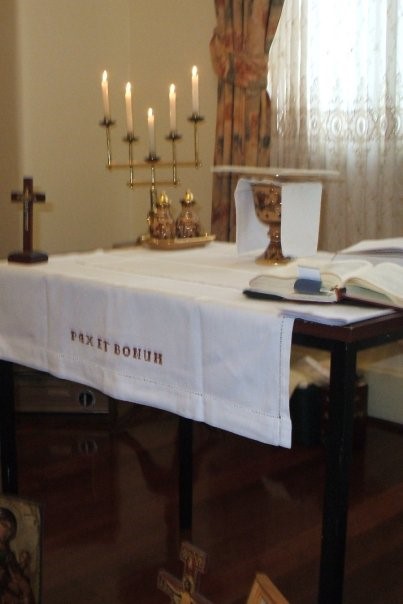
The cup and the bread are held up high so we can see and worship. The bread snaps as it is broken. The white circle lands softly in our palm. We caress the cup as it is handed to us. We taste the wafer and the wine, and the rich sweet aroma of the wine greets us as we drink.

Sight, sound, touch, taste and smell: five senses animate us as we come to Holy Communion. 

And our five senses together trigger a sixth sense: that of memory. The heart of the ritual of Holy Communion brings vividly to mind all the hundreds, or thousands, of celebrations of the Eucharist that we have been part of. For me, they have been in parishes, in cathedrals, in homes, in school chapels and in the bush – everywhere Christians gather for the Lord’s Supper. Our memory reaches further back through generations of Christians to the night Jesus gave bread and wine as a presage of his death.

Salvador Dali – The Last Supper

The memory of that night, the night he was betrayed, the night before he died, is strong, so strong that the events of the Last Supper reach forward into our time. We re-member Jesus, his disciples and his actions, and it’s as if they are happening here now. The scholars call this phenomenon of re-membering anamnesis’ – the very opposite of amnesia.

There’s a paradox at work here. The Eucharist is focused on the material of bread and wine, and yet its heart is the presence of Jesus with us. This presence is in fact an aching, loving absence that Franciscan friar Fr Thaddée Matura calls An Ardent Absence . Some Christians speak of the Real Presence, others of the memorial meal, but the effect is the same. When we touch the bread, we name it the Body of Christ, but we are not touching the actual body of Jesus; the bread somehow invokes his presence with us.

This is the Easter mystery: Christ has died, Christ is risen, Christ will come again. Jesus Christ is both absent and truly present.  Only with the consummation of all things at the end of time will the absence and the presence be drawn together into one ubiquitous and unambiguous presence.

This Easter most of us will miss the Eucharist, the touching, the tasting and smelling, the gazing, the hearing. At best we will have disembodied seeing through the medium of a screen. But in these times of quarantine and physical isolation, the risen Lord is even more closely present to us. The Psalmist affirms,

‘The Lord is near to the broken-hearted
and saves the crushed in spirit.
(Psalm 34:18)

And there is one rich gift, a gift of the Risen Word, which binds us all together. Words reach across the screen, whether in text like this, or the words spoken by a priest somewhere streaming the Eucharist. Because of Him who is the Word, these words have the power to hold us, to enfold us, to bring us into the presence of the Risen One.

Christ is risen.
He is risen indeed. Alleluia!