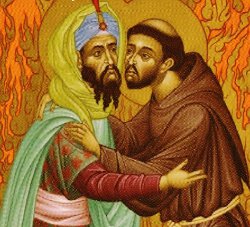
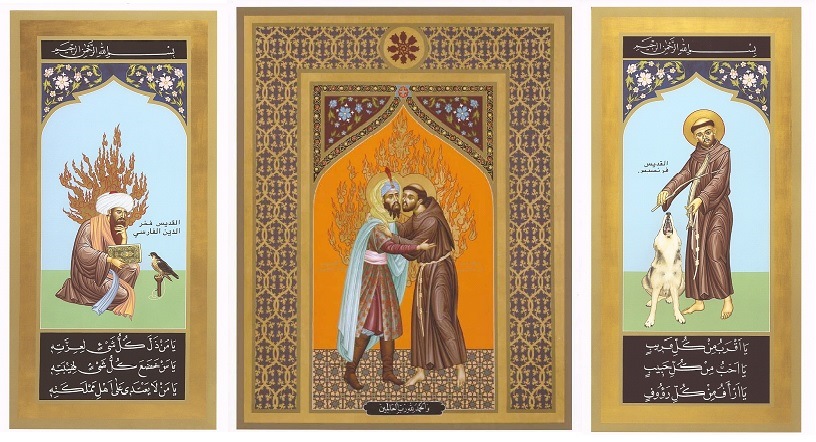
THE SULTAN PREACHES TO SAINT FRANCIS, AD 1219


 THE SULTAN PREACHES TO SAINT FRANCIS, AD 1219

The Sufi Path of Love – Saint Francis and the Sultan

Two Chapbooks by Brother Noel SSF – review


At Home in this Country

Noel Jeff’s two chapbooks reviewed by Ted Witham tssf

Noel Jeffs SSF, Ode to Warrigal Creek Massacre,
2025, A4 card folded.
ISBN 9780646826042.

Noel Jeffs, a Brother in the Society of Saint Francis comes from a farming family as I do. Settler folk like us cannot deny that our comparative wealth and social position derive from the dispossession of Aboriginal people.

The name Warrigal Creek in Victoria, like Pinjarra in WA, and doubtless similar names in other States, resonates because of the massacre perpetrated there. The name produces a complex amalgam of emotions, which Brother Noel explores in this poem.

Hope for reconciliation of country seems to be blown away by the ‘hot anger of a tied-up dog’ (line 3); shame for these murderous acts follows, and ‘now in pain I knead this atrophy’. (line 11). This line describes the violence with which the recollection of Warrigal Creek is turned over in the poet’s mind, like pushing, smoothing, pulling, pounding, tearing and restoring flour and water when making bread. The word ‘knead’ is a homonym for ‘kneed’, and I take from this that the poet’s rumination brings him to a silent place of kneeling in penitence.

The last and biggest emotion is ‘grieving’, grieving that the ‘litter of bones’ (18) may let the poet’s shame be revealed.

But hope seeps through the crammed lines of the poem. The insistence that this is ‘my country’ is used here to recognise the shared pain of remembering. It is ‘country’ as named by its original inhabitants, but it becomes ‘my country’ when truth is revealed.

The poem is printed on one A4 card folded. The front depicts four rainbow serpents entwined in a circle. The heads of the snakes form a cross with the word ‘sacred’ inscribed four times on the circumference. Printing in black and white has made the symbol rather harsh. References to the full story of the Warrigal Creek massacre are on the front and back covers.

The card would make a suitable emblem of remembrance for participants in a day of truth-telling, especially about the Warrigal Creek massacre. I commend Brother Noel for this brave contribution to the national and necessary task of truth-telling, This poem on its card is ‘a plaque to heroically // scold’ (13-14)

The Angelus and Mudbricks

Noel Jeffs SSF, Roads to Stroud: Grasping at Tears, Precipices, Sydney, Darkstar Digital 2024, 19 pages

Brother Noel’s chapbook consists in two poems of just under 140 lines each, describing the journey taken by the poet from the city into the bush of the Hunter Valley in NSW.

The Stroud of the title of Brother Noel’s poems needs some explanation as Stroud figures large in the imaginations of Australian Anglican Franciscans.

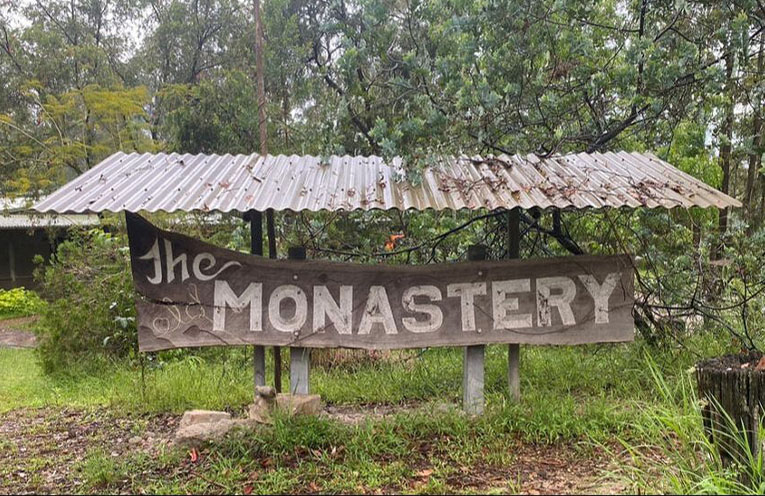
Nearly 50 years ago, three Anglican Franciscan nuns from the Community of Saint Clare in England arrived in Stroud in NSW with a vision to build a house for the Community. A small block of land just outside the town of Stroud was sold to the Sisters. Under the leadership of Sister Angela, an Australian, the Sisters, with volunteers helping, made mudbricks and constructed them into a unique building – a monastery with almost no straight lines but a lot of character.

A Chapel and Hermitage for the Brothers, initially for the priest-brothers to provide chaplaincy to the Sisters, was constructed 100 metres away from the monastery.

Since then, all three branches of the Franciscan family have made deep connections with this small section of attractive bush. Some of Noel’s fellow-Brothers make their home here, and Third Order members have enjoyed the rich hospitality of the place. Sadly, the Sisters returned to England in 2000, but memories of them are strong, especially in the old monastery, now a retreat house imbued with prayer.

In Brother Noel’s second poem under review, Precipices, ‘mudbricks and mudbricks’ (p.14) and the Angelus bell of the Chapel (p.16) take us straight to the property at Stroud. (It may also be intentional that the grey cover and simple typeface mimic the covers of the Sisters’ booklets of poetry and spirituality back in the 70s – a fitting homage!)

Noel Jeffs’ writing is thick with classical, Biblical and Franciscan allusions giving the whole experience of the poet’s visits to Stroud a nuanced exploration of ‘this parade of // fervour to want to come back year, // after year’.

The poet’s experience of leaving the city ‘awash with railway yards // tracks to sentience and homely inner-city birds’ (page 3) and arriving at Stroud where he finds it ‘ensconced in // its wilderness of wildness, made a // garden estate.’ (15)

The natural world and the human world are as entwined in the city as in they are in the country.

When the first Europeans arrived in NSW in 1788, some described the ‘natural’ parklands, the result of many thousands of years of land care by the Indigenous inhabitants, as a garden estate, so there’s a double irony in Jeffs’ description. Stroud, with its beautiful curated gum trees and mown grass, is a ‘garden estate’ hewn from wilderness.

The ‘loss’ of wilderness (or the Indigenous parkland?) is claimed with ‘a black fella warrior stood here // beckoning on, welcoming us in // in a vision.’ (15), the word ‘vision’ doing double duty here for physical vision and insight.

Jeff’s language is oblique. Words slip from meaning to meaning. As the poet is travelling north, watching the illusion of staying still in the train and seeing the bush moving, he asks, ‘What do I want to say about // the cantering bushland which // surrounds and is enveloped // by a tunnel of true darkness // which shapes my life in all its // passages?’ (12) The bush is cantering by as a horse canters, but it is also ‘canted’, (‘written slant’ as Emily Dickinson would say), so that it describes both the scenery and the poet’s inner feelings.

I relish the musicality of Brother Noel’s verse. He is a master of assonance which ranges from pure rhyme to distant echoes of sound. Savour the repeated ‘s’ , ‘p’, ‘ps’, and ‘l’ sounds in these three lines:

‘The circumference is here, and no longer

lying lips, give me a platypus and make

them safe.’ (13)

Simple in intention, the poems describe a journey home. But where is home, and what does it mean? The city ‘in which I am free // and lucky to be alive’ (1), or Stroud, where ‘I have gone to heaven, and am // coming down on the other side // of the earth’ (14)?

The archetypal ‘snakes [which] make love on poles’ (3) are a striking and original image, but they are surely meant to evoke the Caduceus, the staff of Mercury, the messenger of the gods, and widely used as a symbol of medicine. In ‘Grasping at Tears’, the poet is going to Stroud, and with him the messenger of the gods, a diplomat, the bringer of medicine, peace and healing. But the Caduceus also speaks truth with deception. The poet is an unreliable messenger, and his message is a rich potpourri of ambiguous imagery, alluring music and insights almost made explicit.

The poems are introduced by two fine photos taken by Brother Noel, the first shows the gravel road into Stroud, and the second a butcherbird enjoying her reflection in the outdoor shaving mirror at the Hermitage.

The poet may be ‘Grasping for Tears’, but it is unclear whether the tears are tears of sadness or tears of delight – probably both. I find the two poems ultimately hopeful, as the poet claims that:

‘Home is a handsome place   

an exotic space for silence

A limbering tree-house (5)

***

Ode to Warrigal Creek Massacre and Roads to Stroud are available direct from the author, Noel Jeffs SSF, at noeljeffs@hotmail.com.

Abstract, but luminously beautiful


Noel Jeffs SSF, Walking in Stealth: after Pushkin,
Penrith NSW, Moshpit Publishing 2022

37 pages, paperback

$25 online

Reviewed by Ted Witham tssf

My first pass at reading Brother Noel Jeff’s second book of poetry, Walking in Stealth, left me bewildered. I could see the beautiful edifice of the poems, but I felt I was on the outside walking around looking for a way in. These are complex and mysterious poems. Many are in sonnet-like forms, with rhymes that surprise and an attention to musicality, both in the sounds of words and the overall effect of the poems. They are best appreciated read aloud.

Writing in the New Yorker about the 19th Century symbolist French poet Stéphane Mallarmé, Alex Ross said, ‘After only a few lines of Mallarmé, you are engulfed in fine mist, and terror sets in.’ I had a similar sense of being put off balance by Noel Jeff’s 18 poems.

These poems ‘were [Noel’s] morning meditations as the sun rose over [his] right shoulder and dawned the day…’  The way into the poems, I am finding, is to stand in imagination next to the poet and look at the dawn with him. The different elements of the morning – the sky, especially, and ‘the grace of birds’, ‘the creating moon’ don’t exactly come into focus, but they float around in the beauty of the words creating an abstract painting.

As these images come into view, the concerns of the poet bubble to the surface of the words: awe before the opening sky, contrasts between the simple beauty of a ‘limpid lake’ and ‘spokes of noise’ (22), the constraints of the human body, the paradox of the beauty and the destructive power of the sun. (31) Physical desire is ‘Crotches burning’ which ‘spin this top in a world’ (30). There are no final answers, just abstract shapes, beautiful Rorschach blots. It’s probably no coincidence that Brother Noel trained as a psychotherapist.

A reader could hunt through these poems simply for arresting images: ‘my own ram’s horn to make a shawm’ (18) takes me straight to Psalms and the Jewish shofar. ‘try perfume lathering’ (13) mixes delight into the two senses of smell and touch.

I found hints of the Franciscan Dun Scotus’s theology of the ‘Word’. Each creature, Scotus taught, is a little ‘Word’ opening itself to the viewer and telling its story of the Creator. Each word in the poems likewise opens into a celebration of the Creator. Noel Jeff’s vocation as an Anglican Franciscan friar is at home in this Creation Theology.

Ultimately, however, Brother Noel’s delight is in words, their beauty and how the meaning of words shape-shifts.

It was said of Mallarmé that the challenge was not to translate his French poetry into English; what was needed was a translation into French! You could say the same for these poems; they would be impossible to translate into English! And yet, they deserve time, opening yourself as readers to the play of meaning, the gambol of musical words, and finding an ineffable effect on you, drawing you back into the words.

I know too little about Pushkin to understand the link with Pushkin, but Noel Jeff’s poems can be enjoyed without knowing the connections. The reader simply needs time to find a way in. They are beautiful on the inside as on the out.

Translating Saint Francis


I am pleased to announce that two poems I have translated from medieval Italian and Umbrian into English have been published in the Adelaide Literary Journal.

Part of Jacopone da Todi’s Lauda (Praises) on the subject of poverty is published as Lauda XV

Francis Seal of Love, by Vittoria Colonna is a Petrarchan sonnet. Colonna was a great admirer of St Francis.

Ships of States


Ships of States

What is poetry?

craft carved from hard words and soft,
coloured for the eye and sounded well,
and polished along the true,
tacked with perfume and fathomed for a spell.

argosy launched from the mire of mind
to sail in auditors’ ears,
and float in currents of readers’ specific
memory, bliss and tears.

tender (legal or outlaw) convoyed from hand to hand
rich koine valued by someone new
or poems pocketed lying idle
lost change hiding in plain view.

****

Ted Witham 

Joint Winner WA Poets’ 2018 Occasional Poetry Prize.


Bourgeois Bacchanalia?


Glyn Max1783197412-01-_sx142_sy224_sclzzzzzzz_well, Drinks with Dead Poets: The autumn term, Oberon Books, 2012. Hardcover, 200 pages.
$20 online

Reviewed by Ted Witham


Drinks with Dead Poets was a delightful surprise. A professor of poetry called ‘Glyn Maxwell’ turns up in a mysterious village to teach a term of poetry. He meets his eclectic class and directs them to readings of a series of 19th Century poets. Professor Maxwell is not sure if it is by his doing, or the organisation of Kerri, the efficient registrar, but each poet has been invited to the village on the Thursdays of the autumn term.

Each poet arrives in the village according to their personality. Nature poet John Clare walks in across the fields. Emily Dickinson, visiting from the States, arrives by train. The Brownings, Robert and Elizabeth, their relationship as ambiguous as ever, are fetched in their coach. W.B. Yeats appears on the island in the middle of the lagoon.

Each poet behaves in character. It takes some time to warm the serious Father Gerard Manley Hopkins, but once relaxed, he speaks with great joy about the craft of poetry. The conversations teacher and students have with these poets are the actual words of each poet.

Although Professor Maxwell has been allotted a little room off the village hall for his teaching, a lot of the action takes place in one or other of the drinking establishments in the village. The professor is occasionally successful in imparting deep insights about the poets.

The professor himself has limited success in asking questions or directing the questions of the audience. One of the students asks each poet, ‘Where do you get your ideas from?’, and this hackneyed request is met with incomprehension, sarcasm, or gentle correction according to the temperament of the poet in residence.

By using this public reading format, the book avoids long quotations from these poets, providing representative snippets instead.

After a hip-hop celebrity recites a mangled version of The Rime of the Ancient Mariner in Coleridge’s presence, the students tune into the idea of poetry as performance, and look forward to hearing subsequent poets read their work, with questions following.


In November, the professor’s birthday is celebrated in wild style in a nearby country house. In December, Lord Bryon and the students repeat Bryon’s exploit in the Hellespont by swimming across the icy village lagoon.

The professor is never quite sure whether his class is part of the college, or an unofficial elective: poetry is taken not quite seriously by this academy. On the other hand, this professor drinks with students and even sleeps with one of the female students. He would be the subject of disciplinary hearings if he were officially on the staff! These drinks are taken with a suburban bacchanalian spirit which grows out of the playful premise that dead poets can drink with 21st Century students.

I missed out on studying the Romantic poets because of the cycle of the English curriculum at Uni. This wonderful book has partly made up for that. If you love poetry, and you are intrigued by the fantasy setting Glyn Maxwell has created, you will thoroughly enjoy taking Drinks with Dead Poets.


Psalm 114 for Noongar country


When Israel came into the Great South Land:
and the People of God among a people of an alien tongue.

Torndirrup became his sanctuary:
and Walyunga his domain.

The sea saw that, and fled:
Derbal Yiragan was driven back.

Pualaar Miial skipped like a ram:
and the foothills like young sheep.

What ailed you, O sea, that you fled:
O Yiragan, that you were driven back?

O Bluff Knoll, that you skipped like a ram?:
O little hills like young sheep?

Tremble, O Noongar country, at the Lord’s presence:
at the presence of the God of gods.

Who turned the rock into a billabong:
and threw sand into the waterhole to make it safe.

***

(Acknowledging Professor David Frost’s version of Psalm 114 in A Prayer Book for Australia)

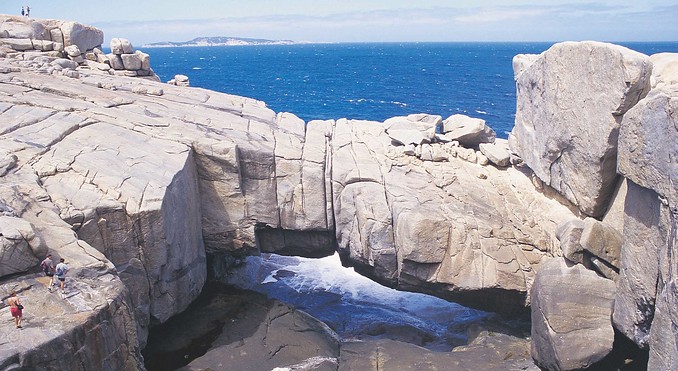
 Torndirrup – the National Park on the south coast at Albany with the Gap and Natural Bridge.

Walyunga – National Park on the Darling Range near Perth with many sacred places associated with the Waagyl.

Derbal Yiragan – Swan River

Pualar Miial – Bluff Knoll (tallest peak in the Stirling Ranges)

Throwing sand – When Noongars arrive at a water-hole or river, they throw sand into the water so as not to disturb the Waagyl and make the water safe for drinking and swimming.

The Gap, Torndirrup National Park, courtesy pleasetakemeto.com

Psalm 108 for Noongar country


My heart is fixed, O God, my heart is fixed:
I will sing and make melody.

Awake, my soul, and awake, sticks and didj:
for I will awake the morning.

I will play the didj, O Lord, among the peoples:
its circle buzzing breathes our gratitude.

I will chip your clapping sticks among the nations:
its clicking claims your eternal praise.

For the dawn in the east rises in gold and scarlet:
robes of Easter and Pentecost overwhelm the sky.

Your faithfulness reaches to the clouds:
and the land is a body painted with white and ochre dreamings.

Be exalted, O God, above the southern skies:
and let your glory shine over Noongar country;

That all whom you love may be delivered:
Noongars and wedulahs, O save us by your right hand, and answer us.

***

(Acknowledging Professor David Frost’s version of Psalm 108 in A Prayer Book for Australia)

 The ‘didj’ (didgeridoo) was technically not a part of Noongar culture before the arrival of Europeans, but they have adopted it since contact with ‘wedulahs’ (white fellas) has brought them into contact with other Indigenous groups.  

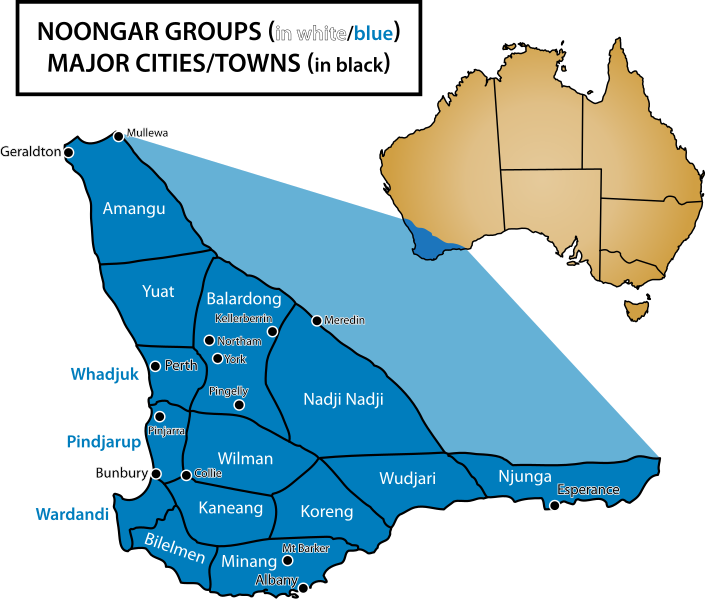
My country of origin is Koreng country. I now live in Wardandi country.

Noongar country (Western Australia)


Psalm 148 for Western Australia


Praise the Lord. Praise the Lord from heaven:
praise him from the heights of Toolbrunup.

Praise him, all his angels:
O praise him all his hosts.

Praise him, sun and moon, rippling staircase across the sea:
praise him, all you stars of light.

Praise him you highest heaven:
and you Cross bright against the dark of night.

Let them praise the name of the Lord:
for he commanded and they were made.

He established them for ever and ever:
he made an ordinance which shall not pass away.

O praise the Lord from the earth:
praise him you golden super-pit and caves of glistening stalactites.

Bush-fire and hail, cyclone and heat:
and willy-willies fulfilling his command.

Mountains of iron and giant ant-hills:
gum-trees, and grass-trees, and grey-green plains of spinifex.

Dingoes and kangaroos:
creeping things and long loping emus.

Elders of tribes, and many nations:
refugees and boat-people, and all who’ve crossed the seas.

Young folk and children:
Seniors and toddlers together,

Let them praise the name of the Lord:
for his name alone is exalted.

His glory is above earth and heaven:
and he has lifted high the stocks of his people.

Therefore he is the praise of all his servants:
of the children of the West, a people that is near him. Praise the Lord.

(Acknowledging Professor David Frost’s version of Psalm 148 in A Prayer Book for Australia)

* Toolbrunup – second highest peak (1,052 metres above sea level) in the Stirling Range in the Great Southern region of WA

* Staircase of the Moon – in Broome and Meelup in February and March the rising full moon shines over the east-facing beach to create a spectacular light effect like a staircase.

* super-pit – open-cut gold mine near Kalgoorlie 3.5 x 1.5 km and 600 metres deep.

* willy-willy – local word for dust-storm or mini-tornado.

* spinifex – properly called Triodia, these arid grasses are endemic to outback Australia.

Willly-willy


Psalm 89 for Western Australia


Lord, I will sing for ever of your loving kindnesses:
my mouth shall proclaim your faithfulness throughout all generations.

Let the heavens praise your wonders, O Lord:
and let your faithfulness be sung by your holy ones in cathedrals and karri forests.

O Lord God of hosts, who is like you?:
your power and your faithfulness are all about you.

You rule the raging of the sea:
when its waves surge at Yallingup, you still them,
when its tides rush in at Hedland, you level them.

You created the Kimberley and the Great Southern:
Kununurra and Esperance shall sing of your name.

The endless array of the stars is yours:
and so are the far-dreamt deserts of the interior.

You founded the fertile valleys of the West:
and filled the rivers with gilgies and fish.

Happy the people who know the cry of the black cockatoo:
who walk, O Lord, in the paths of your creating.

They rejoice all the day because of your name:
because of your righteousness they are exalted.

Our land belongs to our God:
our country to the One who makes us.

(Acknowledging Professor David Frost’s version of Psalm 89 in A Prayer Book for Australia)

* karri – eucalyptus diverticolor trees which grow extremely straight up to 80 metres.

* gilgie – a freshwater crustacean found in West Australian waters.

Karri forest (courtesy Wikipedia)