In the name of + God, Maker, Lover and Holy Spirit.
[You can listen to Ted preaching this sermon here]
There was once an evil and powerful king. Anyone who disagreed with him would be punished. Anyone who spoke up against him would likely be killed.
This king grew more powerful by conquering other cities and nations. His conquests had three phases. Firstly, he defeated the enemy by killing as many people as possible, sometimes thousands of human beings. Secondly, he obliterated their city and then captured its leaders. Thirdly, he deported all the remaining people to his teeming multicultural city and set them free.
This last phase was not as generous as it might sound. The defeated people would arrive in his city with nothing after a forced march of weeks or months. This meant they would be forced to eat the cheapest local food. They could not afford to eat their favourite dishes or according to their own food laws. They needed to learn the local language quickly, so they could bargain for food and necessities.
These captives had nowhere to return to because their city had been smashed to dust. They had no choice about any of these changes, so they quickly took on the culture of their new city – they became loyal (or frightened) citizens of the powerful king, making him richer and more powerful.
The children of the captives could improve themselves and the cleverest of them even became wealthy and powerful. One captive, whom the king named Belteshazzar, interpreted the king’s dream and became the king’s senior adviser, and he got the king to appoint three of his friends to senior positions in the king’s service.
These four young men were from Jerusalem.
They remembered how this ruthless king had destroyed every building in Jerusalem and most of all their beautiful temple. His soldiers had carried away the gold and sacred furnishings, especially the precious Ark of the Covenant. They remembered how this king had bound Jerusalem’s king, Zedekiah, and forced him to watch soldiers take a superhot brand and put out the eyes of all Zedekiah’s own sons. Then they had blinded Zedekiah in the same brutal way.
Belteshazzar’s real name was Daniel, and his story gives his name to the book in the Bible.
The powerful king decided to have a statue of himself built.
‘It will be the biggest, bestest, and most striking statue that anyone in the history of the world has seen,’ he said. And it was: five stories high and its two footprints the size of a room. Made of bronze and covered in gold, it was visible right across the city, glinting in the sunlight.
As Daniel tells the story:
When [everyone was] standing before the statue that Nebuchadnezzar had set up, 4 the herald proclaimed aloud, “You are commanded, O peoples, nations, and languages, 5 that when you hear the sound of the horn, pipe, lyre, trigon, harp, drum, and entire musical ensemble, you are to fall down and worship the golden statue that King Nebuchadnezzar has set up. 6 Whoever does not fall down and worship shall immediately be thrown into a furnace of blazing fire.” 7 Therefore, as soon as all the peoples heard the sound of the horn, pipe, lyre, trigon, harp, drum, and entire musical ensemble, all the peoples, nations, and languages fell down and worshipped the golden statue that King Nebuchadnezzar had set up. [Daniel 3:3b-7 NRSV)
The three young men still carried in their hearts the commandment of their God from their old city,
You shall have no other gods before me. 4 ‘You shall not make for yourself an idol, whether in the form of anything that is in heaven above or that is on the earth beneath or that is in the water under the earth. 5 You shall not bow down to them or serve them, for I the Lord your God am a jealous God…’
[Exodus 3:5a NRSV]
So, the three young men did not bow down and worship. Someone denounced them to the king, someone dobbed them in. The king called for Meshach, Shadrach and Abednego and told them what he had heard. He said to them,
‘Now if you are ready, when you hear the sound of the horn, pipe, lyre, trigon, harp, drum, and the entire symphony orchestra, you should fall down and worship the statue that I have made. But if you do not worship, you shall immediately be thrown into a furnace of blazing fire, and who is the god who will deliver you out of my hands?’ [Daniel 3:15]
But Shadrach, Meshach and Abednego said they could not obey.
17 ‘If our God whom we serve is able to deliver us from the furnace of blazing fire and out of your hand, O king, let him deliver us.18 But if not, be it known to you, O king, that we will not serve your gods and we will not worship the golden statue that you have set up.’ [Daniel 3:17]
This answer threw the king into a rage.
He ordered the fire to be made seven times hotter than usual. The soldiers shovelled on more wood, napalm, tar and brushwood. The flames streamed up 49 cubits – seven times seven cubits or 30 metres high in our measure. It was so hot that several of the guards who threw the three Judeans into the fire were instantly burned to death. That king just shrugged. Who cares? Just as long as Meshach, Shadrach and Abednego paid for their insolence.
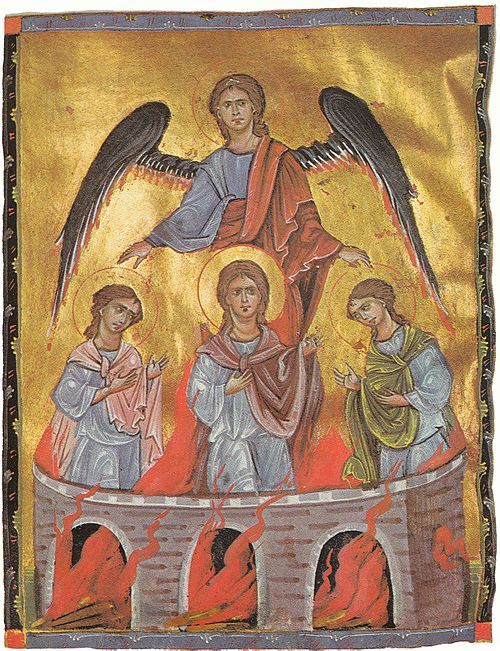
The three young men did not burn. They walked about in the flames. Unharmed. The fire did not touch them. it didn’t even burn their clothes. The king in amazement watched them walking about. They were even singing the Canticle from which we recited this morning. And the king was sure that he could see a fourth person in the fire, and, he said, this fourth person ‘had the appearance of a god.’ So the king called them and the three came out of the furnace alive with not even the smell of smoke on them.
The king was impressed. Anyone who doesn’t respect the God of Shadrach, Meshach and Abednego, watch out! he said. Impressed, maybe, but he was hardly a convert.
I remember reading about Shadrach, Meshach and Abednego when I was 9 or 10 in my Church Mailbag Sunday School and I thought it was an adventure story. Now when I read it, I realise it is a horror story. It tells of the way a cruel and powerful king distorts and destroys everyone’s lives.
Even as a child, I wondered whether I would have the courage to keep faith with my beliefs in the face of tyranny, or whether I would deny God. Now I still wonder the same, but I understand more why people do take the frightened way out to protect their families or their own lives; though it is not easy, because we live in Daniel’s world today.
Several thousand Iranians have been murdered in a meaningless war in the last few weeks. 75,000 (or more) killed in Gaza since the horrific events of October 7, 2023, less than three years ago. The leaders of countries targeted and imprisoned or murdered. Whole cities flattened. And millions around the world finding it hard to pay for essential items because that king in Washington considers the suffering of others irrelevant to his own objectives. And that, too, is killing thousands as it forces the poor into deeper hunger and bleaker cold.
Many people in the US today confront the quandary that confronted Shadrach, Meshach and Abednego nearly three thousand years ago – whether to bow down and worship or to stand up for justice and truth. And in other countries. And it could happen here in Australia too.
So those three Jews ask us the same question: what would we do? What does God’s love require of us?
+++
But there’s another question for us as Christians thinking about this story this morning.
Who was that fourth person in the fiery furnace?
- Was it an angel?
- Was it Daniel?
- Was it one of the patriarchs from Israel’s past, Moses, perhaps or Elijah?
- Was it God?
My conclusion is that it was Jesus Christ himself. Not as Jesus of Nazareth, but Jesus the Son of God, who was begotten by the Father before creation. The Son of God cares so much for people that when they are in the deepest, most awful situation possible, he comes to us in the horror and fear as a person with us.
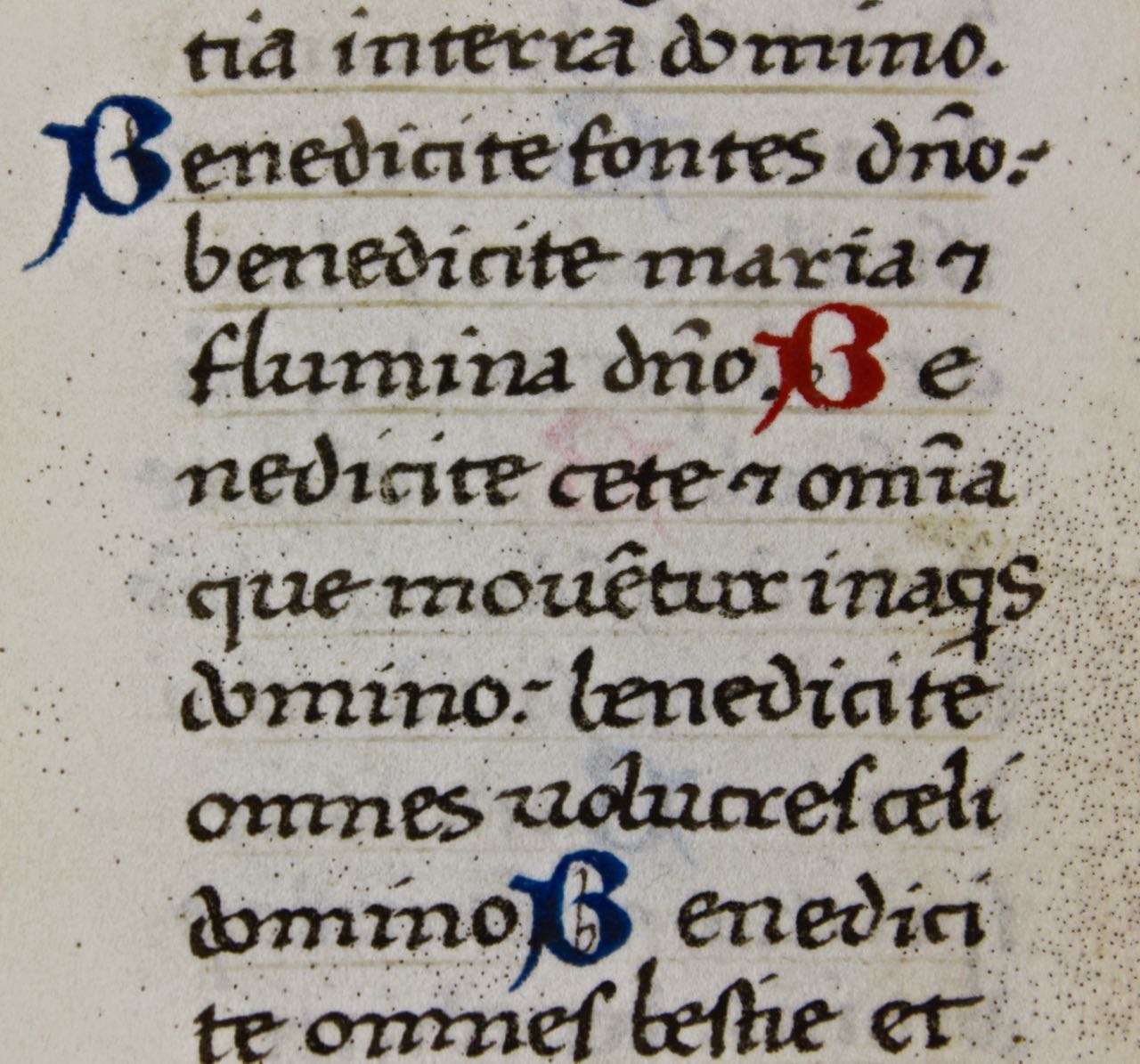
The three young Judeans sang the Canticle, the Benedicite, part of which we recited this morning.
In their song, they blessed God in the holy temple of his glory, they blessed God who dwells on the cherubim and who looks into the abysses, and they blessed God in his kingdom and in the whole cosmos. (Daniel 3:53-56]
God cares about the abysses, the deepest places. Christ comes to us as a fellow human being, one of us, even though he is God, and strengthens us to get through even the worst of our difficulties.
All of us know these deepest places. When a friendship or love relationship goes wrong; when we are seriously sick or in chronic pain; when we are unbearably lonely. We’ve all been there – and probably more importantly, we know others who are there now.
This, for me is the central meaning of the Trinity. God who created the world, who created us, loves us so much that He sends His Son to give us courage to live. It is not enough for God to love us in the abstract; God sends God’s strength in the way that will be best for us and mean the most to us, in human form.
We know the power of the touch of a family member when we are grieving: Christ with us to comfort. We might have experienced the lash of a good friend’s tongue warning to stop doing something spectacularly stupid. Christ with us in truth.
Last week near the beach at Rockingham, I saw where a homeless person had set up their bed and blankets near the main door of a shop, in a corner out of the south wind and the early morning sun. I wouldn’t be surprised if it was a Christian in the shop who allowed them to be there. But it wouldn’t matter if it was a non-believer, or a Muslim or a Sikh, that kindness was Christ present in that protection.
Our little dog Lottie hovers near me with concern in her eyes when I am in severe pain or breathlessness. She too is God incarnate.
And sometimes the powerful spiritual presence of Jesus himself, who loves us eternally. We treasure the awe in our hearts as we share in this Holy Eucharist. We cultivate his presence by daily prayer and regular immersion in the Scriptures.
The invitation for us is this: knowing in our heads that God our loving Father is always present to us in human form, in the form of Jesus Christ the Son of God, we are invited to recognise in our hearts his presence, his comfort, his strengthening, his guidance. And to help us recognise the Son of God, God sends Holy Spirit to remind us of God’s loving presence.
This is the answer to evil. This is the answer to the wars, the cruelty, the indifference of kings. The compassionate presence of Christ with us, and, living in Christ, we too are Christ’s eyes, and hands, and feet.
This is the Trinity, constantly at his work of love, creating us and his beautiful world, being present with us in the Temple, in the cosmos and in the deepest abysses, and whispering in our hearts that he will be always with us.
We bless the name of Father, Son and Holy Spirit,
who is worthy to be praised and glorified forever.
Amen.
+++
Sermon preached at St Brendan ‘s-by-the-Sea, Warnbro, Trinity Sunday, May 31, AD 2026.
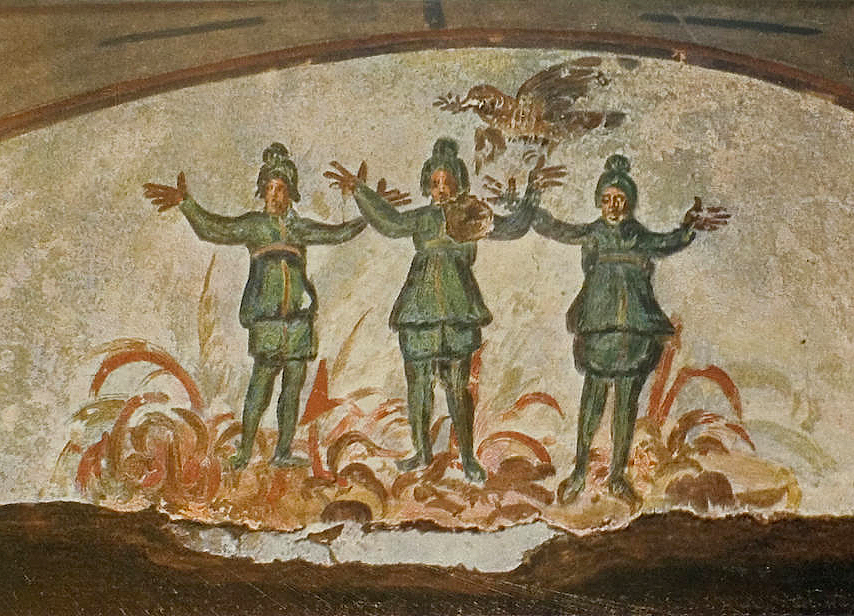
Featured Image: Shadrach, Meshach, and Abednego in the fiery furnace, from the book Die Malereien der Katakomben Roms, plate 78; original painting in the Pricilla Catacombs.