Two Chapbooks by Brother Noel SSF – review


At Home in this Country

Noel Jeff’s two chapbooks reviewed by Ted Witham tssf

Noel Jeffs SSF, Ode to Warrigal Creek Massacre,
2025, A4 card folded.
ISBN 9780646826042.

Noel Jeffs, a Brother in the Society of Saint Francis comes from a farming family as I do. Settler folk like us cannot deny that our comparative wealth and social position derive from the dispossession of Aboriginal people.

The name Warrigal Creek in Victoria, like Pinjarra in WA, and doubtless similar names in other States, resonates because of the massacre perpetrated there. The name produces a complex amalgam of emotions, which Brother Noel explores in this poem.

Hope for reconciliation of country seems to be blown away by the ‘hot anger of a tied-up dog’ (line 3); shame for these murderous acts follows, and ‘now in pain I knead this atrophy’. (line 11). This line describes the violence with which the recollection of Warrigal Creek is turned over in the poet’s mind, like pushing, smoothing, pulling, pounding, tearing and restoring flour and water when making bread. The word ‘knead’ is a homonym for ‘kneed’, and I take from this that the poet’s rumination brings him to a silent place of kneeling in penitence.

The last and biggest emotion is ‘grieving’, grieving that the ‘litter of bones’ (18) may let the poet’s shame be revealed.

But hope seeps through the crammed lines of the poem. The insistence that this is ‘my country’ is used here to recognise the shared pain of remembering. It is ‘country’ as named by its original inhabitants, but it becomes ‘my country’ when truth is revealed.

The poem is printed on one A4 card folded. The front depicts four rainbow serpents entwined in a circle. The heads of the snakes form a cross with the word ‘sacred’ inscribed four times on the circumference. Printing in black and white has made the symbol rather harsh. References to the full story of the Warrigal Creek massacre are on the front and back covers.

The card would make a suitable emblem of remembrance for participants in a day of truth-telling, especially about the Warrigal Creek massacre. I commend Brother Noel for this brave contribution to the national and necessary task of truth-telling, This poem on its card is ‘a plaque to heroically // scold’ (13-14)

The Angelus and Mudbricks

Noel Jeffs SSF, Roads to Stroud: Grasping at Tears, Precipices, Sydney, Darkstar Digital 2024, 19 pages

Brother Noel’s chapbook consists in two poems of just under 140 lines each, describing the journey taken by the poet from the city into the bush of the Hunter Valley in NSW.

The Stroud of the title of Brother Noel’s poems needs some explanation as Stroud figures large in the imaginations of Australian Anglican Franciscans.

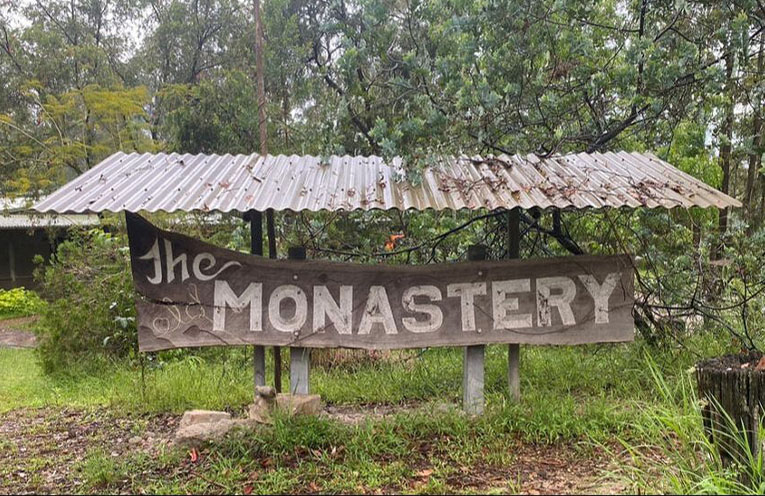
Nearly 50 years ago, three Anglican Franciscan nuns from the Community of Saint Clare in England arrived in Stroud in NSW with a vision to build a house for the Community. A small block of land just outside the town of Stroud was sold to the Sisters. Under the leadership of Sister Angela, an Australian, the Sisters, with volunteers helping, made mudbricks and constructed them into a unique building – a monastery with almost no straight lines but a lot of character.

A Chapel and Hermitage for the Brothers, initially for the priest-brothers to provide chaplaincy to the Sisters, was constructed 100 metres away from the monastery.

Since then, all three branches of the Franciscan family have made deep connections with this small section of attractive bush. Some of Noel’s fellow-Brothers make their home here, and Third Order members have enjoyed the rich hospitality of the place. Sadly, the Sisters returned to England in 2000, but memories of them are strong, especially in the old monastery, now a retreat house imbued with prayer.

In Brother Noel’s second poem under review, Precipices, ‘mudbricks and mudbricks’ (p.14) and the Angelus bell of the Chapel (p.16) take us straight to the property at Stroud. (It may also be intentional that the grey cover and simple typeface mimic the covers of the Sisters’ booklets of poetry and spirituality back in the 70s – a fitting homage!)

Noel Jeffs’ writing is thick with classical, Biblical and Franciscan allusions giving the whole experience of the poet’s visits to Stroud a nuanced exploration of ‘this parade of // fervour to want to come back year, // after year’.

The poet’s experience of leaving the city ‘awash with railway yards // tracks to sentience and homely inner-city birds’ (page 3) and arriving at Stroud where he finds it ‘ensconced in // its wilderness of wildness, made a // garden estate.’ (15)

The natural world and the human world are as entwined in the city as in they are in the country.

When the first Europeans arrived in NSW in 1788, some described the ‘natural’ parklands, the result of many thousands of years of land care by the Indigenous inhabitants, as a garden estate, so there’s a double irony in Jeffs’ description. Stroud, with its beautiful curated gum trees and mown grass, is a ‘garden estate’ hewn from wilderness.

The ‘loss’ of wilderness (or the Indigenous parkland?) is claimed with ‘a black fella warrior stood here // beckoning on, welcoming us in // in a vision.’ (15), the word ‘vision’ doing double duty here for physical vision and insight.

Jeff’s language is oblique. Words slip from meaning to meaning. As the poet is travelling north, watching the illusion of staying still in the train and seeing the bush moving, he asks, ‘What do I want to say about // the cantering bushland which // surrounds and is enveloped // by a tunnel of true darkness // which shapes my life in all its // passages?’ (12) The bush is cantering by as a horse canters, but it is also ‘canted’, (‘written slant’ as Emily Dickinson would say), so that it describes both the scenery and the poet’s inner feelings.

I relish the musicality of Brother Noel’s verse. He is a master of assonance which ranges from pure rhyme to distant echoes of sound. Savour the repeated ‘s’ , ‘p’, ‘ps’, and ‘l’ sounds in these three lines:

‘The circumference is here, and no longer

lying lips, give me a platypus and make

them safe.’ (13)

Simple in intention, the poems describe a journey home. But where is home, and what does it mean? The city ‘in which I am free // and lucky to be alive’ (1), or Stroud, where ‘I have gone to heaven, and am // coming down on the other side // of the earth’ (14)?

The archetypal ‘snakes [which] make love on poles’ (3) are a striking and original image, but they are surely meant to evoke the Caduceus, the staff of Mercury, the messenger of the gods, and widely used as a symbol of medicine. In ‘Grasping at Tears’, the poet is going to Stroud, and with him the messenger of the gods, a diplomat, the bringer of medicine, peace and healing. But the Caduceus also speaks truth with deception. The poet is an unreliable messenger, and his message is a rich potpourri of ambiguous imagery, alluring music and insights almost made explicit.

The poems are introduced by two fine photos taken by Brother Noel, the first shows the gravel road into Stroud, and the second a butcherbird enjoying her reflection in the outdoor shaving mirror at the Hermitage.

The poet may be ‘Grasping for Tears’, but it is unclear whether the tears are tears of sadness or tears of delight – probably both. I find the two poems ultimately hopeful, as the poet claims that:

‘Home is a handsome place   

an exotic space for silence

A limbering tree-house (5)

***

Ode to Warrigal Creek Massacre and Roads to Stroud are available direct from the author, Noel Jeffs SSF, at noeljeffs@hotmail.com.

Satire kicks our consumerist world

The Transition is the funniest – and best crafted – novel – I have read this year.


Luke Kennard, The Transition, Fourth Estate (2017)

Paperback (Used) from $10, Kindle e-book from $8

ISBN 9780008200459

Reviewed by Ted Witham

The Transition is the funniest – and best crafted – novel – I have read this year. Well-known in Britain as a poet, this is Luke Kennard’s first novel.

Millennials Karl and Genevieve are struggling to make ends meet. Locked out of the housing market with Karl unemployed, Genevieve is a Primary school teacher. She loves her job, and despite her day-to-day frustrations in the classroom, believes in its importance to society.

Karl writes online ‘cheat’ essays for university students of English literature. He is drawn more into the online world of writing for cash until he finds himself convicted for fraud for his almost intentional participation in an illegal scam.

Instead of jail time, the couple is offered a placement in ‘The Transition’, a program that invites a commitment of six months to turn their finances, and lives, around. They are billeted in the spare room of Stu and Jenna, who follow a mysterious Manual to reform their guests.

‘The Transition’ turns out to be not quite as advertised. As Karl explores the scheme’s underbelly, Kennard reveals a wider community based on inequality, where the poorer middle-class are shut out of the common wealth of their society, and where big data distorts and dictates their lives.

These forces override people’s compassion for mental illness, and Genevieve’s descent into illness is sensitively described.

The themes are serious. Kennard treats them seriously, but with a joyous lightness that helps us sympathise with a couple just trying to make it through the week.

I plan to re-gift my copy of The Transition this Christmas – and I have no feelings of guilt whatever in doing so. It’s the sort of novel you want to share!

Testing faith


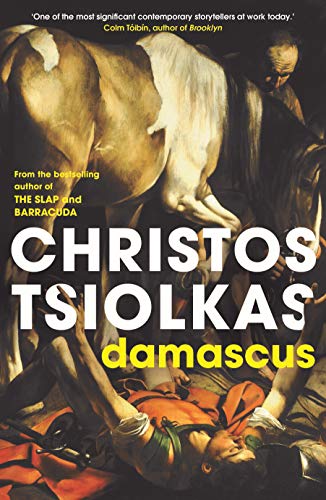
Christos Tsiolkas, Damascus, Allen & Unwin 2019,
ISBN 9780760875091, 423 pages.

From $AUD19 online, Kindle edition $AUD 16

Reviewed by Ted Witham

Christos Tsiolkas tells the story of Saint Paul in such a gritty fashion that I nearly gave up on the novel several times. It is not for the faint-hearted. Greek-Australian novelist Christos Tsiolkas is known for his hard-hitting and relentlessly honest writing. The Slap, a suburban novel exploring whether adults other than parents can administer corporal punishment, provoked controversy.

Tsiolkas’ previous novels, including Barracuda and The Slap, have been turned into movies. I wonder whether anyone will dare to make Damascus – The Movie. The novel skates on blasphemy – not a new charge against Tsiolkas – and its depiction of the brutality of the pagan empire surrounding and threatening the early Christians is sickening. The love between Paul and Timothy, and between Timothy and Thomas, is at the least obsessive, if not outright sexual. This factor alone will make it difficult for many Christians to accept the novel.

Three axes explore the different directions in which the early church was developing: Paul and Timothy represent the more orthodox view, that Jesus is the Saviour, that he has appeared after the resurrection, and that he will return soon and take into the resurrected life all the baptised.

Paul and Able (as Tsiolkas names the ex-slave Onesimus) represent the dilemma faced by the early church when Jesus does not return. Able believes that the Christians should ditch this teaching, and also baptise infants.

The third axis is Timothy and Thomas. This represents the view of some early Christians that Jesus was a great teacher and prophet who died – end of story. (Tsiolkas confesses in the afterword that this is closest to his view.)

The conflicts between these emerging theologies drive the story.

There are underlying themes that are common to Tsiolkas’ other work. The intense relationships between the men in the story reflect Tsiolkas’ own struggles with sexuality. The severity of a faith which requires its apostles to forsake family is portrayed fiercely. The treatment of the refugees who pour out of Judea after the destruction of the temple resonates with today.

I would not recommend this novel to fellow-Christians unless you really want to be challenged. It may be the book for a friend who is amoral and extremely secular, a lover of the violence in the Vikings series or Game of Thrones. Damascus has a depth and a challenge to believe that is absent from those.

Whoever reads Damascus will be moved and outraged. It will divide readers. Any novelist that can achieve those outcomes so forcefully is to be respected!

My novella The White Dove reviewed


My friend and fellow-author Philip Bodeker has reviewed my novella, The White Dove, obtainable through Smashwords.

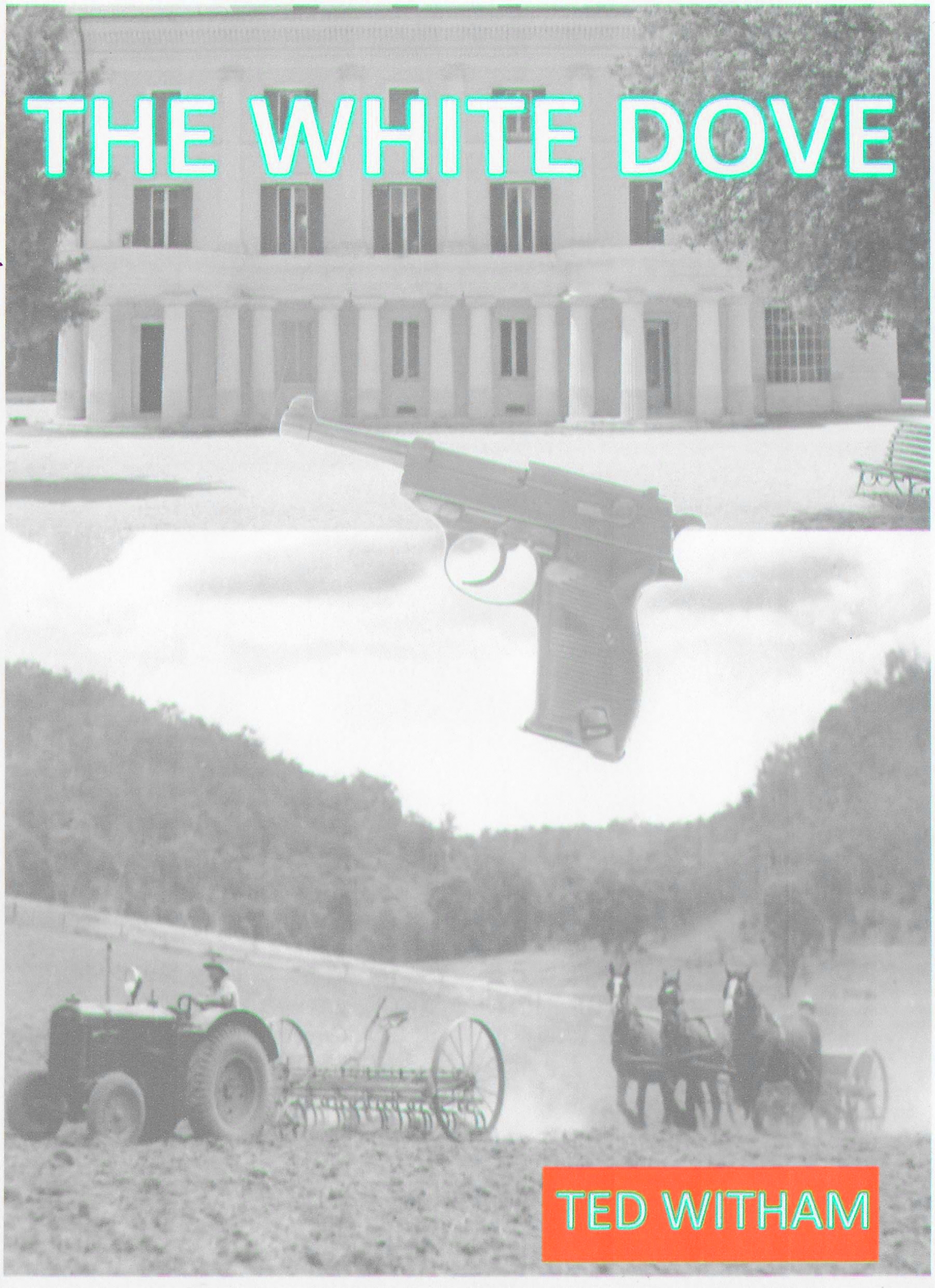
THE WHITE DOVE.  (Ted Witham) Underground resistance in wartime France

From the small country town of Kojonup in Western Australia, where she has learned to handle wheat, sheep, trucks and guns, Emily Collins travels to France, marries into aristocracy and becomes involved during World War II, smuggling Jews and stranded Allied airmen across borders.  In a cat-and-mouse pursuit across France, avoiding murderous French Vichy “milice”, The White Dove is whisked along secret pathways and escape “pipelines” to meet trusted anti-German conspirators in quaintly named French farms and villages.

Through shocking tragedies, lost loves and secret meetings our Australian heroine is propelled in breathtaking escapades towards an escape route through the High Pyrenees mountains into Spain. Her skills in French dialects and Latin are invaluable as she encounters country folk and then a Franciscan religious community where she assumes the guise of a Franciscan nun.
Much of her story is possibly foreshadowed in the life story of The White Dove’s author, Anglican minister, scholar and languages lecturer Ted Witham, who like Emily was raised on a wheatbelt farm, studied French and Latin at the University of Western Australia and was educated at an elite Perth school.

The story doesn’t end at the Pyrenees. A family farm ownership dispute follows her across France, but is curiously solved by none other than family friend John Curtin, who after her return to Australia has become Australia’s Prime  Minister.

Emily’s skills and resistance experience now make her an ideal choice for Britain’s Special Operations Executive, or SOE, where she becomes part of the secret spy operations centre at Bletchley. A flickering romantic attachment with a rescued British airman during their initial escape across the Pyrenees reignites as the two become part of her final spy mission.

Review: Philip Bodeker.

Archbishop of Canterbury’s Lent Book Renews Engagement


Looking through the Cross

Graham Tomlin, Looking Through the Cross: The Archbishop of Canterbury’s Lent Book 2014, Bloomsbury Academic (2014), Paperback, 240 pages.

Good stocks at St John’s Books, Fremantle. $19.95
Kindle edition available from Amazon for $10.88

Reviewed by Ted Witham. First published in Anglican Messenger, February 2014

Being a Christian requires personal engagement – with God, with Jesus Christ, with neighbour and stranger, with truth, with good and evil. For most of us, being a Christian can be complex and demanding, but we remain committed because we believe that God is eternally committed to us.

A good Lent book refreshes this sense of personal engagement with Christian living. It should encourage, inspire and inform by taking readers both back to when they fell in love with the faith and forward by challenging readers to grow spiritually. Good Lent books are often about the Cross and Resurrection clueing us into the liturgical movement of Lent and the Paschal mystery at its climax.

Graham Tomlin’s Looking through the Cross is a very good Lent book. It is about the Cross. Tomlin tells us that his early chapters are looking at the cross, trying to understand more deeply its meaning for us, and the later chapters are looking through the cross, using the cross as a lens on the world.

In the chapter headings, ‘The Cross and Wisdom’, ‘The Cross and Evil’, ‘The Cross and Power’, ‘The Cross and Identity’, ‘The Cross and Suffering’, ‘The Cross and Ambition’, ‘The Cross and Failure’, ‘The Cross and Reconciliation’, and ‘The Cross and Life’, it is not entirely clear when we change from looking at to looking through. I am sure that ambiguity is deliberate: the cross always both teaches us about itself and reveals how it has changed God’s world.

Graham Tomlin writes clearly. Reading his book is like sitting with the most patient teacher, sharing with us his understanding of how the cross comes alive for him. His explanation of the connection between the cross of Christ and our personal sin is the clearest I’ve encountered in 40 years of reading books about Christianity. ‘Those who have perpetrated evil must be held to account,’ he writes. ‘The evil that has disrupted the world cannot simply be ignored or glossed over: it must be banished, dealt with, put right. Restoration is possible, but only when sin is somehow atoned for.’

Archbishop Rowan Williams commissioned The Reverend Dr Graham Tomlin to write this year’s Lent book. His successor in Canterbury, Justin Welby, ‘could not be more pleased’ with the choice. Centred in scripture, scholarship and pastoral experience, this book seems to me to bridge some of the divides in contemporary Anglican thinking.

The cross demands that we clearly separate Christian faith from the surrounding culture. In the powerful chapter on identity, Tomlin describes how our experience of family christenings obscures the radical change God makes in us in baptism when God gives us a new identity. Using the image of a protected witness or juvenile criminal with a new identity, he reminds us how hard it is to live out of a new identity, and how the old identity will continue to exert a pull on our lives.

But the cross is ultimately the path to life. We are made not to end in death, but in life. Tomlin reminds us of the leap in imagination we need in order to lay hold of this reality, but also rallies us with the knowledge that the new life of the cross and resurrection is ultimately God’s work and not only ours.

It is helpful if a Lent book has some guidance for its use: questions to provoke reflection or small group discussion, suggestions for art response, even a reading program. Looking through the Cross has none. This is a significant drawback in a book promoted for Lenten reading. Even without this, individual laity, clergy and groups will find Dr Tomlin’s book refreshing, challenging and clear. At the end of Lent, the book will help readers emerge at Eastertide re-engaged with their Christian faith.

Novel Readings of Australian Men’s Emotions


I’ve been reading two new and extraordinary Australian novels: Richard Flanagan’s Narrow Road to the Deep North and Tom Keneally’s Shame and the Captives. Both deal with the Second World War.

My brother and I were born just after the War. He remarked recently how much the men we had grown up with had been marked by that war. We grew up on a farm, and we saw farmers who spent their time drinking not farming; our nearest neighbours lived with their grandparents, but they turned out to be paternal grandmother and maternal grandfather who shared their house. On a remote farm, one farmer loyally cared for ‘Mad Jack’. Today this eccentric would be recognised as an untreated sufferer of Post-Traumatic Stress Disorder.

The novels by Flanagan and Keneally take us to events that damaged many Australian men: the Burma railway and the Cowra break-out.  Both novels, though explicitly fiction, describe the events fully, but exploit what novels do best: they humanise the characters. Both novelists are unusually ambitious. Flanagan’s main character Dorrigo Evans is a doctor who ends up as Officer Commanding the prisoners building the Thai-Burma railway. This is dangerous ground. Australians have made ‘Weary’ Dunlop into a hero and this character is too like the legend of ‘Weary’. But Dorrie Evans believes he is no hero. He is a man just managing to hold himself together in the extreme conditions.

Flanagan shifts the time backwards and forwards between the doctor’s pre-war infatuation with his uncle’s young wife, and his serial womanising after the war. His one real act of heroism may be some years after the war when he saves his society wife and children from a Tasmania bushfire.  But on his death-bed, he has a kind of vision of his heroism on the railway. He remembers when the Japanese guards force him to select 200 men to march to another camp. The men are sick and dying, and he must make selections knowing that he is sending the men to a certain death, others he is saving. Yet he moves through the parade, putting his hand affectionately on the shoulder and naming each man chosen. He gets up early next morning, feeling the heavy responsibility for his choices. In his dream, each man comes up to him, shakes his hand or salutes him with a cheery ‘Thank you, Sir,’ or ‘All the best to you.’ Somehow the little he does, even the mistakes he makes, are seen as heroism, and Flanagan shows us how hollow he feels, almost as though he is a fake, or has been mistaken for someone else.

I was gripped by Flanagan’s depiction of loyalty between ordinary men. Just trying to stay alive in a hellish world, they both helped each other and sometimes failed to help each other. The profound cruelty inflicted on these men created something of beauty, a tiny bloom in the dark jungle. We all know and feel the barrier to giving this bond of mateship its real name. Flanagan dares once in the novel to call it love. The novel also acknowledges how the hardships also ravaged Australian men in ways that their children who are Flanagan’s generation – my generation – are only beginning to understand.

For Richard Flanagan, behind unexpressed emotions the laconic Australian male hides a vulnerability, and many are not only vulnerable but fragile too.


Our emotions are unexplored territory, and Tom Keneally, from an earlier generation, knows that our lack of familiarity with the world of emotions makes it difficult for us to explore the emotional lives of others. The Italians and the Japanese in the POW camp at Gawell, the fictional palimpsest for the real Cowra, provide Keneally with contrasting case studies.

I was surprised to learn that most of the detainees were not internees but were prisoners of war. The Italians and the Japanese were kept in separate compounds and had very different attitudes to being captured: the Italians were on the whole relieved. Their allegiance to Mussolini was not deep, and in any case Italy was about to fall to the allies. The Japanese seethed with resentment both towards themselves and their captors. Their ambition as warriors had been to kill or be killed in the service of the Emperor. To be so weak as to be captured was shameful, and they bore their shame with difficulty.

The Japanese despised the Australians for looking after the camp according to the Geneva Convention. This compassion was weakness. They refused to cooperate and found little ways to make life difficult for their captors.

The Italians by contrast were happy to work on Australian farms, to attend Mass with Australian families and to reach out for human contact. We follow Giancarlo, or “Johnny”, the work-release prisoner on the farm of a widower and his daughter-in-law. An affair develops between the two, leading to confusion in the novel’s climax when Tengan is re-captured on their farm after the “break-out”.

Keneally shows us the emotional deafness of career Colonel Abecare and his subordinate Major Suttor, whose main interest was writing a popular radio serial, both to their own feelings and to the cultural-based emotions of their prisoners. The shame of Japanese warrior Tengan and his hatred for his enemy is well-drawn. On the other hand, the contempt of the Koreans for their Japanese superiors is hidden from the Australians. They saw the warrior mentality and loyalty to the Emperor as dangerous and meaningless.

The killings and suicides in the break-out shock the Australians who are not prepared for such extreme expression of emotion. Abecare, the old English soldier, is slaughtered, and the Australians are left to muddle through. And the novelist continues to hint at a kind of cultural autism, an inability in Australian men to read the emotions of others, because they cannot read or articulate their own.

My brother is right. We accepted that generation of damaged men just as eccentrics. It has taken a life-time to begin to understand their impact on us and to learn to love and hate, and fear and enjoy, to be angry and disgusted, and to know that these emotions are the essence of life.

Moving Stories


REVIEW:  Robert Béla Wilhelm, Perfect Joy in Holy Week: Walking with St Francis of Assisi in the Footsteps of Our Lord, Storyfest Productions 2013 (Volume 3 of the Collected Works of Robert Béla Wilhelm).

Reviewed by Ted Witham

Dr Robert Béla Wilhelm was our keynote presenter in the Third Order Conference in Perth in 2006. People warmed to Bob and his gentle style of telling stories about St Francis.  Quite a few Tertiaries have kept in touch with Bob since then.

Bob’s style of story-telling moves me, sometimes to tears. I sometimes find them hard to read to others without tearing up. His story-telling evokes an emotional depth to help the listener connect with the richness of his stories.

Perfect Joy in Holy Week is a series of six stories about St Francis for the six days of Holy Week. Each story has a short version and a long version, and each story is introduced by the Scripture readings set for the Eucharist of the day and concluded with provocative reflections.  These stories are accessible to anyone and speak strongly into anyone’s life.

The stories can be used in worship, particularly at an appropriate Eucharist, at an Area/Region meeting or in your private devotions. You can read or tell the story yourself, or, in the iBook version, hear Dr Wilhelm himself bringing these stories to life.

Bob is also an icon writer. Perfect Joy includes traditional icons and paintings as well as some of Bob’s own. So prayerfully are they written I find I have to look carefully to see which are the traditional icons and which are Bob’s.

The attention to detail in this book is obvious. He includes not only the lections for his home Roman Catholic tradition, but also the Anglican and ecumenical lections where they differ. Design values are high even in the E-book versions. The pages were lightly textured and the layout easy to use, colourful and easy on the eye.

While they follow the great events of Holy Week, the stories and reflections can still be enjoyed at any time of the year. Rae and I didn’t get around (typically) to using these stories until Easter week, but we still found them to be fresh, inspiring and encouraging.

The easiest way to obtain either a print or electronic book is by visiting the Storyfest bookstore at http://www.sacredstorytelling.org.

***

Review first published in the Pentecost 2013 Newsletter of the Third Order, Society of Saint Francis, Australian Provinnce.

More than Human?


Martin Higgins, Human+,

Kindle E-Book $US 3.99, Paperback 230 pages (online) from $AUD 18.26

Reviewed by Ted Witham

This book and I did not start well together. The narrator initially sounded like science fiction’s clichéd young male narrator who is attempting to channel Raymond Chandler and whose only friend is the barman.  But within a few pages, I was surprised to realise that I was inside the head of a schizoid drug-user with heightened paranoia. I changed from groaning to admiring the writing.

David, the drug-user, turns out to be a select adept at psychological precognition – mind-reading. He has the ability to tune into people’s thoughts, moods and memories. A mystery organisation recruits him and offers to train his precognitive gifts. He befriends the trainers and discovers that his talents outshine theirs.

The organisation engineers a high-profile position for him, inventing a back-story with academic papers and university records. Lawrence, one of the trainers, seemingly deserts the organisation, and David is left to wonder whether being caught up in the world of high capitalism is the best use of his supra-human gifts.

To its credit, the book does not give a pat answer to this question, but leaves the reader with complex possibilities: with the help of nanotechnology, will human beings ever develop advanced communication abilities? Can capitalism deliver the most ethical future for humanity? Will there always be people left behind by human progress – will the poor always be with us despite all the promises of technology? Are reading and story-telling technologies by which we enter the thought-worlds and moods of other humans and transform ourselves into more than humans?

At the end of the book, I was surprised how much I had enjoyed it. I enjoyed the company of the first person narrator, I was intrigued with the bigger questions raised by his experience, and I continued to wonder where the hard science ended and the fiction begun. That’s a mark of good science fiction.

The book was professionally presented, so I did not have the common experience with E-books of being confronted by spelling and grammar clangers. The story kept me interested until the end, and it was altogether an enjoyable and worthwhile read.

Hope for Palestinians


Michelle Cohen Corasanti, The Almond Tree, Reading, UK: Garnet Publishing

Paperback from $AUD 11.22 (online) or Kindle E-book: $US 3.49

Reviewed by Ted Witham

I wept frequently while reading this outstanding first novel.

The Almond Tree tells the story of Ichmad Hamid, a gifted Palestinian boy whose family home is destroyed to make way for Jewish settlers. They lose their orchard and, after some years in a tent, are able to build a one-room cement-block house on the tiny patch of land the Israelis leave for them. Ichmad’s beloved Baba is sent to prison for 14 years after 12-year-old Ichmad helps radicals bury weapons in their backyard.  Their small home and all its possessions are again destroyed by Israeli soldiers.

In his father’s absence, Ichmad takes on the role of provider for his family, working on Israeli settler construction sites for far less wages than the suspicious Iraqis and Russians who work with him. Following his father’s advice Ichmad tries to choose always the way of peace, and despite endless provocations, not to return hatred for hatred.

Teacher Mohammad offers to tutor the gifted boy every evening after work. Ichmad wins a scholarship in Maths and Physics to Hebrew University, and sets out on a stellar academic career. He collaborates with his Professor, a bitter Jew whose family was murdered in Auschwitz. Eventually the two become close friends and win the Nobel Prize jointly for their work on nanotechnology.

Ichmad continues to support his family on his Professor’s wage at Harvard, and maintains close contact with his village. He identifies with their life-giving almond tree with its roots deep in Palestinian soil. At every turn in his story  he encounters tragedy, much of it caused by the brutality of Israeli occupation, and Ichmad’s desire to choose peace almost always – eventually – turns the tragedies into something deeper and positive for his people and his family.

This is a powerful first novel by a courageous Jewish-American woman. I did not need to be persuaded that the occupation of Palestine is anything but a disaster for the Palestinians. It would be wonderful if this novel helped others to see the human cost of providing a secure and secular state for the Jewish people. It may just be sufficiently powerful to do so.