As a writer and language teacher, I know the power of
language. We express ourselves in words and sentences. With language we
persuade others to see things the way we do. The language of others influences
the way we see the world.
Think of the differences between Ayers Rock and Uluru: the former celebrating the Chief Secretary of SA at the time explorer William Gosse sighted the rock in 1873; the latter marking the complex relationship the Anangu have formed with Uluru-Kata Tjuta over tens of thousands of years.
The English names in our country reflect the dispossession of the land by its Second Peoples. Ayers Rock, backed up by the colonists’ military power, rendered Uluru invisible. This has been repeated time and again across Australia. The obliteration of Aboriginal names may not have been a deliberate policy, but it was part of the large-scale destruction of Indigenous culture by the incomers.
We should rejoice that, at times, the settlers listened to the locals and used their name for the place. (According to Professor Leonard Collard, about half of south-western Australia’s placenames are Noongar.)
Wejulahs (my mob!) enjoying the ‘water that is there when all else is dry’, Lake Toolbrunup
Toolbrunup, the name of the lake on our family farm and of the mountain on the horizon, is` close to the original. It means ‘the place which has water when all else is dry’, which was true until 20 years ago. Sadly changing land use has turned the lake into a place which is perpetually dry, but the name still reflects the memory of the Koreng people who gathered there year after year at the end of the hot season well into the European period.
For this is the power of Aboriginal placenames: they record
a staggeringly long bond between people and land. They are memory; they are the
keepers of value; they are part of the record of the most ancient continuous
culture in the world. It is arrogant to continue to give places new European
names if they are already named.
Of course, it is appropriate that the built environment
should be named both for Aboriginal and wejulah
reasons. A new school can be called the Bob Hawke College, but another one
could be named the Wagyl Kaip College after the inland region of Wardandi
country. Above the Forrest Highway could be the Mokine Overpass. Our history
now, for better or for worse, is a joint story.
Mokine – image courtesy Elders Real Estate
Local governments around Australia are developing commendable policies of dual naming, reviving the hidden Aboriginal name for places alongside the European name. Some have also adopted the principle of first using the Aboriginal placename (with appropriate permission from local elders).
The theme for National Reconciliation Week 2019 is ‘Grounded
in Truth: Walk Together with Courage’. What better place to start finding the
truth is in the literal ground, the
land beneath our feet? Sensitivity to placenames will speed this recovery of
truth and memory and help wejulah to
absorb more of Indigenous culture and reality and walk together with courage
into the future.
Israel Folau has been sacked. Rugby Australia could have handled the situation differently. But in the end, it was Folau’s own doing, and he knew it, so cannot escape responsibility. To his credit, it appears that he accepts his punishment.
Folau knew how his post would be heard. He claims it was
written in love: what he posted was
bound to be heard as the opposite.
I think I have some credibility to comment on this: for four years I was the CEO of an inter-denominational Christian agency. Our main ministry was in a secular context. I learned that I was constrained in what I could say. Very constrained. But paradoxically, I learned that I could say anything at all – if I said it the right way.
Effective communication requires you to think yourself into
the shoes of the audience. It requires understanding their context, and,
specifically, to communicate Christian truth, you must appreciate their
beliefs: what they believe and how they express it.
Israel Folau’s post was based on I Corinthians 6:9-10. He
added to it the command to ‘Repent’ and ‘Jesus saves.’ He invokes God’s mercy
for repentant sinners, a central Christian teaching. However, I Cor. 6:9-10 was
not written for non-believers: it was written for ‘brothers and sisters’. What
is more, it was written for believers of the 1st Century. Its language
does not cut through in the 21st Century; or it cuts through in the
wrong way.
Folau’s Instagram followers include non-believers. If he was genuinely warning sinners to repent, then he should have known that they would not hear his message that way. He had already amended I Cor. 6:9-10 to include mercy for the repentant: he could have ditched “hell” and crafted a sermon to be heard!
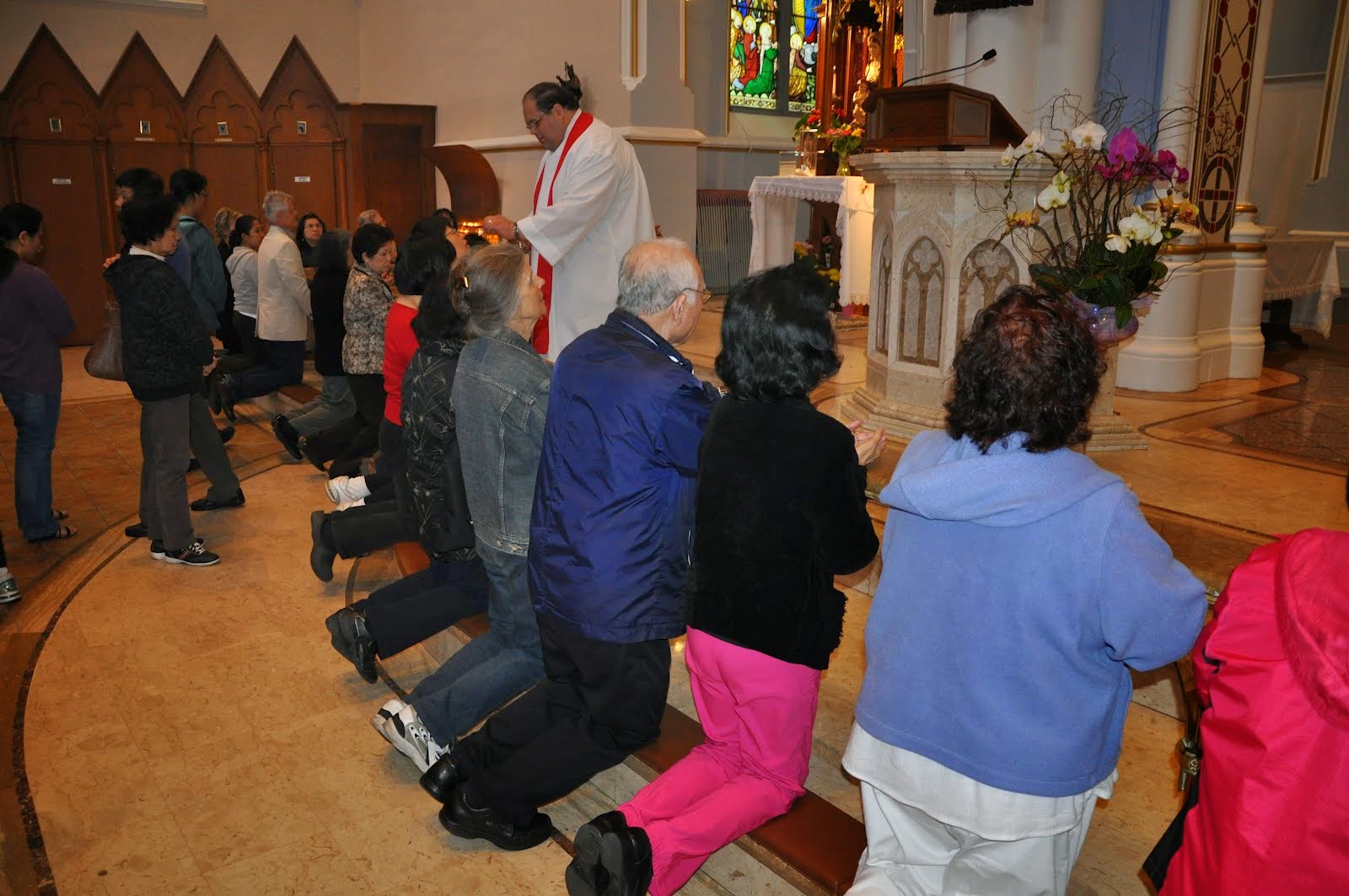
I have a childhood memory
of Grandad kneeling in his striped flannel pyjamas at his bedside saying his
prayers. Those were the days when the reflexive response of a congregation to
the liturgical command “Let us pray” was to instantly fall to its knees.
Like the American tourist
in London overawed by the Tower and the Beefeaters, we didn’t think about it. When
the tourist heard one uniformed Tower guard call to another, “Neil! Neil!”, he responded
instantly as in church and fell to his knees.
In his diminished height
in the kneeling position, in every folded part of his body, Grandad was
demonstrating his belief that he was in the presence of One far greater than
himself. To bend before such a One is the only way to dare to enter into
conversation with the Eternal One.
The Usher sings in
Gilbert and Sullivan’s Trial by Jury, “Silence
in Court, and all attention lend. Behold
your Judge! In due submission bend!”
More telling for us Christians is the Biblical example. The Hebrew word “shachah” means “to bow down” and implies kneeling and touching the ground with the forehead. Abraham, Moses and many others “bow down” at least 172 times. In the New Testament, the Greek word for “I bow down” is “proskuneo”. It means literally, “I kiss, like a dog licking its master’s hand”, and occurs 60 times in the New Testament. The people of God expect to bow down, to show loving submission to their God.
We, as a church, have
made considered decisions over the past 30 years to abolish kneeling. We have decided
to stand as the redeemed people of Christ to hear the Words of Institution
during the Eucharist. In many churches, altar rails have been removed to open
the space and to encourage people to receive communion standing. These
decisions are now inscribed as rubrics in our modern Prayer Books.
What we do in church and
in ritual prayers at home is drill or repetitive training. And in those days when
we knelt, we were training our bodies, minds and souls to enter the presence of
God with adoration, awe and humility.
By standing where we used to kneel, we now train ourselves to stand upright, taking on the posture of people who are not bound and folded up in sin but forgiven and free. I think these changes are a nett gain to us.
What we do in church changes and evolves to meet the needs of today’s Christians. But we have lost much. We must be a people who can bend in the presence of the Almighty. However earnestly I may plead, I doubt habitual kneeling will be restored to general liturgical practice. In any case, I can no longer physically kneel, and as the church ages, there will be many like me.
But I suggest four
changes to church we can make:
To
be aware of kneeling as a proper liturgical posture, and to ask ourselves when
kneeling is appropriate.
To
kneel before and after Communion and before and after the service to mark those
times of prayer.
To
choose to kneel on occasion to receive Holy Communion to express humility.
For
leaders to never say, “Sit for the prayers”, but allow people to kneel by instructing,
“Kneel or sit for the prayers as you are comfortable”.
And at home review our posture for our own individual praying. Should we always be relaxed and comfortable in an armchair? Are there times when kneeling is the best posture, like my Grandad at the bedside before we commend ourselves to God’s keeping while we sleep?
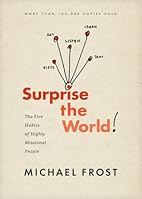
Under $10 online. $6.95 from Christ’s Church, Anglican Parish of Mandurah. Digital version at Exponential (free)
ISBN 9781631465161
Michael
Frost, Surprise the World: the five
habits of missional people, Colorado Springs: NavPress, 2016.
Insanity, they say, is doing the same thing over and over and expecting a different result. We Christians at the beginning of the 21st Century should recognise that kind of insanity: if we expect our usual patterns of worship, however contemporary and relevant, to continue to draw people into Christ, then we shall continue to be disappointed by the Church.
There is a place for ministry to Baby Boomers using traditional worship, but every member of the congregation is aware that the mean age of our fellow church-goers is increasing. In other words, Baby Boomers are aging, dying and not being replaced by younger people. Older people in their eighties continue trying to keep up the level of Christian activity that had when younger, and are experiencing burnout and disillusionment.
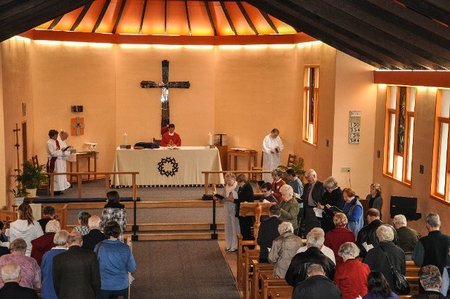
Photo courtesy St John the Divine Anglican Church, Courtneay, British Columbia
The answer is not more of the same. The Anglican pattern of gathering
everyone for the Sunday Eucharist is only 60 years old, going back to the
Parish and People Movement of the 1950s. We can dare to envisage new ways of
being church.
Bunbury’s new Bishop, Ian Coutts, has been circulating copies of Surprise the World! as he visits parishes in his diocese. Bishop Ian states that responding to the Good News of Christ is pretty simple, really. Loving each other so that we want to reach out and love others.
He has chosen a book that all Anglicans can use and act on. The book is about “shar[ing] your faith in surprisingly simple ways.” Australian evangelist Michael Frost, Co-founder of the Forge Mission Training Network, encourages us to follow his model of B.E.L.L.S.: “We BLESS people, both inside and outside the church. We EAT together, sharing meals with believers and non-believers alike. We LISTEN to the … Holy Spirit. We intimately LEARN CHRIST, … [and] we see ourselves as SENT by God to everywhere life takes us.”
The strength of this model is that it does not assume that every Christian is a gifted evangelist. Few Christians are: most of us are to live our lives so that they provoke questions, “living a questionable life”, and answer them simply and directly as they arise out of our mixing with nonbelievers.
Frost emphasises that the B.E.L.L.S. model is not a one-off program, but the cultivation of life-long habits that will feed this evangelistic lifestyle. The model as described is not difficult or complicated, and it sounds fun, social justice will be practised and beauty will be encountered.
I am impressed by this little book. As a Franciscan tertiary, my first aim is to “make Christ known and loved everywhere”. These habits will speed my steps to opening doors to conversations about the Good News.
I am also in ongoing pain, a misfiring of my nervous system. Pain is closely related to depression: if you have pain, the pain will eventually make you depressed. Two spiritual strategies to defeat the depression, and so modulate the pain, are to reach out to others in need and put yourself out in the community (and not hide away in dangerous isolation). B.E.L.L.S. gives me means to do that (BLESSing and EATing) and also shows how to nurture these activities through prayer and Bible study (LISTENing and LEARNing Christ).
There are questions for discussion for each chapter of Surprise the World! These will help
readers take in what they have discovered and put the five habits into practise.
I am delighted that Bishop Ian recommended the book to me,
and that he is encouraging others to discover B.E.L.L.S. and whistles (no
whistles actually!) I read the book in three hours. Now I want to find three
people to meet with, discuss the book, and get busy. Hopefully, B.E.L.L.S. will
lead away from insanity!
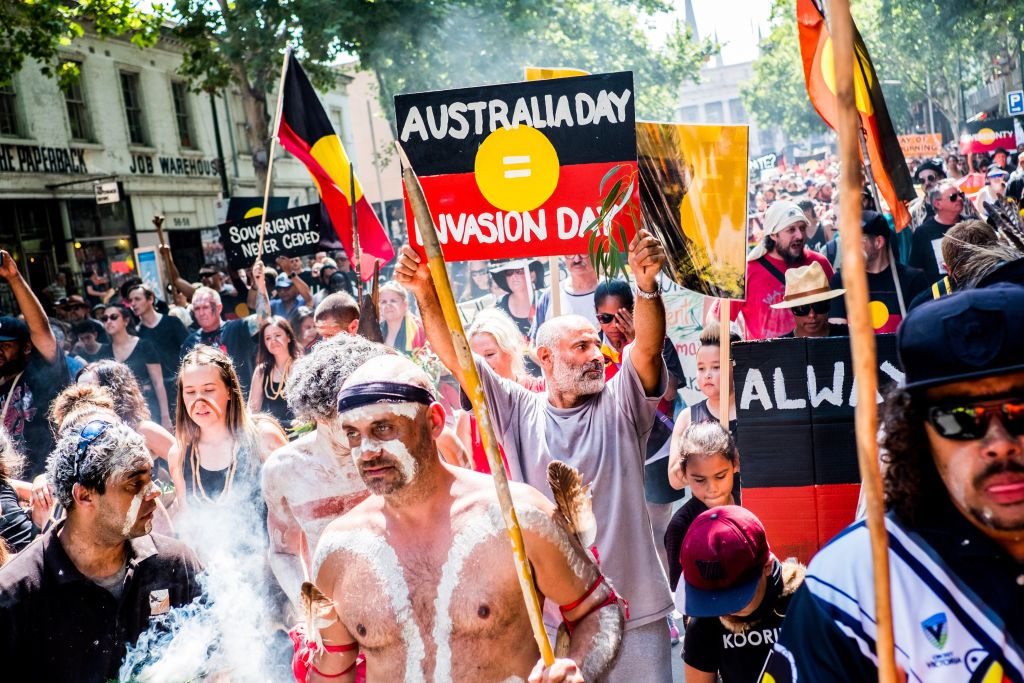
On Australia Day in 2013, I blogged as a native, but not indigenous, Australian that we should prize the anger that comes from seeing this day as Invasion Day: anger that fuels social justice and reconciliation. I believed that we should celebrate the Aboriginal culture, with its complexity, subtlety and beauty, that has survived as Survival Day, and even rejoice in the culture that came from Europe but which has now been modified by its exposure to Aboriginal culture.
Australians all, let us rejoice seemed to be the theme of my blog six Australia Days ago. I still think my piece said it well for a whitefella.
But there has been a change in six years. The #changethedate campaign has made Australians more uncomfortable about celebrating on Invasion Day. But that campaign and others has also had another effect: it has empowered Aboriginal people to make something else of Australia Day.
Yothu Yindi. Photo Mushroom Music
Yesterday on the ABC I watched a smoking ceremony, I was welcomed to Eora country, I heard Yothu Yindi sing Tjapana and Treaty, I thrilled at superb didjeridoo playing, I was intrigued by those who spoke in language, and I felt unexpectedly proud when Advance Australia Fair was sung in an Aboriginal tongue.
It was an ABC concert, so I wasn’t surprised that actor and PlaySchool presenter Luke Carroll acted as one of the hosts, but his presence was a pointer to the extent to which the concert was coloured black! It was an Aboriginal takeover, and I felt moved. I felt pride that this was our land, and I felt warmly welcomed into its deep culture.
There were intense emotions expressed on the streets of capital cities at Invasion Day marches, and it is obvious that not all Indigenous people agree on strategy: should they protest until change happens, or should change happen by changing the mainstream celebration?
Source: Getty
Whichever is the most effective strategy, Aboriginal people are speaking loudly. They must say whether Australia Day can be rescued or whether we can only express our belonging together on a day without the historical resonances of invasion and frontier wars.
I for one look forward to a celebratory date with Aboriginal and all Australians.
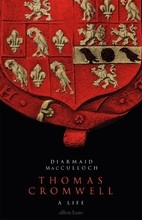
Diarmaid MacCulloch, Thomas Cromwell: A Revolutionary Life, London: Penguin Random House 2018. 728 pages, hardback. 45 full-colour plates. ISBN 9780670025572 $50 online.
The downside to studying theology at Melbourne’s Trinity College in the 1970s was the lack of explicit input concerning Anglicanism. The upside, of course, was access to the best lecturers in Australia regardless of denomination, and the cross-fertilisation between Methodists, Presbyterians, Roman Catholics and Anglicans.
We needed both, of course; the grounding in our own tradition,
and tools to engage with others. Overall, Trinity didn’t do too badly,
but I have felt my lack of knowledge about our Anglican tradition –
until now. Reading Diarmaid MacCulloch’s Thomas Cromwellwas like a semester-length course in the English Reformation with a particularly knowledgeable and clear communicator of Church History.
The first and obvious thing I learned was that the clichés of Henry VIII starting the Church of England solely to have his marriage to Queen Katherine annulled, and of Cromwell, the systematic destroyer of monasteries, are both wrong.
Cromwell did become one of Henry’s chief ministers, rising to Lord Privy Seal and Vice-Gerent of the Church before being torn down by enemies like the Duke of Norfolk and finally beheaded on the King’s orders. Henry and Cromwell were both politicians who needed each other, but MacCulloch discerns their subtly different agendas. Henry was at times obsessed with the Queen question, but he also sought to be the Supreme Head of a Church with the best of Lutheran theology and the conservation of many papist ideas, especially the real presence of the Lord in the bread and wine of Holy Communion.
Henry was a progressive Catholic, believing he could achieve a middle way conserving the best of Rome and political stability. Luther had given rise to great instability, so it was wisest while presenting Henry with Lutheran books, not to mention the name!
MacCulloch, who is Professor of the History of the Church at Oxford University, argues that Thomas Cromwell pursued a consistent ‘evangelical’ agenda, ‘evangelical’ being the term he chooses to describe those pressing for reform. Cromwell knew how to use the power King Henry gave him as his Vice-Gerent of the Church. He put himself above all the bishops, even above his friend Archbishop Cranmer of Canterbury. He invited scholars from Geneva to bring reformed ideas to England. He promoted his ‘evangelical’ friends to important bishoprics. He encouraged printers to produce tracts that expressed his ’evangelical’ ideas, and was not afraid to explore even more radical views.
Cromwell ’s role in the dissolution of the monasteries is dissected with clarity, explaining why Cromwell ordered some to hand over their property to the king, while remaining friends with the Abbots and Priors of others.
Following his early mentor Cardinal Wolsey, Cromwell wanted to reform monastic life. In particular, he wanted them to become centres of bible study, social justice (including proper provision for the poor) and morality. Cromwell made sure there were proper pensions or livings for the monks after the lands of their monastery were distributed to the wealthy. The Anglican Church never condemned the principle of monasticism, just its corruption.
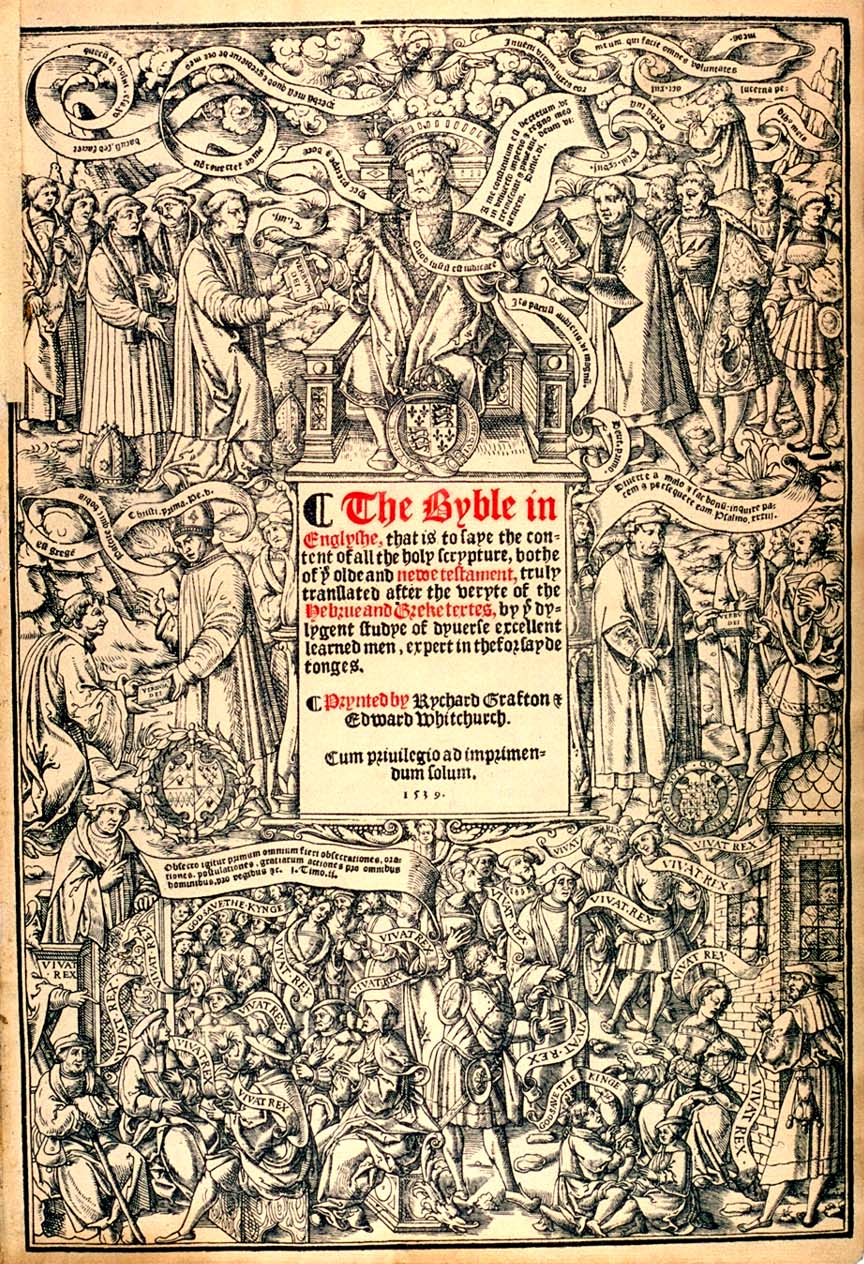
Frontispiece of the Great Bible
He promoted the principle of ordinary Christians reading the Bible, sometimes risking the King’s anger. He manoeuvred the King and Parliament into insisting that every church have an English Bible. Henry finally took pride in the Great Bible whose influence carried through all English translations. Cromwell often turned to the friar Miles Coverdale to carry out the work of translation.
It was the King, particularly when he needed more and more money to build up the coastal defences, who saw the dissolution of monasteries as a cash cow. He often left the details, and the blame, to his minister.
Cromwell
Thomas Cromwell was skilled in getting things done. He generated the contacts, he used his power ruthlessly, and he did more than others in centralising the organisation of the kingdom. He divided Wales into shires and put in charge there a trusted lieutenant. He tried the same, without great success, in Ireland.
Cromwell played a leading part in turning Tudor England from an island backwater into a major power. As a Member of Parliament responsible for managing the King ’s business first in the Commons and then in the House of Lords, Cromwell threw himself with great energy into the detail of legislation and process.
It may well be that Thomas Cromwell was the reason England did not experience the same violence as did Germany and other reforming countries.
The mystery of Thomas Cromwell is how he rose from the yeoman class to the most powerful Lord in the land after his King. Little is known of his early life, although MacCulloch has more information than other biographers. He learned several languages, presumably while in Europe. It was probably then that he developed his interest in the reform of the Church. He made friends with a number of Europeans, and used them to grow an import business. At some time, he was picked up by Cardinal Wolsey who trained him as a politician.
Professor MacCulloch traces the life of a great man whose influence in the development of England and the Anglican Church was long-lasting. Cromwell teased out the interdependence for England of Church and State. He served Henry VIII, that difficult master, with deep loyalty. He also inspired deep enmity, and conservative noble churchmen like the Duke of Norfolk were ever ready to bring down the upstart.
Though they succeeded, within a year, the King was complaining that he had lost his best advisor. Many of the men he had put into positions of power remained there after his death and extended their mentor’s influence in their lifetime.
Diarmaid MacCulloch has written a highly readable biography which should be a standard text for students of Anglicanism. For me, I am grateful that a large gap in my theological education has been filled so thoroughly and enjoyably.
Now begins the year ecclesiastical with storms of judgment, visions of the end, rejection of all ideas plastical they clog the soul and block God from being friend.
Without our spiritual cleansing drastical blindness hides the holy incarnation, makes belief selective and tactical its fearful retreat from fervent vocation.
Advent imagery wild and fantastical stirs up our hearts to see the larger stage. opens us to live enthusiastical integrity in this and the coming age.
He
will come, he says, in clouds of glory:
Now the time to heed and join his story.
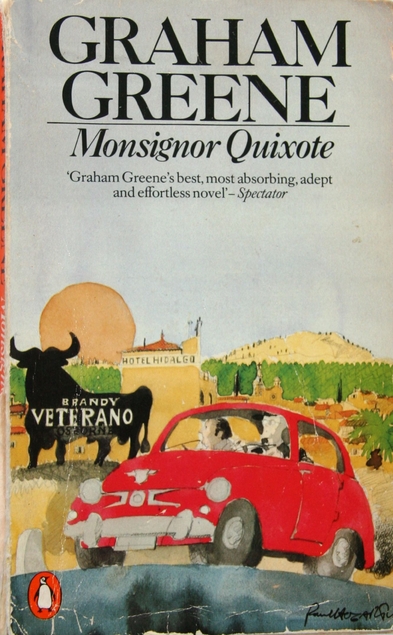
Graham Greene, Monsignor
Quixote, London: Penguin Books, 1982.
In public library system.
256 pages, paperback. New $15, Used $10, online
Reviewed by Ted Witham
Graham Greene’s modern take on Don Quixote made me laugh out loud. The way simple parish priest Father Quixote becomes a Monsignor is delightfully unbelievable. With a vague ideathat he is like his ancestor Don Quixote, the new Monsignor sets out on adirectionless road-trip with deposed Communist mayor ‘Sancho’ Panza. He nameshis ancient Seat motor car Rocinante after Don Quixote’s steed.
Fortified by a few sausages and a great deal of wine of La
Mancha, the priest and the mayor, old friends and sparring partners, find
themselves hilariously tilting at the Guardia Civil, the modern equivalent of
windmills.
The two friends discuss faith and communism, friendship and
authority, and sleep off the wine. The exploration of these deep topics is playful
but insightful.
Greene’s writing is lucid and engaging. I don’t know how I missed this, Greene’s ‘best novel’ according to the Spectator, but it was great fun.
I didn’t expect, at age 70, to have to contend again with the dark. Not the dark of my childhood, when I feared a dressing gown draped over the door was an alien axe-wielding murderer, but the darkness of not knowing the God of my Christian faith.
Each time the darkness comes, I find it is easy to forget all I have been taught. Each time the darkness comes, I feel shame; shame as if the relationship with God I thought I had was sham; shame as if the faith I have taught I no longer experience; shame at the thought of having to profess publicly that I was wrong.
Along with the shame comes fear. At age 70, my thoughts turn healthily to my coming death and whatever follows. What if there is no “life after death”? What if there is no “beatific vision”? What if there is nothing? What value then do I have?
So it is good to be reminded by French Franciscan Thaddée Matura, in his essay An Ardent Absence, that darkness in Christian life is the norm, that grand encounters with God are infrequent and fleeting. Matura recalls us to the teaching that God is a fiery furnace, and if we were to encounter him as he is, we would immediately be burnt to nothing. It is due to his grace that we do not see him face-to-face in this lifetime.
Father Matura also reminds us that despite the darkness, we can continue to follow the paths to God to which we are committed. We are to prepare for the beatific vision, for the great meeting that will raise us to God ’s presence.
The darkness is hard. As we pass through it, we do not know what we are doing. We experience both fear and boredom. We may encounter the ‘plague that destroys at noonday’ (Psalm 91), the acedie of the desert fathers and mothers, as we question the whole of Christian life; we wonder if this darkness is the normal, then why? Why?
But I hang on to those fleeting moments of revelation, those traces, hints of reality. A realisation grew through 1969, the year of the Leighton Ford crusade, that friendship with Christ is the heart of Christian living. I remind myself of the dove I saw [in my mind] flying up and expanding its wings over the congregation after we had received communion on the Fourth Sunday in Easter in 1974 in St Mark’s, Fitzroy. I revisit my tears when, meditating in the hard seats in the chapel in Perth’s Wollaston College, I felt enveloped by love. I feel my heart jump when the icon of St Francis behind the chapel of the Franciscan Missionaries of Mary in Brisbane appeared to move and gaze back at me.
And I can simply be affirmed by Thaddée Matura, as I am by St John of the Cross, by St Francis, by St Richard of Victor, by a lengthy list of Christian teachers, that we make our way through this world blind, in darkness, and our joy is real — but anticipatory.
George
Appleton, the prayerful Archbishop of Perth during the 1960s, once
wrote, ‘I go on in cold faith only because you push me.’ That push from an-Other keeps me going.
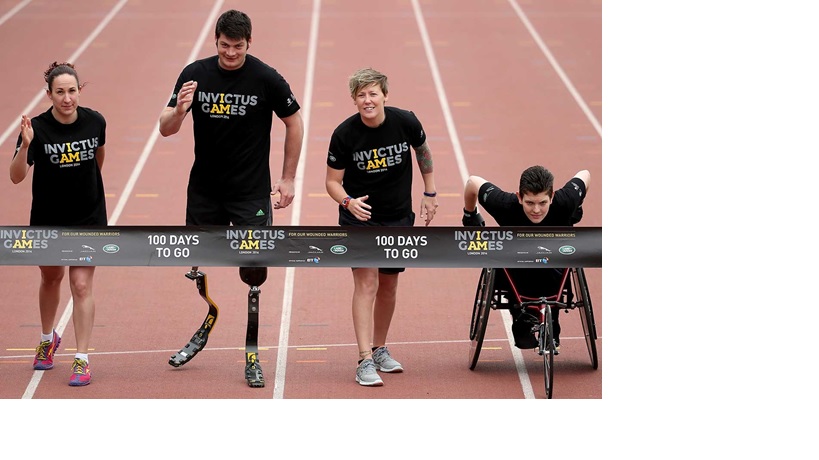
I am troubled by the Invictus Games. Not just the strange ways the Latin participle ‘invictus’ gets used, but by the normalisation of the warrior spirit. The propaganda around the Games makes war seem good.
In a world where it has become part of the culture to thank every member of the military for their ‘service’, and the Invictus Games seems set to increase such thoughtless commentary even more, I know I need to be precise in my criticism.
War is the way of the world. And the world is divided into nation states. I would be crass indeed not to recognise these realities and fail to acknowledge the sacrifices that the military make to keep our nation safe.
I respect individual sailors, soldiers and airmen for their choice and for their part in my freedom. I am in awe of the peace-keeping that Australian forces do around the world. I recognise that much of the activity of the Australian Army in Afghanistan was building schools and hospitals, surely a good legacy.
But war is a sub-optimal activity for humanity. Partly because the nation-state is an imperfect institution – nations both create conditions for our flourishing and also create artificial divisions between human beings – and mainly because the aggression and killing war involves means that we should not consider war the final best way of relating that human beings can find. We live in a fallen world, and war is a symptom of our sinfulness and not of our glory as human beings.
Much of the lethal activity of war is sly. Drones fly invisible above their targets, and ‘clinically’ murder only the targets. Insurgents, who consider themselves patriots, leave death-dealing devices on roadsides. Proxy wars are fought in countries like Syria between the US and Russia, condemning millions of children to a half-life in refugee camps.
I look forward to a world in which nations are superseded by a common humanity and war has given way to peace, where swords are beaten into ploughshares, and the trillions of dollars we spend on armaments are diverted to the benefit of humanity.
This is why I think we should take care with the language we use, and the language we accept, around the Invictus Games. The fighting spirit that restores the wounded to purposeful lives is to be admired. The positive attitudes to disability the Games foster are to be encouraged. We should applaud the new appliances which improve the lives of those living with disability. The contributions the participants made through their service in the armed forces are to be commended.
But any implication that war itself is unambiguously good needs to be challenged. Let us ‘normalise’ disability, by all means. But let us not ‘normalise’ the fact of war. Let us in all ways and in all circumstances question its place in our common life, and decry the death, destruction and waste it brings. Let us aspire to a world without war, a world without the need for warriors, a world where we embrace, not fight, our fellow human beings.